
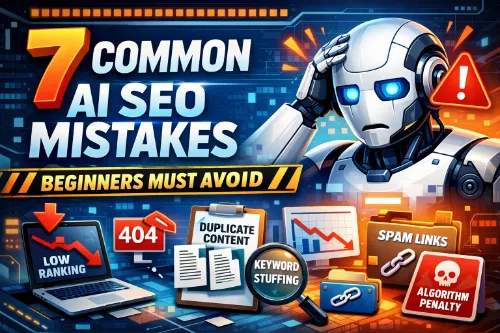
Beginners using AI for SEO frequently make critical errors that hurt rankings rather than help them. The 7 most common AI SEO mistakes include: over-relying on AI-generated content without human editing, ignoring search intent, skipping keyword research, neglecting E-E-A-T signals, producing thin or duplicate content, misusing AI tools for technical SEO, and failing to track performance metrics. Avoiding these mistakes requires combining AI efficiency with human expertise, strategic keyword targeting, and consistent content quality standards.
Introduction: Why AI SEO Is Both an Opportunity and a Minefield
Artificial intelligence has completely transformed the way we approach search engine optimization. What used to take a team of writers, analysts, and technical SEO specialists weeks to accomplish can now be done in hours with the right AI tools. That is both exciting and dangerous — especially for beginners.
The truth is, AI SEO is not a magic button. When used incorrectly, AI can tank your search rankings, trigger Google penalties, and waste enormous amounts of time and money producing content that never performs. The beginner’s mistake is assuming that more AI output equals better SEO results. It doesn’t.
If you’re just getting started with AI SEO strategy, this guide is your early warning system. Below, we break down the seven most common AI SEO mistakes beginners make — and exactly how to avoid each one. Whether you’re a blogger, small business owner, or aspiring digital marketer, understanding these pitfalls will save you months of frustration and give your site a fighting chance in today’s competitive search landscape.
Mistake #1: Publishing Raw AI Content Without Human Editing
This is the single most common mistake beginners make, and it’s also the most damaging. AI writing tools like ChatGPT, Jasper, and Claude can produce grammatically correct, readable content at scale. The problem is that “readable” does not mean “rankable.”
Raw AI content tends to be generic. It hits the surface of a topic without genuine insight, repeats information that’s already saturated online, and lacks the experience-based perspective that Google’s quality guidelines now explicitly reward. According to Google’s Search Quality Rater Guidelines, content is evaluated based on Experience, Expertise, Authoritativeness, and Trustworthiness — collectively known as E-E-A-T. Raw AI content struggles to demonstrate any of these qualities on its own.
Beginners often publish hundreds of AI-generated articles thinking volume alone will drive traffic. Instead, they end up with a site full of thin, undifferentiated content that Google deprioritizes or manually reviews. Understanding Google’s AI content policy is essential before you publish a single AI-assisted piece.
How to avoid it: Treat AI as your first draft, never your final draft. Every piece of AI-generated content should be reviewed, fact-checked, enriched with personal insights or data, and edited for tone and brand voice before publishing. Read more about how to properly edit AI content for SEO to make sure your content actually ranks.
Mistake #2: Ignoring Search Intent
AI tools are excellent at generating text around a keyword. What they often get wrong is the why behind the keyword — also known as search intent. Search intent refers to what a user actually wants when they type a query into Google. Are they looking to buy something? Learn something? Compare options? Find a specific website?
When beginners prompt AI tools with a keyword and publish whatever comes out, they frequently end up with content that doesn’t match the intent behind that keyword. For example, if someone searches “best AI SEO tools,” they want a comparison list — not a 2,000-word explainer on how AI works. Publishing the wrong content format for a keyword means you’ll rank poorly even if everything else is technically correct.
This mistake is closely tied to how AI SEO works at a deeper level. Modern search engines don’t just match keywords — they interpret meaning, context, and user behavior signals to determine which pages best satisfy a search query.
How to avoid it: Before generating any AI content, manually search your target keyword and study the top-ranking results. What format do they use? How long are they? What questions do they answer? Use that information to guide your AI prompt. You can also explore AI tools for on-page SEO optimization to help you align content with intent more effectively.
Mistake #3: Skipping Proper Keyword Research
Many beginners assume AI can handle keyword research automatically. Some AI tools do offer keyword suggestions, but they are no substitute for dedicated AI keyword research tools that pull real search volume, competition data, and trend analysis from live databases.
The mistake here is twofold. First, beginners often target keywords that are either too broad and competitive (impossible to rank for as a new site) or too obscure (no meaningful search volume). Second, they fail to map keywords strategically across their site, leading to keyword cannibalization — where multiple pages compete against each other for the same term.
According to Moz’s Beginner’s Guide to SEO, effective keyword research is the foundation of any content strategy. Without it, even the best AI-generated content becomes a shot in the dark.
How to avoid it: Use tools like Ahrefs, Semrush, or Google Keyword Planner before prompting your AI writing assistant. Identify low-competition, long-tail keywords relevant to your niche. Then structure your content around those keywords with clear topical clusters. If you’re exploring what tools to use, compare free vs. paid AI SEO tools to find the right fit for your budget and goals.
Mistake #4: Neglecting E-E-A-T Signals
Google’s algorithm increasingly rewards content that demonstrates real-world Experience, Expertise, Authoritativeness, and Trustworthiness. This is especially true in competitive niches like health, finance, law, and marketing. AI content, by default, cannot demonstrate genuine experience — it can only simulate it.
Beginners who rely entirely on AI content without adding credibility signals will struggle to earn rankings in competitive spaces. This means no author bios, no citations, no original data, no first-person case studies, and no external links to credible sources. The result is content that looks and reads like a machine wrote it — because it did.
Understanding the difference between AI content vs. human content in terms of Google’s quality evaluation helps clarify why E-E-A-T matters so much. Google’s Search Central documentation on helpful content explicitly prioritizes people-first content — content written for humans, not search engines.
How to avoid it: Add author bylines with credentials. Link to reputable external sources. Include original quotes, data, or case studies. Build topical authority through consistent, deep coverage of your subject area. Consider supplementing your AI content workflow with genuine expert insights, even if AI handles the structural drafting. Explore AI vs. human SEO approaches to understand where each has its strengths.
Mistake #5: Producing Thin or Duplicate Content at Scale
One of AI’s most seductive capabilities is speed. You can generate 50 articles in a day. But if those 50 articles are thin, repetitive, or semantically too similar to each other and to content already on the web, you’ve just created an SEO liability — not an asset.
Thin content refers to pages that provide little substantive value to users. Duplicate content refers to pages that are identical or nearly identical to other pages, either on your own site or elsewhere on the web. Both are well-documented ranking suppressors. Google’s Helpful Content System is specifically designed to downrank sites that produce large volumes of low-quality, machine-generated content.
This is why AI content penalties are a real concern that every beginner using AI for content creation needs to understand before scaling up.
How to avoid it: Prioritize depth over volume. One comprehensive, well-researched 2,500-word article will outperform ten shallow 300-word AI stubs every time. Use an AI content optimization checklist to ensure every piece meets a minimum quality threshold before publishing. Run your content through plagiarism checkers and use tools like Surfer SEO or Clearscope to ensure topical depth and uniqueness.
Mistake #6: Misusing AI Tools for Technical SEO
Technical SEO — site speed, crawlability, schema markup, mobile optimization, Core Web Vitals — is a critical ranking factor that many beginners ignore entirely when they adopt AI content tools. They assume that great content is enough. It isn’t.
Even worse, some beginners attempt to use general-purpose AI chatbots for technical SEO tasks they’re not designed for, generating incorrect schema markup, poorly formatted meta tags, or misguided recommendations for site architecture. This creates technical issues that actively harm rankings.
For example, incorrectly implemented schema markup can confuse search engine crawlers, while slow page speed caused by improperly optimized images or scripts suppresses rankings regardless of content quality. Google’s Core Web Vitals remain a confirmed ranking signal, meaning technical health directly impacts how well your content performs.
How to avoid it: Use specialized AI tools built for technical SEO rather than general writing assistants. Platforms like Screaming Frog, Sitebulb, and SEMrush’s site audit tool can identify and help you fix SEO errors using AI tools. For deeper technical work, consider AI technical SEO audits to systematically identify and resolve issues affecting your site’s crawlability, speed, and indexability. Also prioritize AI and Core Web Vitals optimization as part of your regular site maintenance.
Mistake #7: Failing to Measure, Analyze, and Iterate
The final — and perhaps most underestimated — mistake beginners make is treating AI SEO as a “set it and forget it” system. They publish content, wait, and wonder why the traffic never comes. They never look at what’s working, what isn’t, and why.
SEO is not a one-time effort. It’s a cycle of publishing, measuring, learning, and refining. AI can help you produce content faster, but it cannot replace the analytical discipline required to understand your audience, track keyword rankings, monitor click-through rates, and adjust your strategy based on real data.
Without a clear system for measuring AI SEO ROI, you have no way to know whether your AI-powered content strategy is generating leads, driving sales, or growing your audience. You’re flying blind.
According to Backlinko’s SEO study, the #1 result in Google gets approximately 27.6% of all clicks, while pages beyond position 10 receive almost none. If you’re not tracking where you rank and optimizing to move up, you’re leaving enormous amounts of traffic on the table.
How to avoid it: Set up Google Search Console and Google Analytics from day one. Track your keyword rankings using tools like Ahrefs or Semrush. Monitor your organic traffic trends weekly. Review which pages are getting impressions but low clicks (a sign you need better title tags or meta descriptions). Build an AI SEO content calendar so you’re publishing strategically, not randomly. And if you’re using AI to generate content, build a regular review cycle into your workflow to update, improve, and expand your best-performing pieces. Understanding how AI SEO increases website traffic is only useful if you’re measuring whether that traffic is actually growing.
Putting It All Together: How to Use AI for SEO the Right Way
Avoiding these seven mistakes doesn’t mean avoiding AI altogether. It means using AI as a tool within a thoughtful, human-led strategy — not as a replacement for one.
The most effective AI SEO strategies combine machine efficiency with human judgment. AI handles the heavy lifting: drafting outlines, generating first drafts, suggesting keywords, identifying content gaps, and automating repetitive tasks. Humans handle the strategic decisions: what to write about, how to differentiate the content, how to build authority, and how to serve the reader’s actual needs.
If you’re building a content operation with ChatGPT for SEO content strategy, start small. Publish ten well-edited, well-researched AI-assisted articles before scaling to a hundred. Study the results. Learn what resonates with your audience and what Google rewards in your specific niche.
For local businesses, the same principles apply with added nuance. AI SEO for local businesses requires hyper-local keyword targeting, Google Business Profile optimization, and local keyword research using AI to capture near-me searches and geo-specific queries. Explore AI for Google Business Profile optimization to ensure your local presence is as strong as your on-site SEO.
If you’re running an e-commerce store, AI SEO for e-commerce growth demands a different playbook — one that integrates product schema, review signals, category page optimization, and AI-driven content personalization to serve different buyer segments effectively.
Whatever your niche, the fundamentals remain the same: match search intent, demonstrate expertise, build technical health, and measure everything.
Looking Ahead: The Future of AI SEO
The landscape is evolving faster than ever. Voice search, AI-powered search engines, and algorithm changes are reshaping what it means to rank. The future of AI SEO in 2026 will reward brands and creators who build genuine topical authority, produce deeply helpful content, and stay ahead of emerging AI SEO trends.
Understanding how AI search engines differ from Google and how AI is reshaping search rankings will be increasingly important as tools like Google’s AI Overviews, Perplexity, and ChatGPT Search become mainstream discovery channels. Optimizing for AI search requires a fundamentally different approach than traditional blue-link SEO — one focused on being cited as a source rather than simply ranked as a page.
Voice search optimization using AI is another area beginners consistently overlook. As smart speakers and mobile assistants become the primary search interface for millions of users, content that answers questions in a natural, conversational format will gain significant ranking advantages.
The ethical issues in AI SEO — from content authenticity to disclosure standards — will also shape how Google and other search platforms treat AI-assisted content in the years ahead. Staying informed and staying ethical is both the right thing to do and the strategically smart thing to do.
Conclusion: Smarter AI SEO Starts with Avoiding These Mistakes
AI has made SEO more accessible than ever. But accessibility without understanding creates a false confidence that leads beginners down costly paths. The seven mistakes outlined here — publishing raw AI content, ignoring search intent, skipping keyword research, neglecting E-E-A-T, producing thin content, misusing technical AI tools, and failing to measure results — are not abstract risks. They are the real, documented reasons why most beginner AI SEO strategies fail.
The antidote is simple but requires discipline: use AI to accelerate your work, not to replace your thinking. Pair it with solid traditional SEO fundamentals, genuine expertise, and a commitment to serving your readers first and search engines second.
Ready to go deeper? Explore the full AI SEO mastery curriculum and learn how to build an AI-powered content operation that actually ranks, converts, and grows — the right way.
FAQs
1. What are the most common AI SEO mistakes beginners make?
The most common mistakes include publishing unedited AI content, ignoring search intent, and skipping keyword research.
2. Why is publishing raw AI content harmful for SEO?
Raw AI content often lacks depth, originality, and credibility, which can hurt rankings.
3. What is search intent and why does it matter?
Search intent refers to what users actually want when they search, and matching it is essential for ranking.
4. Can AI replace keyword research?
No. AI can assist, but proper keyword research still requires reliable data and strategy.
5. What is E-E-A-T in AI SEO?
It stands for Experience, Expertise, Authoritativeness, and Trustworthiness, which are critical for content credibility.
6. Why is thin content bad for SEO?
Thin content provides little value and is often deprioritized by search engines.
7. What is duplicate content in AI SEO?
It refers to content that is too similar to existing pages, which can negatively impact rankings.
8. Can AI tools handle technical SEO fully?
No. Some tools help, but improper use can create technical errors that harm rankings.
9. Why is technical SEO important in AI SEO?
Technical factors like site speed and crawlability directly affect search visibility.
10. What happens if I don’t track SEO performance?
You won’t know what works or what needs improvement, leading to poor results.
11. Can AI SEO be automated بالكامل?
No. AI supports automation, but human oversight is necessary for success.
12. How can I avoid AI SEO mistakes?
Use AI as a tool, not a replacement, and combine it with human editing and strategy.
13. Is more AI content always better?
No. Quality matters more than quantity in SEO.
14. Why is human editing important in AI SEO?
It improves accuracy, adds expertise, and aligns content with user intent.
15. Can poor AI SEO lead to penalties?
Yes. Low-quality or unhelpful content can trigger ranking drops.
16. What tools should beginners use for AI SEO?
Beginners should use keyword research tools, analytics platforms, and AI writing tools together.
17. How often should I review my AI SEO content?
Regularly update and improve content based on performance data.
18. Does AI SEO require ongoing effort?
Yes. SEO is a continuous process of optimization and improvement.
19. What is the best approach to AI SEO?
A hybrid approach combining AI efficiency with human expertise delivers the best results.
20. What is the biggest takeaway for beginners in AI SEO?
Use AI strategically, maintain content quality, and always prioritize user value.

