
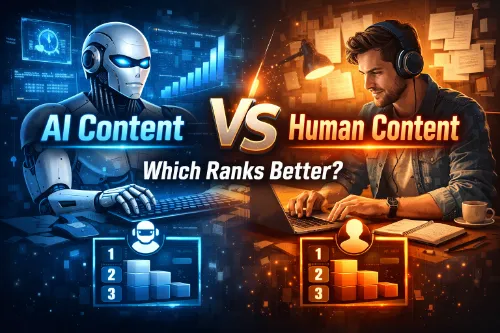
AI Content vs Human Content– Neither pure AI content nor pure human content automatically ranks better on Google — the winner is hybrid content that combines AI’s efficiency with human expertise, editing, and originality. Pure AI content struggles with E-E-A-T signals, hallucinations, and generic output that blends in rather than stands out. Pure human content wins on authenticity, depth, and creativity but loses on speed, scale, and data-driven optimization.
In 2026, Google’s algorithm rewards content quality over production method, meaning AI-assisted content that has been edited, fact-checked, and enriched with real human expertise consistently outranks both unedited AI content and unoptimized human content. The real question isn’t AI vs. human — it’s how well you combine the two.
Introduction: The Debate That’s Dividing the Content World
Ask ten SEO professionals which ranks better — AI content or human content — and you’ll get ten different answers, each delivered with absolute confidence. One will tell you AI content is dominating search results. Another will insist Google is systematically destroying AI-generated pages. A third will argue that only human writing carries the authenticity Google rewards.
They can’t all be right. In fact, most of them are missing the actual answer.
Here’s the truth, based on documented case studies, Google’s public guidance, and the actual performance data of thousands of pages across the web: neither pure AI content nor pure human content wins the ranking battle. Hybrid content — AI-assisted, human-refined — consistently outperforms both extremes.
This isn’t a diplomatic compromise. It’s what the data shows. And it’s the reality shaping the future of AI SEO and content strategy in 2026.
In this comprehensive breakdown, we’ll dig into the strengths and weaknesses of AI content, the strengths and weaknesses of human content, why the pure versions of each struggle in today’s search landscape, and exactly how hybrid content combines the best of both to dominate rankings. By the end, you’ll know precisely how to produce content that ranks — and why the “AI vs. human” framing is the wrong question to begin with.
The Case for AI Content: What It Does Brilliantly
Before we can compare, let’s honestly assess what AI content excels at. Modern AI writing tools have become remarkably capable, and dismissing them is as misguided as worshipping them.
Speed and scale. This is the obvious one. AI can produce a 2,000-word first draft in minutes. A human writer might take eight hours to produce the same word count. For organizations publishing large volumes of content, this efficiency is transformative.
Consistency. AI doesn’t have bad days, writer’s block, or inconsistent energy. It produces reliable output every time, which is valuable for maintaining publishing cadence.
Data-driven structure. When paired with AI SEO tools for content optimization like Surfer SEO or Clearscope, AI-generated content can hit exact keyword targets, ideal word counts, and optimal structural patterns identified from top-ranking pages.
Broad knowledge access. AI models have been trained on vast amounts of text. They can produce competent content on almost any topic, quickly summarizing information that would take a human hours to research.
Cost efficiency. AI content at scale is dramatically cheaper than equivalent human writing. For businesses operating on tight content budgets, this matters.
Translation and localization. Producing content in multiple languages — once an expensive undertaking — has become affordable with modern AI.
Understanding how AI SEO works reveals why these tools produce structurally sound SEO content: they’re specifically trained to recognize patterns that correlate with search visibility.
The Case Against Pure AI Content: Where It Falls Short
For every strength AI content brings, there’s a corresponding weakness that pure AI content cannot overcome without human intervention. Understanding these is essential before relying too heavily on AI.
No real experience. This is the single biggest limitation. Google’s E-E-A-T framework — Experience, Expertise, Authoritativeness, Trustworthiness — explicitly prioritizes content created by people with real-world experience. AI has no experience. It has access to descriptions of experience, which is fundamentally different. When an AI writes about running a marathon, raising a child, or launching a business, it’s paraphrasing what others have said, not speaking from lived knowledge.
Generic output. AI trained on the internet produces content that blends into the internet. It captures the average of what’s already been written rather than adding something new. Search engines increasingly reward differentiation, and AI struggles to provide it.
Factual inaccuracies and hallucinations. AI tools fabricate statistics, invent expert quotes, and confidently state false information. Publishing unverified AI content can seriously damage your credibility and trust signals.
Repetitive phrasing and patterns. Even the best AI models have tells — certain phrasings, structures, and transitions that recur across outputs. Readers and algorithms both eventually recognize these patterns.
Lack of brand voice. AI defaults to neutral, generic tone unless heavily prompted and edited otherwise. Building a distinctive brand voice through pure AI output is extremely difficult.
No original insights. AI cannot generate genuine insight from firsthand observation, research, or experience. It can only rearrange existing information.
These limitations are exactly why many common AI SEO mistakes trace back to publishing AI content without sufficient human refinement. And they’re why AI content penalties disproportionately affect sites that lean heavily on unedited AI output.
The Case for Human Content: What People Do Best
Now let’s look honestly at human content’s strengths — the qualities that even the most advanced AI cannot currently replicate.
Genuine expertise and experience. A cardiologist writing about heart health, a chef writing about cooking techniques, a lawyer writing about contract law — these people bring something to their content that no AI can: actual knowledge gained through years of practice.
Original perspective. Humans can synthesize information in genuinely novel ways, forming opinions, identifying patterns others have missed, and drawing unexpected connections.
Emotional resonance. Humans write with emotion. They understand humor, irony, pathos, and cultural nuance in ways that AI approximates but doesn’t genuinely feel.
Creative storytelling. The ability to craft compelling narratives, develop memorable metaphors, and engage readers emotionally is still a distinctly human strength.
Ethical judgment. Humans make value-based decisions about what to include, what to omit, how to frame sensitive topics, and what standards of accuracy to uphold.
Accountability. A human author can be held accountable for what they write. They have reputations to protect, credentials to maintain, and audiences to answer to.
Cultural context. Humans intuitively understand cultural references, regional variations, generational differences, and subcultural nuances in ways AI struggles with.
These human strengths explain why the AI SEO vs human SEO debate never fully resolves in favor of automation. Something essential gets lost when humans are removed from the content creation loop entirely.
The Case Against Pure Human Content: Where People Fall Short in SEO
This is where content purists may struggle to agree, but the data is clear. Pure human content — written without any AI assistance or data-driven optimization — often underperforms in search rankings for specific reasons.
Slower production. In a content ecosystem where millions of pages are published daily, slower publishing means falling behind on topical relevance and opportunity.
Inconsistent optimization. Human writers without tools often miss keyword opportunities, underestimate required depth, or produce content that doesn’t match search intent.
Limited data access. Humans can’t realistically process the volume of competitor analysis, keyword data, and ranking factor correlation that AI tools handle instantly.
Cognitive biases. Human writers have assumptions about what readers want that may not match actual search behavior. AI tools ground content in real search data.
Scaling limitations. Even the best human writer can’t produce comprehensive topical coverage across hundreds of subtopics quickly enough to build strong topical authority alone.
Higher costs. Quality human writing is expensive. For many businesses, relying exclusively on human writers means publishing far less content than competitors.
According to research from Semrush’s State of Content Marketing report, businesses using AI-assisted workflows consistently produce significantly more content while maintaining or improving quality metrics compared to all-human teams.
The Real Winner: Hybrid Content
Here’s what actually ranks in 2026: content that combines AI efficiency with human expertise. This hybrid approach consistently outperforms both pure AI and pure human content across nearly every measurable SEO metric.
What does hybrid content look like in practice?
Strategy is human-led. A human decides what topics to cover, which audiences to target, and what unique angle to bring. AI doesn’t pick the strategy; it executes it.
Research is AI-accelerated. AI keyword research tools surface opportunities, analyze competition, and identify content gaps instantly. Humans evaluate and prioritize based on strategic fit.
Outlines are AI-drafted, human-refined. AI generates initial structure based on data from top-ranking pages. Humans refine the outline to align with their specific expertise and audience.
First drafts are AI-generated. This is where AI saves the most time. A detailed prompt produces a working draft in minutes.
Editing is heavily human. This is where the magic happens. Humans fact-check every claim, add personal expertise, share real-world examples, inject brand voice, cut generic filler, and elevate the writing from competent to compelling. Learning how to edit AI content for SEO is arguably the most valuable skill in modern content work.
Optimization is AI-assisted. Tools like Surfer or Clearscope ensure the final content hits structural and semantic targets that correlate with rankings.
Author identity is human. Real bylines, real credentials, real author bios. Google increasingly rewards content tied to identifiable human experts.
This hybrid approach is the core of every effective AI blog writing workflow used by top-performing sites today.
Ranking Factors: Head-to-Head Comparison
Let’s compare pure AI, pure human, and hybrid content across the factors that actually determine search rankings.
Content quality. Pure AI produces competent but generic content. Pure human produces distinctive but often under-optimized content. Hybrid wins both on quality and optimization.
E-E-A-T signals. Pure AI scores poorly — no real experience, unclear authorship. Pure human scores well if the writer has credentials. Hybrid scores highest when credentialed humans add expertise to AI drafts.
Search intent matching. Pure AI can match intent structurally when prompted well but often misses deeper intent. Pure human matches intent intuitively but may lack structural discipline. Hybrid combines both.
Technical SEO. AI-assisted content benefits from consistent structural optimization. Pure human content varies wildly. Hybrid delivers consistency with quality.
Production speed. Pure AI is fastest. Hybrid is slower than AI alone but far faster than pure human. Pure human is slowest.
Originality. Pure AI is least original. Pure human is most original. Hybrid is originally-informed and data-optimized.
Fact accuracy. Pure AI is unreliable due to hallucinations. Pure human is more reliable but not immune to errors. Hybrid with human fact-checking is most reliable.
Cost per article. Pure AI is cheapest. Pure human is most expensive. Hybrid is middle ground with far better ROI than either extreme.
Ranking performance. Hybrid content consistently outperforms both alternatives in documented case studies. Reviewing actual AI SEO case studies confirms this pattern across industries.
What Google Actually Rewards (And Why Hybrid Wins)
Google’s official position on AI content has been remarkably consistent. The Google Search Central guidance makes clear that the focus is on content quality, not production method.
Google’s systems reward:
- Content that demonstrates real expertise
- Content that satisfies search intent comprehensively
- Content with clear authorship and accountability
- Content that’s factually accurate and well-sourced
- Content that provides unique value beyond what’s already available
- Content created primarily to help users, not to game rankings
Hybrid content naturally excels at all of these because it combines AI’s ability to hit structural and semantic targets with human expertise, accountability, and originality. Neither pure AI nor pure human content reliably hits all six criteria at scale.
Understanding Google’s AI content policy in detail reinforces this: Google isn’t anti-AI. It’s anti-low-quality. The hybrid approach is simply the most reliable path to high-quality content at reasonable scale.
Case Study Patterns: What’s Happened in the Real World
Several clear patterns have emerged from documented site performance over the past two years.
Sites built on unedited AI content crashed. During the 2024 Helpful Content updates and subsequent core algorithm changes, sites that published large volumes of AI content with minimal human editing experienced catastrophic traffic losses. Many lost 80% or more of their organic visibility within weeks.
Sites with balanced hybrid approaches grew. Sites using AI as a drafting tool within quality-focused workflows — with heavy editing, author identity, and expertise signals — often gained traffic during the same updates.
Pure human-written sites held steady but didn’t scale. Traditional publishers with all-human writing teams maintained rankings but struggled to keep up with competitors publishing higher volumes of optimized hybrid content.
The lesson is clear: neither extreme wins. The middle path — AI as accelerator, human as quality control and expertise source — dominates.
When AI Content Actually Wins
There are specific scenarios where AI-heavy content outperforms more human-intensive approaches. Understanding these helps you allocate resources strategically.
Factual reference content. Encyclopedia-style explainers, definitions, and foundational concept articles where information is well-established and stable. AI handles these efficiently with minimal human editing needed beyond fact-checking.
Product descriptions at scale. E-commerce sites with thousands of products benefit enormously from AI-generated descriptions. Human editing focuses on featured products and category overviews. This is especially true for AI SEO for e-commerce growth.
Localized variations. Adapting content for different regions, languages, or market segments. AI excels at efficient localization.
Listicles and comparison content. Structured formats where AI’s pattern-matching strengths align with what readers want.
Meta descriptions and title tag variations. Generating dozens of variations for A/B testing is exactly where AI shines.
When Human Content Actually Wins
Conversely, some content categories still benefit from heavier human involvement.
Thought leadership. Original research, opinion pieces, industry predictions, and expert analysis benefit most from human perspective.
Personal narratives. Stories, case studies, and first-person accounts require genuine human voice.
Sensitive topics. Health, finance, legal content, and YMYL (Your Money or Your Life) topics require demonstrable human expertise and accountability.
Brand-defining content. Your About page, mission statement, manifesto, and foundational brand content should be deeply human.
Controversial or nuanced subjects. Topics requiring ethical judgment, cultural sensitivity, or careful positioning benefit from human hands.
Practical Guidance: How to Implement Hybrid Content
If you’re ready to move from theory to practice, here’s a practical framework for hybrid content creation.
1. Start with clear strategy. Define your audience, topic pillars, and unique angle before generating anything. Plan your editorial calendar using AI SEO content calendar planning principles.
2. Use AI for keyword and competitive research. Identify opportunities with data-driven tools. Don’t guess what to write about.
3. Create detailed prompts. A generic prompt produces generic content. Build a library of refined prompts for AI SEO writing specific to your niche and brand voice.
4. Draft with AI. Generate a first draft focused on structure, data points, and breadth of coverage.
5. Edit extensively. This is where the real work happens. Follow a comprehensive AI content optimization checklist that covers fact-checking, adding expertise, aligning voice, and ensuring originality.
6. Add human signals. Real author bylines with real bios. Original data, case studies, and examples. First-person observations where appropriate.
7. Optimize on-page elements. Use AI tools for on-page SEO optimization to fine-tune titles, meta descriptions, headings, and internal linking.
8. Measure and iterate. Track which hybrid approaches work best for your audience. Adjust your workflow based on actual performance data.
The Future: Where This Is All Heading
The trajectory is clear. As AI tools continue improving, the gap between AI-only content and hybrid content will continue widening — in favor of hybrid. Why? Because the easier it becomes to produce AI content, the more AI content will exist, and the more Google will need to reward differentiation.
Genuine expertise, original research, authentic experience, and distinctive voice will become more valuable, not less, as the internet fills with AI output. The competitive moat for content creators won’t be “can you produce AI content” — everyone can. It will be “can you produce content that stands out among the AI noise.”
Understanding the broader future of AI SEO in 2026 and emerging AI SEO trends reinforces this direction. The rise of AI search engines vs Google — Perplexity, ChatGPT Search, Google AI Overviews — also rewards content that can be cited as authoritative. Hybrid content, with its combination of data-optimization and genuine expertise, is uniquely positioned to earn those citations.
Conclusion: Stop Asking “AI or Human?” and Start Asking “Both, How?”
The AI vs. human content debate is a false binary. It’s like asking whether a chef should use a knife or their hands — the answer is obviously both, used appropriately for different tasks.
AI content alone lacks the experience, originality, and accountability that modern SEO demands. Human content alone lacks the speed, data-driven optimization, and scale that modern competition requires. Hybrid content — strategically led by humans, accelerated by AI, refined by human expertise — wins on almost every metric.
If you’re trying to decide where to invest your content strategy, stop asking which side to pick. Start asking how to combine them most effectively for your specific business, audience, and goals. The sites dominating search rankings in 2026 aren’t the ones that chose AI or human purity. They’re the ones that built thoughtful, disciplined hybrid workflows and executed them consistently.
Ready to build a hybrid content operation that actually ranks? Explore the complete AI SEO mastery curriculum and learn how to combine AI efficiency with human expertise to produce content that wins in today’s search landscape.
FAQs
1. Does AI content rank better than human content?
No. Neither automatically ranks better—hybrid content performs best.
2. What is hybrid content in SEO?
It combines AI-generated drafts with human editing, expertise, and originality.
3. Why does pure AI content struggle to rank?
It often lacks real experience, originality, and strong E-E-A-T signals.
4. What are the strengths of AI-generated content?
Speed, scalability, consistency, and data-driven structure.
5. What are the strengths of human-written content?
Authenticity, creativity, expertise, and emotional connection.
6. Why is hybrid content more effective?
It combines AI efficiency with human insight and quality control.
7. Can AI content be original?
Not fully. AI rearranges existing knowledge, so human input adds uniqueness.
8. Does AI content lack expertise?
Yes, unless human experts add real-world insights and experience.
9. Is human-only content enough for SEO today?
It can work, but it may lack scalability and optimization efficiency.
10. Can AI improve SEO optimization?
Yes. AI helps with keyword targeting, structure, and content analysis.
11. What role does human editing play in AI SEO?
It improves accuracy, adds depth, and ensures content quality.
12. Which content type is more cost-effective?
AI is cheaper, but hybrid content offers better ROI overall.
13. Can AI content handle complex topics?
It can assist, but human expertise is needed for depth and accuracy.
14. Does Google favor hybrid content?
Google favors helpful, high-quality content, which hybrid content often delivers.
15. What is the biggest weakness of AI content?
Lack of real experience and potential factual inaccuracies.
16. What is the biggest weakness of human-only content?
Slower production and limited scalability.
17. How can I create effective hybrid content?
Use AI for drafting and humans for editing, expertise, and refinement.
18. When should AI content be used more heavily?
For structured, repetitive, or large-scale content tasks.
19. When should human input be prioritized?
For expert insights, storytelling, and high-stakes topics.
20. What is the key takeaway in AI vs human content?
The best results come from combining both, not choosing one over the other.

