
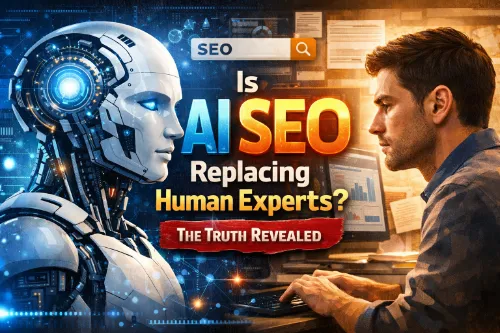
AI SEO vs Human SEO – AI is not replacing human experts — it is reshaping their role. While AI excels at data analysis, keyword research, content drafting, and technical audits at scale, human SEO specialists remain essential for strategy, creativity, brand voice, ethical judgment, and relationship-building tasks like outreach and link-building. The most successful SEO outcomes in 2026 come from a hybrid approach where AI handles repetitive, data-heavy work and humans provide strategic direction, experience-based insights, and quality oversight. Google’s algorithm continues to prioritize people-first content, meaning human expertise is more valuable than ever — not obsolete.
Introduction: The Question Every SEO Professional Is Asking
Walk into any marketing conference in 2026 and you’ll hear the same nervous conversation happening in hallways and coffee lines: “Is AI going to take my job?” For SEO professionals, this question feels particularly urgent. After all, AI tools can now generate blog posts in seconds, analyze thousands of keywords in minutes, and audit entire websites faster than a human could finish their morning coffee.
So here’s the honest answer, right up front: No, AI is not replacing human SEO experts — but it is fundamentally changing what those experts do.
The relationship between AI SEO and human expertise is more nuanced than the clickbait headlines suggest. AI is not the villain threatening to unemploy an entire industry, nor is it a magic replacement that makes human knowledge obsolete. It’s a powerful tool — and like every powerful tool in history, it amplifies skilled users while exposing the limits of unskilled ones.
In this article, we’ll break down exactly what AI does well in SEO, where it falls short, which jobs are changing, which skills are more valuable than ever, and how smart professionals are positioning themselves for the future. If you’re wondering whether to double down on your SEO career or pivot entirely, this is the clearest picture you’ll find.
What AI SEO Actually Does (And Does Well)
Before we can answer whether AI replaces humans, we need to understand what AI is genuinely good at. Modern AI SEO tools have become remarkably sophisticated. Understanding how AI SEO works under the hood helps clarify why these tools are so effective at certain tasks — and why they still struggle with others.
Here’s where AI genuinely outperforms humans in SEO work today:
Data analysis at scale. AI can process millions of data points from Google Search Console, Ahrefs, and Semrush simultaneously, identifying patterns no human analyst could spot manually. AI keyword research tools can surface long-tail opportunities, analyze search intent clusters, and map competitor keyword gaps in minutes rather than days.
Content drafting speed. AI writing assistants produce first drafts at a pace no human writer can match. What took a writer eight hours now takes thirty minutes of prompting and editing. For content-heavy strategies, this is transformative.
Technical audits. AI technical SEO audits can crawl an entire website, flag broken links, identify indexation issues, analyze Core Web Vitals, and suggest schema markup improvements faster and more comprehensively than manual review.
Repetitive optimization. Meta descriptions, title tag variations, alt text generation, internal link suggestions — these formerly tedious tasks can now be automated with remarkable consistency using AI tools for on-page SEO optimization.
Pattern recognition. AI excels at identifying what separates top-ranking pages from underperformers across thousands of SERP examples, informing content structure and optimization decisions.
According to research published by Search Engine Journal, over 75% of SEO professionals now use AI tools daily — but the overwhelming majority use them as assistants, not replacements. That distinction matters.
Where AI Still Falls Short (And Probably Always Will)
For every task AI does brilliantly, there are others where it genuinely struggles — and these gaps aren’t closing as fast as some predicted. Understanding the real differences between AI SEO vs human SEO reveals why human expertise remains indispensable.
Strategic thinking. AI can execute tactics brilliantly, but it doesn’t know which tactics to execute. Deciding what content to create, which audiences to target, which markets to enter, and how to position your brand against competitors requires strategic judgment that AI simply doesn’t possess. It can tell you what ranks; it can’t tell you what matters.
Original expertise and experience. This is the single biggest gap, and it’s getting bigger — not smaller. Google’s E-E-A-T guidelines explicitly prioritize content created by people with real-world experience. AI has no experience. It can simulate expertise convincingly, but it cannot genuinely know what it’s like to run a restaurant, treat a patient, fix a transmission, or raise a child. The difference between AI content vs human content in Google’s eyes often comes down to this experiential authenticity.
Ethical judgment. Where do you draw the line between optimization and manipulation? When is AI-generated content transparent and when is it deceptive? The ethical issues in AI SEO require human values and accountability that machines cannot provide.
Relationship-building. Link-building, digital PR, influencer outreach, partnership development — these fundamentally human activities rely on genuine connection, trust, and persuasion. An AI-sent outreach email gets ignored. A thoughtful, personalized pitch from a real person gets responses.
Creative differentiation. AI tools trained on existing content tend toward the average. They produce competent, safe, middle-of-the-road output that blends in rather than stands out. Truly distinctive brand voice, surprising creative angles, and memorable storytelling still require human imagination.
Nuanced quality control. AI can miss subtle errors, cultural insensitivity, factual inaccuracies, and brand voice inconsistencies that a skilled human editor catches immediately. Which is why editing AI content for SEO remains a critical human skill.
What Actually Happens When Businesses Go “AI-Only”
There’s a clear pattern emerging from businesses that have tried to replace human SEO entirely with AI automation. It usually goes something like this: rapid initial content production, a brief surge in indexed pages, then stagnant or declining organic traffic, followed by a sobering realization that something critical is missing.
Sites that rely exclusively on AI-generated content without human oversight are increasingly facing AI content penalties from Google’s Helpful Content System. The common pattern: thin, repetitive, undifferentiated content at scale gets deprioritized — regardless of how well-optimized it appears on paper.
Meanwhile, businesses that maintain human strategic oversight while using AI for execution consistently outperform their AI-only competitors. This is why common AI SEO mistakes so often trace back to one root cause: removing the human from the loop entirely.
The lesson is clear and repeatable: AI is a force multiplier for skilled humans, not a replacement for them.
The New Role of the SEO Expert in 2026
So if AI isn’t replacing SEO experts, what exactly are SEO experts doing now? The answer is that their role has evolved — and in many ways, elevated.
The modern SEO specialist vs AI debate misses the point. The best specialists aren’t competing with AI; they’re wielding it. Their job description has shifted from “doing the work” to “directing the work.”
Strategists, not executors. Today’s SEO experts spend less time writing meta descriptions and more time defining content strategy, identifying market opportunities, and mapping customer journeys. They’re the architects; AI is the construction crew.
Editors and quality controllers. With AI producing drafts at scale, the premium skill is knowing what “good” looks like and editing AI output into content that actually ranks and resonates. This means building an AI content optimization checklist and applying it rigorously.
Prompt engineers and workflow designers. The ability to extract high-quality output from AI depends entirely on the skill of the prompt. SEO pros who master prompts for AI SEO writing and design efficient AI blog writing workflows produce dramatically better results than those who wing it.
Data interpreters. AI generates enormous amounts of data, but making sense of that data — understanding what’s signal versus noise, what’s actionable versus vanity — is a distinctly human skill that grows more valuable, not less.
Relationship managers. Client communication, stakeholder alignment, cross-team collaboration, and building trust with external partners remain irreplaceable human responsibilities.
Ethics and compliance officers. Someone has to ensure AI-generated content meets Google’s AI content policy, respects intellectual property, discloses AI involvement appropriately, and aligns with brand values. That someone is a human.
Industry Data: What’s Actually Happening to SEO Jobs
The data tells a more optimistic story than the doom headlines suggest. According to the World Economic Forum’s Future of Jobs Report, AI is expected to create more jobs than it eliminates over the next decade — though the nature of those jobs is shifting significantly.
In SEO specifically, job postings have not declined. What’s changed is the skill requirements. Modern SEO job descriptions increasingly list AI tool proficiency, prompt engineering, data analysis, and strategic thinking as required skills. Junior roles that focused purely on repetitive execution (like manually writing hundreds of meta descriptions) are decreasing. Strategic, analytical, and leadership roles are growing.
This mirrors what Harvard Business Review found in broader AI adoption studies: AI tends to augment middle and senior professionals while disrupting entry-level task-based work. For SEO professionals, this means investing in strategy, analysis, and specialized expertise pays off more than ever.
The Hybrid Model: Where the Real Competitive Edge Lies
The businesses winning in 2026 aren’t choosing between humans and AI. They’re combining them intentionally. Here’s what the hybrid model actually looks like in practice.
Strategy layer (Human-led): Market research, brand positioning, audience definition, content strategy, and campaign planning happen with human judgment at the center. AI provides data inputs; humans make decisions.
Research and analysis layer (AI-heavy, human-guided): AI keyword research tools surface opportunities; humans evaluate them against strategic priorities. AI audits the site; humans prioritize fixes.
Production layer (AI-first, human-refined): AI drafts content, generates variations, and handles repetitive optimization. Humans edit, fact-check, add expertise, and ensure brand voice consistency. Understanding how to write SEO blogs using AI efficiently is now a core professional skill.
Distribution and promotion layer (Human-led): Outreach, partnerships, PR, and community engagement remain deeply human activities. AI can assist with personalization at scale, but the relationships are built by people.
Measurement and iteration layer (AI-assisted, human-directed): AI tracks metrics and flags anomalies; humans interpret results and adjust strategy. Measuring AI SEO ROI requires human judgment about what success actually means for the business.
This hybrid model consistently outperforms both pure-human and pure-AI approaches. The benefits of AI SEO multiply when paired with human oversight, rather than replacing it.
Which SEO Skills Are Now More Valuable Than Ever?
If you’re planning your SEO career, these are the skills that are appreciating — not depreciating — in the AI era:
Strategic SEO thinking. The ability to connect SEO activities to business outcomes is pure gold. Ranking for the wrong keywords accomplishes nothing; strategic prioritization is where human value concentrates.
Prompt engineering. Extracting high-quality output from AI tools is its own discipline. Master it, and your productivity multiplies.
Data literacy. Interpreting analytics, understanding statistical significance, and translating data into action are increasingly the differentiators between top performers and average ones.
Content editing and quality assurance. Knowing what makes content rank-worthy — and being able to elevate AI drafts to meet that standard — is a premium skill.
Technical SEO expertise. Understanding JavaScript rendering, Core Web Vitals, schema markup, international SEO, and complex crawling scenarios remains deeply valuable. AI can suggest fixes, but implementing them correctly requires real technical knowledge.
Local SEO specialization. AI SEO for local businesses requires deep understanding of Google Business Profile optimization, local citation management, and geographic targeting that AI alone struggles to handle effectively.
Industry specialization. Deep knowledge of specific verticals — healthcare, legal, finance, SaaS — creates moats that generic AI content cannot breach.
Communication and client relations. Explaining SEO to non-technical stakeholders, building trust, and managing expectations are skills AI cannot replicate.
E-E-A-T authenticity. Being an actual expert with real credentials and experience matters more as AI-generated content floods the web. Authentic authorship has become a competitive advantage.
What Beginners Should Do Right Now
If you’re new to SEO and worried about entering a field during massive change, here’s practical guidance:
Learn both sides. Understand traditional SEO vs AI SEO thoroughly. The fundamentals of search haven’t changed — crawling, indexing, ranking, user intent. AI is a new layer on top, not a replacement.
Master the tools. Get proficient with at least one tool from each category: keyword research (Ahrefs or Semrush), content optimization (Surfer or Clearscope), technical audits (Screaming Frog), and AI writing (ChatGPT or Claude). Explore comparisons of free vs paid AI SEO tools to build your stack strategically.
Develop a specialty. Generalist SEO is a crowded field. Specializing in a vertical, a technical niche, or a specific channel gives you a defensible position.
Build a portfolio. Real case studies with real results are worth more than certifications. Document your work, measure your outcomes, and build proof of your impact.
Stay informed. The field is moving fast. Understanding AI SEO trends and the future of AI SEO in 2026 helps you position yourself ahead of the curve rather than reacting behind it.
The Broader Truth: Search Itself Is Changing
One reason the “AI replacing SEO” question feels so urgent is that search itself is being reshaped by AI. Google AI Overviews, Perplexity, ChatGPT Search, and other AI search engines are changing how users discover information and how websites earn visibility.
This shift — sometimes called AI search optimization or Generative Engine Optimization (GEO) — requires a new playbook, not an obsolete one. Being cited as a source in an AI Overview requires different optimization than ranking #1 in traditional search results. Content optimized for featured snippets and AI summaries often looks different from standard SEO content.
Similarly, the rise of voice search through smart speakers and mobile assistants means voice search optimization using AI is becoming increasingly important. The evolution of voice search requires SEO experts to understand natural language queries, conversational content structures, and intent mapping in ways AI cannot fully automate.
The professionals who adapt to these changes — learning new optimization frameworks, testing new content formats, measuring new metrics — will thrive. Those who wait for things to “go back to normal” will be left behind. Not by AI, but by other humans who embraced AI as a tool.
Conclusion: The Truth About AI and SEO Experts
So let’s return to the original question: Is AI SEO replacing human experts?
The honest answer is that AI is replacing tasks, not professionals. It’s automating the repetitive, data-heavy, time-consuming parts of SEO while elevating the strategic, creative, and relational parts. The SEO professional of 2026 looks very different from the SEO professional of 2020 — but they are still essential, still valuable, and arguably more strategically important to their organizations than ever before.
The real threat isn’t AI replacing SEO experts. The real threat is SEO experts who refuse to learn AI being replaced by SEO experts who have. The gap between the two is widening fast, and it’s where the entire competitive landscape of the industry will be decided over the next few years.
If you’re an SEO professional, your path forward is clear: embrace AI as your most powerful tool yet, invest heavily in strategic and creative skills that AI cannot replicate, specialize in areas where deep human expertise matters, and position yourself as the person who directs AI rather than the person AI directs.
Ready to master the hybrid approach? Explore the complete AI SEO mastery curriculum and learn how to build an SEO practice that combines machine efficiency with irreplaceable human expertise.
FAQs
1. Is AI replacing SEO experts?
No. AI is transforming tasks, not replacing professionals. Human expertise remains essential.
2. What tasks can AI handle in SEO?
AI can manage data analysis, keyword research, content drafting, and technical audits efficiently.
3. What tasks still require human SEO experts?
Strategy, creativity, brand voice, and relationship-building still depend on human skills.
4. Can AI create a full SEO strategy?
No. AI can assist, but strategy requires human decision-making and business understanding.
5. Why is human editing important in AI SEO?
It ensures accuracy, adds expertise, and aligns content with quality standards.
6. What is the hybrid SEO approach?
It combines AI efficiency with human strategy for the best results.
7. Does Google prefer human-written content?
Google prefers helpful, people-first content, regardless of whether AI was used.
8. Can AI handle link building?
No. Outreach and relationship-building require human interaction.
9. What is the new role of SEO experts in 2026?
They act as strategists, editors, and decision-makers rather than task executors.
10. Is AI SEO suitable for beginners?
Yes, but it still requires learning strategy and best practices.
11. Can AI understand brand voice?
Partially, but humans refine and maintain consistent tone and identity.
12. What skills are most important for SEO professionals now?
Strategy, data analysis, content editing, and AI tool usage are critical.
13. Does AI eliminate entry-level SEO jobs?
Some repetitive tasks are reduced, but new roles focused on strategy and AI management are growing.
14. Can AI replace creativity in SEO?
No. Creativity and unique perspectives still come from humans.
15. How does AI improve SEO productivity?
It speeds up repetitive and data-heavy tasks significantly.
16. What is prompt engineering in SEO?
It is the skill of creating effective inputs to get better results from AI tools.
17. Why is data interpretation important in AI SEO?
AI provides data, but humans must analyze and act on it effectively.
18. Can AI handle client communication in SEO?
No. Building trust and managing relationships require human interaction.
19. What is the future of SEO careers with AI?
SEO roles will evolve toward strategy, oversight, and AI integration.
20. What is the key takeaway about AI and SEO experts?
AI enhances human capabilities, but cannot replace human judgment and expertise.

