
AI SEO helps local businesses rank faster by automating time-intensive tasks like local keyword research, Google Business Profile optimization, review management, citation building, and location-specific content creation. Local businesses using AI SEO tools typically see meaningful ranking improvements in 30–90 days instead of the 6–12 months traditional local SEO often requires.
AI accelerates results in six key ways: faster keyword and competitor research, automated Google Business Profile management, AI-generated location-specific content at scale, intelligent review response systems, predictive analysis of ranking opportunities, and automated citation consistency monitoring. For local businesses, the combination of AI efficiency and strong local signals (reviews, NAP consistency, GBP optimization) dramatically compresses the timeline to reach page one and appear in Google’s Map Pack for “near me” searches.
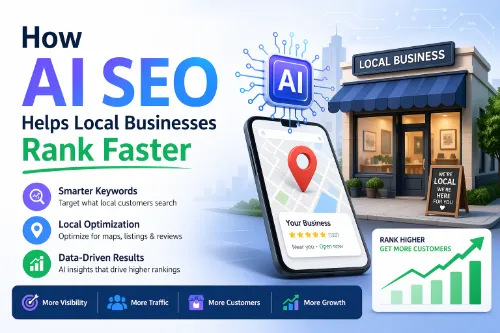
Introduction: Why Speed Matters More for Local Businesses
When a national brand is building SEO, they can afford patience. They have marketing budgets, brand recognition, and multiple revenue channels. A local business doesn’t have that luxury. If a new restaurant, dental practice, or plumbing service can’t start attracting customers within the first 90 days, they face serious financial pressure — regardless of how brilliant their long-term SEO strategy might be.
This is exactly where AI SEO creates its most dramatic impact. Local businesses that combine traditional local SEO fundamentals with modern AI tools are ranking in weeks instead of months — appearing in Google’s Map Pack, capturing “near me” searches, and generating phone calls from organic search faster than ever before.
In this comprehensive guide, we’ll break down exactly how AI SEO for local businesses accelerates rankings, which specific tactics produce the fastest wins, what tools to use, and how to avoid the mistakes that slow businesses down. Whether you run a brick-and-mortar shop, a service-based business with a defined territory, or a multi-location operation, you’ll find actionable guidance here.
Understanding how AI SEO works in a local context is the foundation. Let’s dive into why and how it helps local businesses rank faster.
Why Local Businesses Rank Faster with AI (The Honest Answer)
Before diving into specific tactics, let’s address the core reason AI accelerates local rankings. It’s not magic. It’s math.
Local SEO rewards businesses that consistently execute across many small signals: Google Business Profile updates, citation consistency, review generation, location-specific content, local backlinks, and on-page optimization for geographic keywords. Each signal alone is small. Combined and executed consistently, they add up to rankings.
The bottleneck has always been time. Small business owners managing daily operations simply can’t dedicate hours each week to posting GBP updates, responding to every review, auditing citations across 50 directories, creating neighborhood-specific content, and tracking rankings. It’s too much.
AI removes that bottleneck. What used to require a dedicated team or marketing agency can now be handled by a business owner spending 30–60 minutes per week with the right tools. The ranking signals get generated consistently. The signals compound. And rankings follow.
This is the mechanical reason AI speeds up local SEO: it makes consistent execution possible at a scale that was previously unachievable for small businesses. Understanding traditional SEO vs AI SEO reveals exactly how this changes competitive dynamics in local markets.
The 6 Ways AI SEO Actually Accelerates Local Rankings
Let’s get specific. Here are the six mechanisms through which AI compresses local ranking timelines.
1. Faster Keyword and Competitor Research
Traditional local keyword research meant manually checking search volumes, analyzing competitor websites one by one, and guessing which keywords were realistic to target. This took weeks for thorough research.
AI-powered keyword tools accomplish the same work in hours. Modern AI keyword research tools cluster local keywords by search intent, identify geographic variations, and surface opportunities competitors are missing. Tools like Ahrefs and Semrush analyze entire local competitive landscapes in minutes, revealing exactly which keywords drive your competitors’ traffic.
The practical impact: where you used to spend weeks building a keyword list, you can now build a comprehensive local keyword strategy in a single afternoon. This compresses the “planning” phase of local SEO from months to days. Dedicated local keyword research using AI strategies make this even more efficient.
2. Automated Google Business Profile Optimization
Google Business Profile is the single most important ranking factor for local businesses. Yet most businesses either set it up once and ignore it, or attempt to manage it manually and fail to keep up.
AI tools now handle GBP management actively: generating weekly posts, optimizing descriptions for local keywords, identifying photo opportunities, flagging profile issues, and even suggesting Q&A responses. Platforms dedicated to AI for Google Business Profile optimization can produce a complete month of GBP posts in a single planning session.
The result: your GBP signals stay strong and fresh, which Google rewards with better Map Pack visibility. Businesses that post weekly updates, add photos regularly, and maintain complete profiles consistently outrank those with static profiles.
3. AI-Generated Location-Specific Content at Scale
Local businesses rank better when they have substantive content about their service area — neighborhood guides, location-specific service pages, local news coverage, community engagement content. Traditional content creation makes this impractical for small businesses.
AI writing tools accelerate this dramatically. A single plumbing business can create 15 service-area pages (one for each neighborhood they serve) in the time it used to take to write one. A restaurant can produce weekly blog posts about local events, seasonal menus, and neighborhood stories without hiring a writer. A dental practice can build out extensive FAQ content addressing local patient concerns.
Combined with proper editing and human expertise, this AI-assisted content ranks. It signals local relevance to Google, captures long-tail local keywords, and demonstrates topical authority in your service area. Learn effective approaches in our AI blog writing workflow guide.
4. Intelligent Review Management Systems
Reviews are among the strongest local ranking signals. But most businesses treat review management reactively — responding when they remember, requesting reviews occasionally, losing track of which platforms need attention.
AI-powered review management tools transform this. They monitor reviews across 100+ platforms in real time, generate professional response drafts for owner approval, automate review request campaigns via SMS and email, and identify patterns in review feedback that could improve operations.
The ranking impact is significant. Google explicitly factors review quantity, quality, recency, and response rate into local rankings. Businesses using AI review management tools typically see their review volume 3–5x within 90 days, with corresponding improvements in both Map Pack rankings and click-through rates.
According to BrightLocal’s Consumer Review Survey, nearly all consumers now check online reviews before choosing a local business. AI makes systematic review management feasible for any business size.
5. Predictive Analysis of Ranking Opportunities
Traditional local SEO required significant experience to know where to focus effort. Which citations matter most? Which keywords are actually realistic? Which competitors should you study?
AI-powered platforms analyze your local market and predict exactly where effort produces the highest returns. They identify which citations competitors have that you don’t, which keywords you’re closest to ranking for, which content gaps represent the biggest opportunities, and which technical fixes would most impact rankings.
This eliminates guesswork. Instead of generic SEO advice, you get specific, prioritized action items calibrated to your specific market and competitive position. Following this prioritized guidance dramatically accelerates ranking improvements compared to scattered effort.
6. Automated Citation Consistency Monitoring
NAP consistency — identical business Name, Address, and Phone number across every directory — is foundational for local rankings. But maintaining consistency across 50+ directories as your business evolves is a nightmare without tools.
AI citation management platforms like BrightLocal, Yext, and Moz Local continuously monitor your citations, detect discrepancies, and either fix them automatically or flag them for attention. When you change phone numbers, move locations, or update hours, these platforms push the changes everywhere at once.
The ranking impact happens quickly. Citation cleanup often produces visible ranking improvements within 30 days as Google recognizes the consistency and increases local trust signals.
The Fastest-Ranking Local SEO Playbook Using AI
Now let’s get tactical. Here’s a proven 90-day playbook that uses AI to compress local ranking timelines as much as possible.
Days 1–14: Foundation and Research
Claim and fully optimize Google Business Profile. Complete every field. Select accurate primary and secondary categories. Add 10+ high-quality photos. Write a compelling description incorporating local keywords naturally.
Set up tracking. Google Search Console, Google Analytics 4, and a local rank tracker like BrightLocal. You can’t improve what you don’t measure.
Conduct AI-powered keyword research. Use Ahrefs, Semrush, or Ubersuggest to identify 30–50 target keywords covering primary services plus geographic modifiers. Include “near me” variations.
Audit existing citations. Use a tool like BrightLocal or Whitespark to find every existing citation, identify inconsistencies, and plan cleanup.
Competitive analysis. Study your top 3–5 local competitors. Document their GBP categories, review counts, recent posts, top-ranking keywords, and citation profiles.
Days 15–45: Execution Sprint
Fix all citation inconsistencies. This single action often produces noticeable ranking improvements within weeks.
Publish foundational content. Create or optimize service pages for each core offering plus location pages for primary service areas. Use AI writing tools for drafting, human editing for quality. Follow a thorough AI content optimization checklist for every piece.
Implement local business schema. Add structured data to your website telling search engines exactly what your business does, where it’s located, and your service area. Our guide on AI SEO for schema markup walks through exactly how.
Start GBP posting cadence. Post 2–3 updates weekly. Use AI to generate initial drafts, human editing to ensure quality and brand voice.
Launch review generation system. Set up automated review requests via your CRM, email system, or dedicated tool like BirdEye. Every satisfied customer should receive a review request within 24 hours of service.
Days 46–75: Content and Authority Building
Publish location-specific blog content. One or two pieces per week covering neighborhood topics, local events, community involvement, and service-specific content for your area. AI writing tools make this volume achievable.
Build quality local backlinks. Chamber of Commerce, local business associations, community sponsorships, local news mentions. Focus on relevance over quantity.
Optimize for “near me” searches. Create specific content and on-page optimization targeting common “near me” variations. Explore specific strategies in our AI SEO for near-me searches guide.
Voice search optimization. Structure content for conversational queries. As voice search optimization using AI becomes mainstream, this positioning pays off.
Days 76–90: Optimization and Scale
Analyze early results. Which keywords are moving? Which pages are getting impressions? Where are clicks converting? Use data to adjust priorities.
Optimize underperforming content. Expand, update, and enhance pages with impressions but low CTR.
Scale what’s working. If specific content types or post formats are driving results, double down.
Plan next quarter. Based on what’s working in your market, map the next 90 days of content, citations, and optimization.
This systematic approach consistently produces visible ranking improvements by day 30 and significant traffic growth by day 90.
What Makes This Work: The Ranking Signals AI Addresses
Understanding why this playbook works requires understanding what Google actually evaluates for local rankings. Local Pack rankings depend on three primary factors according to Google’s own guidance:
Relevance. How well your business matches what the searcher is looking for. AI tools improve relevance through better keyword targeting, comprehensive content, and accurate GBP categorization.
Distance. How far your business is from the searcher. You can’t change your physical location, but you can optimize for multiple service areas through location pages and proper service area declarations.
Prominence. How well-known your business is. This encompasses reviews, citations, backlinks, content depth, and overall online visibility. AI tools accelerate prominence-building across every dimension.
AI SEO doesn’t trick any of these factors. It just makes execution across all of them feasible at small-business scale. That’s why the approach works — and why it produces faster results than traditional local SEO.
Specific Tactics That Produce the Fastest Wins
Some local SEO tactics produce ranking movements faster than others. If speed is your priority, prioritize these.
Google Business Profile completeness and activity. Ranks can shift within days of major GBP improvements — adding categories, uploading photos, posting updates. Start here.
Citation consistency fixes. Cleaning up NAP inconsistencies often produces visible movement within 30 days.
Review velocity. Actively generating new reviews signals business momentum to Google. A jump from 20 to 50 reviews in 60 days often correlates with Map Pack improvements.
On-page optimization for specific local keywords. Updating title tags, meta descriptions, and headers to include target geographic keywords can produce movement within a few weeks.
Service-area pages. Creating dedicated pages for each neighborhood or service area you cover typically generates rankings for those specific geographic queries within 60 days.
Schema markup implementation. Adding local business schema provides immediate relevance signals. Schema itself doesn’t guarantee rankings, but it removes barriers to ranking.
Slower-moving tactics — like building genuine topical authority through extensive content or earning significant editorial backlinks — still matter but take longer. Starting with fast-impact tactics produces visible results quickly, which supports your motivation to sustain longer-term efforts.
The AI Tool Stack That Makes This Possible
You don’t need enterprise software to execute this playbook. Here’s the practical tool stack for most local businesses.
Foundation layer (essential):
- Google Business Profile (free)
- Google Search Console (free)
- Google Analytics 4 (free)
Research layer:
- Ubersuggest ($29/month) or Ahrefs Lite ($129/month) for keyword research
- ChatGPT Plus ($20/month) for competitive analysis and content planning
Management layer:
- BrightLocal ($29–$79/month) for citations, rank tracking, and review monitoring
- Or Semrush Local ($20/month add-on) if using Semrush already
Content layer:
- ChatGPT or Claude ($20/month) for drafting
- Surfer SEO ($89/month) for content optimization (optional but helpful)
Review management layer:
- BirdEye or Podium for automated review generation (if revenue justifies; starts around $299/month)
- Or use BrightLocal’s built-in review features for lower budgets
Total monthly investment for small local businesses: typically $50–$150. Returns: often 5–20x that amount in new customer revenue within 90–180 days.
Comparing free vs paid AI SEO tools helps you scale your investment based on actual business results.
Common Mistakes That Slow Down Local Rankings
Even with AI tools, businesses make predictable mistakes that prevent fast rankings. Avoid these.
Inconsistent NAP. Different phone numbers or address variations across directories signal confusion to Google. Audit and standardize first.
Neglecting GBP. Claiming your profile but never posting, updating, or responding to reviews kills local rankings. GBP needs active weekly attention.
Generic AI content. Publishing unedited AI content about generic topics doesn’t help local rankings. Content must be specific to your location, services, and audience.
Ignoring review generation. Waiting for reviews to happen organically leaves enormous ranking potential on the table. Proactive review generation is essential.
Fake reviews. Absolutely never. Google’s detection is sophisticated, and the penalty — complete profile suspension — is devastating.
Keyword stuffing. Unnatural keyword insertion in GBP descriptions, website content, or business names violates guidelines and can trigger penalties.
Setting and forgetting. Local SEO rewards consistency. Sporadic effort produces sporadic results. Make it weekly and sustainable.
No tracking. Without measurement, you can’t optimize. Track rankings, traffic, calls, and conversions consistently.
These patterns connect to broader common AI SEO mistakes that slow down results across every niche.
Real-World Timeline Expectations
What should local businesses actually expect from an AI-powered local SEO strategy?
Weeks 1–4: Foundation work. Citation cleanup in progress. GBP fully optimized. Initial content published. Baseline tracking established. Typically some small ranking improvements visible by end of week 4.
Weeks 5–8: Content scaling. Reviews accelerating. First noticeable ranking movements for target keywords. Initial bumps in GBP views, calls, and direction requests.
Weeks 9–12: Compounding effects. Rankings stabilizing in positive positions. Organic traffic growing 30–100%+. Phone calls and conversions measurably up. Map Pack appearances increasing.
Months 4–6: Established momentum. Map Pack rankings stable. Blog content driving consistent traffic. Reviews reaching critical mass (100+ for many businesses). Dominant positioning for primary service-location keywords.
Months 7–12: Authority phase. Topical authority established. Broader keyword coverage. Consistent lead flow. Competitive positioning strong in the market.
These timelines assume consistent weekly execution, not sporadic effort. They also assume reasonable competitive conditions — extremely competitive markets (major city legal or medical practices, for example) may take longer.
Exploring AI SEO case studies provides specific examples of timelines and results across different industries.
The Business Impact: What Faster Local Rankings Actually Mean
Rankings are a means, not an end. What do faster local rankings translate into for real businesses?
More phone calls. Customers searching local queries overwhelmingly prefer to call. Better rankings mean more calls, typically within 60–90 days of starting the playbook.
More walk-in traffic. For businesses with physical locations, Map Pack visibility directly drives foot traffic.
More form submissions and online bookings. Service businesses with online booking or quote forms see significant lead increases.
Lower customer acquisition costs. Organic local traffic converts better and costs less than paid alternatives. As organic volume grows, your blended CAC drops.
Better customer quality. Customers who found you through organic local search typically have higher intent than those from paid ads or random discovery.
Competitive moat. Established local rankings become defensive assets. Once you’re positioned, competitors must spend more to displace you than you spend to maintain position.
Understanding how to measure AI SEO ROI helps you translate ranking improvements into business outcomes that justify continued investment.
The Future of AI Local SEO
The local SEO landscape continues evolving. Several trends are reshaping what fast local rankings look like.
Zero-click local results. More customers are getting answers directly in search without visiting websites. Optimizing for visibility in AI Overviews and direct answers becomes increasingly important.
AI-powered search engines. AI search engines vs Google reshape how customers discover local businesses. Being cited in AI responses is a new form of local visibility.
Hyper-personalization. Google is surfacing different local results to different users based on behavior, preferences, and context. This personalization frontier is becoming its own discipline within AI search optimization.
Voice search dominance. As smart speakers and mobile assistants grow, voice search and AI evolution reshape local discovery patterns.
AI agents for local management. Autonomous agents that handle posting, review responses, and listing management with minimal human oversight are emerging.
These shifts align with broader AI SEO trends shaping the future of AI SEO in 2026.
Conclusion: Speed Comes From Consistent Execution, Not Shortcuts
Local businesses don’t rank faster because AI does magic. They rank faster because AI makes consistent execution possible at a scale that would have required professional teams just a few years ago.
The playbook in this guide isn’t complicated. It’s not secret. It’s systematic application of proven local SEO fundamentals — citation consistency, GBP optimization, reviews, location-specific content, local backlinks — executed with the efficiency that only AI tools enable.
Start with the foundation: claim your GBP, implement tracking, conduct AI keyword research, and audit citations. Execute the 90-day playbook with discipline. Measure honestly. Adjust based on results. Sustain the effort through the inevitable plateau periods.
Businesses that commit to this approach consistently outrank larger, better-funded competitors who treat local SEO as an afterthought. The market isn’t won by who has the most budget. It’s won by who executes with the most consistency — and AI finally makes that consistency achievable for small businesses.
The competitive window is still open. Most local businesses haven’t yet adopted AI-powered local SEO strategies. Those who move decisively now establish positions that become progressively harder for competitors to displace later.
Ready to build a complete local SEO strategy that gets you ranking faster than your competition? Explore the full AI SEO mastery curriculum and learn how to combine AI efficiency with proven local SEO fundamentals for sustainable growth.
FAQs
1. How does AI SEO help local businesses rank faster?
AI automates key tasks like keyword research, content creation, and profile optimization, speeding up results.
2. How fast can local SEO results appear with AI?
Many businesses see improvements within 30–90 days with consistent execution.
3. What is the main advantage of AI in local SEO?
It allows consistent optimization across multiple ranking factors without heavy manual work.
4. Can AI manage Google Business Profile updates?
Yes. AI can generate posts, optimize descriptions, and suggest improvements regularly.
5. How does AI improve local keyword research?
It quickly identifies location-based keywords and competitor opportunities.
6. Can AI create location-specific content?
Yes. AI can generate multiple service-area pages and local blog content efficiently.
7. Does AI help with review management?
Yes. AI tools can monitor reviews and generate response suggestions.
8. What is predictive SEO in local search?
AI analyzes data to suggest actions that are most likely to improve rankings.
9. Can AI track local rankings automatically?
Yes. It monitors rankings across locations and keywords in real time.
10. What is citation consistency monitoring?
AI checks and maintains consistent business information across directories.
11. Does AI reduce the need for SEO agencies?
It reduces workload, but strategy and oversight are still important.
12. Can AI improve Map Pack rankings?
Yes. By strengthening GBP, reviews, and citations, AI improves Map Pack visibility.
13. What is the fastest local SEO improvement?
Optimizing Google Business Profile and fixing citations often produce quick results.
14. How does AI help small business owners?
It saves time and makes advanced SEO strategies accessible without large teams.
15. Can AI generate review requests?
Yes. It automates sending review requests via email or SMS.
16. Does AI help with competitor analysis?
Yes. It analyzes local competitors and identifies ranking opportunities.
17. What is the biggest benefit of AI local SEO?
Faster execution and consistent optimization across all ranking factors.
18. Can AI optimize content for “near me” searches?
Yes. It helps create content aligned with local search intent.
19. What is the biggest mistake using AI for local SEO?
Inconsistent effort and publishing low-quality, unedited content.
20. What is the goal of AI-powered local SEO?
To increase visibility, traffic, and customer conversions faster.

