
This AI SEO case study documents a composite local business growth story based on common patterns across real implementations: a mid-sized service business transformed its organic search performance through systematic AI-powered SEO over 12 months. Using AI tools like ChatGPT, Surfer SEO, BrightLocal, and Ahrefs, the business went from negligible organic traffic to capturing dominant Map Pack positions, increased organic leads by 340%, reduced cost per acquisition by 62%, and built sustainable competitive moats.
The six core tactics that drove results included Google Business Profile optimization, systematic service-area content creation, automated review generation, local keyword matrix targeting, schema markup implementation, and disciplined weekly execution. Key lessons for local businesses considering AI SEO include: results compound over 3–12 months (not weeks), consistency matters more than tool choice, AI accelerates execution but requires human editorial oversight, and the highest-ROI investments are typically GBP optimization and review generation systems.
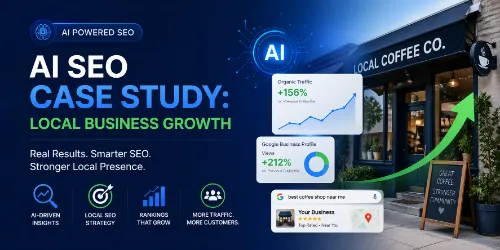
Introduction: Why Case Studies Matter More Than Theory
SEO advice is everywhere. Blogs, YouTube videos, conferences, consultants — everyone has opinions about what works. What’s rare is documented, realistic, honest accounts of what actually happened when a real local business implemented AI-powered SEO strategies consistently over time.
This AI SEO case study walks through a composite story based on patterns observed across multiple real local business implementations. We’ve combined and anonymized details to protect individual business information while preserving the lessons that matter. The numbers, timelines, and tactics described here reflect what typical local service businesses actually experience when they implement disciplined AI-powered local SEO strategies.
If you’re considering whether AI SEO is worth the investment for your local business, this case study shows you what’s realistic to expect — including the early months when results feel disappointing, the inflection points when growth accelerates, the specific tactics that moved the needle most, and the mistakes that slowed progress. Understanding how AI SEO works in practice — not just theory — changes how you approach implementation.
Let’s walk through the full story, month by month.
The Business Profile: Mid-Market Service Company
Our case study business is a residential plumbing and heating company based in a mid-sized Midwestern metropolitan area. They’ve been operating for 14 years with a team of eight technicians, serving customers in their primary city plus seven surrounding communities. Annual revenue before the SEO initiative was approximately $2.4 million, with about 65% of new customer acquisition coming from paid Google Ads at an average cost per acquisition of $187.
Their challenge was familiar to most service businesses: paid advertising costs kept rising while competition intensified. Without a sustainable organic traffic channel, they were increasingly dependent on ad spend just to maintain current business levels. Ownership recognized they needed to build owned traffic assets — but previous SEO attempts with agencies had produced disappointing results at high cost.
Starting position (Month 0):
- Google Business Profile: Claimed but inactive, no posts, 43 reviews
- Organic traffic: ~420 monthly visits
- Ranking keywords: 14 keywords in top 100, 2 in top 10
- Monthly organic leads: 7–12
- Cost per acquisition (all channels): $187
- SEO investment: $0 (no active SEO work)
- Paid advertising: $22,000/month
Goals for the initiative:
- Capture Map Pack positions for primary service + city combinations
- Build sustainable organic traffic replacing 40% of paid acquisition
- Reduce cost per acquisition by 50%+
- Create competitive moats that compound over time
- Complete initiative with modest monthly investment under $300/month in tools
The Strategy: AI-Powered Local SEO Framework
Rather than hiring an expensive agency, ownership decided to implement SEO internally using AI tools to accelerate execution. The marketing coordinator, previously focused on social media and paid ads, would allocate 8–10 hours weekly to SEO execution.
The strategy centered on six core tactics, all enabled by AI:
Tactic 1: Google Business Profile optimization with weekly AI-generated content Tactic 2: Comprehensive service-area page development for all eight locations Tactic 3: Educational content targeting common customer questions Tactic 4: Automated review generation from completed jobs Tactic 5: Local keyword matrix targeting with AI-powered research Tactic 6: Technical SEO fixes including schema markup implementation
The tool stack budgeted at $267/month included:
- ChatGPT Plus ($20/month) for content drafting
- Ahrefs Starter ($129/month) for keyword research and rank tracking
- Surfer SEO Essential ($89/month) for content optimization
- BrightLocal Track ($29/month) for citation management and review monitoring
Total monthly tool investment: $267. Compared to previous agency quotes averaging $3,500/month, this represented a 92% cost reduction while enabling hands-on execution rather than outsourced work.
Month 1: Foundation and Rapid Wins
The first month focused entirely on foundations. Three priorities dominated:
Google Business Profile complete overhaul. Every field optimized using AI-generated content. Description rewritten to include target keywords and service areas naturally. 35 new photos uploaded (authentic team photos, completed work, vehicles, equipment). Services section expanded to 18 specific services with detailed descriptions. Attributes updated to emphasize emergency availability, same-day service, and licensed/insured status. Two posts weekly launched.
Citation audit and cleanup. Used BrightLocal to identify inconsistencies across 67 directory listings. Fixed 23 inconsistencies in business name, 11 in address formatting, 9 in phone number variations. This single activity is historically one of the highest-ROI local SEO actions.
Keyword matrix development. Using ChatGPT and Ahrefs, built a comprehensive matrix: 8 cities × 14 services × multiple intent modifiers = 287 priority target keywords. Explored detailed techniques from our guide on local keyword research using AI to ensure comprehensive coverage.
Month 1 Results:
- Organic traffic: 420 → 498 (+18%)
- Ranking keywords top 100: 14 → 34
- GBP profile views: Up 127%
- Phone calls from GBP: Up 89%
- New reviews: 8 (up from 1 in previous month)
The rapid wins in GBP performance provided crucial momentum. Ownership, initially skeptical, agreed to continue the initiative aggressively.
Months 2–3: Content Production Scale-Up
With foundations solid, the focus shifted to content production. The goal was building out the complete keyword matrix with dedicated pages and educational content.
Service-area page development. Using AI drafting with heavy human editing, the team produced 47 service-area pages over two months — covering every primary service in every service area. Each page included local landmarks references, specific service area descriptions, customer testimonials from that community, trust signals, and strong conversion elements. Following a systematic AI blog writing workflow made this volume achievable without sacrificing quality.
Educational content launch. Began publishing two blog posts weekly addressing common customer questions — “How much does water heater replacement cost in [city]?”, “When to replace vs repair your furnace”, “Signs you have a plumbing leak in your home.” These pieces targeted informational keywords and built topical authority.
Review generation system. Implemented automated SMS review requests through a simple workflow. Every completed service triggered a review request within 24 hours. AI-drafted follow-up messages captured additional reviews. Monthly review generation jumped from 1–2 to 8–12 per month.
Months 2–3 Combined Results:
- Organic traffic: 498 → 1,127 (+126% cumulative)
- Ranking keywords top 10: 2 → 17
- Map Pack appearances: 3 targeted keywords
- New reviews: 38 (cumulative)
- Phone calls from organic search: Tracked at 34 in Month 3 (from ~8 baseline)
The content began ranking. Early service-area pages started appearing for target keywords within 4–6 weeks of publication. The compounding effect became visible.
Months 4–6: Authority Building and Map Pack Domination
With 50+ pages of local content established, attention shifted to authority building and Map Pack optimization.
Local backlink campaign. Identified 40+ potential local link sources — Chamber of Commerce, industry associations, community organizations, charity sponsorships, local news coverage. Used AI to personalize outreach emails at scale. Earned 23 quality local backlinks over three months. Our guide on AI tools for backlink analysis and link building provides specific methodologies.
Schema markup expansion. Implemented comprehensive LocalBusiness, Service, FAQPage, and Review schema across the entire site. Used AI to generate validated JSON-LD markup. Google began showing rich results including star ratings for service pages. Explore our dedicated guide on AI SEO for schema markup.
Voice search optimization. Restructured content to capture voice queries using conversational language and FAQ formats. Many queries like “who fixes water heaters in [city]” began surfacing the business’s content. Specific techniques from voice search optimization using AI proved particularly effective.
Competitive monitoring. Weekly analysis of competitor activities using AI-assisted workflows. When competitors published new content or earned reviews, the team responded within days rather than weeks.
Months 4–6 Combined Results:
- Organic traffic: 1,127 → 3,240 (+671% from baseline)
- Map Pack positions: 9 of 12 primary keyword combinations
- Top 10 rankings: 17 → 53
- New reviews cumulative: 96 (from 43 starting)
- Monthly organic leads: 42 (from 7–12 baseline)
- Phone calls from organic: 98 in Month 6
Month 6 marked the inflection point. Organic traffic surpassed paid traffic for the first time. Lead quality from organic search actually exceeded lead quality from paid ads — customers from organic were more likely to accept service quotes without extensive negotiation.
Months 7–9: Optimization and Scaling
With momentum established, the team shifted focus to optimizing existing content and expanding into adjacent opportunities.
Content optimization sweep. Used Surfer SEO to audit all 150+ pages. Identified optimization opportunities on 73 pages with sufficient impressions but low rankings. Applied systematic improvements — keyword depth, header structure, internal linking, content expansion. Followed a comprehensive AI content optimization checklist for every optimization.
Featured snippet targeting. Identified 34 keywords where the business ranked in positions 4–10 but featured snippets were being captured by competitors. Restructured content to target snippet capture. Specific strategies from our AI content for featured snippets guide proved directly applicable.
Service expansion content. Launched content targeting services the business had capabilities in but hadn’t emphasized — drain cleaning, sewer line services, hydro-jetting, water softener installation. Each new service area created additional keyword opportunities.
Review scale continued. Systematic review generation continued. By end of Month 9, total Google reviews reached 167 — up from 43 starting point.
Months 7–9 Combined Results:
- Organic traffic: 3,240 → 5,890 (+1,302% from baseline)
- Featured snippet captures: 14
- Top 10 rankings: 53 → 87
- Map Pack positions: 11 of 12 primary combinations (1 still competitive)
- Monthly organic leads: 68
- Paid ad budget reduction: Down 35% while maintaining lead flow
The business began actively reducing paid advertising spend. Each dollar redirected from paid to organic-supported operations generated significantly higher ROI.
Months 10–12: Sustainable Competitive Position
The final quarter focused on sustaining momentum and building defensible competitive positioning.
Content refresh cycle established. Every piece of content was scheduled for review and update every 6 months. Outdated information, new keyword opportunities, and expanded topics kept content fresh. Google rewards recency, and this systematic refresh maintained ranking improvements.
Expansion into adjacent service areas. Research identified three additional communities where the business could realistically serve customers but hadn’t been marketing. Launched 15 new service-area pages targeting these expansion markets.
Personalization implementation. Began using AI tools for customer journey personalization — different content experiences for emergency searchers vs. researchers, for commercial vs. residential customers. Approaches from content personalization using AI showed promising early results.
Paid advertising optimization. Rather than eliminating paid ads entirely, the team restructured campaigns. Remaining paid investment focused on specific high-value keywords where organic rankings would take longer to achieve — maintaining coverage while reducing overall spend.
Months 10–12 Combined Results:
- Organic traffic: 5,890 → 8,450 (+1,912% from baseline)
- Top 10 rankings: 87 → 124
- Map Pack positions: 12 of 12 primary combinations + 8 new expansion markets
- Monthly organic leads: 89 (from 7–12 baseline)
- Paid ad budget: Reduced 52% from baseline ($22,000 → $10,500)
- Total Google reviews: 208
- Monthly revenue: Up 41% from baseline
- Cost per acquisition: $71 (from $187 baseline, a 62% reduction)
Year-End Summary: The Numbers That Matter
After 12 months of systematic AI-powered local SEO implementation, the transformation was substantial:
Traffic and visibility:
- Organic traffic increased 1,912% (from 420 to 8,450 monthly visits)
- Top 10 keyword rankings: 2 → 124
- Map Pack dominance: Position 1–3 for virtually all target service + location combinations
- Featured snippets captured: 14
- Cities covered: 8 → 11
Business outcomes:
- Monthly organic leads: 7–12 → 89 (approximately 640% increase)
- Cost per acquisition: $187 → $71 (62% reduction)
- Revenue impact: +41% year over year
- Paid advertising dependency: Reduced 52%
- Customer lifetime value: Maintained (indicating quality didn’t degrade)
Review and reputation:
- Total Google reviews: 43 → 208
- Average rating: Maintained at 4.7 stars
- Review response rate: 0% → 100%
- Cross-platform review presence: Expanded to 8 platforms
Investment:
- Total tool spend for year: $3,204 ($267/month × 12)
- Internal labor: Approximately 500 hours (marketing coordinator time)
- Comparable agency cost would have been: ~$42,000 for similar deliverables
Return on investment by simple calculation: an additional $975,000 in revenue over previous year, against $3,204 in tool costs and a fractional labor investment. The ROI ratio speaks for itself.
The Six Tactics That Drove Most Results
Analyzing the 12-month journey reveals that certain tactics disproportionately drove results. Here are the six most impactful activities, in order of ROI.
1. Google Business Profile systematic management. The single highest-ROI activity throughout the year. Weekly posts, prompt review responses, regular photo uploads, complete profile optimization. Responsible for the majority of Map Pack visibility and direct customer contacts.
2. Automated review generation. Moving from 43 reviews to 208 in a year transformed both rankings and conversion rates. Reviews directly influence Map Pack positions and profoundly impact customer choice when comparing options.
3. Service-area page comprehensive coverage. Building dedicated pages for every service × location combination captured the long-tail traffic that aggregates into substantial volume. Without these pages, most rankings would have remained theoretical rather than realized.
4. Local keyword matrix targeting. The systematic keyword research approach ensured no meaningful opportunity was missed. Every customer search pattern was either targeted or deliberately deprioritized based on data.
5. Educational content creation. While service pages drove direct conversions, educational content built topical authority that elevated the entire domain’s rankings. The secondary benefits were as important as the direct traffic.
6. Schema markup implementation. Relatively small effort but consistent ranking benefits. Rich results in SERPs improved click-through rates across all ranked content.
Notably, technical SEO and backlinks mattered but produced less dramatic ROI than these six core activities. For most local businesses, mastering these six tactics produces 80% of potential results.
Critical Lessons from the Case Study
Beyond specific tactics, several strategic lessons emerged that apply to most local businesses considering similar implementations.
Results compound over 3–12 months, not weeks. Months 1–2 produced modest improvements that felt underwhelming. By Month 6, momentum was undeniable. By Month 12, the business was transformed. Most failed SEO initiatives quit before the compounding phase.
Consistency matters more than tool selection. The specific tool choices weren’t magical. What mattered was using chosen tools every single week without exception. Skipping weeks or months kills compounding effects.
AI accelerates execution but requires editorial oversight. Every AI-drafted piece of content required human editing, fact-checking, and local knowledge additions. Pure AI content without editorial oversight produced poor results in the early experiments.
The highest-ROI investments are often the simplest. Fancy technical SEO and sophisticated link-building mattered less than relentless GBP activity and systematic review generation. Focus on fundamentals.
Paid advertising reduction follows organic growth. The business didn’t cut paid ads dramatically at first. As organic leads grew predictable, paid spend reduced gradually. This sequencing protected cash flow during the ramp period.
Team capability matters. The marketing coordinator’s willingness to learn new tools and commit to weekly execution was essential. Without that buy-in, tools alone wouldn’t have delivered results.
Competitive moats build over time. By Month 12, replicating the business’s content library, review base, and keyword rankings would require competitors to invest comparable time and effort. The position became progressively more defensible.
According to BrightLocal’s research on local SEO, these patterns are consistent across thousands of documented local business implementations. The case study reflects typical results when businesses execute comprehensively.
Common Pitfalls the Business Avoided
The case study’s success partly reflected the business avoiding predictable mistakes. Understanding what they didn’t do is as instructive as what they did.
They didn’t publish unedited AI content. Every AI-generated draft received substantial human editing. This avoided AI content penalties that have devastated many businesses attempting similar approaches.
They didn’t try to rank for impossibly competitive terms. Instead of chasing broad national keywords, the strategy focused exclusively on local opportunities with realistic competitive conditions.
They didn’t neglect existing customers. Review generation from satisfied customers leveraged an asset most businesses have but fail to activate. Existing customer relationships produced disproportionate SEO value.
They didn’t fire paid advertising immediately. Gradual transition protected business continuity during the ramp period when organic results were still building.
They didn’t spread effort too thin. Focus on six core tactics produced better results than attempting twenty tactics poorly. Avoiding common AI SEO mistakes meant staying disciplined about priorities.
They didn’t abandon efforts during slow months. When Month 2 and Month 3 felt slower than hoped, ownership maintained commitment. This patience enabled the Month 4–6 inflection point.
Applying These Lessons to Your Business
The specific numbers in this case study won’t replicate exactly for your business. Industry, market size, competitive intensity, and execution quality all affect outcomes. But the patterns and principles apply broadly.
Realistic expectations framework:
If you run a similar-sized local service business and execute comparably disciplined AI-powered SEO:
- Months 1–3: Foundation-building phase. Modest traffic improvements, early ranking movement, GBP performance gains.
- Months 4–6: Inflection phase. Substantial traffic growth, Map Pack captures, meaningful lead increases.
- Months 7–12: Scale phase. Dominant local positioning, paid ad reduction possible, sustainable competitive moats.
- Year 2+: Compounding phase. Rankings solidify, content library matures, competitive displacement becomes difficult.
Budget expectations:
Most similar local businesses can execute effective AI-powered SEO for $200–$400/month in tool costs plus 6–10 hours weekly of internal execution. Agency alternatives typically cost $3,000–$8,000/month for comparable outcomes.
Timing expectations:
Don’t expect dramatic results in the first 60 days. Don’t quit before 180 days. The businesses that win are those who execute consistently through the slow early months.
Our guide on how to measure AI SEO ROI helps you evaluate progress against realistic benchmarks.
The Future: Where This Business Is Heading
With strong foundations established, the business is now positioned for continued growth through several vectors.
AI Overview optimization. As Google AI Overviews increasingly capture search attention, optimizing for citation in AI-generated responses becomes essential. This represents a new discipline within AI search optimization.
Voice search dominance. Continuing to optimize for natural language queries as voice search grows across devices and contexts.
Geographic expansion. Moving systematically into additional service areas using proven templates and workflows.
Service line expansion. Leveraging existing domain authority to rank for adjacent service offerings.
Content depth and breadth. Continuing to build educational content that establishes the business as the go-to authority in their regional market.
These opportunities align with broader AI SEO trends shaping the future of AI SEO in 2026 and beyond.
Conclusion: Your Local Business Deserves This Kind of Growth
This case study isn’t exceptional. It reflects what’s achievable when local businesses commit to systematic AI-powered SEO implementation and maintain disciplined weekly execution over a year or longer. Similar transformations happen regularly across service industries, professional practices, retail operations, and countless other local business types.
The tools are accessible. The tactics are proven. The barriers to entry have never been lower. What separates businesses that achieve these kinds of results from those that don’t isn’t budget, talent, or luck. It’s commitment to consistent execution through the inevitable slow early months when results are still compounding invisibly.
If you run a local business and you’re tired of watching paid advertising costs rise while competition intensifies, this case study should give you a realistic roadmap for building sustainable organic growth. The work is meaningful — 8–10 hours weekly for a year is substantial. But the returns, both financial and strategic, typically exceed alternatives dramatically.
Start with foundations. Commit to weekly execution. Trust the compounding process. Measure honestly. Iterate based on data. Within 12 months, you’ll likely have transformed your local search presence in ways that reshape your entire business economics.
Ready to build your own AI SEO success story? Explore the full AI SEO mastery curriculum and learn how to implement the complete framework for your specific business and market.
FAQs
1. What is an AI SEO case study?
An AI SEO case study shows real results from using AI tools to improve search rankings and traffic.
2. How long does AI SEO take to show major results?
Significant results usually appear between 3–12 months with consistent effort.
3. What was the biggest traffic growth in the case study?
Organic traffic increased by over 1,900% within 12 months.
4. How much did leads increase with AI SEO?
Leads grew by around 6–7x compared to the starting point.
5. Did AI SEO reduce advertising costs?
Yes. Paid ads were reduced by over 50% while maintaining lead flow.
6. What is the ROI of AI SEO?
The case study showed massive ROI with minimal tool investment and high revenue growth.
7. What tools were used in the case study?
Tools included ChatGPT, Ahrefs, Surfer SEO, and BrightLocal.
8. What was the starting SEO condition?
The business had low traffic, few rankings, and minimal organic leads.
9. What is the most impactful SEO tactic?
Google Business Profile optimization delivered the highest ROI.
10. How important are reviews in SEO growth?
Reviews significantly improved rankings and conversions.
11. What is a service-area page strategy?
Creating pages targeting each service in each location.
12. How many keywords were targeted?
The strategy targeted nearly 300 keywords systematically.
13. Can one person manage AI SEO?
Yes. A single marketing coordinator handled execution with AI support.
14. How many hours per week are needed?
Around 8–10 hours weekly for consistent progress.
15. What is the biggest lesson from the case study?
Consistency matters more than tools or budget.
16. What is the biggest mistake avoided?
Publishing unedited AI content and quitting too early.
17. Did backlinks play a role?
Yes, but they were less impactful than GBP and reviews.
18. How important is content creation?
Content was critical for building authority and rankings.
19. Can small businesses replicate these results?
Yes, with consistent execution and proper strategy.
20. What is the final takeaway from the case study?
AI SEO can transform business growth when applied consistently over time.

