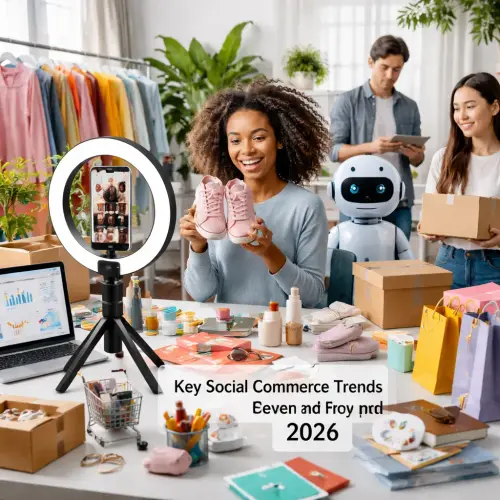
social commerce trends brands must know in 2026 Key Takeaways
Social commerce is evolving faster than ever, and brands that fail to adapt will lose ground.
- AI-driven tools will personalize shopping experiences in real time, making every interaction feel tailored.
- Live shopping continues to explode, with platforms like TikTok and Instagram turning video into a primary sales channel.
- Social search is replacing traditional search engines, meaning brands must optimize product discovery within apps.
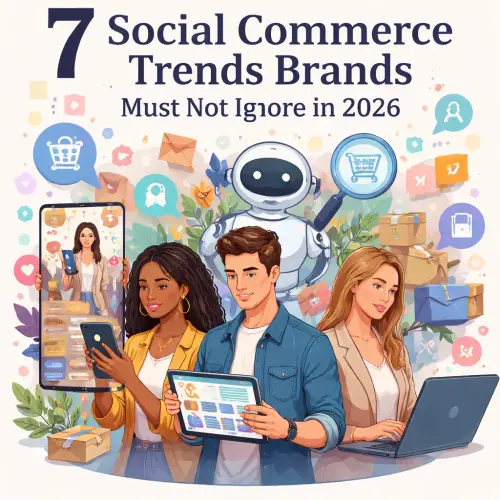
Why Social Commerce Trends Brands Must Know in 2026 Matter for Your Business
Social media platforms are no longer just for engagement—they are full-fledged sales engines. By 2026, social commerce is projected to account for nearly 20% of total ecommerce revenue in key markets. Understanding the social commerce trends brands must know in 2026 helps you stay relevant, reach younger audiences, and convert followers into loyal customers. Let’s dive into each trend and how you can take advantage of it.
Trend 1: AI-Powered Personalization at Scale
Artificial intelligence is transforming how products are recommended on social platforms. Algorithms now analyze user behavior, past purchases, and even real-time engagement to serve hyper-personalized product feeds. For brands, this means fewer generic ads and more relevant placements.
How to Act on This Trend in 2026
Invest in AI-driven ad tools offered by platforms like Meta and TikTok. Use dynamic product ads that update based on user interactions. Test AI chatbots for customer service that can recommend products based on conversational cues. According to Forrester Research, brands using AI personalization see conversion rates increase by up to 30%.
Real-World Example
Beauty brand Glossier uses AI to analyze customer skin tone and preferences from social interactions, then suggests tailored product bundles directly in Instagram DMs. This creates a seamless, almost concierge-like experience.
Trend 2: Live Shopping Goes Mainstream
Live-stream shopping events, popularized in Asia, are now a staple on Western platforms. In 2026, expect every major social app to offer integrated live shopping features, from YouTube Shopping to Pinterest TV. These events combine entertainment with instant purchase capability. For a related guide, see AI-Driven Feeds Explained Simply: How Platforms Decide.
Building a Live Shopping Strategy
Start with small, authentic sessions rather than polished productions. Partner with micro-influencers who have engaged followings. Promote your live events across all channels beforehand. Use countdown stickers and exclusive discounts to drive urgency. A report from eMarketer shows that live shopping conversions are 10 times higher than traditional ecommerce for certain categories.
Common Pitfall to Avoid
Don’t treat live shopping like a TV infomercial. Viewers want real interaction—answering questions, showing product details up close, and sharing unscripted moments. Keep it genuine.
Trend 3: Social Search Surpasses Traditional Engines
Younger consumers increasingly turn to TikTok and Instagram to search for product recommendations instead of Google. This shift means brands must optimize their social content for discoverability within each platform’s search algorithm. For a related guide, see Why TikTok Is Replacing Google Search in 2026: Essential Shift You Can’t Ignore.
Optimizing for Social Search
Use keyword-rich captions and hashtags that reflect how users actually phrase queries (e.g., “best waterproof mascara for sensitive eyes”). Create product-focused video content that answers common questions. Encourage user-generated content (UGC) that ranks in search results. According to Gartner, 40% of Gen Z now prefer social search over traditional search engines for product discovery.
Trend 4: Shoppable Video and Short-Form Commerce
Short-form video remains the most engaging format, and platforms are making it easier to tag products directly within clips. In 2026, shoppable video will expand to include interactive elements like polls, quizzes, and clickable hotspots.
Maximizing Shoppable Video Impact
Keep videos under 60 seconds for highest retention. Show the product in use early. Add a clear call-to-action like “Tap to shop” at the peak moment of interest. Test different formats: tutorials, unboxings, and behind-the-scenes snippets. Track which videos drive the most direct sales and double down on that style.
Trend 5: Social Loyalty Programs and Community Commerce
In 2026, brands are moving beyond simple loyalty points to community-driven rewards. Exclusive access, early product drops, and VIP groups on platforms like Discord or WhatsApp are becoming powerful retention tools.
Implementing Community Commerce
Create a private Facebook group or Telegram channel for your most engaged customers. Offer members-only discounts or first looks at new products. Use polls to let them vote on product features. This builds emotional investment and turns customers into brand advocates. According to Harvard Business Review, community-driven brands see 50% higher customer lifetime value.
Trend 6: Augmented Reality Try-On Experiences
AR is no longer a gimmick—it’s a practical tool that reduces returns and increases buyer confidence. By 2026, AR try-ons will be standard for categories like eyewear, cosmetics, apparel, and home decor within social apps.
Getting Started with AR Commerce
Partner with platforms that offer built-in AR tools, such as Instagram’s Spark AR or Snapchat’s Lens Studio. Start with a single product category to test performance. Promote AR experiences through Stories and Reels. IKEA’s AR app lets customers visualize furniture in their homes, a feature now integrated into Instagram shopping.
Trend 7: Direct Messaging as a Sales Channel
Consumers want to ask questions and get fast answers before buying. In 2026, social DMs (via Instagram, WhatsApp, Facebook Messenger) will become primary conversion funnels, especially for high-consideration purchases.
Turning DMs into Revenue
Use chatbots for initial queries and hand off to human agents for complex questions. Set up quick reply templates for common questions (e.g., sizing, shipping). Integrate your CRM with social inboxes so agents see purchase history. Offer exclusive DM-only discounts to encourage the first sale.
Useful Resources
- Think with Google: The Future of Social Commerce – A deep dive into consumer behavior shifts and platform evolution.
- McKinsey and Company: Social Commerce as the Next Frontier – Data-driven insights on market size, growth projections, and strategic implications for brands.
Frequently Asked Questions About Social Commerce Trends Brands Must Know in 2026
Conclusion: Your 2026 Social Commerce Action Plan
The social commerce trends brands must know in 2026 are not optional—they represent a fundamental shift in how people shop. By embracing AI personalization, live shopping, social search optimization, and community-driven loyalty, you position your brand at the forefront of this movement. Start small, test relentlessly, and scale what works. The brands that act now will define the future of social selling.
Frequently Asked Questions About social commerce trends brands must know in 2026
What are the biggest social commerce trends for 2026?
The biggest trends include AI personalization, live shopping, social search dominance, shoppable video, community loyalty programs, AR try-ons, and DM-based selling.
How will AI change social commerce in 2026?
AI will power hyper-personalized product recommendations, chatbots for instant customer service, and dynamic ad creatives that adapt to each user’s behavior in real time.
Is live shopping still relevant in 2026?
Yes, live shopping is growing rapidly. Platforms like TikTok, Instagram, and YouTube are investing heavily in live commerce features, and conversion rates remain significantly higher than traditional ecommerce.
What is social search and why does it matter?
Social search refers to using platforms like TikTok and Instagram to find products and reviews instead of Google. It matters because younger consumers trust peer content over traditional ads, and optimizing for it boosts organic discovery.
How do I make my videos shoppable in 2026?
Use platform-native tools like Instagram Product Tags, TikTok Shopping, and YouTube Shopping cards. Tag products directly in the video timeline so viewers can buy without leaving the app.
What is community commerce?
Community commerce uses private groups (e.g., WhatsApp, Discord, Facebook Groups) to build loyalty, offer exclusive deals, and involve customers in product decisions. It increases retention and lifetime value.
Can small brands afford AR try-on technology?
Yes. Platforms like Snapchat and Instagram offer free or low-cost AR tools for brands. Start with simple lenses or filters that demonstrate one product. As you grow, invest in more complex AR experiences.
Should I use chatbots for social commerce sales?
Absolutely. Chatbots can handle routine questions, recommend products based on preferences, and free up human agents for complex interactions. They increase response speed and conversion rates.
What role do influencers play in social commerce in 2026?
Influencers remain critical for building trust and driving discovery. Micro-influencers with niche audiences often achieve higher engagement and conversion rates than macro-influencers.
How does social commerce affect return rates?
Social commerce can lead to higher return rates if product expectations aren’t met. AR try-ons and detailed video demos help reduce returns by giving customers a realistic sense of the product before purchase.
Which social platform is best for social commerce in 2026?
There is no single best platform. Instagram and TikTok lead for fashion and beauty, while Pinterest excels for home decor and DIY. YouTube is strong for tech and tutorials. Choose based on your target audience.
Do I need a separate social commerce team?
Not necessarily, but as your social commerce revenue grows, dedicated roles for community management, live shopping production, and analytics become valuable. Start by training your existing social team.
How do I measure social commerce success?
Track metrics like conversion rate, average order value, return on ad spend, customer acquisition cost, and repeat purchase rate. Platform analytics tools and UTM parameters help attribute sales accurately.
What is the future of social selling beyond 2026?
The future points toward even deeper integration of AI, virtual reality, and seamless checkout within all social touchpoints. Expect social platforms to become full-blown ecommerce ecosystems.
Are DMs really a sales channel?
Yes. Many consumers prefer asking questions privately before buying. Brands that respond quickly in DMs and offer personalized recommendations convert at a higher rate than those that rely only on public posts.
How often should I run live shopping events?
Start with once a week and adjust based on engagement. Consistency builds an audience. Use analytics to see which days and times yield the highest attendance and sales.
Can social commerce work for B2B brands?
Yes. LinkedIn and even Instagram are used for B2B discovery, especially in industries like office supplies, software, and professional services. Shoppable posts and live demos can effectively generate leads.
How do I integrate social commerce with my existing ecommerce store?
Use platform APIs or third-party tools like Shopify’s social commerce integrations to sync inventory, track orders, and manage customer data across channels. Consistent branding and pricing are key.
Is user-generated content important for social commerce?
Extremely. UGC builds social proof and trust. Encourage customers to post photos or videos with your products, and repost them (with permission) on your channels with shoppable tags.
What’s the biggest mistake brands make with social commerce?
The biggest mistake is treating social commerce as a simple add-on rather than a strategy. Brands that fail to invest in content creation, community engagement, and platform-specific optimization rarely see success.