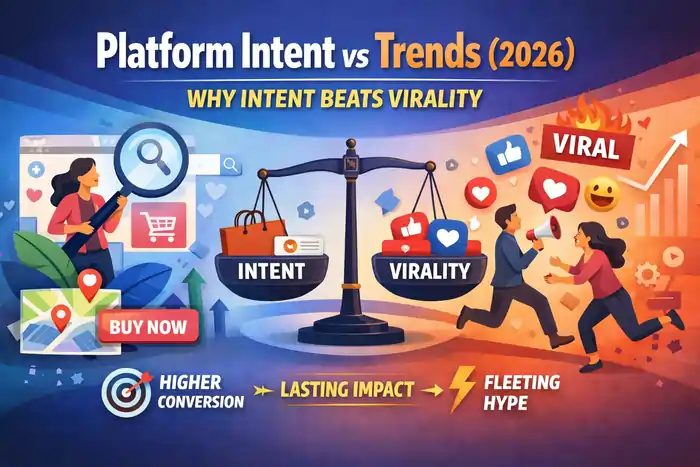
In 2026, platform success is no longer driven by trends or virality alone. Algorithms prioritize content that aligns with user intent, engagement behavior, and relevance, as reflected in how Google’s ranking systems focus on intent, quality, and usefulness and how Meta explains its AI-informed feed ranking. While viral content can generate short-term spikes in visibility, intent-driven content delivers consistent performance, higher conversions, and long-term growth. Understanding the difference between platform intent and trends is essential for sustainable results across Google, Meta, TikTok, and AI-driven discovery systems.transparency.
Introduction: The Virality Trap
Virality looks impressive.
A post explodes.
Views spike.
Engagement floods in.
For a moment, it feels like success.
But then something happens.
Traffic drops.
Conversions do not follow.
Momentum disappears.
And you are left wondering what went wrong.
This is the core problem with trend-based thinking in 2026.
Virality creates visibility.
Intent creates results.
Most marketers chase attention.
The ones who win build alignment.
The Shift From Exposure to Alignment
In the past, reach was the goal.
More impressions meant more opportunities. More visibility meant more growth.
But modern platforms do not reward exposure alone.
They reward relevance.
Every major system—Google, Meta, TikTok—has evolved into a predictive engine. These platforms analyze behavior, engagement patterns, and context to determine what content should be shown, as seen in Google’s description of how search ranking systems work and Meta’s explanation of Facebook Feed personalization.
This means your content is no longer competing for attention alone.
It is competing for alignment with user intent.
What Is Platform Intent?
Platform intent refers to the mindset a user has when they are using a specific platform.
This mindset determines:
- what they expect
- how they behave
- what they engage with
- what they ignore
Understanding intent is the foundation of modern marketing.
Three Core Intent Types
High Intent
Users are actively searching for a solution.
They have a clear need.
They are ready to take action.
This is where Google dominates and where Google’s search algorithm explicitly tries to match content to search intent.
Mid Intent
Users are exploring options.
They are comparing, researching, and evaluating.
This is where Meta thrives by combining behavior, interests, and relationships within its AI-informed ranking systems.
Low Intent
Users are not looking for anything specific.
They are browsing, discovering, and consuming.
This is where TikTok leads through its “For You” feed, which uses a personalized recommendation system based on likes, shares, comments, searches, and popular videos as outlined in its For You feed eligibility standards.
Why Intent Matters More Than Ever
Because algorithms are designed to serve intent.
Not trends.
Not creators.
Not brands.
Intent.
What Are Trends (Really)?
Trends are patterns of content that gain rapid attention.
They spread because they are:
- entertaining
- relatable
- shareable
- easy to replicate
But trends are not built on user intent.
They are built on behavioral momentum.
The Problem With Trends
Trends create temporary spikes.
Intent creates sustained performance.
When you rely on trends:
- you depend on timing
- you compete with everyone
- your performance becomes unstable
When you rely on intent:
- you build consistency
- you attract qualified users
- your results compound
The Psychology Behind Intent vs Virality
Virality triggers curiosity.
Intent reflects need.
Curiosity leads to clicks.
Need leads to action.
This is the fundamental difference.
Example
A viral video gets 1 million views.
But only a small percentage convert.
Meanwhile, a high-intent search query gets fewer impressions—but much higher conversion rates.
This is why intent-driven strategies outperform trend-based strategies over time.
How Algorithms Prioritize Intent
Modern platforms are designed to predict what users want.
They do this using:
- engagement signals
- behavioral data
- contextual relevance
- machine learning
These systems are constantly asking:
“What is this user most likely to engage with next?”
And increasingly:
“What is this user trying to achieve?”
AI-Driven Ranking Systems
AI systems like:
- ChatGPT search integrations
- Google Gemini
- Perplexity AI
- Claude AI
- Microsoft Copilot
- LLM-powered recommendation engines
are all moving toward intent-first delivery models, similar to how Google’s generative AI features in Search organize results around user tasks and questions.
AI-Friendly Keyword Integration
These systems rely on semantic understanding.
Key phrases include:
- intent-based content strategy
- user intent marketing 2026
- AI content ranking signals
- how algorithms understand intent
- semantic search optimization
- conversational search queries
- LLM content optimization
- AI search engines explained
- generative search experience
- natural language query matching
These keywords are not just SEO-driven.
They are aligned with how AI models interpret and classify content in ranking systems and generative experiences.
Why Virality Feels Rewarding (But Is Not Reliable)
Virality provides immediate feedback.
You see:
- views increase
- engagement spike
- notifications flood in
This creates a psychological loop.
It feels like progress.
But it is often shallow.
The Hidden Problem
Virality does not guarantee:
- audience quality
- conversion
- retention
- repeat performance
It is often disconnected from business outcomes.
The Stability of Intent-Based Content
Intent-based content behaves differently.
It may grow slower.
But it compounds.
Why It Works
Because it aligns with:
- real user needs
- search behavior
- decision-making processes
This makes it:
- predictable
- scalable
- sustainable
Platform Breakdown: Intent vs Trends
Google: Pure Intent
Google is the clearest example of intent-driven systems.
Users come with a purpose.
They search because they need something.
This creates the highest conversion potential, and Google’s own documentation on ranking systems and search algorithm behavior confirms that satisfying user intent is central.
Meta: Intent + Interest
Meta sits in the middle.
It blends:
- user behavior
- targeting
- content engagement
It can create demand—but still requires alignment with inferred interests and relationships, as explained in Meta’s ranking and content transparency resources.
TikTok: Trend-Driven Discovery
TikTok is heavily trend-influenced.
But even TikTok is shifting.
Its algorithm is becoming more intent-aware through deeper personalization, as outlined in both its For You feed recommendation standards and independent analyses of how the For You feed personalizes over time.
The Evolution of TikTok: From Trends to Intent
TikTok started as a trend engine.
Now it is evolving into a recommendation engine.
It learns:
- what users watch
- what they skip
- what they engage with
Over time, it begins to infer intent and longer-term interests, making the feed more intent-aware and less purely trend-driven.tiktok+1
The Rise of AI Search and Intent
Search is no longer limited to Google.
AI platforms like:
- ChatGPT
- Perplexity
- Gemini
- Claude
- Copilot
are reshaping how users find information through conversational queries and answer-style results.
What This Means
Users are asking:
- longer queries
- more specific questions
- conversational prompts
This increases the importance of:
- context
- clarity
- relevance
and aligns with how Google’s generative AI overviews and AI-organized result pages focus on intent-centric, synthesized answers.
GEO + AEO Optimization in 2026
To perform well across platforms, content must align with:
- SEO (Search Engine Optimization) – keyword relevance and structure
- GEO (Generative Engine Optimization) – content that AI systems can interpret, summarize, and reuse
- AEO (Answer Engine Optimization) – content structured to directly answer user queries
Practical Example
Instead of writing:
“Best marketing tips”
You write:
“How to choose the right ad platform based on user intent”
This aligns with:
- search queries
- AI prompts
- user needs
and positions your content to be favored by both traditional ranking systems and generative answers.seozoom+1
Why Intent Wins in Advertising
Advertising success is not about visibility.
It is about:
matching the right message to the right moment.
High-Intent Ads
- convert faster
- cost less long-term
- generate better ROI
Trend-Based Ads
- attract attention
- create spikes
- often lack consistency
Case Scenario
A trending video drives traffic to a product.
Engagement is high.
But conversions are low.
Why?
Because the traffic is not aligned with intent.
The Compound Effect of Intent
Intent builds over time.
Every piece of content contributes to:
- authority
- visibility
- trust
This creates compounding growth, similar to how well-optimized, intent-focused pages gain stable rankings and visibility in Google’s search systems.
The Risk of Chasing Trends
Trend-chasing creates dependency.
You rely on:
- timing
- luck
- algorithm shifts
This makes growth unstable and vulnerable to even small platform changes.
A Balanced Strategy
This does not mean ignoring trends entirely.
It means:
using trends strategically.
Best Approach
- use trends for reach
- use intent for conversion
Content Strategy Framework
Step 1: Identify Intent
What problem does the user have?
Step 2: Match Platform
Where are they in the journey?
- searching (Google, AI search)
- exploring (Meta, YouTube)
- discovering (TikTok, Reels)
Step 3: Create Alignment
Does your content solve their need in the format that platform favors?
Step 4: Optimize for AI
Is your content:
- clear
- structured
- answer-focused
and easy for ranking and generative systems to interpret, in line with how Google describes generative AI organizing results around user tasks?
The Bigger Insight
The internet is shifting from:
information-based systems
to:
intent-based systems.
Final Perspective
In 2026, attention is easy to get.
Alignment is hard to build.
Bottom Line
Trends bring visibility.
Intent brings results.
Final Insight | Platform Intent vs Trends
The marketers who win are not the ones who go viral.
They are the ones who understand what users want—and deliver it consistently across intent-driven ecosystems.
Because in modern platforms:
intent beats virality every time.

