
Topic cluster planning using AI helps Isulan businesses build comprehensive, interconnected content architectures that signal deep expertise to Google — earning broader search rankings, stronger topical authority, and more consistent local search visibility across Sultan Kudarat and the SOCCSKSARGEN region.
AI tools map entire topic territories, identify content gaps, prioritize cluster content by business value, and connect every piece of content through strategic internal linking — transforming isolated blog posts and service pages into a cohesive SEO content system that compounds in authority over time. This guide explains how AI-powered topic cluster planning works, how to build topic clusters for any local business in Isulan, and how cluster architecture drives sustainable long-term search performance.
Why Isolated Content Never Builds the Search Authority Isulan Businesses Need
Most local businesses in Isulan approach content creation the same way: publish a blog post when inspiration strikes, add a new service page when a new offering launches, update the homepage occasionally with a seasonal promotion. Each piece of content is created in isolation, with no structural connection to other content on the site and no strategic framework linking individual pages into a coherent subject matter expertise signal.
This approach produces a website that looks like a collection of unrelated documents rather than a comprehensive resource on any particular topic. And that is exactly how Google evaluates it — as a site with broad, shallow coverage of many topics rather than deep, authoritative expertise in any specific domain. The result is predictable: rankings that plateau, authority that fails to accumulate, and a content investment that generates diminishing returns because each new piece of content starts from scratch rather than building on the authority established by previous content.
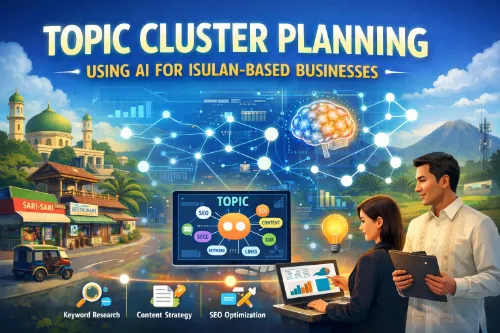
Topic cluster planning solves this problem at its root. Instead of creating isolated content pieces, topic cluster planning organizes content into interconnected groups — clusters — where a central pillar page covers a broad topic comprehensively and a set of cluster pages address specific subtopics in depth, all connected through strategic internal linking that concentrates authority across the entire cluster.
Google’s algorithm increasingly rewards this kind of organized, comprehensive topic coverage with what SEO practitioners call topical authority — the recognition that a website is a reliable, expert resource on a specific subject. When topical authority is established in a category relevant to an Isulan business, Google rewards the entire cluster with improved rankings — not just for individual keywords, but across the full breadth of the topic territory the cluster covers.
AI has transformed topic cluster planning from a labor-intensive strategic exercise into a scalable, data-driven process that any Isulan business can execute systematically. This guide explains how AI-powered topic cluster planning works in practice and how Isulan businesses can build the cluster architecture that drives sustainable search authority in the Sultan Kudarat local market. For the broader strategic context, our resource on content strategy and topical authority and the overview of AI SEO services in Isulan provide the complete framework.
The Anatomy of a Topic Cluster: How the Architecture Works
Before examining how AI builds topic clusters, it helps to understand the structural components of an effective cluster and how they work together to build topical authority.
The Pillar Page: Comprehensive Coverage of the Core Topic
The pillar page is the central hub of a topic cluster — a comprehensive, authoritative page that covers the cluster’s core topic in sufficient breadth to serve as the definitive resource on that subject for a local Isulan audience. Pillar pages are typically longer than standard service or blog pages, covering the full scope of a topic area while linking to cluster pages for deeper treatment of specific subtopics.
For a legal services firm in Isulan, a pillar page on “business legal services in Isulan” would cover the full range of business legal needs — registration, contracts, disputes, employment law, intellectual property — with enough depth on each subtopic to demonstrate comprehensive expertise, and with internal links to dedicated cluster pages that cover each subtopic in depth. The pillar page targets the broad head keyword (“business legal services Isulan”) while the cluster pages target the specific long-tail variations (“business contract lawyer Isulan,” “employment dispute resolution Sultan Kudarat”).
AI-powered keyword research identifies the ideal pillar page keyword for each cluster — the head term with the broadest relevant search volume and the most commercial significance for the business — and maps the full semantic territory that the pillar page needs to cover to establish comprehensive topical authority. Search intent mapping confirms that pillar pages target commercial investigation intent — the broad exploratory searches that buyers make when they are beginning to evaluate options in a category.
Cluster Pages: Deep Coverage of Specific Subtopics
Cluster pages are the supporting content that surrounds and strengthens the pillar page — individual pieces of content that each address a specific subtopic within the cluster’s broader theme with greater depth than the pillar page can provide. Each cluster page targets a specific long-tail keyword variation and answers a specific question or need that buyers at different stages of the decision journey bring to their search.
For the legal services cluster example, cluster pages might include: “How to register a corporation in Isulan,” “Employment contract requirements for Sultan Kudarat businesses,” “What to do when a business contract is breached in the Philippines,” and “Intellectual property registration for Isulan entrepreneurs.” Each of these targets a specific informational or transactional keyword, provides genuine depth on its specific subtopic, and links back to the pillar page as the authoritative overview of the broader category.
The relationship between pillar and cluster pages is reciprocal: the pillar page links down to cluster pages, directing Google and readers to specific subtopic depth. Cluster pages link back up to the pillar page, passing the authority accumulated through their own keyword rankings back to the central hub. This bidirectional linking creates an authority network where the entire cluster strengthens with each new piece of cluster content added.
Internal Linking: The Architecture That Makes Clusters Work
The strategic internal linking that connects pillar and cluster pages is not an afterthought — it is the mechanism through which topic clusters actually build authority. Without deliberate internal linking, a group of topically related pages is just a collection of documents. With strategic internal linking using keyword-rich anchor text, the same pages form an authority network that Google reads as evidence of comprehensive expertise.
AI SEO optimization audits internal linking across existing content to identify pages that should be part of topic clusters but lack the connections that cluster membership requires — orphan pages with no internal links, over-linked pages accumulating more internal equity than they need while related pages are under-supported, and anchor text patterns that could be improved to strengthen keyword relevance signals on destination pages.
How AI Plans Topic Clusters for Isulan Businesses
The manual process of topic cluster planning — identifying pillar topics, mapping semantic subtopics, prioritizing cluster content by keyword opportunity, and designing the internal linking architecture — can take weeks for a single cluster. AI reduces this timeline to days while simultaneously improving the depth and accuracy of the cluster map produced.
Step 1: AI-Powered Pillar Topic Identification
The first step in AI topic cluster planning is identifying which broad topics warrant pillar page treatment for a specific Isulan business. Not every topic area a business touches deserves a full cluster — only those where there is sufficient keyword depth (enough related subtopics with genuine search volume to fill multiple cluster pages), sufficient commercial relevance (the topic area connects directly to the business’s revenue-generating services or products), and sufficient competitive opportunity (the cluster can realistically achieve topical authority in the Isulan and Sultan Kudarat local market).
AI tools analyze your business’s service or product categories against local search volume data, competitive landscape analysis, and competitor content gap analysis to identify the topic areas where cluster investment will produce the strongest combination of achievable rankings and business value. A hardware store in Isulan might discover that “construction materials Sultan Kudarat” has sufficient keyword depth and competitive opportunity for a full cluster, while “plumbing tools Philippines” does not — because national competitors have too strong a presence at the national level for a local cluster investment to be viable.
Step 2: AI Semantic Mapping of the Full Cluster Territory
For each identified pillar topic, AI semantic analysis maps the complete territory of related subtopics, questions, keyword variations, and content angles that constitute the full cluster. This mapping goes far beyond simple keyword expansion — it traces the conceptual connections between ideas, identifies the buyer journey stages represented by different subtopics, and surfaces the specific content gaps that competitors have left unfilled in each cluster territory.
Tools like Semrush’s Topic Research, Ahrefs Content Explorer, and MarketMuse incorporate AI semantic analysis that produces comprehensive topic maps showing how subtopics relate to each other and to the pillar topic, which subtopics have been covered by competitors and which have not, and which subtopics represent the highest-volume, highest-intent keyword opportunities within the cluster territory.
This semantic map becomes the topical map — the complete architectural blueprint for the cluster, showing every piece of content that needs to be created, what keyword each piece targets, what intent it satisfies, and how it connects to every other piece in the cluster through internal links.
Step 3: Intent Classification Across the Cluster
A well-designed topic cluster serves buyers at every stage of the decision journey — from initial awareness and research through comparison and evaluation to the final transaction. AI intent classification applied across the cluster map ensures that each stage is represented by the right content type targeting the right intent.
Search intent mapping at the cluster level produces a distribution across the four intent categories: informational cluster pages that capture research-stage traffic and build brand familiarity, commercial investigation cluster pages that address comparison-stage buyers evaluating options, transactional cluster pages that capture buyers ready to make a decision, and navigational content that ensures direct brand searches lead seamlessly to the most relevant pages.
For a medical clinic in Isulan building a cluster around “primary healthcare services Isulan,” intent classification ensures the cluster includes: informational content on common health conditions and prevention (capturing early-stage searchers), commercial investigation content comparing service options and what to expect from consultations (serving comparison-stage buyers), and transactional service pages targeting “book appointment Isulan clinic” and “same-day consultation Sultan Kudarat” keywords (capturing decision-ready buyers).
Step 4: Priority Sequencing for Content Production
A comprehensive topic cluster for a local Isulan business might require fifteen to thirty individual pieces of content — far more than can be produced simultaneously with any reasonable content budget. AI prioritization sequences production by the expected impact of each piece on overall cluster authority and business revenue.
AI content planning applies a multi-factor priority ranking to each cluster content piece: keyword search volume, competition difficulty, commercial intent strength, internal linking value (some pages are more central to the cluster architecture and unlock more authority when published), and speed to ranking (some subtopic pages have lower competition and can achieve strong rankings quickly, generating early evidence of cluster performance).
This prioritized production sequence means that cluster investment produces measurable results from the earliest content pieces published rather than requiring the complete cluster to be built before any performance is visible. Scale content production using AI workflows executes this prioritized production plan efficiently — maintaining consistent quality across all cluster content while producing at the volume and speed that makes comprehensive cluster building economically viable for Isulan businesses of all sizes.
Building Topic Clusters for Specific Isulan Business Types
The topic cluster approach applies across every industry and business type in Isulan and Sultan Kudarat — but the specific cluster architecture varies by business model and competitive landscape.
Service Business Clusters
For service businesses in Isulan — legal firms, medical clinics, accounting practices, construction companies, cleaning services — topic clusters are organized around service categories rather than products. The pillar page covers the service category comprehensively, and cluster pages address specific service variations, geographic service area pages, buyer education content, and FAQ content that serves different stages of the service buyer journey.
Optimize service pages within cluster architecture by ensuring each service page functions as both a cluster content piece (linking to and from the pillar page and related cluster pages) and a standalone conversion asset (targeting transactional intent and optimized for lead generation). Local SEO content generation adds Isulan and Sultan Kudarat specific context throughout service cluster content — making every piece of cluster content genuinely locally relevant rather than generically applicable.
Local SEO in Isulan using AI builds service cluster architecture specifically calibrated to the local competitive landscape — identifying the topic territories where Isulan service businesses can establish dominant topical authority and where the cluster investment will produce the strongest competitive differentiation.
E-Commerce Product Clusters
For Isulan e-commerce businesses, topic clusters organize around product categories rather than individual products. A category page serves as the pillar, with product pages, buying guides, comparison content, use case content, and local availability content serving as cluster pages that collectively establish the business as the authoritative local resource for that product category.
Category page SEO optimization builds the pillar page anchor of e-commerce clusters, while product page SEO optimization develops the individual product cluster pages that target specific transactional buyer searches. E-commerce SEO content fills the informational and commercial investigation cluster positions with buying guides, comparison content, and product category education that serves research-stage buyers before they are ready to make a specific product choice. AI product descriptions and AI SEO for local e-commerce complete the e-commerce cluster content architecture.
Hyperlocal Geographic Clusters
For Isulan businesses serving multiple barangays, municipalities, or the broader Sultan Kudarat province, geographic clusters extend topical authority across service area coverage. The pillar page covers the primary service or product category for the Isulan market broadly, with cluster pages targeting specific geographic variations: individual barangay service pages, nearby municipality coverage pages, and regional service area content that captures the full geographic scope of the business’s customer base.
Hyperlocal SEO content strategies build these geographic cluster layers systematically — creating the locally specific content depth that national competitors cannot replicate and that Google rewards with strong local search rankings across the entire service area. The relationship between international SEO and local SEO is particularly relevant for businesses whose geographic clusters extend beyond Isulan into regional and national search territories.
Advanced Topic Cluster Features: Schema, Featured Snippets, and Rich Results
Topic cluster architecture creates specific opportunities for advanced SEO enhancements that further amplify the authority and visibility benefits of cluster content.
Structured data SEO and AI schema markup applied across topic cluster content enable rich results that enhance the search listings of cluster pages — FAQ dropdowns for FAQ cluster content, HowTo rich results for instructional cluster pages, Article schema for informational cluster content, and LocalBusiness schema reinforcement across the entire cluster. FAQ and schema content generation creates the structured question-and-answer content that both satisfies informational cluster intent and enables FAQ-enhanced search listings.
Featured snippets in Google are most commonly won by cluster content — specifically by cluster pages that address a narrow, specific question with exceptional clarity and comprehensiveness. A well-built topic cluster for an Isulan business creates dozens of featured snippet opportunities across the cluster’s informational content pieces. A comprehensive rich results SEO strategy maximizes these enhanced listing opportunities across the complete cluster architecture.
Metadata and CTR optimization across all cluster content ensures that every cluster page earns the maximum click-through rate from its rankings — particularly important for cluster pages targeting informational and commercial investigation intent where the competition for clicks is highest. CTR optimization strategies applied to cluster content metadata compound the traffic benefit of cluster authority building.
Measuring Topic Cluster Performance for Isulan Businesses
Topic cluster performance measurement requires tracking metrics at both the individual page level and the cluster level — because the defining characteristic of cluster success is the lift that the entire cluster receives as individual pages gain authority.
SEO performance tracking for topic clusters should monitor: pillar page ranking position for the head keyword, average ranking position across all cluster pages for their individual target keywords, organic traffic volume to the cluster as a whole, and — most importantly for Isulan businesses — the leads and revenue generated from cluster traffic. SEO reporting translates this cluster-level performance data into business outcome metrics that connect content investment to revenue impact.
AI SEO audits and AI SEO audits and reporting monitor cluster health continuously — identifying cluster pages that have lost ranking ground, internal linking gaps that are limiting authority flow within the cluster, and new keyword opportunities within the cluster territory that represent additional content investment priorities. AI content refresh and updating maintains cluster content freshness as the competitive landscape and local market conditions evolve.
Local search visibility tracking measures how topic cluster authority translates into local ranking improvements specifically for Isulan and Sultan Kudarat searches — the geographic performance that matters most to local businesses. AI SEO strategies evolve cluster content approaches based on this local performance data continuously. Technical SEO improvements address the structural factors that support or limit cluster page ranking performance across the entire site.
AI-assisted SEO article creation and AI SEO content writing maintain the content production pace needed to build clusters comprehensively — ensuring that every identified cluster content opportunity is executed at the quality level that both Google and local Isulan buyers expect. SEO content that converts and AI SEO for conversion rate optimization ensure that cluster traffic converts into business outcomes at rates that justify the content investment.
Landing page creation within cluster architecture creates high-converting anchor points for the transactional cluster content that captures decision-ready buyers. On-page SEO optimization and AI SEO optimization applied consistently across all cluster content ensure that every page in the cluster meets the technical and content quality standards that ranking requires. Competitor content gap analysis identifies the specific cluster content gaps that competitors have left open — the highest-priority content investments within any cluster.
AI for local SEO calibrates every aspect of cluster architecture to the specific local search environment of Isulan and Sultan Kudarat — ensuring that cluster content serves the specific language, intent patterns, and buyer psychology of local customers rather than a generic national audience. Local SEO strategies built on AI topic cluster planning give Isulan businesses the sustainable, compounding search authority that isolated content creation can never produce.
For Isulan businesses ready to invest in professional topic cluster planning, AI SEO for small business in Isulan and AI SEO services cost in Isulan provide realistic investment context. An AI SEO agency in Isulan with deep local market knowledge builds cluster architectures calibrated to the specific competitive landscape of Sultan Kudarat. AI SEO services and AI SEO applied to topic cluster planning give Isulan businesses the most durable and compounding SEO investment available — content architecture that grows stronger with every piece added and that builds the kind of local search dominance that competitors cannot easily displace.
FAQs
1. What is a topic cluster in SEO?
A topic cluster is a group of related content centered around a main pillar page and supported by subtopic pages.
2. Why are topic clusters important for SEO?
They build topical authority, which improves rankings across multiple related keywords.
3. What is a pillar page?
A pillar page is a comprehensive guide that covers a broad topic and links to detailed subtopics.
4. What are cluster pages?
Cluster pages are focused content pieces that explore specific subtopics in depth.
5. How do pillar and cluster pages work together?
They are connected through internal links, strengthening authority across the entire topic.
6. Why does isolated content fail in SEO?
Because it does not build authority or signal expertise to search engines.
7. What is topical authority?
It is the credibility a website earns by covering a subject comprehensively.
8. How does AI improve topic cluster planning?
AI analyzes keywords, competitors, and content gaps to build complete content maps.
9. What is semantic mapping in SEO?
Identifying all related subtopics and keywords within a topic area.
10. How does AI identify content gaps?
By comparing your content with competitors and highlighting missing topics.
11. What is search intent in cluster planning?
Understanding what users want when searching and matching content to that intent.
12. Why should clusters include different intent types?
To capture users at every stage of the buying journey.
13. What are the four types of search intent?
Informational, navigational, commercial investigation, and transactional.
14. How should content production be prioritized?
Based on keyword value, competition, and potential business impact.
15. Can small businesses use topic clusters?
Yes. AI makes cluster planning scalable even for small local businesses.
16. How do topic clusters improve internal linking?
They create structured links that distribute authority across pages.
17. What is a topical map?
A structured plan showing all content pieces within a cluster.
18. How do e-commerce businesses use topic clusters?
By organizing content around product categories, guides, and product pages.
19. What is a geographic topic cluster?
Content targeting specific locations like barangays or cities.
20. How do you measure topic cluster success?
Through rankings, traffic growth, and conversions across the entire cluster.

