
SEO reporting for business owners in Isulan should focus on the metrics that directly connect search performance to business revenue — leads generated, calls received, bookings made, and sales attributed to organic search — rather than technical metrics like keyword positions and traffic volumes that are meaningful to SEO specialists but difficult for business owners to translate into investment decisions.
This guide explains which SEO metrics actually matter for Isulan and Sultan Kudarat business owners, which metrics are often reported but rarely useful, how to read and interpret SEO reports effectively, and what questions to ask your SEO provider to ensure reporting reflects genuine business impact rather than superficial activity.
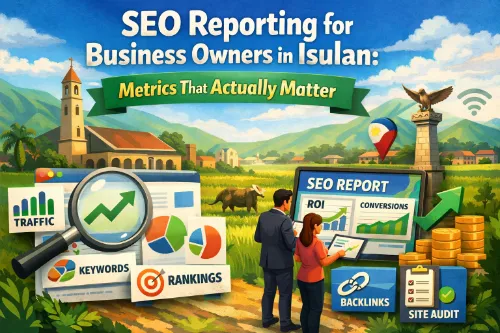
The SEO Reporting Problem Most Isulan Business Owners Experience
If you have ever received a monthly SEO report from an agency or consultant and felt simultaneously like you received a lot of information and understood very little of what it means for your business, you are not alone.
Most SEO reports are written for SEO specialists, not for business owners. They lead with keyword ranking tables showing position changes across hundreds of keywords. They include organic traffic graphs with multiple colored lines representing different traffic segments. They feature technical health scores, backlink counts, and domain authority numbers. They may be genuinely accurate — but they communicate in a language that requires SEO expertise to interpret, and they often fail to answer the question that every business owner actually needs answered: is my investment in SEO generating returns, and what specifically is happening with that return?
This communication gap has two real costs for Isulan business owners. The first is that it makes informed SEO investment decisions impossible — if you cannot connect your SEO report to your business outcomes, you cannot evaluate whether to increase, maintain, or reduce your SEO investment. The second is that it allows underperforming SEO work to go undetected — a report full of technical metrics can appear comprehensive and professional while concealing a strategy that is not generating actual business results.
This guide gives Isulan business owners the framework to evaluate SEO reports clearly — knowing which metrics to focus on, which to deprioritize, which questions to ask, and how to read the specific numbers that indicate whether your SEO investment is producing genuine business value. SEO reporting built around business owner clarity rather than specialist comprehensiveness is the foundation of a productive SEO relationship. For the complete strategic context, our resource on AI SEO services in Isulan explains the full scope of what AI-powered SEO strategy should deliver.
The Metrics That Actually Matter: Organized by Business Priority
Here is the complete framework for evaluating SEO performance as a business owner in Isulan — organized from the metrics that matter most to the metrics that matter least for making investment and strategy decisions.
Priority 1: Revenue and Lead Metrics (The Only Numbers That Justify Investment)
Organic leads generated. The number of inquiries, contact form submissions, appointment bookings, or quote requests that came from visitors who arrived through organic Google search. For a dental clinic in Isulan, this is the number of new patient inquiry calls or appointment form submissions attributable to organic search. For a construction supply company in Sultan Kudarat, it is the number of purchase inquiries from organic search visitors.
This is the metric that most directly answers the question every business owner should be asking: is my SEO investment generating business? If organic leads are growing month over month, SEO is working. If organic leads are flat or declining despite other metrics showing improvement, the SEO strategy has a conversion problem that ranking and traffic improvements alone are not solving.
AI SEO for conversion rate optimization addresses this conversion problem — identifying the specific page and content elements that are preventing organic visitors from becoming leads. SEO content that converts ensures that the content strategy serves both ranking goals and conversion goals simultaneously rather than prioritizing one at the expense of the other.
Revenue attributed to organic search. For e-commerce businesses, the total purchase revenue from customers who arrived through organic Google search. For service businesses, the estimated revenue value based on lead volume, lead-to-client conversion rate, and average client value. This is the clearest possible expression of SEO ROI — and any SEO report for a business owner should include this calculation or the components needed to make it.
E-commerce SEO content, product page SEO optimization, AI product descriptions, category page SEO optimization, and AI SEO for local e-commerce investments should all be traceable to specific organic revenue outcomes in a properly constructed SEO report.
Return on SEO investment. Total revenue generated from organic search divided by total SEO investment over the measurement period. An SEO report that never includes this calculation — or the components needed to make it — is not giving you the information you need to make a sound investment decision. If your monthly SEO investment is ₱15,000 and your organic search is attributable to ₱90,000 in monthly revenue, your ROI is 6x. That is a number worth knowing.
Priority 2: Traffic Quality Metrics (Telling You Whether Traffic Is Valuable)
Organic sessions from local searches. Not just total organic traffic, but the portion specifically from Isulan and Sultan Kudarat local searches — the geographic traffic segment most directly connected to your local business revenue. An Isulan dentist who sees 500 monthly organic sessions but discovers that 400 of them are from national searches for general dental information has a different situation than one whose 500 sessions are 400 local Isulan service searches. Local search visibility data in your report should break this geographic distinction clearly.
Organic conversion rate. The percentage of organic visitors who take a desired action — submit a form, call the business, make a purchase. If your website receives 500 organic visitors per month and generates 5 leads, your organic conversion rate is 1%. Industry benchmarks vary, but a declining conversion rate alongside stable or growing traffic indicates a conversion problem that optimization can address. A consistently low conversion rate suggests a fundamental mismatch between the traffic your SEO is attracting and the buyers your business serves.
New versus returning organic visitors. A healthy proportion of returning organic visitors indicates that people who found your website through search are coming back — a signal of content quality and business trust. For local Isulan service businesses where the consideration period before booking can be several weeks, returning organic visitors are often the buyers who are closest to converting.
Priority 3: Visibility Metrics (Leading Indicators of Future Traffic)
Rankings for your most commercially valuable keywords. Not all keyword rankings deserve equal attention in your report. The rankings that matter most are for the specific searches that your most valuable potential customers make when they are ready to engage — “dentist near me Isulan,” “construction supply Sultan Kudarat,” “accounting services Isulan.” These commercial intent local keywords are your indicator keywords — their ranking trends predict your future lead volume more reliably than broad ranking averages across hundreds of keywords.
Search intent mapping identifies which of your target keywords carry the highest commercial intent — the searches closest to the purchase or inquiry decision. Your SEO report should separate these high-intent commercial keywords from informational keyword rankings and give you a clear picture of how both are trending.
Google Maps Local Pack visibility. For local businesses in Isulan with physical locations, appearing in the top three results of Google’s Local Pack for relevant local searches is often more valuable than organic rankings. A report that tracks Local Pack visibility separately from organic rankings gives you visibility into this distinct and highly valuable search real estate. AI for local SEO strategies that improve Local Pack rankings directly impact the inquiry volume that comes through Google Maps and Google Business Profile — one of the primary contact channels for local Isulan service businesses.
Total keyword footprint growth. The total number of keywords your website ranks for in any position should be growing over time as your content strategy and topical authority investment accumulates. A flat keyword footprint despite active content investment may indicate that new content is not being indexed, is being indexed but not ranking, or is targeting keywords too competitive for the current domain authority. A growing keyword footprint without proportional traffic growth may indicate that rankings are improving but not yet at the positions that earn significant clicks — an expected pattern in the first six to twelve months of a sustained SEO strategy.
Priority 4: Technical Health Metrics (Background Infrastructure)
Technical metrics — Core Web Vitals scores, crawl error counts, site speed scores, indexation rates — are meaningful context indicators for understanding why other metrics are performing as they are, but they are rarely the primary story in a business owner-focused SEO report.
Technical SEO improvements that have been made or are in progress should appear in the report narrative — explaining what was fixed, why it mattered, and what ranking or traffic improvement it is expected to produce. Technical metrics presented without this context (“your Core Web Vitals LCP is 2.8 seconds”) mean little to a business owner without the accompanying explanation of whether 2.8 seconds is good or bad, whether it has improved or worsened, and what impact it has on ranking performance.
AI SEO audits and AI SEO audits and reporting should present technical findings in business-impact terms — not “your LCP is 2.8 seconds” but “your homepage load time on mobile is slower than Google’s recommended threshold, which is contributing to a ranking disadvantage for your primary local service keyword; this month we implemented image optimization improvements that should bring it within the required range.”
What to Look for in a Good SEO Report: A Business Owner Checklist
Beyond the specific metrics described above, a good SEO report for an Isulan business owner demonstrates specific qualities that distinguish genuinely useful reporting from superficially impressive data presentation.
Leads First, Rankings Second
A good SEO report opens with business outcomes — leads generated, revenue attributed to organic search, comparison to previous month and previous year — before presenting the technical metrics that explain how those outcomes were achieved. If your SEO report opens with a keyword ranking table and buries the lead generation data on page four, that is a structural signal about whose perspective the report is designed for.
Explained Trends, Not Just Numbers
Every significant metric change in a good SEO report should be accompanied by an explanation of why it changed. A 15% increase in organic traffic is good news — but “organic traffic increased 15% this month primarily driven by improved rankings for the keyword ‘dental clinic Isulan’ following the service page optimization completed last month” is infinitely more useful than the raw number alone because it connects the outcome to the specific strategy activity that produced it.
Clear Action Items for the Coming Month
Every good SEO report should conclude with three to five specific, prioritized actions planned for the coming month — explaining what will be done, why it is the priority, and what improvement it is expected to produce. This forward-looking action list transforms reporting from a historical record into an operational planning tool that justifies continued investment and maintains strategic momentum.
AI SEO strategies should evolve based on performance data reported monthly — with the action list reflecting updated priorities informed by what the current month’s data reveals about what is working, what needs improvement, and what new opportunities have emerged.
Honest Assessment of What Is Not Working
A trustworthy SEO report acknowledges underperformance honestly and explains what is being done to address it — rather than presenting selectively positive data while omitting metrics that show areas of weak performance. If specific target keywords are not progressing toward page one as projected, the report should say so and explain the diagnosis and response plan.
Competitor content gap analysis findings that identify why competitor pages have displaced your rankings should appear in the report — providing the specific competitive intelligence that contextualizes your own performance rather than presenting your metrics in a competitive vacuum.
Questions to Ask Your SEO Provider About Your Reports
If you are currently receiving SEO reports that do not answer the questions described above, these specific questions will direct the conversation toward the metrics and insights that actually matter for your business:
“How many leads from organic search did we generate this month, and how does that compare to last month?” This question immediately reveals whether your reporting tracks the business outcome metrics that justify SEO investment.
“What is the estimated revenue value of this month’s organic leads?” This question connects lead volume to business impact — the calculation that makes ROI assessment possible.
“Which specific optimization activities this month are responsible for the performance changes we’re seeing?” This question tests whether your SEO provider can connect strategy execution to outcomes — a basic accountability requirement that superficial reporting cannot satisfy.
“What specific actions are planned for next month, and what improvement should I expect to see from each?” This forward-looking question distinguishes strategy-driven SEO from activity-driven SEO — the difference between a provider executing a plan calibrated to your goals and one executing a generic workflow regardless of your specific performance situation.
SEO performance data that cannot answer these questions is not incomplete by accident — it reflects a reporting approach that prioritizes specialist-facing metrics over business-owner clarity. Insisting on business-outcome-centered reporting is not unreasonable; it is the appropriate standard for any professional service relationship where the client is paying for results.
How AI Makes Better Business-Owner-Focused SEO Reporting Possible
AI has fundamentally improved what is possible in SEO reporting by automating the data collection, correlation, and interpretation work that previously made comprehensive, business-outcome-connected reporting too time-consuming for most SEO providers to produce efficiently.
AI SEO audits and reporting platforms automatically aggregate data from Google Search Console, Google Analytics 4, rank tracking tools, local visibility monitoring platforms, and technical audit systems — producing the integrated multi-source performance picture that manual data collection would require hours to compile. AI interpretation layers then identify the meaningful patterns within this integrated data: which metric changes are significant versus normal variation, which performance trends require strategic response, and which specific optimization activities are most likely to produce the improvements the business needs.
The output is AI-generated reporting narratives that explain performance changes in plain language, connect metric movements to business outcomes, and present prioritized action recommendations in formats that business owners — not just SEO specialists — can evaluate, approve, and hold their providers accountable to.
Local SEO in Isulan using AI performance tracking in AI-powered reports specifically monitors the local search metrics — Local Pack positions, local keyword rankings, geographic traffic distribution — that are most directly connected to Isulan and Sultan Kudarat business revenue. Local search visibility data presented alongside revenue metrics makes the local ROI of SEO investment immediately visible.
Topical authority growth tracking in AI reports shows how the long-term content investment through topic cluster planning, topical map development, and AI content planning is accumulating into competitive ranking advantages — connecting the strategic content work to the visibility improvements that eventually produce business outcomes. AI-assisted SEO article creation and AI SEO content writing output performance is tracked from publication through ranking development to traffic and lead generation — providing the end-to-end content ROI data that justifies continued content investment. Scale content production ROI is tracked through the organic traffic and lead volume generated per content piece produced. Local SEO content generation and hyperlocal SEO content strategies performance is tracked through local search visibility improvements. On-page SEO optimization and metadata and CTR optimization improvements are tracked through CTR and ranking position changes. CTR optimization strategies effectiveness is tracked through click-through rate improvements at specific ranking positions. Technical SEO improvements are tracked through Core Web Vitals score changes and their correlation with ranking improvements. AI SEO optimization effectiveness is tracked through competitive benchmark score improvements. Optimize service pages performance is tracked through service keyword ranking improvements and inquiry volume changes. Landing page creation ROI is tracked through campaign-specific conversion performance. Structured data SEO and AI schema markup results are tracked through rich result appearance and CTR impact. Featured snippets in Google won are reported as high-visibility SEO milestones. Rich results SEO strategy effectiveness is tracked through enhanced listing appearance rates. The relationship between international SEO and local SEO performance requires separate tracking tracks when both strategies are active.
For Isulan businesses evaluating their current SEO reporting, AI SEO for small business in Isulan and AI SEO services cost in Isulan provide realistic context for what high-quality AI SEO services with proper business-owner-focused reporting should cost. An AI SEO agency in Isulan that provides genuinely business-outcome-centered reporting — not just technical metric tables — is the partner that enables the informed investment decisions and continuous strategy improvement that produce lasting local search results. AI SEO services and AI SEO delivered with transparent, business-owner-focused reporting give Isulan business owners the clear, actionable intelligence they need to confidently invest in organic search as a primary, measurable, continuously improving revenue channel.
FAQs
What is SEO reporting for business owners?
SEO reporting presents search performance data in a way that shows how SEO contributes to leads, sales, and revenue.
Why do many SEO reports confuse business owners?
Because they focus on technical metrics instead of explaining how SEO impacts actual business results.
What are the most important SEO metrics for business owners?
The most important metrics are leads, revenue, and return on investment from organic search.
What are organic leads in SEO?
Organic leads are inquiries, calls, or bookings generated from users who found the business through search engines.
How is SEO revenue measured?
It is calculated based on sales or estimated value generated from organic search traffic.
What is ROI in SEO reporting?
ROI measures how much revenue is generated compared to the cost of SEO investment.
Why is traffic quality more important than traffic volume?
High-quality traffic is more likely to convert into customers, while high volume alone does not guarantee results.
What is organic conversion rate?
It is the percentage of organic visitors who take a desired action like making a purchase or inquiry.
Why should local businesses track local traffic?
Local traffic reflects potential customers who are more likely to convert into actual sales.
What are visibility metrics in SEO reports?
They include keyword rankings, impressions, and search visibility in results pages.
Which keyword rankings matter most?
High-intent keywords that reflect customer buying or inquiry behavior are the most valuable.
What is Google Local Pack visibility?
It refers to appearing in the top map results for local searches, which drives high-value traffic.
What is keyword footprint?
It is the total number of keywords a website ranks for in search engines.
Are technical SEO metrics important for business owners?
Yes, but only as supporting data to explain performance—not as the main focus of reports.
What should a good SEO report include first?
It should start with leads, revenue, and business outcomes before technical details.
Why is trend explanation important in reports?
It helps business owners understand why performance changed and what caused the results.
What should be included in an SEO action plan?
Clear next steps, priorities, and expected outcomes for the next reporting period.
Why is honesty important in SEO reporting?
Transparent reporting builds trust and helps address issues early before they affect results.
What questions should business owners ask about SEO reports?
Ask about leads generated, revenue impact, causes of changes, and planned next steps.
Does AI improve SEO reporting for business owners?
Yes, AI translates complex data into clear insights and connects performance directly to business outcomes.

