
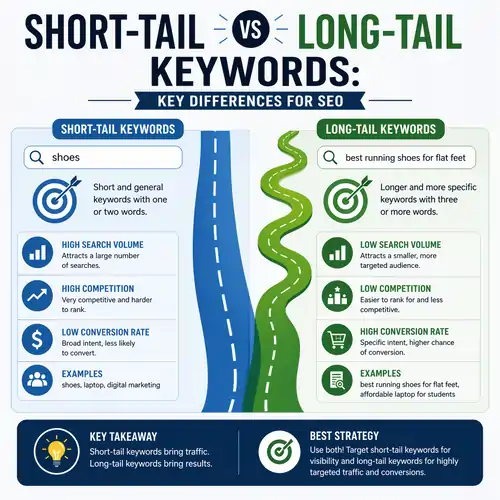
Short-tail vs long-tail keywords differ in length, competition, search intent, and conversion potential. In modern SEO (Search Engine Optimization), short-tail keywords bring high search volume but strong competition, while long-tail keywords offer lower competition, clearer search intent, and higher conversion rates. A balanced keyword strategy that combines both is essential for improving rankings, driving targeted traffic, and succeeding in semantic SEO, AEO, and GEO optimization.
Introduction
Understanding the difference between short-tail keywords and long-tail keywords is one of the most important steps in building a successful SEO strategy. Many beginners focus only on high-volume keywords, assuming that more searches automatically mean better results.
However, this approach often leads to frustration, slow rankings, and low conversions.
The truth is simple: not all keywords perform the same way. Choosing the right type of keyword can determine whether your content ranks, attracts traffic, or converts users.
In modern SEO keyword research, the goal is not just to find popular keywords but to understand search intent, competition, and user behavior. This is where the difference between short-tail vs long-tail keywords becomes critical.
What Are Short-Tail Keywords
Short-tail keywords are broad search terms typically made up of one to three words.
Examples include:
- SEO
- keyword research
- digital marketing
These keywords are highly popular and generate large amounts of traffic.
Characteristics of Short-Tail Keywords
- High search volume
- High keyword difficulty
- Broad search intent
- Competitive rankings
Because of their broad nature, short-tail keywords often attract a wide audience but lack specificity.
Advantages of Short-Tail Keywords
- Massive Traffic Potential
Short-tail keywords can bring large volumes of visitors due to their popularity. - Brand Visibility
Ranking for a broad keyword increases brand awareness. - Top-of-Funnel Reach
These keywords are effective for attracting users at the awareness stage.
Disadvantages of Short-Tail Keywords
- High Competition
Ranking for short-tail keywords is extremely difficult. - Low Conversion Rates
Broad intent often leads to lower engagement and conversions. - Unclear User Intent
It’s harder to determine what users actually want.
What Are Long-Tail Keywords
Long-tail keywords are more specific search phrases typically made up of three or more words.
Examples include:
- how to do keyword research for SEO
- best SEO tools for beginners 2026
- short-tail vs long-tail keywords explained
Characteristics of Long-Tail Keywords
- Lower search volume
- Lower keyword difficulty
- Clear search intent
- Higher conversion potential
Advantages of Long-Tail Keywords
- Higher Conversion Rates
Users searching long-tail keywords usually know what they want. - Lower Competition
Easier to rank compared to short-tail keywords. - Better Targeting
These keywords attract more qualified traffic.
Disadvantages of Long-Tail Keywords
- Lower Search Volume
Less traffic per keyword. - Requires More Content
You need multiple pages to scale traffic.
Short-Tail vs Long-Tail Keywords: Key Differences
| Factor | Short-Tail Keywords | Long-Tail Keywords |
|---|---|---|
| Length | 1–3 words | 3+ words |
| Search Volume | High | Low to medium |
| Competition | High | Low |
| Search Intent | Broad | Specific |
| Conversion Rate | Low | High |
| SEO Difficulty | Hard | Easier |
Why Both Keyword Types Matter in SEO
A successful SEO keyword strategy uses both types.
Short-Tail Keywords for Awareness
Use short-tail keywords to:
- Build brand visibility
- Target broad audiences
- Create pillar content
Long-Tail Keywords for Conversions
Use long-tail keywords to:
- Target specific queries
- Improve rankings faster
- Increase conversions
Understanding Search Intent in Keyword Strategy
Search intent is the foundation of modern SEO.
There are four main types:
- Informational intent
- Navigational intent
- Transactional intent
- Commercial intent
How Short-Tail Keywords Align With Intent
Short-tail keywords often match informational intent, but lack clarity.
How Long-Tail Keywords Align With Intent
Long-tail keywords match specific intent, making them ideal for:
- AEO
- Voice search
- Featured snippets
Semantic SEO and Keyword Context
Modern SEO relies heavily on semantic SEO.
Instead of repeating one keyword, search engines analyze:
- Context
- Meaning
- Related terms
Role of LSI Keywords
LSI keywords support your main keyword.
Examples:
- SEO content strategy
- search engine ranking factors
- keyword optimization techniques
NLP Optimization and Keyword Usage
Google uses Natural Language Processing (NLP) to understand content.
This means:
- Write naturally
- Use related phrases
- Focus on clarity
How to Use Short-Tail and Long-Tail Keywords Together
1. Start With a Short-Tail Keyword
Example:
- SEO strategy
2. Expand With Long-Tail Keywords
Examples:
- SEO strategy for beginners
- best SEO strategy 2026
3. Build Topic Clusters
Create:
- Pillar content (short-tail keyword)
- Supporting articles (long-tail keywords)
Keyword Research Process for Both Types
Step 1: Identify Seed Keywords
Start with broad topics.
Step 2: Use Keyword Tools
Analyze:
- Search volume
- Keyword difficulty
Step 3: Analyze SERP Results
Understand:
- Content format
- User expectations
Step 4: Find Long-Tail Variations
Use:
- Google suggestions
- People Also Ask
Step 5: Group Keywords
Organize into clusters.
GEO and AEO Optimization With Keywords
GEO (Generative Engine Optimization)
Focus on:
- Structured content
- Clear answers
- Context
AEO (Answer Engine Optimization)
Optimize for:
- Question-based keywords
- Featured snippets
- Voice search
Common Mistakes in Keyword Strategy
- Ignoring search intent
- Focusing only on volume
- Overusing keywords
- Not using semantic keywords
Real Example of Keyword Strategy
Short-Tail Keyword:
- SEO tools
Long-Tail Keywords:
- best SEO tools for beginners
- affordable SEO tools 2026
Future of Short-Tail and Long-Tail Keywords
SEO is evolving toward:
- AI-driven search
- Voice search
- Entity-based SEO
But both keyword types remain essential.
Conclusion
Understanding short-tail vs long-tail keywords is critical for building a strong SEO strategy.
Short-tail keywords bring visibility, while long-tail keywords bring conversions.
By combining both, you can:
- Rank faster
- Drive targeted traffic
- Improve SEO performance
Frequently Asked Questions (FAQ)
1. What are short-tail keywords?
Short-tail keywords are broad search terms with high search volume. They usually contain one to three words. They are highly competitive and harder to rank for.
2. What are long-tail keywords?
Long-tail keywords are specific phrases with lower competition. They usually have three or more words. They often result in higher conversion rates.
3. Which is better for SEO?
Both short-tail and long-tail keywords are important. Short-tail keywords build visibility. Long-tail keywords drive targeted traffic and conversions.
4. Why are long-tail keywords easier to rank?
They have lower competition compared to short-tail keywords. Fewer websites target them. This increases ranking chances.
5. Do long-tail keywords bring less traffic?
Yes, individually they have lower search volume. However, combined they can drive significant traffic. They also bring higher quality visitors.
6. What is search intent?
Search intent is the reason behind a search query. It determines what users expect. Matching intent improves rankings.
7. Can beginners rank for short-tail keywords?
It is very difficult due to high competition. Beginners should focus on long-tail keywords first. This improves early success.
8. What is keyword difficulty?
Keyword difficulty measures competition level. Higher difficulty means harder ranking. Lower difficulty is better for beginners.
9. What are LSI keywords?
LSI keywords are related terms that support your main keyword. They improve content relevance. This helps SEO performance.
10. How many keywords should I target?
Focus on one primary keyword and related keywords. Avoid overloading content. Keep it natural and relevant.
11. What is semantic SEO?
Semantic SEO focuses on meaning and context. It uses related terms instead of repetition. This aligns with modern algorithms.
12. What is keyword clustering?
Keyword clustering groups related keywords. It helps organize content. This improves topical authority.
13. What is AEO in SEO?
AEO focuses on answering questions directly. It helps appear in featured snippets. This improves visibility.
14. What is GEO in SEO?
GEO focuses on AI-driven search engines. It optimizes content for AI results. This is important in modern SEO.
15. Should I avoid short-tail keywords?
No, they are still important. They help build visibility. Use them alongside long-tail keywords.
16. How do I find long-tail keywords?
Use keyword tools and Google suggestions. Analyze search results. Focus on user intent.
17. Can long-tail keywords rank faster?
Yes, they usually rank faster due to lower competition. They are ideal for new websites. They help build authority.
18. Do keywords still matter in SEO?
Yes, keywords are still essential. They help search engines understand content. Proper use improves rankings.
19. What is keyword stuffing?
Keyword stuffing is overusing keywords unnaturally. It harms readability and SEO. Avoid this practice.
20. How does AI impact keyword strategy?
AI improves understanding of context and intent. It shifts focus from exact keywords to meaning. This makes SEO more strategic.
Disclaimer
This content is for educational and informational purposes only. SEO results may vary depending on competition, industry, and implementation strategies. Always conduct your own research and testing before applying SEO techniques.

