
Metadata and CTR optimization using AI helps Isulan businesses get more clicks from their existing Google rankings by crafting title tags and meta descriptions that are precisely aligned with what local searchers want to see — driving higher click-through rates without needing to improve ranking positions first. AI tools analyze top-performing search listing patterns, local buyer language, and competitor metadata to generate title and description formulas that consistently outperform generic alternatives. This guide explains how metadata works, why CTR matters for SEO, and how Isulan businesses can use AI to turn every search ranking into maximum traffic.
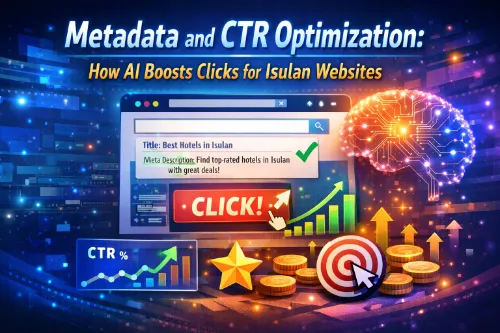
The Hidden Traffic Problem Most Isulan Businesses Never Notice
There is a metric that determines how much traffic your Isulan business website actually receives from search — and it is not your ranking position. It is your click-through rate.
Click-through rate (CTR) is the percentage of people who see your website in Google search results and actually click on it. A business ranking in position three with a 12% CTR gets more traffic than a business ranking in position two with a 5% CTR. And yet the overwhelming majority of Isulan businesses that invest in SEO focus exclusively on ranking position and ignore CTR almost entirely.
This is a significant and costly oversight. Google serves your search listing — your title tag, your meta description, and your URL — to thousands of potential customers in Isulan and Sultan Kudarat every month. Whether those people click on your listing or scroll past it to a competitor is determined almost entirely by the quality of your metadata. A compelling, locally relevant, intent-matched title and description earns the click. A generic, poorly written, or keyword-stuffed listing earns nothing — regardless of how strong your ranking is.
The relationship between CTR and ranking is also bidirectional. Google uses click-through rate as a ranking signal — pages that consistently earn more clicks than expected for their ranking position receive a ranking boost over time, while pages that consistently underperform on CTR face ranking suppression. This means that optimizing your metadata is not just a traffic strategy — it is a ranking strategy.
AI has transformed what is possible in metadata and CTR optimization. Where manual metadata writing depended on individual copywriting skill and intuition, AI tools now analyze thousands of high-performing search listings to identify the specific patterns, formulas, and language choices that earn clicks for local searches in markets like Isulan. The result is metadata that is both data-driven and locally specific — the combination that consistently outperforms generic alternatives in local search results.
Our dedicated resource on metadata and CTR optimization covers the foundational principles, while this guide provides the complete AI-powered implementation strategy for Isulan businesses. For the broader local SEO context, our overview of AI SEO services in Isulan explains how metadata optimization fits within a complete search visibility strategy.
Understanding the Metadata Elements That Drive CTR
Before examining how AI optimizes metadata, it helps to understand precisely which elements comprise your search listing and what role each plays in earning clicks from local Isulan searchers.
The Title Tag: Your Most Powerful CTR Asset
The title tag is the blue clickable headline that appears at the top of every search listing. It is the first thing a potential customer reads when they see your website in search results — and it is the primary determinant of whether they click or scroll past.
An effective title tag for an Isulan business achieves four things simultaneously: it signals topical relevance to Google’s ranking algorithm, it matches the specific intent of the searcher’s query, it communicates a local connection to Isulan or Sultan Kudarat customers, and it creates enough interest or urgency to earn the click over competing listings.
Title tags have a character limit — approximately 60 characters before Google truncates them with ellipsis in desktop search results. Mobile search results allow slightly fewer characters before truncation. Every character counts, which means the ordering and selection of words within a title tag requires precision that AI analysis supports far better than intuition alone.
The most effective title tag formula for Isulan local business pages follows this structure: Primary Keyword + Local Qualifier + Differentiating Value Proposition + Brand Name. For example: “Affordable Dental Clinic in Isulan — Same-Day Appointments | [Brand]” communicates the service (dental clinic), the location (Isulan), the key differentiator (affordable, same-day), and the brand — all within the character limit, all in priority order.
The Meta Description: Converting Impressions Into Clicks
The meta description is the paragraph of text that appears below the title tag in search results. At approximately 155 to 160 characters for desktop (slightly fewer for mobile), it provides enough space to communicate a specific value proposition, address a key buyer concern, and include a clear call to action.
Unlike the title tag, the meta description does not directly influence ranking — Google has confirmed it is not a direct ranking factor. But it profoundly influences CTR, which indirectly influences ranking through engagement signals. A meta description that directly addresses what the searcher is looking for, communicates a local value proposition, and ends with an action prompt consistently earns more clicks than a description that merely restates the page’s topic.
For local Isulan businesses, meta descriptions should always include at least one geographic reference, at least one specific value proposition relevant to local buyers (pricing context, availability, service area, delivery options), and a clear call to action that aligns with the intent of the target keyword.
The URL Structure: The Third Metadata Element
The URL that appears in search results — the green or gray text below the title — is the third metadata element that influences CTR. Clean, readable URLs that include the primary keyword perform better than parameter-heavy or randomly structured URLs because they signal relevance and professionalism to searchers evaluating which result to trust.
For Isulan businesses, URL structure should follow a logical hierarchy: domain.com/category/service-isulan or domain.com/location/isulan-service-name. These structures are both search-engine friendly and reader-friendly — a searcher can look at the URL and immediately understand what page they will land on.
How AI Transforms Metadata and CTR Optimization
Manual metadata writing produces metadata that is generally competent but rarely exceptional. It reflects the copywriter’s intuition about what local Isulan searchers respond to — intuition that may be accurate or may miss the mark entirely without data to validate it. AI metadata optimization replaces intuition with evidence, applying pattern analysis across thousands of high-performing search listings to identify what actually works.
AI Analysis of Top-Performing SERP Listings
AI SEO optimization tools analyze the title tags and meta descriptions of pages currently ranking in positions one through five for any target keyword. This analysis reveals the specific language patterns, structural formulas, and value proposition approaches that are earning high CTRs for that particular search query — in that particular competitive environment.
For an Isulan business targeting “construction materials delivery Sultan Kudarat,” AI analysis of the current top-ranking listings reveals which title formulas are performing best: whether listings with price signals (“affordable,” “best price”) outperform those with availability signals (“same-day delivery,” “in stock”), whether geographic specificity in the title increases CTR for this query type, and whether benefit-led or feature-led descriptions earn more clicks from Sultan Kudarat construction buyers.
This data-driven approach to metadata creation means that every title tag and meta description produced for an Isulan business is informed by real performance evidence rather than copywriting assumptions. CTR optimization strategies built on this AI analysis consistently outperform manually written metadata across every page type and keyword category.
Search Intent Alignment in Metadata
One of the most common CTR killers for Isulan business websites is metadata that does not match the intent of the searcher’s query. A transactional searcher looking for a plumber they can call today will scroll past a listing whose meta description leads with company history. An informational searcher looking to understand dental treatment options will ignore a listing whose title leads with “Book Now — Immediate Appointments Available.”
Search intent mapping applied to metadata ensures that the language, tone, and focus of every title tag and meta description mirrors the specific intent of the searcher — making the listing feel immediately relevant rather than generically promotional.
AI intent classification enables this at scale: for an Isulan business with fifty pages, each targeting different keyword intents, AI can generate intent-matched metadata for every page simultaneously rather than requiring manual intent assessment and copywriting for each individual listing.
Local Language and Buyer Psychology Integration
AI-powered keyword research reveals not just what Isulan and Sultan Kudarat residents search for, but the specific language they use — the colloquial terms, the locally relevant value signals, the trust indicators that matter specifically to buyers in this market. This language intelligence feeds directly into metadata creation, ensuring that title tags and meta descriptions use the words and phrases that resonate with local buyers rather than generic marketing language.
For Isulan business metadata, this means incorporating locally relevant trust signals: references to years of service in Sultan Kudarat, mentions of PhilHealth acceptance for healthcare businesses, references to local delivery coverage areas, or acknowledgment of the specific barangays or municipalities served. These local specifics signal to Isulan searchers that your business understands and serves their community — increasing both click-through rates and the quality of traffic that arrives on your page.
Local SEO in Isulan using AI integrates this local language intelligence across all metadata elements, ensuring that your search listings feel authentically local rather than generically applicable to any market.
Metadata Optimization by Page Type for Isulan Businesses
Different page types require different metadata approaches, each calibrated to the specific intent and decision stage of the searcher who is most likely to encounter that listing.
Service Page Metadata
Service pages target commercial investigation and transactional intent — searchers who are evaluating or ready to choose a local service provider. Metadata for service pages should lead with the specific service, include the geographic qualifier, and communicate the key decision-making information that comparison-stage buyers prioritize.
For a legal services firm in Isulan, service page metadata might read: Title — “Property Dispute Lawyer Isulan | Sultan Kudarat Legal Services”; Meta — “Experienced property lawyers serving Isulan and Sultan Kudarat. Free initial consultation. Call today for expert legal advice you can trust.” This combination signals topical relevance, geographic specificity, a clear value proposition (free consultation), and an action prompt — all within the character constraints.
Optimize service pages through metadata that earns clicks from local buyers who are genuinely ready to engage, not just browse. SEO content that converts ensures that the page visitors land on after clicking delivers on the promise made in the metadata.
Product Page Metadata for E-Commerce
For Isulan e-commerce businesses, product page SEO optimization metadata must include the product name and key specification in the title, with pricing context, availability, and delivery information in the meta description. Transactional product searches respond strongly to metadata that answers the buyer’s primary decision questions before they even click: “Is this the right product? Is it available? Can I afford it? Will it arrive quickly?”
AI product descriptions inform metadata creation by identifying the specific product attributes that local Isulan buyers prioritize — the selling points that earn clicks for product listings in the Sultan Kudarat market specifically. E-commerce SEO content and category page SEO optimization extend metadata optimization across the full e-commerce content architecture. AI SEO for local e-commerce integrates local buyer intent throughout product and category metadata.
Blog and Informational Page Metadata
Informational pages targeting research-stage queries require metadata that positions the page as the most complete, most trustworthy answer to the searcher’s question. Title tags for informational content should lead with the question or topic the page addresses, communicating immediately that this page will answer what the searcher is looking for. Meta descriptions should preview the specific value the page delivers — the key insight, the practical guidance, or the comprehensive overview that distinguishes this page from generic alternatives.
AI-assisted SEO article creation and AI SEO content writing produce content that matches the depth and comprehensiveness promised by well-optimized informational metadata — ensuring that the high CTR earned by compelling metadata is supported by content quality that keeps visitors engaged and signals positive user experience signals back to Google.
Landing Page Metadata for Campaigns
Campaign-specific landing page creation requires metadata tightly focused on the campaign’s primary keyword and offer. Landing page metadata should be the most directly transactional of any page type — every word in the title and description exists to earn the click from a searcher who is ready to act. No brand storytelling, no educational framing, no peripheral value propositions. Just the specific offer, the specific location, and the specific action prompt that aligns with a high-intent local search.
Advanced CTR Optimization Techniques Using AI
Beyond basic metadata quality, several advanced AI-powered techniques can further improve click-through rates for Isulan business search listings.
Rich Results and Enhanced Listings
Structured data SEO and AI schema markup enable enhanced search listings that go beyond the standard title-description-URL format. Star ratings, pricing information, event details, FAQ dropdowns, and availability indicators all appear as rich results when the correct schema markup is implemented — making your listing visually larger and more informative than unstructured competitor listings at the same ranking position.
Featured snippets in Google represent the ultimate CTR advantage — appearing above all standard organic results in a dedicated answer box that captures a disproportionate share of clicks for informational queries. AI analysis of featured snippet patterns for Isulan-relevant queries identifies the specific content formats — definitions, numbered steps, comparison tables, direct question answers — that earn featured snippet selection most reliably.
A comprehensive rich results SEO strategy for Isulan businesses combines schema markup implementation, featured snippet targeting, and FAQ and schema content generation into an integrated enhanced listing strategy that maximizes the visual prominence and information density of every search listing your business earns.
A/B Testing Metadata With AI
AI SEO audits and performance monitoring enable data-driven metadata testing for Isulan businesses with sufficient search impression volume. By tracking CTR performance for specific pages over time through Google Search Console, businesses can identify which metadata variations earn higher CTRs and systematically improve underperforming listings.
AI accelerates this testing cycle by generating multiple metadata variants for each page simultaneously — different title formulations, different meta description approaches, different value proposition emphases — and predicting which variants are most likely to outperform based on pattern analysis of high-CTR listings in comparable categories.
Competitive Metadata Intelligence
Competitor content gap analysis applied to metadata reveals what your competitors are communicating in their search listings — and more importantly, what they are not communicating that your business could use as a differentiation opportunity. If every competitor’s listing for “accounting services Isulan” focuses on price, a listing that emphasizes speed, digital delivery, or specialized industry expertise stands out through differentiation rather than competing on the same value proposition as every other listing on the page.
AI for local SEO competitive metadata analysis identifies these differentiation opportunities systematically across your entire keyword portfolio — giving Isulan businesses a metadata strategy that is both locally calibrated and competitively differentiated.
Measuring and Improving CTR Performance Over Time
The effectiveness of metadata optimization is directly measurable through Google Search Console’s Performance report, which shows impressions, clicks, CTR, and average position for every keyword and page combination. Tracking these metrics over time reveals whether metadata improvements are translating into higher click-through rates and whether those higher CTRs are producing the ranking improvements that follow sustained CTR outperformance.
SEO performance tracking for metadata optimization should establish baseline CTR benchmarks for each page before any changes are made, then monitor CTR trends over 30, 60, and 90-day windows following metadata updates. Pages that show CTR improvement validate the metadata approach. Pages that show no improvement or CTR decline need further analysis and revision.
SEO reporting translates CTR improvement data into business outcomes — connecting higher click-through rates to increased traffic volumes, and increased traffic volumes to lead generation and revenue impact. This business-outcome framing makes the value of metadata optimization visible and measurable to Isulan business owners who need to evaluate their SEO investment in concrete terms.
AI SEO audits and reporting automate the ongoing monitoring of CTR performance across your entire page inventory — flagging pages where CTR has declined below expected benchmarks and generating specific metadata revision recommendations before ranking damage accumulates. AI content refresh and updating applies the same continuous improvement logic to content quality, ensuring that the pages visitors land on after clicking continue to deliver the engagement signals that support sustained ranking and CTR performance.
Technical SEO improvements address the page speed and mobile experience factors that influence whether a high-CTR listing translates into a positive user experience — because a compelling metadata click that leads to a slow-loading or poorly mobile-optimized page produces a bounce that undermines the CTR gains achieved.
Local search visibility monitoring tracks CTR performance specifically for Isulan and Sultan Kudarat local searches — the geographic segment where your metadata optimization investments have the most direct business impact. AI SEO strategies evolve metadata approaches based on this local performance data, continuously refining title and description formulas as competitive landscapes shift and as new CTR performance patterns emerge.
Content strategy and topical authority built on well-performing metadata creates a compounding advantage: strong CTR improves rankings, improved rankings increase impressions, increased impressions provide more CTR data, and more CTR data enables further metadata refinement. Topical authority built through consistent content depth and quality reinforces the trustworthiness signals that make searchers more likely to click your listing when they recognize your brand across multiple relevant queries. Topical map and topic cluster planning ensure that this authority accumulates systematically across your entire topic territory.
AI SEO for conversion rate optimization closes the loop between CTR and business outcomes — ensuring that the increased traffic generated by metadata improvements converts into leads and sales at rates that make the full optimization chain — from search impression through click through conversion — produce measurable ROI for Isulan businesses.
Whether you are implementing metadata optimization independently or working with an AI SEO agency in Isulan that combines AI analytical power with local market expertise, the principle is the same: every search impression your Isulan business earns is an opportunity that your metadata either captures or wastes. AI SEO services and AI SEO applied to metadata and CTR optimization ensure that every opportunity is captured — consistently, at scale, and with the local precision that turns search visibility into real business growth for Isulan and Sultan Kudarat businesses.
Understanding AI SEO services cost in Isulan in the context of CTR improvement makes the investment case clear: even a modest improvement in click-through rate across your top-ranking pages produces a significant and compounding increase in monthly traffic without requiring any additional ranking improvements. AI SEO for small business in Isulan makes this optimization accessible at price points appropriate for local businesses at every stage.
Your rankings are already earning impressions. Make sure your metadata is earning the clicks.
FAQs
1. What is CTR in SEO?
CTR (click-through rate) is the percentage of users who click your website after seeing it in search results.
2. Why is CTR important for SEO?
It determines how much traffic you get from your rankings and can influence ranking performance.
3. Can CTR affect rankings?
Yes. Higher CTR signals to Google that your content is relevant, which can improve rankings.
4. What is metadata in SEO?
Metadata includes the title tag, meta description, and URL shown in search results.
5. Which metadata element is most important?
The title tag, because it directly impacts both rankings and clicks.
6. What is the ideal length of a title tag?
Around 50–60 characters to avoid truncation.
7. What is the ideal length of a meta description?
Around 150–160 characters for optimal display.
8. Do meta descriptions affect rankings directly?
No, but they strongly influence click-through rates.
9. How does AI improve metadata optimization?
By analyzing high-performing search listings and generating data-driven titles and descriptions.
10. What is intent-based metadata?
Metadata that matches the purpose of the user’s search query.
11. Why is search intent important in CTR?
Because users click listings that clearly match what they are looking for.
12. How can local businesses improve CTR?
By including location, value propositions, and clear calls to action in metadata.
13. What makes a title tag compelling?
Relevance, clarity, local context, and a strong value proposition.
14. What should a good meta description include?
Keywords, benefits, location signals, and a call to action.
15. What is CTR optimization?
Improving titles and descriptions to increase clicks without changing rankings.
16. How does structured data affect CTR?
It enhances listings with rich results like ratings and FAQs, making them more clickable.
17. What are rich results?
Enhanced search listings with additional visual or informational elements.
18. How can AI help test metadata performance?
By generating variations and analyzing which ones perform better.
19. How do you measure CTR success?
Using tools like Google Search Console to track impressions and clicks.
20. What is the fastest way to increase traffic without improving rankings?
Optimizing metadata to increase click-through rate.

