
AI SEO optimization of title tags, meta descriptions, and click-through rates helps local businesses rank higher on Google and attract more qualified visitors by using artificial intelligence to craft search listings that are precisely aligned with local buyer intent, competitive search landscapes, and the specific language patterns that drive clicks in local markets. This guide explains how AI analyzes and improves every element of a local search listing — from title tag formulas and meta description structures to CTR improvement strategies and rich result enhancements — giving local businesses a systematic framework for turning search impressions into traffic and traffic into revenue.
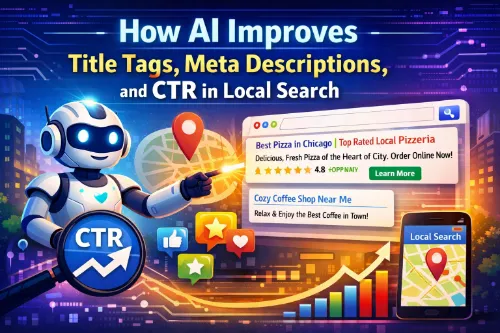
The Gap Between Ranking and Traffic That AI Closes
Every local business owner who has invested in SEO understands one metric intuitively: ranking position. Page one means visibility. Page two means obscurity. Page one, position one means the most traffic. These intuitions are directionally correct but dangerously incomplete — because ranking position and traffic volume are not the same thing, and the gap between them is determined almost entirely by the quality of your search listing.
Consider two local businesses competing in the same market. Business A ranks in position three with a title tag that reads “Business A — Services.” Business B ranks in position four with a title tag that reads “Affordable Dental Care in Isulan — Same-Day Appointments Available.” Despite ranking one position lower, Business B earns significantly more clicks — because its listing communicates immediate, specific, locally relevant value to every searcher who sees it, while Business A’s listing communicates almost nothing.
This is the gap that AI SEO optimization of title tags, meta descriptions, and CTR closes: the space between the ranking you have earned and the traffic that ranking should be generating. For local businesses across the Philippines — in Isulan, Sultan Kudarat, and every market where local search is the primary customer acquisition channel — closing this gap is often the fastest path to meaningful traffic growth without requiring any additional ranking improvements.
AI SEO optimization applies machine learning analysis to thousands of local search listings to identify the specific patterns, formulas, and language choices that earn high click-through rates for local searches — and applies those patterns systematically to every page on your website. The result is a search presence that not only ranks but converts impressions into clicks at rates that compound ranking improvements over time through positive engagement signals.
This guide covers the complete AI-powered approach to title tag optimization, meta description creation, and CTR improvement for local businesses — with specific application to the local search environment where intent specificity and geographic relevance determine who gets clicked and who gets ignored. For the broader context of how these optimizations fit within complete local SEO strategies, our resource on metadata and CTR optimization and the overview of AI SEO services in Isulan provide the full strategic framework.
Understanding How Google Uses Title Tags and Meta Descriptions
Before examining how AI optimizes these elements, it is important to understand precisely what role each plays in the search ranking and traffic system — because the mechanics determine the optimization strategy.
Title Tags: Ranking Signal and Click Driver Simultaneously
The title tag is the only metadata element that functions as both a direct ranking signal and a primary CTR driver. Google uses the title tag to understand the topical focus of a page and to assess its relevance to a specific search query. It also displays the title tag as the clickable blue headline in search results — the first text a searcher reads when evaluating whether to click your listing.
This dual function means that title tag optimization must achieve two goals simultaneously: it must signal keyword relevance to Google’s algorithm with sufficient clarity to earn a strong relevance score for the target query, and it must communicate a compelling value proposition to human searchers with sufficient clarity to earn a click over competing listings.
The tension between these goals is real. Pure keyword optimization produces title tags like “Dentist Isulan Dental Services Sultan Kudarat” — highly keyword-dense but uncompelling to human readers. Pure copywriting produces title tags like “The Smile You’ve Always Wanted Starts Here” — compelling in isolation but missing the keyword specificity that Google needs to rank the page correctly. AI resolves this tension by identifying the title tag formulas that achieve both goals simultaneously — the specific patterns where keyword precision and human persuasion reinforce rather than compete with each other.
On-page SEO optimization principles establish the technical requirements: title tags should be 50 to 60 characters to avoid truncation in desktop search results, slightly shorter for mobile, with the primary keyword positioned as early as possible within that character limit. AI-powered keyword research identifies the specific primary keyword that belongs in each page’s title tag — the term with the optimal combination of local search volume, commercial intent, and achievable competition difficulty for each specific page.
Meta Descriptions: Pure CTR Driver With Indirect Ranking Impact
Unlike title tags, meta descriptions are not a direct ranking factor — Google has confirmed they do not influence ranking position directly. But they are a significant indirect ranking factor through their influence on click-through rate. Pages that consistently earn higher CTRs than expected for their ranking position receive positive engagement signals that contribute to ranking improvements over time, while pages that consistently underperform on CTR face the inverse effect.
The meta description is displayed as the paragraph of text below the title tag in search results — typically 150 to 160 characters for desktop, slightly fewer for mobile — and it serves as the extended pitch that converts a searcher who was attracted by the title tag into an actual click. An effective meta description for a local business page answers the searcher’s next three questions after reading the title: “Is this the right type of business? Do they serve my area? What should I do next?”
Search intent mapping is foundational to effective meta description writing because different intent types require completely different description approaches. Transactional intent searches respond to meta descriptions that lead with availability, pricing context, and action prompts. Commercial investigation intent searches respond to descriptions that lead with differentiators, trust signals, and comparison-ready information. Informational intent searches respond to descriptions that preview the specific answer or guidance the page provides.
The URL: The Third Listing Element That Influences CTR
The URL structure displayed in search results — the breadcrumb or path visible below the title in Google listings — is the third element that influences whether a searcher clicks your listing. Clean, readable, keyword-containing URLs signal professionalism and page relevance before the searcher even reads the title. Complex, parameter-heavy, or meaningless URL strings signal the opposite.
For local businesses, URL structure should reflect a logical geographic and topical hierarchy: domain.com/services/dental-isulan or domain.com/products/construction-materials-sultan-kudarat. These URLs communicate both the service/product and the location in a format that human searchers can evaluate at a glance and that Google’s systems read as reinforcing geographic and topical relevance signals.
How AI Analyzes and Improves Title Tags for Local Search
The AI approach to title tag optimization begins with data rather than assumptions — analyzing what is actually working in local search results for your specific keyword targets before writing a single word of title tag copy.
SERP Pattern Analysis for Local Query Types
AI tools crawl the current top-ranking pages for every keyword your local business targets and extract the title tag patterns of pages ranking in positions one through five. This analysis reveals the structural patterns — keyword position, geographic qualifier placement, value proposition framing, character length — that are associated with high-ranking, high-CTR listings for each specific query type in your local market.
For a local plumbing service targeting “plumber Isulan,” AI SERP analysis might reveal that title tags leading with the service type (“Plumber in Isulan”) consistently outperform those leading with the brand name, that geographic qualifiers placed after the service term perform better than those placed before it, and that titles including an urgency or availability signal (“24/7 Plumber Isulan”) earn higher CTRs than those without. This data-driven insight replaces guesswork with evidence in every title tag decision.
CTR optimization strategies built on this SERP pattern analysis produce title tags that are calibrated to the specific competitive environment of each local keyword — not generic best practices that may or may not apply to the Sultan Kudarat local search market.
Intent-Matched Title Tag Formulas by Page Type
Different page types require different title tag formulas, each matched to the specific intent of the searcher most likely to encounter that listing. Search intent mapping applied to title tag optimization produces distinct formulas for each intent category:
Transactional intent pages — service pages, product pages, booking pages — use action-oriented title tags that confirm the searcher has found what they are looking for and that make taking action feel immediately accessible. Formula: [Service/Product] in [Location] | [Key Differentiator] — [Brand]. Example: “AC Repair in Isulan | Same-Day Service — CoolTech HVAC”
Commercial investigation intent pages — comparison pages, category pages, service overview pages — use evaluation-supporting title tags that position the page as a trustworthy source for decision-making. Formula: Best [Category] in [Location] | [Social Proof Signal] — [Brand]. Example: “Best Accounting Firms in Isulan | 10+ Years Serving Sultan Kudarat”
Informational intent pages — blog posts, guides, FAQ pages — use question-answering or knowledge-signaling title tags that promise specific, useful information. Formula: How to [Action] in [Location]: [Specific Outcome Promise]. Example: “How to Register a Business in Isulan: Complete 2026 Guide”
AI SEO optimization applies these intent-matched formulas across your entire page inventory simultaneously, ensuring consistent title tag quality across every page type rather than the inconsistent quality that results from manual, page-by-page title tag writing.
Geographic Qualifier Optimization for Local Search
For local businesses, the geographic qualifier — the location reference within the title tag — is one of the most important CTR elements because it signals immediate local relevance to searchers who have a specific geographic need. But geographic qualifier optimization is more nuanced than simply adding “Isulan” or “Sultan Kudarat” to every title tag.
AI analysis of local search CTR data reveals which geographic qualifier placements and formulations earn the highest CTRs for different query types: whether “in Isulan” outperforms “Isulan” alone, whether “Sultan Kudarat” additions to Isulan-targeted titles increase or decrease CTR for searches originating from the Isulan area, and whether neighborhood-level geographic qualifiers outperform city-level ones for certain service types.
Local SEO in Isulan using AI applies this geographic intelligence to title tag optimization specifically — ensuring that every local search listing communicates geographic relevance in the format that local buyers respond to most strongly. AI for local SEO extends this geographic precision across every metadata element for comprehensive local listing optimization.
AI-Powered Meta Description Optimization for Local Businesses
Meta description optimization with AI goes significantly beyond ensuring descriptions are within character limits and contain the target keyword. AI analysis of meta description performance across large datasets reveals the specific structural patterns, language choices, and value proposition approaches that earn consistently higher CTRs for local business listings.
The Local Meta Description Framework
Effective meta descriptions for local business pages follow a three-part framework that AI applies systematically:
Part 1 — Local Relevance Confirmation (first sentence). The first sentence of a local business meta description should immediately confirm geographic relevance and service scope: “Serving Isulan and Sultan Kudarat since 2010” or “Available throughout the SOCCSKSARGEN region.” This confirmation filters out non-local traffic and reassures local searchers that this result is specifically relevant to their location.
Part 2 — Primary Value Proposition (second sentence). The second sentence communicates the specific reason to choose this business over every other listing on the page — the differentiator that makes your listing the most compelling option in the search results. This might be a unique service feature, a pricing advantage, a convenience benefit, or a trust signal specific to the local market.
Part 3 — Action Prompt (final phrase). Every local business meta description should end with a clear, specific action prompt that tells the searcher exactly what to do next: “Call now for a free estimate,” “Book your appointment online today,” or “Get same-day delivery in Isulan.” This action prompt creates the micro-conversion of the click — turning passive search result browsing into active engagement with your listing.
Local SEO content generation applies this framework to meta description creation for every page type — service pages, product pages, blog posts, location pages — ensuring consistent quality and local relevance across the entire site. Scale content production using AI enables this quality at volume for businesses with large page inventories.
Competitor Meta Description Intelligence
Competitor content gap analysis applied to meta descriptions reveals what competing local businesses are communicating in their search listings — and identifies the specific value proposition gaps where your business can differentiate its listings through unique and more compelling messaging.
If every competitor’s meta description for “construction supply Isulan” focuses on product variety and low prices, a description that emphasizes same-day delivery, expert advice, and local knowledge stands out through differentiation rather than competing on the same proposition as every other listing. AI-powered keyword research identifies the specific language and value signals that local Isulan buyers respond to — grounding meta description differentiation in buyer psychology rather than generic marketing assumptions.
Advanced CTR Optimization: Beyond Title Tags and Meta Descriptions
Title tags and meta descriptions are the primary CTR levers, but advanced AI SEO optimization addresses additional listing elements that further improve click-through performance for local businesses.
Rich Results and Enhanced Listing Elements
Structured data SEO and AI schema markup enable enhanced search listings that appear visually larger and more informative than standard text listings — star ratings, pricing information, availability status, FAQ dropdowns, event dates, and business hours all appear as rich enhancements when the correct schema markup is implemented.
For local businesses, these rich result enhancements are significant CTR multipliers. A search listing with a 4.8-star rating and 127 reviews visible below the title earns dramatically more clicks than an identical listing without those trust signals — even at the same ranking position. A listing with FAQ dropdowns showing direct answers to the searcher’s questions occupies more visual space on the search results page and provides more information before the click than any standard listing can.
Featured snippets in Google represent the ultimate CTR advantage — appearing in the prominent answer box above all standard organic results with a significantly higher share of clicks than any other listing position. AI analysis of featured snippet patterns for local query types identifies the specific content formats and page structures that earn featured snippet selection for searches relevant to local businesses in Isulan and Sultan Kudarat.
A comprehensive rich results SEO strategy builds on FAQ and schema content generation to create the complete enhanced listing architecture that maximizes visual prominence and information density across every search listing your business earns.
Google Business Profile Optimization for Local Pack CTR
Local businesses appearing in Google’s Local Pack — the map-based local results that appear for geographically qualified searches — have a separate CTR optimization challenge from standard organic listings. Local Pack CTR is influenced by business name, review count and rating, category classification, proximity signal, and the primary photo displayed in the listing.
AI for local SEO optimization for Google Business Profile applies the same data-driven approach to Local Pack listing elements — analyzing which profile elements are associated with higher Local Pack CTRs for local businesses in Isulan and Sultan Kudarat and recommending specific profile improvements that increase the percentage of Local Pack viewers who click through to your website or call your business directly.
Hyperlocal SEO content strategies extend local search optimization to the neighborhood and barangay level — ensuring that local businesses appear in the most geographically specific searches with listings that communicate hyperlocal relevance to buyers searching from specific locations within the Isulan service area.
Measuring, Testing, and Continuously Improving CTR Performance
AI-powered title tag and meta description optimization is not a one-time implementation — it is a continuous improvement cycle driven by performance data.
SEO performance tracking through Google Search Console provides the impression, click, and CTR data for every keyword and page combination — the raw material for continuous CTR optimization. Pages with CTRs significantly below the average for their ranking position are immediate optimization targets: their title tags and meta descriptions are failing to earn their fair share of clicks from the rankings they have achieved.
SEO reporting translates CTR improvement data into business outcomes — connecting higher click-through rates to traffic volume increases and traffic volume increases to lead generation and revenue impact. AI SEO audits and reporting automate the ongoing monitoring of CTR performance across every page, flagging underperforming listings and generating specific metadata revision recommendations before traffic losses become significant.
AI content refresh and updating applies the same continuous improvement logic to listing elements — refreshing title tags and meta descriptions that have lost CTR performance as competitor listings improve or as search result landscapes evolve. Technical SEO improvements address the page speed and mobile experience factors that determine whether a high-CTR click delivers the positive user experience that sustains ranking improvements.
Content strategy and topical authority built on high-CTR listing strategies creates brand recognition that compounds CTR over time — searchers who see your business appearing consistently for multiple related local queries develop brand familiarity that makes them more likely to click your listing even when it is not in the top position. Topical authority and topic cluster planning support this brand recognition through consistent presence across an entire topic territory. Topical map and ai content planning guide the content architecture that makes this consistent presence achievable.
AI-assisted SEO article creation and AI SEO content writing ensure that the pages behind optimized listings deliver the content quality that sustains positive user engagement signals — because a compelling listing that delivers a poor page experience ultimately undermines the CTR gains achieved. SEO content that converts and AI SEO for conversion rate optimization close the full loop from search impression through click through conversion.
Local search visibility monitoring tracks CTR performance specifically for local searches — the geographic segment where title tag and meta description optimization have the most direct impact on business outcomes. AI SEO strategies evolve listing optimization approaches continuously based on this local performance data.
For businesses across local SEO strategies and international SEO and local SEO contexts, the relationship between title tag precision, meta description quality, and local CTR performance is the same: searchers click listings that communicate immediate, specific, locally relevant value — and AI makes it possible to deliver that communication consistently across every page, every keyword, and every local search opportunity your business creates.
Optimize service pages with AI-optimized listings, apply product page SEO optimization principles to e-commerce listings, build landing page creation strategies around high-CTR metadata, and extend e-commerce SEO content, AI product descriptions, category page SEO optimization, and AI SEO for local e-commerce across your complete digital presence.
Whether you implement these optimizations independently or with an AI SEO agency in Isulan that combines AI precision with local market knowledge, AI SEO services and AI SEO applied to title tags, meta descriptions, and CTR transform your search rankings from positions into traffic — and your traffic from visitors into customers. AI SEO for small business in Isulan and AI SEO services cost in Isulan make this precision accessible at every business scale.
FAQs
1. What is AI SEO optimization for metadata?
It is the use of AI to improve title tags, meta descriptions, and CTR for better search performance.
2. Why is CTR important in local SEO?
Because it determines how much traffic your rankings actually generate.
3. Can a lower-ranking page get more clicks?
Yes. A more compelling search listing can outperform higher-ranked competitors.
4. What is the role of title tags in SEO?
They act as both a ranking signal and the main clickable headline in search results.
5. How should a title tag be structured?
Include the keyword, location, value proposition, and brand.
6. Why is keyword placement important in titles?
Keywords placed early improve relevance and visibility.
7. What is the ideal title tag length?
Around 50–60 characters to avoid truncation.
8. What is the purpose of meta descriptions?
To persuade users to click on your listing.
9. Do meta descriptions directly affect rankings?
No, but they influence CTR, which impacts rankings indirectly.
10. What makes a high-performing meta description?
Clear value, local relevance, and a strong call to action.
11. What is search intent in metadata optimization?
Aligning titles and descriptions with what users want to achieve.
12. How does AI improve title tag creation?
By analyzing top-ranking listings and identifying winning patterns.
13. What is SERP pattern analysis?
Studying top search results to understand what works for rankings and clicks.
14. Why are geographic keywords important?
They signal local relevance and attract nearby customers.
15. How does AI improve local SEO listings?
By optimizing language, intent, and structure for local search behavior.
16. What is structured data in CTR optimization?
Code that enables enhanced search listings like ratings and FAQs.
17. How do rich results affect CTR?
They increase visibility and make listings more attractive.
18. What is Local Pack optimization?
Improving visibility and clicks in map-based local search results.
19. How can businesses test metadata performance?
By tracking CTR changes using Google Search Console.
20. What is the fastest way to increase SEO traffic?
Improve title tags and meta descriptions to boost CTR.

