
In 2026, higher bids alone do not guarantee that your ads will show or rank at the top of Google Ads results. Instead, Google uses a system called Ad Rank, which combines your bid with multiple quality and relevance signals, including expected click-through rate (CTR), ad relevance, landing page experience, and the expected impact of ad extensions.
Google’s own breakdown of how the Google Ads auction works explains that ad visibility depends on this blend of bid and quality—not just budget. This means advertisers who create more relevant ads and better user experiences can often outperform competitors who spend more but optimize less. To win in modern ad auctions, you need to focus on improving Quality Score, aligning your ads with user intent, and optimizing your landing pages—not just increasing your budget.
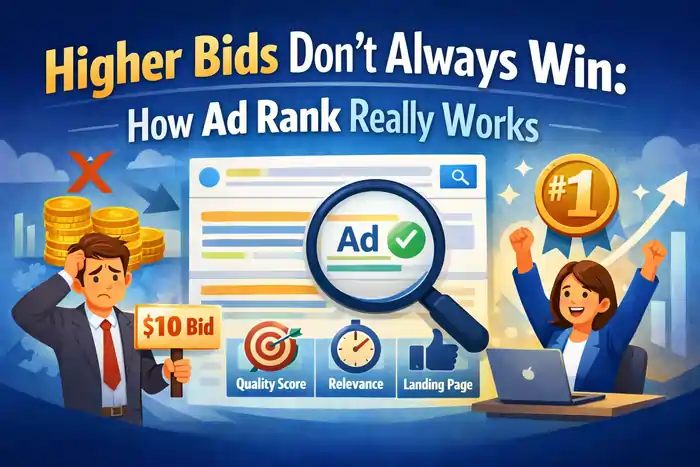
Introduction: The Most Expensive Misunderstanding in Paid Ads
If you’re new to paid advertising, you’ve probably believed this at some point: “If I bid higher, I’ll win.” It sounds logical. More money should lead to more visibility, more clicks, and better results.
But that assumption breaks quickly in real campaigns.
You increase your bids expecting better performance, yet your costs rise while your results stay flat—or even decline. You might see impressions, but they don’t convert. Or worse, your competitors with smaller budgets continue to outrank you.
This is where many advertisers get stuck. The issue isn’t budget—it’s misunderstanding how the system actually works.
Google Ads is not a highest-bid-wins platform. It is a relevance-driven auction system, and once you understand that, your entire strategy changes.
How Google Ads Actually Works
Most people imagine Google Ads as a simple auction where the highest bidder wins placement. In reality, Google evaluates much more than just how much you’re willing to pay.
Google itself explains, in its help article on how the Google Ads auction works, that ad visibility depends on a combination of bid, ad quality, and the expected impact of ad assets and formats—not just budget.
This means you are not simply competing on money. You are competing on value—how useful and relevant your ad is to the person searching.
That shift is what separates struggling advertisers from profitable ones.
The Core System: Understanding Ad Rank
At the center of everything is Ad Rank.
Ad Rank determines whether your ad appears, where it appears, and how often it enters auctions. It’s recalculated every time a search happens, which means performance is dynamic—not fixed.
Google’s explanation of Ad Rank highlights that it includes your bid, auction-time ad quality (including Quality Score components), thresholds, the context of the search, and the expected impact of extensions and other formats.
A simplified way to think about it is:
Ad Rank ≈ Bid × Quality Score (plus other signals)
But in practice, it’s more accurate to view it as a combination of:
- your willingness to pay
- your relevance to the user
- your expected performance
- your overall experience quality
This is why higher bids alone don’t guarantee success.
Why Higher Bids Don’t Always Win
Google’s goal is not to show the advertiser who pays the most. Its goal is to show the ad that best satisfies the user.
If users click on irrelevant or poor-quality ads, they lose trust in the platform, which directly impacts Google’s long-term revenue.
So instead, Google rewards advertisers who:
- match user intent accurately
- provide clear and useful messaging
- deliver strong landing page experiences
This is why a smaller advertiser with a well-optimized campaign can outperform a larger competitor with a bigger budget but weaker execution.
The Four Factors That Beat Higher Bids
1. Quality Score: Your Real Advantage
Quality Score is Google’s way of measuring how useful your ad is, based on expected CTR, ad relevance, and landing page experience.
Google’s official description of Quality Score for Search campaigns explains that this 1–10 score reflects how relevant and useful your ad and landing page are compared to other advertisers for the same keyword. A higher Quality Score often leads to better positions and lower costs for the same bids.
A high Quality Score acts like leverage. It allows you to compete more efficiently, often paying less for better positions. For example, an advertiser bidding lower but delivering a better experience can win auctions against someone spending more inefficiently.
2. Expected Click-Through Rate (CTR)
Expected CTR reflects how likely users are to click your ad. It’s one of the strongest signals Google uses to predict usefulness.
Google confirms in its guidance on expected CTR and Quality Score components that click behavior and historical performance play a key role in assessing ad quality.
Improving CTR isn’t about tricks—it’s about clarity and alignment. When your ad clearly solves a user’s problem, people click.
Strong headlines, clear value propositions, and relevant messaging all contribute to higher CTR.
3. Ad Relevance: Matching Intent
Ad relevance measures how closely your ad aligns with what the user is actually searching for.
Modern search systems are built on understanding intent—not just matching keywords. Google’s public explainer on how search works shows how it evaluates meaning, context, and intent to determine relevant results.
If your ad doesn’t match intent, it won’t perform—no matter how much you bid. This is why tightly structured campaigns and intent-based messaging outperform generic ads every time.
4. Landing Page Experience: Where Most Campaigns Fail
Even if your ad is strong, a weak landing page can ruin everything.
Google evaluates whether your page:
- delivers what the ad promises
- loads quickly
- works well on mobile
- provides clear, useful information
Their landing page experience guidelines emphasize relevance, transparency, and ease of navigation as key factors. And Google’s Core Web Vitals documentation highlights performance signals like loading speed, interactivity, and visual stability as part of page experience.
A mismatch between ad and landing page is one of the fastest ways to lose auctions and waste spend.
The AI Shift: Why Strategy Matters More Now
In 2026, advertising platforms rely heavily on machine learning. These systems evaluate user behavior, predict outcomes, and optimize delivery in real time.
Google has also emphasized in its guidance on Search and AI-generated content that helpful, people-first content remains the priority—even when AI is involved.
This means automation doesn’t replace strategy—it amplifies it.
If your campaign is well-structured, AI helps it scale. If it’s poorly structured, AI exposes the weaknesses faster.
Real Example: High Bid vs Smart Strategy
Imagine two advertisers targeting the same keyword: “buy running shoes.”
The first advertiser uses a generic ad and sends traffic to a homepage. Even with a high bid, their relevance is weak, their CTR is low, and their costs rise.
The second advertiser uses a highly specific ad—“Buy Running Shoes Online – Free Shipping Today”—and sends traffic to a focused category page.
Even with a lower bid, the second advertiser wins more auctions, pays less per click, and converts better.
This is the difference between spending more and optimizing better.
The Economics of Optimization
Research from firms like McKinsey on digital transformation and data-driven performance shows that companies using structured optimization outperform those relying on simple execution and budget increases alone.
In advertising, this translates directly to performance:
- Spending more increases exposure
- Optimizing better increases efficiency
And efficiency is what drives profitability.
Common Mistakes That Lead to Overpaying
Many advertisers unknowingly rely on tactics that hurt performance:
- Focusing only on increasing bids
- Using broad keywords without clear intent
- Sending traffic to generic landing pages
- Not testing ad variations
Each of these issues reduces efficiency—and forces you to spend more just to maintain results. Google’s own Quality Score guidance recommends using the 3 components (expected CTR, ad relevance, landing page experience) as diagnostics to find and fix these weaknesses.
What Actually Wins in 2026
Winning campaigns focus on alignment.
They match keywords to intent, ads to messaging, and landing pages to expectations. They prioritize clarity over cleverness, relevance over reach, and performance over assumptions.
They treat advertising as a system—not a shortcut.
Step-by-Step Strategy to Beat Higher Bidders
- Start by structuring your keywords into tight, intent-based groups so your ads can speak directly to what users are searching for.
- Next, improve your ad copy. Make it clear, specific, and aligned with the keyword. Avoid generic messaging.
- Then optimize your landing pages so they load quickly, match the ad, and guide users toward action.
- Add extensions to improve visibility and CTR, since Google’s auction help notes that assets can positively influence Ad Rank.
- Finally, monitor your data and iterate consistently. Small improvements to relevance and experience compound over time.
Quality Score vs Budget
If you’re deciding where to focus, always improve Quality Score before increasing budget.
- Budget scales traffic
- Quality Score improves efficiency
Without efficiency, more budget simply means more wasted spend, something Google’s own Quality Score documentation hints at by positioning it as a diagnostic tool for user experience quality.
Ads vs SEO: Same Philosophy
Interestingly, the logic behind Google Ads mirrors SEO.
Both systems reward relevance, usability, and user satisfaction. CTR, content relevance, and page experience matter in both environments, as seen in Google’s how search works and page experience documentation.
This reinforces a key idea:
Google rewards value—not shortcuts.
The Bigger Insight: Ads Are Systems
Ads are not switches you turn on and off.
They are systems influenced by:
- data
- behavior
- competition
- optimization
The better your system, the better your results.
Final Perspective: Higher Bids Don’t Always Win
In today’s landscape, competition is higher, AI is smarter, and user expectations are stronger.
You cannot buy performance with budget alone.
But you can build performance through strategy.
Bottom Line
Higher bids don’t guarantee success.
What wins is:
- relevance
- intent alignment
- user experience
- performance signals
Final Insight
The advertisers who win in 2026 are not the ones who spend the most—they’re the ones who understand how the system works and design their campaigns to align with it.

