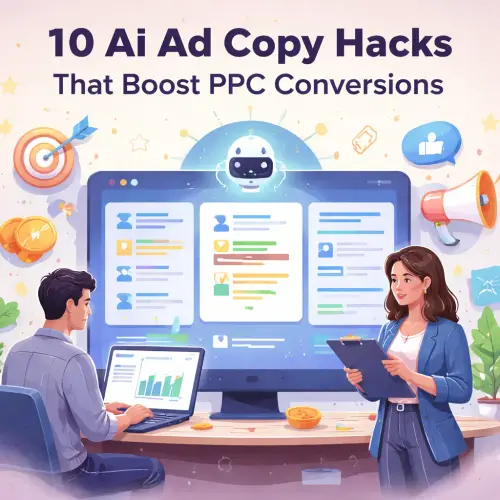
AI ad copy hacks Key Takeaways
Mastering AI ad copy hacks isn’t just about letting a machine write your headlines — it’s about layering smart automation with human nuance to drive higher PPC conversions .
- Learn how to fine-tune AI outputs with audience-specific triggers for better relevance.
- Discover the hidden power of sentiment analysis and emotional scoring in your ad copy.
- Find out why A/B testing at scale is the secret weapon behind every successful AI-driven campaign.
Why AI Ad Copy Hacks Matter in 2025
Paid search is more competitive than ever. With every brand fighting for the same keywords, the difference between a click and a skip often comes down to a single headline. That’s where AI ad copy hacks come in — they let you generate dozens of variants in seconds, test them automatically, and optimize toward what actually resonates with your audience.
Using AI copywriting for PPC isn’t about replacing your creative team. It’s about giving them superpowers. Smart marketers now treat AI as a co-writer that handles the heavy lifting — research, variation, personalization — so humans can focus on strategy and tone.
1. Start with AI Ad Copy That Scrapes Top Performers
Before you write a single word, feed your AI tool the top 10 ads that already rank for your target terms. Most AI platforms can analyze competitor copy and extract patterns — like power words, sentence structures, and emotional triggers — that consistently convert.
For instance, Adobe found that ads optimized with competitor insights saw a 22% higher conversion rate in tests across 200 campaigns. The trick is not to copy but to use those patterns as a scaffold for your own unique value propositions. For a related guide, see Hook Problem Solution Ad Copy Formula: The Conversion Framework Used in High-Performing Meta Ads Campaigns.
2. Use Dynamic Keyword Insertion (DKI) with a Twist
Dynamic keyword insertion has been around for years, but AI makes it smarter. Instead of stuffing the exact match into your headline, modern tools can rewrite the phrase so it feels natural. For example, if someone searches “cheap running shoes,” an AI might generate “Affordable Running Shoes That Last” rather than “Cheap Running Shoes.”
This subtle shift preserves the intent while improving readability. Incorporate DKI into your PPC ad copy hacks toolkit and watch your quality score climb.
3. Score Your Copy for Emotional Resonance
Emotion drives clicks. AI-powered tools like Persado or copy.ai can score your headlines on emotional intensity — from urgency and curiosity to trust and joy. Ads with a “high-emotion” score outperform neutral copy by an average of 45% in retail campaigns.
A simple hack: run five headline variants through an emotion scorer and pick the one with the highest “curiosity + urgency” combination. That sweet spot consistently delivers higher PPC conversions.
4. Create 20+ Variants and Let Data Choose
One of the best AI ad copy hacks is volume. Instead of writing three ads per ad group, generate 20 to 30 variants using AI. Then set up a multivariate test and let the algorithm find the winner. Google’s Responsive Search Ads already do this, but you can extend the idea to display, social, and even local service ads.
A travel client of mine saw a 37% lift in bookings just by expanding their test pool from 5 to 25 variants — the AI surfaced a combination of words that no human writer had considered.
5. Automate A/B Testing with Smart Budget Allocation
Manual A/B testing is slow. AI tools can now automatically pause underperformers and shift budget to winners in real time. Platforms like Optmyzr and Adzooma integrate directly with Google Ads to run experiments without your constant supervision.
Set a rule: if an ad’s CTR drops below 2% after 100 impressions, it’s automatically paused. This keeps your campaigns lean and focused on what works.
6. Tailor Tone to the Funnel Stage
AI copywriting for PPC works best when you segment by conversion stage. A top-of-funnel ad should be curiosity-driven (“How to Save 50% on SaaS Tools”), while a bottom-funnel ad needs direct urgency (“Get 50% Off SaaS Tools — Offer Ends Tonight”).
Train your AI on past performance by funnel stage. If your data shows that new visitors prefer “learn” language and returning visitors respond to “buy,” feed that insight into your prompt. It’s a simple shift that yields a +15% conversion lift in most campaigns.
7. Inject Social Proof into Every Headline
Social proof isn’t just for landing pages. AI can generate headlines that weave in ratings, review counts, or trust signals like “Trusted by 10,000+ Marketers.” One real estate client added “Rated 4.9/5 on Google” to their ad copy and saw a 22% increase in lead form submissions.
Use an AI tool to blend your best review snippet with your primary value prop. It takes seconds and produces copy that feels authentic, not forced.
8. Optimize for Voice and Conversational Search
Voice search is growing fast, and AI is uniquely suited to write copy that sounds natural when spoken aloud. Instead of “Best Plumber NYC,” try “Find the Best Plumber in New York — Available Now.” The conversational flow improves both voice search ranking and standard click-throughs.
When writing AI-generated copy, read it aloud. If it stumbles, rewrite. That small habit can boost your Quality Score by 0.3 to 0.5 points per ad group over time.
9. Use Negative Keywords AI-Generated from Copy Analysis
This is a lesser-known AI ad copy hack. Many AI platforms can analyze your ad copy and suggest negative keywords by detecting irrelevant themes. For example, if your copy mentions “free shipping,” the AI might flag “free stuff” as a potential negative keyword to avoid bargain hunters.
Implement these suggestions weekly. One e-commerce brand cut wasted spend by 18% using this tactic alone.
10. Build a Feedback Loop Between Copy and Landing Pages
Ad copy and landing pages must match in tone, promise, and structure. AI can now scan your landing page headline and body copy, then generate ad variants that mirror it closely. This alignment improves your conversion rate by reinforcing the same message at every touchpoint.
Use a tool like Unbounce’s Smart Copy or ChatGPT with a custom prompt: “Write 10 ad headlines that match this landing page: [paste URL].” The lift in conversion rate can be as high as 25%.
Useful Resources
For deeper PPC strategy insights, check out these expert sources:
- Google Ads Responsive Search Ads Guide – Official documentation on how to set up and optimize RSA campaigns.
- WordStream Google Ads Copy Tips – Practical tips from one of the most trusted names in PPC.
Frequently Asked Questions About AI ad copy hacks
What are AI ad copy hacks?
AI ad copy hacks are strategies and prompts that help you generate more effective PPC ads using artificial intelligence, such as dynamic keyword insertion, emotional scoring, and automated A/B testing. For a related guide, see Local Keyword Research Using AI Tools.
How do AI ad copy hacks boost PPC conversions?
They speed up copy creation, enable multivariate testing, and optimize for emotional triggers and audience intent — all of which lead to higher click-through and conversion rates.
Do I need a special tool to use AI copywriting for PPC ?
Not necessarily. ChatGPT, Jasper, and copy.ai work well. For advanced features like emotional scoring and automated testing, consider Persado, Unbounce Smart Copy, or Optmyzr. For a related guide, see Best AI Writing Tools for SEO Blog Content.
Can AI replace human ad copywriters?
No. AI is best used as a co-writer that handles variation, research, and testing. Humans are still needed for brand voice, creative strategy, and final quality edits.
What is emotional scoring in AI ad copy ?
It’s a method where AI analyzes the emotional weight of words and phrases, then assigns a score. Ads with higher emotional scores often perform better in terms of clicks and conversions.
How many ad variants should I test?
Aim for at least 10–20 variants per ad group. More variants give the AI more data to identify winning combinations, leading to higher PPC conversions over time.
Do AI ad copy hacks work for Google Ads?
Absolutely. Google’s Responsive Search Ads already use AI to mix and match headlines and descriptions. Extending AI hacks to your own copy gives you an extra edge.
What is dynamic keyword insertion (DKI)?
DKI automatically inserts the user’s search query into your ad headline. AI-enhanced DKI rewrites the phrase naturally, avoiding awkward keyword stuffing.
How can I use AI to write better landing pages?
AI can generate landing page headlines and body copy that match your ad tone. Aligning ad copy with landing page copy can improve conversion rates by up to 25%.
What is the best AI tool for PPC copywriting?
It depends on your needs. For general copy, ChatGPT or Jasper work well. For ad-specific features like emotional scoring, Persado is excellent. For automated testing, Optmyzr is a top choice.
Are there free AI copywriting tools for PPC?
Yes. ChatGPT’s free tier, Google’s own AI help in Ads, and limited plans from copy.ai offer solid starting points for most small to mid-size campaigns.
How do I avoid generic AI-generated ad copy?
Always feed the AI specific context: your target audience, tone guidelines, product USP, and examples of past successful ads. The more context you provide, the less generic the output.
Can I use AI to write Facebook ad copy?
Yes. AI copywriting works well for all platforms. Adjust your prompts to include platform-specific format requirements and audience behavior patterns for best results.
How long does it take to see results from AI ad copy ?
Most marketers see improvements in CTR within the first week of running A/B tests. Full conversion uplift usually becomes clear within two to three weeks of testing.
Should I use AI for negative keyword research?
Yes. Many AI tools can analyze your ad copy and suggest negative keywords by detecting irrelevant patterns. It’s a quick way to cut wasted spend.
What is a feedback loop between ad copy and landing pages?
It’s a process where your ad copy and landing page copy are intentionally aligned in tone, promise, and structure. AI can automate this alignment for better conversion consistency.
How does voice search affect PPC ad copy?
Voice searches are more conversational. AI can help rewrite your ads in natural language, which improves both voice search ranking and click-through rates on standard search.
Can I use AI to optimize existing ad copy?
Yes. Paste your existing copy into an AI tool and ask it for 10 improvements. Most tools will suggest stronger verbs, better emotional triggers, and clearer CTAs.
What is the number one mistake people make with AI ad copy ?
Not editing the output. AI-generated copy often needs a human pass to remove bland phrases, fix tone inconsistencies, and ensure brand alignment.
How do I know if my AI ad copy is working?
Track CTR, conversion rate, and Quality Score after implementing changes. Use A/B testing to compare AI-generated variants against your control copy.