
AI for google business profile optimization uses artificial intelligence to automate and enhance every element of your Google listing — from crafting keyword-rich descriptions and category selection to generating weekly posts, responding to reviews, managing Q&A, and analyzing competitor profiles.
The AI-enhanced GBP workflow covers seven core areas: profile completeness optimization, strategic category and service selection, AI-generated descriptions and posts, automated review response systems, intelligent photo management, Q&A automation, and continuous performance monitoring.
Businesses using AI to optimize their GBP typically see Map Pack ranking improvements within 30–60 days, 2–3x increases in profile interactions (calls, direction requests, website clicks), and significantly higher review volumes. The best AI tools for GBP optimization include ChatGPT, Localo, BrightLocal, Semrush Local, and Google’s own AI-powered features. Success requires combining AI automation with genuine human oversight to maintain authenticity and avoid policy violations.
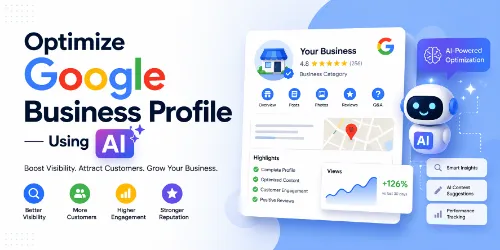
Introduction: Why Your Google Business Profile Is the Most Important Asset You Own
If you own a local business in 2026, your Google Business Profile is arguably the single most valuable piece of digital real estate you’ll ever control. More important than your website. More important than your social media. More important than your paid ads.
Here’s why: when someone searches for your type of business in your area, Google’s Map Pack — those three businesses that appear with photos, ratings, and contact information at the top of search results — captures roughly 44% of all clicks on local searches. Your Google Business Profile is what puts you in that Map Pack. Without optimization, you’re invisible to the majority of people actively searching for what you sell.
Traditional GBP optimization has always been tedious. Writing keyword-rich descriptions, posting updates weekly, responding to every review, managing photos, answering Q&A — it adds up to hours of work each week that most small business owners simply don’t have. This is exactly where AI has transformed the landscape. Tasks that used to require an in-house marketing person or expensive agency can now be handled in 30–60 minutes per week using AI for Google Business Profile optimization approaches designed specifically for this platform.
In this comprehensive guide, we’ll walk through exactly how to use AI to optimize every element of your Google Business Profile — from initial setup through ongoing management. Whether you’re a solo business owner or managing multiple locations, you’ll find actionable guidance that produces measurable ranking improvements.
Understanding how AI SEO works in the context of Google’s local algorithm is the foundation. Let’s build from there.
Why AI Is a Game-Changer for Google Business Profile Optimization
Before diving into specific tactics, let’s understand why AI has had such a dramatic impact on GBP performance specifically.
Google’s local algorithm rewards businesses that demonstrate active engagement. Frequent posts, rapid review responses, regular photo uploads, updated hours, fresh Q&A — these are activity signals that tell Google your business is thriving and deserves visibility. Businesses with static profiles get quietly deprioritized in favor of those that show ongoing commitment.
The problem is that generating this activity consistently is time-consuming. A small business owner running daily operations can’t easily spend 30 minutes drafting a GBP post, another 20 minutes responding thoughtfully to each new review, and another hour planning the next week’s content. It just doesn’t happen.
AI removes this bottleneck. Draft a month’s worth of GBP posts in a single planning session. Generate review responses in seconds. Create optimized descriptions in minutes. Analyze competitor profiles instantly. What used to be impossible for small businesses is now trivial — if you know how to use the tools properly.
The mechanical result: consistent activity signals, better rankings, more visibility, more customers. The strategic result: a competitive moat that becomes harder for competitors to displace over time.
The 7 Core Areas of AI-Powered GBP Optimization
Let’s get specific about where AI actually helps. Here are the seven areas where AI produces the most measurable ranking impact.
1. Profile Completeness and Accuracy
Google explicitly rewards profiles that are 100% complete over those with missing information. Yet most small business profiles have gaps — missing service descriptions, incomplete hours, absent attributes, empty Q&A sections.
How AI accelerates completeness:
Use ChatGPT or Claude to audit your existing profile. Prompt: “Review this list of Google Business Profile fields and sections: [paste your information]. Identify every area where information is missing, incomplete, or could be optimized. Suggest specific improvements for each section.”
The AI will systematically walk through categories, services, hours, special hours for holidays, attributes (like “wheelchair accessible” or “outdoor seating”), service areas, products, and other elements. This audit takes minutes and produces a comprehensive action list.
For deeper completion, use AI to generate suggestions for each section — specific products to highlight, services to describe, attributes that would apply to your business. This removes the mental overhead of figuring out what to include.
2. Strategic Category and Service Selection
Your primary category is arguably the most important single decision in your Google Business Profile. It directly determines which searches trigger your listing.
The AI-driven approach:
Feed ChatGPT a description of your business and ask: “Based on this business description, recommend the optimal primary Google Business Profile category and 3–5 secondary categories. For each, explain the strategic reasoning and which specific search queries each category helps you appear for. Also identify any category combinations that would be strategically powerful but less obvious.”
This produces categorization recommendations you might not have considered. A home remodeler might default to “Contractor” but find that “Home Improvement Store” or specific sub-categories better match actual customer search behavior.
For services, AI helps generate comprehensive service lists. Prompt: “Generate a complete list of 20–30 services a [business type] in [location] might offer. Include common services, niche services, and seasonal offerings. Prioritize services that have meaningful search demand.”
3. AI-Generated Descriptions and Posts
Your business description is prime real estate. It’s where you signal to Google what you do, where you do it, and who you serve. Weekly GBP posts are similarly critical — they’re activity signals that boost rankings and engagement.
Crafting the business description:
A strong GBP description is 400–750 characters, includes primary keywords naturally, mentions your service area, and compels customers to choose you. AI can draft this efficiently.
Prompt: “Write a Google Business Profile description for a [business type] in [city]. Requirements: 700 characters maximum, include the keywords [list], mention we serve [surrounding areas], emphasize our experience with [key specialties], and include a clear call to action. Tone should be professional but warm. Avoid generic phrases like ‘customer service is our priority.’ Be specific about what makes us different.”
Edit the output to add genuine specifics about your business. AI gives you the structure; you add the soul.
Generating weekly GBP posts:
Post 2–3 times weekly minimum. Mix formats: offers, events, updates, and product highlights. AI handles drafting efficiently.
Prompt: “Generate 8 Google Business Profile posts for a [business type] in [location]. Include: 2 update posts about services, 2 offer posts (without being too salesy), 2 event or seasonal posts, and 2 educational tip posts relevant to our customers. Each post should be 150–300 characters, include a clear call to action, and feel authentic rather than corporate.”
Review every draft, add local touches, and schedule through GBP’s native posting feature or a tool like Localo. Understanding ChatGPT for SEO content strategy makes this workflow dramatically more efficient.
4. Automated Review Response Systems
Reviews are powerful ranking signals. Google explicitly factors review quantity, ratings, recency, and response rate into local rankings. Businesses that respond to every review (positive and negative) within 24 hours consistently outrank those that ignore reviews.
The AI-powered review response workflow:
For every new review, generate a personalized response using AI. Prompt: “Write a professional response to this customer review: ‘[paste review].’ Response requirements: under 100 words, mention the specific details they referenced, express genuine appreciation (or address concerns if negative), include subtle keyword reinforcement where natural, and end with an invitation to return.”
AI produces a draft in seconds. You personalize it with specific customer context and post it.
For negative reviews specifically:
“Write a thoughtful response to this negative review: ‘[paste review].’ The response should: acknowledge their experience without being defensive, offer to discuss privately (provide phone/email), avoid making excuses, demonstrate that we take concerns seriously, and show future customers reading this review that we’re a responsive business. Keep it under 120 words.”
AI handles the emotional work of writing balanced responses to frustrated customers. You add the personal touches and commit to actually following through on what you promise.
According to BrightLocal’s local consumer research, the vast majority of consumers read review responses and consider them in their decisions. Every response is a marketing asset, not just a ranking signal.
5. Intelligent Photo Management
Google rewards profiles with regular photo uploads. Photos also drive engagement — profiles with many photos receive significantly more clicks and direction requests.
How AI helps with photos:
While AI can’t take photos for you, it can help with several photo-related tasks:
Photo strategy planning. Prompt: “Generate a 90-day photo upload plan for a [business type]. Suggest specific photo types, subjects, and frequency. Include photos showing team, products/services, workspace/location, customer interactions, before-after examples, and behind-the-scenes moments.”
Photo descriptions and alt text. For each photo you upload, AI can generate descriptive captions that include relevant keywords: “Write three descriptive caption variations for this photo of [description]. Each should be 50–100 characters and include natural keyword usage.”
Photo optimization through third-party tools. Tools like Localo or Pleper analyze which photos drive the most engagement and suggest improvements. Some even use AI to identify low-performing photos that should be removed.
Aim to upload 2–4 new photos weekly. Real, authentic photos of your business always outperform stock photos or overly polished marketing imagery.
6. Q&A Automation
The Q&A section of your GBP is surprisingly powerful — and surprisingly neglected. Questions asked by real customers (and those seeded by you) appear prominently in your listing and directly address common prospect concerns.
The AI-driven Q&A approach:
Generate seed questions. Prompt: “Generate 15 questions a potential customer might ask a [business type] before contacting them. Include practical questions about services, pricing, process, and policies. Prioritize questions that showcase our strengths when answered well.”
Draft comprehensive answers. For each question, AI generates initial answer drafts that you refine with accurate, specific information. Good answers are 50–200 words and include relevant keywords naturally.
Monitor for new real questions. Set up alerts for any new customer questions. Respond within 24 hours using AI-assisted drafting for consistency and professionalism.
Post your own questions and answer them. Google allows business owners to post Q&A content. Use this strategically to surface information that commonly comes up but might not be asked organically.
7. Continuous Performance Monitoring
Optimization isn’t one-and-done. Google Business Profile performance shifts constantly based on competitive activity, seasonal patterns, and algorithm updates. AI-powered monitoring helps you stay ahead.
What AI tools track:
- Profile views and search queries (informational data)
- Ranking positions for target keywords (competitive positioning)
- Competitor GBP activity (benchmarking)
- Review velocity and sentiment (reputation health)
- Photo performance and engagement (content effectiveness)
- Post engagement rates (content optimization)
- Direction requests, calls, and website clicks (business outcomes)
Tools like BrightLocal, Localo, and Semrush Local automate this monitoring and deliver insights directly. For deeper analysis, export your GBP insights to ChatGPT with a prompt like: “Analyze this Google Business Profile performance data [paste data]. Identify trends, anomalies, and specific action items to improve performance in the next 30 days.”
For more on analyzing results, see how to measure AI SEO ROI.
The AI Tool Stack for GBP Optimization
You don’t need enterprise software for GBP optimization. Here’s a practical tool stack for different business stages.
Beginner stack (under $25/month):
- Google Business Profile (free)
- ChatGPT Plus ($20/month) for drafting everything — descriptions, posts, responses, Q&A
- Google Search Console (free) for tracking
Growth stack ($50–$100/month):
- ChatGPT Plus ($20/month)
- Localo or BrightLocal Track ($29/month) for GBP monitoring and automation
- Additional AI review tools as needed
Professional stack ($150–$300/month):
- ChatGPT Plus or Claude Pro
- BrightLocal Grow ($79/month)
- Semrush Local ($20/month per location)
- BirdEye or Podium for review generation (if revenue justifies)
Multi-location enterprise stack ($500+/month):
- Yext or similar platform for listing distribution
- Premium review management
- Custom dashboards for performance tracking
- Dedicated management tools or agency support
Comparing free vs paid AI SEO tools helps you match investment to business size and stage.
The 30-Day GBP Optimization Playbook
Here’s a systematic approach that consistently produces measurable ranking improvements within 30 days.
Week 1: Foundation and Audit
Day 1–2: Complete GBP audit using AI. Identify every missing or weak element. Generate prioritized action list.
Day 3–4: Fix critical gaps — missing categories, incomplete services, wrong hours, absent attributes. Ensure NAP (Name, Address, Phone) is 100% consistent with your website and other directories.
Day 5–6: Rewrite your business description using AI assistance. Incorporate target keywords naturally. Include service area mentions.
Day 7: Review and optimize primary and secondary categories based on AI analysis of your business and competitors.
Week 2: Content and Activity Building
Day 8–9: Generate and schedule 2 weeks of GBP posts using AI. Mix formats: offers, updates, events, educational tips.
Day 10–11: Upload 8–12 new authentic photos. Add AI-generated descriptive captions.
Day 12–13: Seed Q&A section with 5–8 common questions and comprehensive answers.
Day 14: Respond to every existing review (if you haven’t already). Use AI-assisted drafts personalized for each response.
Week 3: Review Generation System
Day 15–16: Set up automated review request system. Via email, SMS, or both. Request every completed customer within 24–48 hours.
Day 17–18: Craft AI-assisted review response templates for different review types (5-star, 4-star, negative, specific service mentions).
Day 19–20: Request reviews from recent satisfied customers manually (if you haven’t systematically asked before). AI drafts the requests.
Day 21: Set up notifications for new reviews so response time stays under 24 hours consistently.
Week 4: Competitive Analysis and Refinement
Day 22–23: Analyze top 3 competitor GBP profiles using AI. Identify gaps, opportunities, and tactics they use that you don’t.
Day 24–25: Plan next 30 days of content based on competitive analysis and early performance data.
Day 26–27: Add additional services, attributes, or categories identified through competitive analysis.
Day 28–30: Review GBP insights data. Identify what’s working, what isn’t. Plan month 2 optimization priorities.
Businesses following this playbook consistently see measurable improvements — increased profile views, more direct interactions (calls, directions), and initial ranking movements for target keywords — by day 30.
Common GBP Optimization Mistakes to Avoid
Even with great AI tools, beginners make predictable mistakes. Avoid these.
Keyword stuffing in the business name. Adding location or service keywords to your business name violates Google’s guidelines and can trigger suspension. Your business name should match what appears on your storefront and legal documents.
Fake reviews. Never. Google’s detection is sophisticated, and the penalty — profile suspension — is devastating. Generate reviews legitimately from real customers only.
Set-and-forget mentality. Claiming your GBP and ignoring it kills rankings. Active management (weekly posts, prompt review responses, regular photo updates) is essential.
Inconsistent NAP across platforms. Your business information must be identical on Google, Yelp, Facebook, your website, and every directory. AI can audit for consistency.
Over-optimized AI descriptions. Descriptions that read as keyword-stuffed or obviously AI-generated hurt more than help. Edit heavily for natural flow.
Ignoring negative reviews. Silence on negative reviews signals abandonment. Every negative review deserves a thoughtful, professional response.
Using stock photos. Authentic photos outperform stock imagery dramatically. Invest in real photos of your business, team, and work.
Neglecting the Q&A section. Empty Q&A is a missed opportunity. Seed with real questions and comprehensive answers.
These patterns connect to broader common AI SEO mistakes that trap businesses attempting AI-powered optimization.
How GBP Optimization Integrates with Broader SEO
Your Google Business Profile doesn’t exist in isolation. It’s part of a complete local SEO ecosystem. Understanding how these elements connect maximizes results.
Website alignment. Your GBP should mirror your website’s core information. Service descriptions, hours, contact information, and location data must match perfectly. Inconsistencies confuse Google and hurt rankings.
Citation consistency. Beyond Google, your business information appears on 50+ directories. Tools like BrightLocal maintain consistency across this ecosystem. Local SEO suffers badly when NAP varies across citations.
Schema markup synergy. Local business schema on your website reinforces GBP information. Google uses schema to verify and enhance business data. See our guide on AI SEO for schema markup.
Content ecosystem. Blog content about local topics, service areas, and community engagement amplifies GBP ranking power. Service-area pages specifically boost your Map Pack visibility.
Review platform diversity. While Google reviews matter most, reviews on Yelp, Facebook, industry directories, and specialized platforms all contribute to overall local authority.
Voice search optimization. As voice queries grow, your GBP needs to answer natural language questions. Learn specific techniques from voice search optimization using AI.
Near-me search targeting. GBP optimization directly feeds “near me” visibility. Learn specific tactics in our AI SEO for near-me searches guide.
Measuring GBP Optimization Success
Tools produce activity. Measurement tells you whether the activity is actually working. Track these metrics.
Profile views (impressions). How many people are seeing your GBP in search and maps? Growing impressions mean improving visibility.
Direct searches vs discovery searches. Direct searches (people searching your business name) indicate brand awareness. Discovery searches (people finding you through category/service searches) indicate SEO effectiveness.
Profile interactions. Phone calls, direction requests, and website clicks are the ultimate business value. Growing interactions mean GBP is delivering results.
Map Pack visibility. Are you appearing in Google’s 3-pack for your target keywords? Track this across primary service + location combinations.
Review velocity and ratings. Are you generating new reviews consistently? Is your average rating trending up or stable?
Post engagement. Which of your GBP posts get the most views and interactions? Use data to refine your content strategy.
Photo performance. Google shows which of your photos get the most views. Upload more content like your top performers.
Google’s Search Central documentation on how local rankings work provides foundational context for understanding why these metrics matter.
The Future of GBP Optimization
Several trends are reshaping how AI-powered GBP optimization will evolve.
Autonomous GBP agents. AI that handles all routine GBP management — posts, reviews, Q&A, photos — with minimal human oversight is emerging and will become mainstream within 1–2 years.
Hyper-personalized local results. Google surfaces different GBP listings to different users based on behavior, search history, and context. Optimization for this personalization becomes its own discipline.
AI Overview integration. Google’s AI Overviews increasingly surface local businesses for relevant queries. Being cited in AI Overviews becomes a new form of local visibility. Learn more about AI search engines vs Google dynamics.
Predictive optimization. AI tools predicting which GBP changes will most improve rankings, eliminating trial and error.
Deeper review AI. AI not just responding to reviews but analyzing review patterns for operational improvements, identifying concerning trends early, and extracting customer insights at scale.
These shifts align with broader AI SEO trends shaping the future of AI SEO in 2026 and beyond.
The Ethics of AI-Powered GBP Management
As AI makes GBP optimization easier, some ethical guardrails matter. Understanding the ethical issues in AI SEO applies specifically here.
Never fake reviews. Even if AI tools make fake reviews easier to generate, this violates Google’s policies and customer trust. Penalties are severe and sometimes permanent.
Don’t impersonate customers in Q&A. Seeding questions is acceptable. Answering as if you’re a customer isn’t.
Maintain authenticity in posts. Every AI-drafted post should be reviewed for accuracy and genuine representation of your business.
Disclose when appropriate. If your industry has specific disclosure requirements for marketing content, follow them.
Respond to reviews honestly. Acknowledging real problems, not dismissing them, builds long-term trust.
Operating ethically isn’t just right — it’s strategic. Google’s systems and consumer sophistication both penalize manipulation over time. Authentic optimization wins in the long run.
Conclusion: Your GBP Is a Competitive Asset Most Competitors Are Ignoring
Most local businesses have claimed their Google Business Profile and then essentially abandoned it. They update hours once a year. They never post. They don’t respond to reviews. Their Q&A sections are empty. Their photos are years old.
This is your opportunity. In virtually every local market, the business that systematically optimizes their GBP using AI-powered workflows dominates local search within 90–120 days. Not because they have more budget or better products — because they execute consistently while competitors don’t.
The tools and techniques in this guide are accessible to any business owner willing to commit 30–60 minutes per week. Foundational optimization (week 1), content systems (week 2), review generation (week 3), and ongoing refinement (week 4 and beyond) compound into ranking positions that become progressively harder for competitors to displace.
Your Google Business Profile is the most valuable piece of digital real estate you control. AI has democratized the ability to optimize it properly. The only question is whether you’ll take advantage of this window — or leave it open for competitors who will.
Ready to build a complete local SEO strategy that wins in today’s competitive search landscape? Explore the full AI SEO mastery curriculum and learn how Google Business Profile optimization fits into a comprehensive approach that drives real customer growth.
FAQs
1. What is AI-powered Google Business Profile optimization?
It uses AI tools to automate and improve every part of your business listing.
2. Why is Google Business Profile important for SEO?
It directly affects your visibility in Google’s Map Pack and local search results.
3. How fast can GBP optimization show results?
Most businesses see improvements within 30–60 days.
4. Can AI write Google Business Profile descriptions?
Yes. AI can generate keyword-rich descriptions optimized for search.
5. How often should I post on my GBP?
At least 2–3 times per week to maintain strong activity signals.
6. Can AI generate GBP posts automatically?
Yes. AI can create multiple posts in minutes for scheduling.
7. Does responding to reviews improve rankings?
Yes. Google rewards businesses that actively engage with reviews.
8. Can AI help respond to reviews?
Yes. It can draft professional responses quickly.
9. What is the ideal response time for reviews?
Within 24 hours for best impact on trust and rankings.
10. Do photos affect Google Business Profile rankings?
Yes. Regular photo uploads increase engagement and visibility.
11. Can AI help with photo optimization?
Yes. It can generate captions and suggest photo strategies.
12. What is the Q&A section in GBP?
A section where customers can ask questions and businesses can respond publicly.
13. Can AI generate questions and answers for GBP?
Yes. It can create helpful FAQ content for your profile.
14. What is the most important GBP ranking factor?
Profile completeness, reviews, and consistent activity signals.
15. Can AI monitor GBP performance?
Yes. AI tools track views, clicks, calls, and ranking changes.
16. What is the biggest mistake in GBP optimization?
Setting up a profile but not maintaining regular activity.
17. Can AI analyze competitors’ GBP profiles?
Yes. It identifies gaps and opportunities for improvement.
18. How does GBP optimization increase customers?
It improves visibility, leading to more calls, visits, and inquiries.
19. Does GBP optimization require technical skills?
No. AI tools simplify most tasks for beginners.
20. What is the goal of AI-powered GBP optimization?
To increase visibility, engagement, and conversions in local search.

