
FAQs (Frequently Asked Questions) are one of the most effective tools for capturing featured snippets in Google because they directly mirror how people search — in questions. When structured properly with clear, concise answers and FAQ schema markup, FAQ content signals to Google that your page directly answers a specific query. This increases eligibility for featured snippet boxes, rich results, and AI Overviews.
Key strategies include writing question-based H2/H3 headings, keeping direct answers within 40–60 words, using FAQ schema (structured data), targeting conversational and “People Also Ask” queries, and integrating internal links to support topical authority. FAQs also improve voice search performance, reduce bounce rates, and drive higher click-through rates from search result pages.
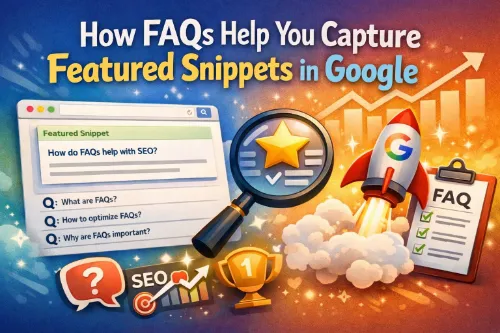
Introduction: Why FAQs Are an SEO Powerhouse
If you have ever typed a question into Google and immediately seen an answer box at the top of the results page — before any blue links — you have seen a featured snippet in action. These coveted “position zero” placements are Google’s way of surfacing the most direct, authoritative answer to a user’s question.
The question every content marketer should be asking is: How do I get my content into that box?
The answer, more often than not, starts with a well-structured FAQ section.
FAQ content is uniquely positioned to win featured snippets because it mirrors the way real people search. When someone types “how does FAQ schema work” or “what is a featured snippet in Google,” they want a direct, confident answer — not a 2,000-word essay to wade through. FAQs deliver exactly that.
In this guide, we will break down the mechanics of how FAQs help you capture featured snippets, how to write them for maximum visibility, and how to implement FAQ and schema content generation as part of a complete SEO strategy.
What Are Featured Snippets and Why Do They Matter?
A featured snippet is a selected search result that appears at the top of Google’s organic results in a special display box. Unlike regular blue links, featured snippets extract a piece of content — a paragraph, list, table, or step-by-step — and display it directly on the results page.
According to Ahrefs research, featured snippets appear for approximately 12.3% of search queries. Pages that earn a featured snippet often see dramatic increases in organic click-through rates — sometimes doubling or tripling their traffic from a single query.
There are several types of featured snippets:
Paragraph snippets — A short block of text (usually 40–60 words) that directly answers a question. These are the most common type and the easiest to target with well-written FAQ answers.
List snippets — Ordered or unordered lists that explain steps or enumerate items. How-to content and “best of” roundups tend to earn these.
Table snippets — Comparative data pulled from tables on a page.
Video snippets — A YouTube video surfaced as the best answer.
FAQs are the most direct pathway to paragraph snippets and list snippets — the two most common and most valuable types.
For a deeper understanding of how featured snippets in Google work and how to pursue them strategically, it helps to understand their relationship with structured content and search intent.
How FAQs Align With Google’s Understanding of Search Intent
Google’s core mission is to match queries with the most relevant, helpful answers. Over the last decade, its algorithms have shifted decisively toward understanding intent — not just matching keywords, but understanding what a searcher actually wants.
FAQs work because they naturally match informational intent — the most common type of search query. When someone asks “what is FAQ schema markup,” they want a definition. When they ask “how do I add FAQ schema to WordPress,” they want steps. FAQ content, by its very structure, delivers answers in the format Google is looking for.
This alignment with search intent mapping is not accidental. Well-crafted FAQs anticipate the natural follow-up questions a reader has after landing on a page, addressing them in a structured way that both satisfies the reader and sends strong signals to Google’s crawlers.
Search intent types your FAQs should target include:
- Informational — “What is a featured snippet?”
- Navigational — “How do I find Google’s rich results test tool?”
- Transactional support — “Does FAQ schema help with conversions?”
- Comparative — “FAQ schema vs. HowTo schema: which should I use?”
Each of these question types, when answered concisely in a structured FAQ, becomes eligible for a featured snippet, a People Also Ask result, or an AI Overview citation.
The Role of FAQ Schema Markup in Featured Snippet Capture
FAQ content alone is a strong start, but the real SEO advantage comes when you pair it with structured data SEO — specifically, FAQ schema markup.
FAQ schema (formally FAQPage in Schema.org vocabulary) is a type of structured data you add to your page’s HTML that explicitly tells Google: “This section of my page is a list of questions and answers.” When implemented correctly, this markup makes your page eligible for rich results — enhanced search listings that show the questions and answers directly in Google’s SERP.
The impact of this cannot be overstated. A rich result showing three expandable FAQ questions under your page title effectively doubles the real estate your listing occupies on the search page. This dramatically increases your visibility and CTR even before any featured snippet placement is considered.
How to Write FAQs That Win Featured Snippets
Not all FAQ content is created equal. To maximize your chances of earning a featured snippet, your FAQ answers need to follow specific formatting principles.
Start With Real Questions People Ask
The foundation of effective FAQ writing is research. Your questions should come from:
- Google’s “People Also Ask” boxes — These are literal question formats Google is already surfacing for your topic.
- Google’s autocomplete — Type your topic into the search bar and record the suggested completions.
- Answer the Public, AlsoAsked.com, or SEMrush’s Keyword Magic Tool — These tools surface question-based keywords at scale.
- Your own customers — Support tickets, sales calls, and social media comments are rich sources of authentic questions.
Integrating AI-powered keyword research into this process allows you to uncover long-tail question queries that your competitors may have overlooked, giving you a cleaner path to featured snippet capture.
Format Questions as H2 or H3 Headings
Google uses heading tags as semantic signals. When you format a FAQ question as an <h2> or <h3>, you are explicitly telling Google: “This is an important question this page addresses.” This formatting is one of the most consistent patterns found in featured snippet winners.
Each question should be phrased exactly as a searcher might type or speak it:
- ✅ “What is FAQ schema markup?”
- ✅ “How do FAQs help with featured snippets?”
- ❌ “FAQ Schema” (not a question — missed opportunity)
Keep Answers Between 40 and 60 Words
Google’s paragraph featured snippets are almost universally between 40 and 60 words. This is not a rule written anywhere in Google’s documentation — it is an observed pattern across thousands of featured snippets.
Write your FAQ answers to be complete, authoritative, and self-contained within this range. Lead with the direct answer in the very first sentence. Do not build up to the answer; give it immediately.
Example:
Question: What is FAQ schema markup?
Answer: FAQ schema markup is structured data code you add to a webpage to tell search engines that the page contains a list of questions and their answers. When implemented correctly, it makes your page eligible for FAQ rich results in Google’s search listings, which display expandable question-and-answer pairs directly in the SERP.
That answer is 53 words. It leads with the definition, adds context, and explains the benefit — all within the featured snippet sweet spot.
Use Natural Language and Conversational Phrasing
As Google’s AI capabilities grow, natural language processing plays an increasingly large role in how content is evaluated. FAQs written in plain, conversational language perform better in AI Overviews, voice search results, and traditional featured snippets than content filled with forced keyword repetition.
This principle extends directly into the world of AI Overviews — Google’s newest SERP feature that synthesizes answers from multiple sources. Pages structured with clear FAQs and natural language are significantly more likely to be cited in AI Overviews.
FAQs, Voice Search, and the Rise of Conversational Queries
Voice search and featured snippets are deeply connected. When Google Assistant, Siri, or another voice interface reads aloud an answer to a spoken question, it almost always pulls from a featured snippet source.
Voice searches are by definition conversational — people ask full questions. “Hey Google, how do FAQs help with SEO?” is structurally identical to the H2 heading format recommended above. This means that FAQ content optimized for featured snippets is simultaneously optimized for voice search.
On-page SEO optimization that incorporates question-format headings, concise answers, and FAQ schema is essentially a three-for-one strategy: you target featured snippets, you target rich results, and you target voice search all with the same content structure.
Integrating FAQs Into Your Content Strategy for Topical Authority
One of the most underutilized aspects of FAQ content is its role in building topical authority — the principle that Google rewards sites that comprehensively cover a subject, not just those that target individual keywords.
When you build a topic cluster around a core subject and include robust FAQ sections on each pillar page and cluster article, you accomplish several things simultaneously:
You cover semantic variations of keywords. A single FAQ section might naturally incorporate “featured snippet optimization,” “position zero,” “answer box,” and “rich result” — all related terms — without forced keyword stuffing.
You answer follow-up questions. Each FAQ answer reduces the need for a searcher to return to Google for a follow-up query, increasing dwell time and signaling content quality to Google.
You create internal linking opportunities. Each FAQ can naturally link to a deeper resource on that sub-topic, strengthening your site’s topical architecture.
For example, an FAQ answering “What is structured data and why does it matter for SEO?” can naturally link to your dedicated guide on structured data SEO or your page on rich results SEO strategy.
This approach is explored in depth in the frameworks for content strategy and topical authority and topical authority building.
People Also Ask: The FAQ Gateway to SERP Domination
Google’s People Also Ask (PAA) boxes are, in many ways, a visible representation of how Google thinks about question-answer relationships. When your page answers a question that appears in a PAA box, you become a candidate for that placement — and PAA placements drive significant additional traffic.
Research from Search Engine Land has documented the explosive growth of PAA boxes across Google’s SERPs. They now appear in a majority of search results, and the questions within them are dynamically updated based on user behavior.
The best strategy for targeting PAA boxes is exactly the same as targeting featured snippets: write clear, question-format headings answered in concise, authoritative paragraphs. The overlap between featured snippet winners and PAA sources is substantial.
Using AI SEO strategies to monitor which PAA questions are appearing for your target keywords — and building FAQ content around them — creates a compounding visibility effect where each answer you capture leads Google to surface more of your questions.
FAQ Best Practices: A Structured Checklist
To maximize the featured snippet potential of your FAQ content, work through this checklist for every piece of content you publish:
Research Phase
- Pull questions from Google’s People Also Ask boxes for your target keyword
- Use keyword research tools to find question-based long-tail variations
- Review competitor content for FAQ questions they are ranking for
- Incorporate questions from customer support and sales teams
Writing Phase
- Format every question as an H2 or H3 heading
- Lead the answer with a direct response in the first sentence
- Keep answers between 40 and 60 words for paragraph snippets
- Use natural, conversational language throughout
- Avoid preambles like “Great question!” or “It depends” — these delay the answer
Technical Phase
- Implement
FAQPageschema markup using JSON-LD - Validate with Google’s Rich Results Test
- Ensure the FAQ section is visible in your page’s HTML (not hidden behind a toggle by default)
- Add internal links within FAQ answers to relevant deeper content
Optimization Phase
- Monitor featured snippet appearance in Google Search Console
- Track PAA appearances using rank tracking tools
- Update FAQ answers when Google surfaces new related questions
- Refresh outdated answers to maintain accuracy and relevance
The AI content refresh and updating process is particularly valuable for FAQ sections, which can become outdated quickly in fast-moving industries.
Common FAQ Mistakes That Kill Featured Snippet Chances
Even well-intentioned FAQ content can miss the mark. Here are the most common mistakes to avoid:
Burying the answer. If your FAQ answer starts with background context before getting to the actual response, Google may not extract it as a snippet. Lead with the answer, always.
Writing answers that are too long. An answer that runs 200 words is not going to become a paragraph snippet. Save the depth for body content and keep FAQ answers tight.
Using vague, non-question headings. Headings like “About Our Services” or “More Information” do not signal question-and-answer structure to Google. Every FAQ heading should be a genuine question.
Neglecting schema markup. Unstructured FAQ content still has some chance of being featured, but FAQ schema dramatically increases eligibility. Not implementing it is leaving easy wins on the table.
Hiding FAQs in JavaScript-rendered content. If your FAQ section is collapsed behind a JavaScript toggle and Google cannot crawl the answer text, it cannot feature it. Ensure the answer content exists in the initial HTML response.
FAQs and Local SEO: A Powerful Combination
FAQ content is not just for broad, national queries. It is equally powerful — arguably more powerful — for local search.
When someone searches “what are the best SEO services near me” or “how much do AI SEO services cost in Isulan,” they are looking for a direct, local answer. FAQ content on local service pages that addresses pricing, service areas, and common local questions is a direct path to featured snippets for these high-intent local queries.
This strategy is particularly effective when combined with local SEO content generation and hyperlocal SEO content strategies. A local FAQ might include:
- “What does an AI SEO service cost in [city]?”
- “How long does it take to rank a local business with AI SEO?”
- “Do I need FAQ schema if I only serve a local area?”
These questions match exactly how local searchers phrase their queries. When answered with FAQ schema on a well-optimized local page, they become highly competitive for featured snippets in local search results.
For businesses targeting specific regions, the guides on local search visibility and local SEO strategies provide frameworks for integrating FAQ content into a full local search strategy.
AI Overviews and FAQs: The Next Frontier
Google’s AI Overviews (formerly SGE) represent the next evolution of the featured snippet. Instead of pulling one answer from one page, AI Overviews synthesize answers from multiple sources, displaying a generated summary at the top of the SERP.
Early analysis of AI Overview citations consistently shows that pages with clear, structured FAQ content, proper schema markup, and strong topical authority are disproportionately cited. The reason is straightforward: AI systems — including Google’s — are trained to identify authoritative, well-structured answers. FAQs provide exactly that.
To position your content for AI Overview citations:
Maintain high factual accuracy. AI systems are trained to prefer trustworthy, verifiable sources.
Cover topics comprehensively. AI Overviews pull from multiple pages to build complete answers. Pages that cover a topic from multiple angles — including FAQs that address edge cases and follow-up questions — are more likely to be referenced.
Use structured data. The same FAQ schema that helps with traditional featured snippets also helps Google’s AI systems understand and attribute your content accurately.
Build E-E-A-T signals. Experience, Expertise, Authoritativeness, and Trustworthiness are the quality signals Google’s guidelines emphasize. Author bios, citations, original research, and thorough FAQ answers all reinforce these signals.
The integration of AI SEO principles into your FAQ strategy is becoming essential as AI Overviews take a larger share of SERP real estate.
Measuring FAQ and Featured Snippet Performance
Building FAQ content is only half the equation. You need to track performance to understand what is working and iterate accordingly.
Key metrics to monitor:
Featured snippet appearances — Google Search Console’s Performance report shows queries where your page appears as a featured snippet (look for “FEATURED_SNIPPET” in the search appearance filter).
Click-through rate (CTR) — Featured snippets and rich results should increase CTR. A drop in CTR despite featured snippet placement may indicate your answer needs to be updated or that a competitor’s content is more compelling.
People Also Ask appearances — Rank tracking tools like SEMrush, Ahrefs, and Moz can identify when your pages appear in PAA boxes.
Impressions vs. clicks for question queries — A high-impression, low-click pattern for question-format queries often indicates your content is appearing in rich results but not convincing searchers to click. Refine your answer to create curiosity for the full article.
Systematic SEO reporting that segments featured snippet and rich result data from regular organic results gives you a clearer picture of your FAQ strategy’s impact. Pair this with regular AI SEO audits to identify opportunities you may be missing.
Scaling FAQ Content Production Without Sacrificing Quality
For businesses managing large content libraries — particularly e-commerce sites, multi-location service businesses, and content-heavy publishers — producing high-quality FAQ content at scale is both essential and challenging.
AI-assisted content workflows have transformed this equation. Using AI SEO content writing and AI-assisted SEO article creation tools, content teams can generate structured FAQ drafts at scale — then apply human editorial oversight to ensure accuracy and brand voice.
For product-heavy sites, this approach integrates naturally with product page SEO optimization and e-commerce SEO content strategies, where product-specific FAQs (“Does this product ship to [city]?” “What is the return policy for [product category]?”) can drive significant featured snippet and rich result traffic.
The scale content production guide provides a practical framework for maintaining quality while producing FAQ content at volume.
Putting It All Together: Your FAQ Featured Snippet Action Plan
Here is a practical sequence for implementing everything covered in this guide:
Step 1 — Audit your existing content. Identify pages that rank on page one for question-based queries but do not have featured snippets. These are your highest-opportunity targets. Run an AI SEO audit to surface these systematically.
Step 2 — Research the questions. For each target page, pull People Also Ask questions, use keyword research tools to find question variations, and identify the exact phrasing Google is rewarding with snippets for your competitors.
Step 3 — Write or rewrite FAQ sections. Format questions as H2/H3 headings. Write 40–60 word answers that lead with the direct response. Avoid preambles, jargon, and padding.
Step 4 — Implement FAQ schema. Add FAQPage JSON-LD structured data. Validate with Google’s Rich Results Test. Submit updated sitemaps to Google Search Console.
Step 5 — Build internal links. Connect FAQ answers to deeper content on your site, strengthening topical architecture and signaling to Google that your site is the authoritative source on the subject.
Step 6 — Monitor and iterate. Track featured snippet appearances, CTR changes, and PAA placements weekly. Update answers when new related questions emerge in Google’s SERPs.
For businesses looking for strategic guidance through this process, AI SEO services can provide a structured approach to FAQ-based featured snippet capture as part of a broader AI SEO optimization program.
Conclusion: FAQs Are Your Featured Snippet Foundation
Featured snippets are among the most valuable pieces of real estate on Google’s search results pages, and FAQs are the most reliable path to earning them. The logic is simple: featured snippets exist to answer questions, and FAQs are literally structured as questions and answers.
By writing question-format headings, keeping answers concise and direct, implementing FAQ schema markup, and building your FAQ strategy around real People Also Ask data, you create content that is perfectly aligned with how Google selects and surfaces featured snippets — and increasingly, how it selects sources for AI Overviews.
The competitive advantage of this approach compounds over time. Every FAQ section you optimize, every schema markup you implement, and every featured snippet you capture builds topical authority, increases organic visibility, and reduces your dependence on paid traffic.
The search landscape is changing rapidly — but the fundamental principle remains constant. Google wants to deliver the best answer to every question. FAQ content, done well, is that answer.
Start with your highest-traffic pages, identify the questions your audience is already asking, and build FAQ sections that answer them with clarity and authority. The featured snippets — and the traffic that comes with them — will follow.
FAQs
What Makes FAQs Effective for SEO?
FAQs are effective because they directly answer user questions in a structured format, aligning with how people search and how Google selects content for featured snippets and rich results.
Why Do FAQs Increase the Chances of Ranking in Featured Snippets?
They provide concise, question-based answers that match Google’s preferred format for extracting and displaying quick answers at the top of search results.
What Is the Best Format for Writing FAQ Questions?
FAQ questions should be written in a natural, conversational way and formatted as H2 or H3 headings to signal importance to search engines.
How Long Should FAQ Answers Be?
Answers should ideally be between 40 and 60 words, making them concise enough for featured snippets while still providing complete information.
Why Should Answers Be Direct and Immediate?
Google prioritizes answers that provide value instantly, so starting with the main answer increases the chances of being selected for snippets.
How Does FAQ Schema Markup Improve SEO?
FAQ schema helps search engines recognize your content as a Q&A format, enabling rich results like dropdown FAQs in search listings.
What Is the Relationship Between FAQs and AI Overviews?
Structured FAQ content makes it easier for AI systems to extract and summarize information for AI-generated search features.
How Do FAQs Support Voice Search Optimization?
Voice searches are conversational and question-based, making FAQ content highly compatible with voice assistant queries.
What Is “People Also Ask” and Why Is It Important?
It is a Google feature that shows related questions, and well-optimized FAQs increase your chances of appearing in those results.
How Can I Find the Best Questions for FAQs?
You can gather questions from Google autocomplete, People Also Ask sections, keyword tools, and real customer inquiries.
What Role Does Search Intent Play in FAQ Content?
FAQs align with informational, navigational, and transactional intents, helping search engines match your content to user needs.
Should FAQ Content Include Internal Links?
Yes, linking to related pages improves site structure and helps build topical authority.
What Are Common Mistakes When Writing FAQs?
Common errors include long answers, unclear questions, delayed responses, and lack of structured data implementation.
Can FAQs Help Reduce Bounce Rate?
Yes, by answering user questions immediately, FAQs keep visitors engaged and reduce the likelihood of leaving the page.
How Do FAQs Contribute to Topical Authority?
They cover multiple related questions, signaling to search engines that your content is comprehensive and authoritative.
Why Is Natural Language Important in FAQs?
Natural, conversational language aligns with modern search algorithms and improves performance in both snippets and AI summaries.
How Do FAQs Improve Click-Through Rates?
Rich results and featured snippets generated from FAQs attract attention and encourage users to click your listing.
Can FAQs Be Used for Local SEO?
Yes, location-specific FAQs can target local queries and improve visibility in local search results.
How Often Should FAQ Content Be Updated?
FAQs should be updated regularly to reflect new trends, customer questions, and changes in your business or industry.
How Do I Measure the Performance of FAQ Content?
Use tools like Google Search Console to track featured snippet appearances, impressions, clicks, and rankings.

