
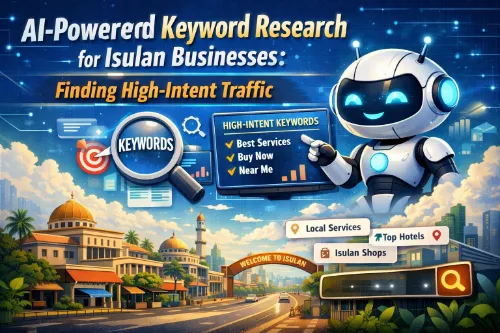
AI-powered keyword research for Isulan businesses uses artificial intelligence tools to identify the exact search terms local customers use when they are ready to buy, book, or inquire — enabling businesses in Sultan Kudarat to attract high-intent traffic that converts into real leads and sales. This guide explains how AI keyword research works, how it differs from traditional methods, and how Isulan businesses can use it to build a search strategy that captures the right customers at the right moment.
Why Most Isulan Businesses Are Targeting the Wrong Keywords
Search engine optimization only works when you are targeting keywords that your actual customers are actually searching for. This sounds obvious — and yet the vast majority of Isulan businesses that attempt SEO fail at this first and most fundamental step.
They target keywords that are too broad, too competitive, or too distant from purchase intent. They optimize for terms like “food delivery” or “construction materials” without any geographic or intent qualifier, competing against national brands and established platforms they have no realistic chance of outranking. Or they target keywords so obscure that no one in their market is searching for them at all.
The result is the same in both cases: invisible websites, wasted content effort, and zero return on SEO investment.
AI-powered keyword research solves this problem by analyzing search data at a depth and speed that no human researcher can match — identifying not just what people search for, but why they search for it, how ready they are to make a decision, and which specific keyword variations are both achievable in rankings and commercially valuable enough to be worth pursuing.
For Isulan businesses specifically, AI keyword research offers a compounding advantage: it can surface local keyword opportunities that generic national SEO tools systematically undervalue, because those tools are calibrated for high-volume markets and often miss the medium-volume, low-competition keywords that local businesses in Sultan Kudarat can realistically dominate.
This guide covers everything Isulan businesses need to know about finding and using high-intent keywords effectively. For a broader view of how keyword research fits within a complete local SEO strategy, start with our guide to AI SEO services in Isulan.
What High-Intent Keywords Actually Are — and Why They Matter More Than Search Volume
The SEO industry has spent years teaching businesses to prioritize search volume — the monthly number of times a keyword is searched. High volume means more potential traffic, so higher-volume keywords must be better targets, right?
Not necessarily. And for local Isulan businesses, often not at all.
Search volume tells you how many people search for a term. It tells you nothing about what those people intend to do. A keyword with 50,000 monthly searches from people doing casual research is worth less to a local business than a keyword with 500 monthly searches from people who are ready to make a purchase today.
High-intent keywords are the ones that signal buyer readiness. They typically include:
Transactional modifiers — words like “buy,” “hire,” “order,” “book,” “near me,” “price,” “cost,” “quote,” or “available.” When someone searches “hire electrician Isulan” or “buy construction materials Sultan Kudarat,” they are not browsing. They are deciding.
Specific product or service names — vague searches indicate early-stage research; specific searches indicate late-stage decision-making. “Accounting services” is informational. “Certified public accountant Isulan Sultan Kudarat” is transactional.
Geographic qualifiers — any keyword that includes Isulan, Sultan Kudarat, SOCCSKSARGEN, or nearby municipalities is almost automatically higher intent for local businesses, because it filters out the casual national audience and identifies people with a specific local need.
Problem-specific language — searches like “water damage repair Isulan” or “teeth cleaning dentist near Isulan” indicate someone with an immediate, specific problem seeking an immediate, specific solution.
Understanding search intent mapping — the practice of categorizing keywords by the underlying purpose of the search — is foundational to any effective keyword strategy. AI tools have made this categorization precise and scalable in ways that manual analysis cannot replicate.
How AI Transforms Keyword Research for Local Businesses
Traditional keyword research relied on pulling data from tools like Google Keyword Planner, manually reviewing search volumes and competition scores, and making educated guesses about which terms were worth targeting. It was slow, incomplete, and heavily dependent on the researcher’s intuition and experience.
AI-powered keyword research replaces this process with something fundamentally more powerful. Here is what AI enables that traditional methods cannot:
Intent Classification at Scale
AI language models can analyze thousands of keywords simultaneously and classify each one by search intent — informational, navigational, commercial, or transactional — with high accuracy. This means an Isulan business can receive a prioritized keyword list where every high-intent, high-commercial-value keyword is already identified and separated from the informational and research-stage keywords that attract traffic but rarely convert.
Semantic Clustering
AI groups keywords by semantic meaning rather than just surface-level similarity. This reveals the full topic territory around any core keyword — showing not just “dentist Isulan” but the entire ecosystem of related searches: “affordable dentist Sultan Kudarat,” “painless tooth extraction Isulan,” “dental clinic open Sunday Isulan,” and dozens more. Each of these represents a specific customer with a specific need, and a well-structured content strategy addresses all of them.
This is the foundation of topic cluster planning — organizing your content around semantic keyword clusters rather than targeting isolated keywords individually. The result is stronger topical authority that Google’s algorithm rewards with improved rankings across an entire topic area.
Competitor Keyword Intelligence
AI tools can crawl competitor websites and identify exactly which keywords they rank for, which pages drive their traffic, and where they have gaps that your business could exploit. This is competitor content gap analysis applied to keyword strategy — identifying specific, achievable ranking opportunities that your competitors have either missed or inadequately addressed.
For Isulan businesses, this analysis often reveals that local competitors have thin or absent content on commercially valuable local keywords — creating low-competition opportunities that a focused content investment can capture relatively quickly.
Long-Tail Keyword Discovery
Long-tail keywords — longer, more specific search phrases — are where high-intent local traffic concentrates. “Plumber” is a head keyword with enormous competition. “Emergency plumber Isulan Sultan Kudarat available on weekends” is a long-tail keyword with minimal competition and extremely high intent. AI tools discover these long-tail variations systematically and at scale, surfacing the specific phrasing that real customers in the Isulan area use.
The advantage of AI keyword research over traditional SEO methods is most pronounced in long-tail discovery: traditional tools often miss low-volume but high-intent long-tail keywords entirely, while AI analysis captures them because it processes natural language patterns rather than just matching search strings.
The AI Keyword Research Process for Isulan Businesses
Understanding how AI keyword research works in practice helps Isulan business owners evaluate service providers, ask the right questions, and apply the output effectively.
Step 1: Seed Keyword Generation
The process begins with identifying seed keywords — the core terms that describe your business, products, and services. For an Isulan hardware store, seeds might include “construction materials,” “hardware supplies,” “paint,” “plumbing supplies,” and “electrical materials.” AI tools then expand these seeds into comprehensive keyword universes, exploring every variation, modifier, and related concept that real searchers use.
Step 2: Local Context Integration
Seed keywords are then filtered and expanded through a local lens. AI tools apply geographic context — Isulan, Sultan Kudarat, SOCCSKSARGEN, specific barangays, and nearby municipalities — to identify the locally specific keyword variations that represent your actual target customers. AI for local SEO tools are specifically designed to capture this local layer of keyword intelligence that generic SEO platforms frequently miss.
Local SEO in Isulan using AI requires understanding not just the standard geographic modifiers but also the specific ways that Sultan Kudarat residents phrase local searches — including colloquial terms, local landmarks used as geographic references, and industry-specific language common in the region.
Step 3: Intent Analysis and Prioritization
Every keyword in the expanded list is then analyzed for search intent and commercial value. High-intent transactional and commercial keywords are flagged for priority targeting. Informational keywords are identified for content strategy purposes. Navigational keywords help optimize brand and location-specific content.
The output of this stage is a prioritized keyword map — a document that tells your business exactly which keywords to target first, second, and third based on their combination of intent, search volume, competition difficulty, and commercial value for your specific business model. AI content planning uses this keyword map as the foundation for every subsequent content decision.
Step 4: Keyword-to-Page Mapping
Keywords do not exist in isolation — they need to be matched to specific pages on your website. Some keywords belong on your homepage. Others belong on specific service pages. Others belong in blog posts or FAQ sections. On-page SEO optimization begins with this keyword-to-page mapping, ensuring that every page on your website has a clear primary keyword and a supporting cluster of related terms.
Metadata and CTR optimization uses the keyword-to-page map to craft title tags and meta descriptions that incorporate high-intent keywords while also being compelling enough to earn clicks when they appear in search results. Getting the keyword right and the metadata compelling is what converts a good ranking into real traffic.
Step 5: Ongoing Keyword Monitoring and Refinement
Keyword opportunity landscapes change over time as competitors respond, search behaviors evolve, and new services or products emerge. AI SEO audits and reporting monitor keyword rankings continuously and surface new opportunities as they appear. AI content refresh and updating uses ongoing keyword data to revise and improve existing content that has lost ranking ground or that could capture additional traffic with targeted updates.
Building a Content Strategy Around High-Intent Keywords
Identifying the right keywords is only half the work. The other half is building content that targets those keywords effectively, earns rankings, and converts the resulting traffic into customers.
Content strategy and topical authority for Isulan businesses should be built around high-intent keyword clusters organized into a coherent topical map. Rather than creating individual pages targeting isolated keywords, a topical map organizes content into interconnected clusters where a pillar page covers a broad topic comprehensively and cluster pages address specific subtopics in depth.
For example, a medical clinic in Isulan might build a topical cluster around “primary healthcare Isulan” — with a pillar page covering the full scope of services, and cluster pages targeting specific high-intent keywords: “prenatal checkup Isulan,” “pedia clinic Sultan Kudarat,” “blood test near Isulan,” and “annual physical exam cost Isulan.” Each cluster page captures a specific segment of high-intent local search traffic. Together, they build topical authority that lifts the ranking of every page in the cluster.
AI-assisted SEO article creation and AI SEO content writing accelerate the production of this content without sacrificing quality — generating well-structured, keyword-optimized drafts that human editors refine with local expertise and professional nuance. Local SEO content generation ensures the geographic specificity that makes content rank for Isulan searches specifically rather than competing at the national level.
For businesses that need content at volume — e-commerce stores with large product catalogs, service businesses covering multiple location pages, or companies building out comprehensive topic clusters rapidly — scaling content production using AI workflows is what makes the economics work.
High-Intent Keyword Strategy for E-Commerce Businesses in Isulan
E-commerce businesses in Isulan face a specific keyword challenge: they need to rank for product-specific transactional keywords that are dominated at the national level by major platforms like Shopee and Lazada. Competing head-to-head with these platforms on broad product keywords is not a viable strategy for most local sellers.
The winning approach is keyword specificity combined with local and long-tail targeting. Instead of trying to rank for “running shoes Philippines,” an Isulan shoe retailer targets “branded running shoes Isulan,” “affordable Nike shoes Sultan Kudarat,” and “sports shoes with same-day delivery Isulan.” These keywords have lower search volume but dramatically lower competition and significantly higher conversion intent from local buyers.
E-commerce SEO content built around this keyword strategy turns product pages into organic search assets rather than just catalog entries. Product page SEO optimization ensures each page targets its primary transactional keyword effectively, while AI product descriptions scale the creation of unique, keyword-rich descriptions across large product catalogs.
Category page SEO optimization targets the commercial-intent keywords that sit between product-level and informational search — terms like “men’s athletic footwear Isulan” or “construction tools Sultan Kudarat” — capturing buyers who are browsing a category rather than searching for a specific item. AI SEO for local e-commerce brings all of these tactics together in an integrated strategy designed for the specific competitive environment that Isulan online sellers operate in.
Landing page creation for campaign-specific or seasonal keywords — “back to school supplies Isulan,” “Christmas gifts delivery Sultan Kudarat” — captures high-intent seasonal traffic that general product pages miss. Hyperlocal SEO content strategies take this further by targeting specific barangays, nearby municipalities, and local landmarks as geographic keyword modifiers.
Turning Keyword Rankings Into Leads and Sales
Ranking for high-intent keywords is valuable. Converting that ranking into actual business revenue is the real goal — and it requires aligning your keyword strategy with your conversion architecture.
SEO content that converts is optimized for both search engines and human decision-making. It anticipates the questions high-intent visitors have when they land on your page, addresses them clearly and confidently, and makes the next step — calling, booking, ordering, or inquiring — as frictionless as possible.
Optimize service pages for your highest-value offerings by ensuring they target primary transactional keywords, contain sufficient depth to satisfy Google’s quality signals, include clear calls to action, and incorporate trust signals like testimonials, certifications, and local credentials that matter to Isulan customers specifically.
AI SEO for conversion rate optimization uses behavioral data and AI analysis to identify where high-intent visitors are dropping off and what content or structural changes would increase conversions. CTR optimization strategies maximize the click-through rate of your search listings — ensuring that even before a visitor lands on your page, your title and meta description are compelling enough to earn the click over your competitors’ listings.
FAQ and schema content generation addresses the specific questions high-intent local searchers ask — “Is this service available in Isulan?” “What is the price range?” “Do you offer delivery to Sultan Kudarat?” — directly on your pages, both answering objections and qualifying visitors before they contact you. Structured data SEO and AI schema markup enhance how your listings appear in search results, while featured snippets in Google and a comprehensive rich results SEO strategy maximize the visibility and credibility of your search presence.
Measuring Keyword Research Success
The success of AI keyword research is not measured by the number of keywords identified — it is measured by the rankings earned, the traffic generated, and ultimately the leads and sales produced.
SEO performance tracking should monitor rank position for each targeted keyword over time, the traffic each keyword drives to its target page, and the conversion rate of that traffic. SEO reporting translates these metrics into clear business outcomes — connecting SEO investment to revenue impact in language that makes sense to business owners, not just SEO specialists.
AI SEO audits assess whether keyword targeting is working as intended across your entire site, identifying pages that are underperforming relative to their keyword potential and recommending specific improvements. Technical SEO improvements address structural issues — site speed, mobile optimization, crawlability — that limit how effectively Google can rank even well-optimized pages targeting the right keywords.
Local search visibility monitoring tracks how your business appears specifically in Isulan and Sultan Kudarat search results — separate from overall national rankings — giving you an accurate picture of your local competitive position. AI SEO strategies evolve based on this performance data, continuously refining keyword targeting as competitive landscapes shift and new opportunities emerge.
Local vs. National Keyword Strategy: What Isulan Businesses Should Know
One of the most consequential decisions in keyword strategy for Isulan businesses is where to compete: local search results or national ones.
The answer for most Isulan businesses is overwhelmingly local — and local SEO strategies built around locally-modified high-intent keywords almost always outperform national keyword targeting in both achievable rankings and conversion quality. The relationship between international SEO and local SEO is relevant for businesses with both local and broader market ambitions — a structure that requires separate keyword strategies optimized for each level.
AI SEO optimization applied to local keyword targeting compresses the timeline to visible results significantly compared to national SEO — because local competition is lower, local content relevance signals are stronger, and Google’s local search algorithms reward geographic specificity in ways that genuinely benefit well-optimized local businesses.
For businesses evaluating the investment, understanding AI SEO services cost in Isulan relative to the traffic and leads that high-intent keyword targeting generates makes the ROI calculation straightforward. AI SEO for small business in Isulan is specifically designed to deliver maximum keyword research depth and content impact at a scale appropriate for local business budgets.
Regardless of business size or industry, the foundation remains the same: find the keywords your best customers are searching when they are ready to buy, create content that captures those searches, and optimize everything that sits between the search and the sale. AI SEO makes this process faster, smarter, and more accurate than any previous approach to search engine optimization — and for Isulan businesses willing to invest in it, the competitive advantage is both significant and durable.
Connect with an AI SEO agency in Isulan that understands the local market, or explore the full range of AI SEO services available to Sultan Kudarat businesses ready to build a search presence that generates real, high-intent traffic and consistent leads.
FAQs
1. What is AI-powered keyword research?
It is the use of artificial intelligence tools to identify search terms customers use when they are ready to take action.
2. Why do many Isulan businesses fail at keyword research?
Because they target broad, irrelevant, or low-intent keywords that don’t convert.
3. What are high-intent keywords?
Search terms that indicate a user is ready to buy, book, or inquire.
4. Why are high-intent keywords more valuable than high-volume keywords?
Because they generate conversions, not just traffic.
5. What are examples of high-intent keywords?
Terms with modifiers like “buy,” “hire,” “near me,” “price,” or specific location names.
6. How does search intent affect SEO strategy?
It determines whether a keyword attracts buyers, researchers, or casual browsers.
7. What is search intent mapping?
Categorizing keywords based on user purpose (informational, commercial, transactional).
8. How does AI improve keyword research accuracy?
By analyzing large datasets quickly and identifying patterns humans may miss.
9. What is semantic keyword clustering?
Grouping related keywords based on meaning rather than exact wording.
10. Why is semantic clustering important?
It helps build stronger content and improves overall search rankings.
11. What is competitor keyword analysis?
Studying what keywords competitors rank for to find opportunities.
12. How does AI identify keyword gaps?
By comparing your content with competitors and highlighting missing opportunities.
13. What are long-tail keywords?
Longer, more specific phrases with lower competition and higher intent.
14. Why are long-tail keywords effective for local businesses?
They are easier to rank for and attract ready-to-buy customers.
15. What is a keyword-to-page mapping strategy?
Assigning specific keywords to specific pages for better optimization.
16. How often should keyword strategies be updated?
Regularly, as search trends and competition change over time.
17. What is topical authority in SEO?
Building credibility by covering a subject comprehensively across multiple pages.
18. How does AI help content creation?
By generating structured drafts and identifying relevant keyword topics.
19. How do keywords translate into sales?
By attracting users with strong intent and guiding them toward action.
20. How do you measure keyword success?
Through rankings, traffic, and conversion rates.

