
Hiring top remote professionals is no longer a perk but a business necessity in 2026. Transitioning to a remote-first model allows companies to bypass local talent shortages and access elite global specialists. Organizations using Search Party Recruiting methods report faster hiring cycles and up to 70% savings on labor costs without sacrificing quality. By integrating AI tools like ChatGPT and Gemini, remote teams can now exceed the productivity levels of traditional office-bound models.
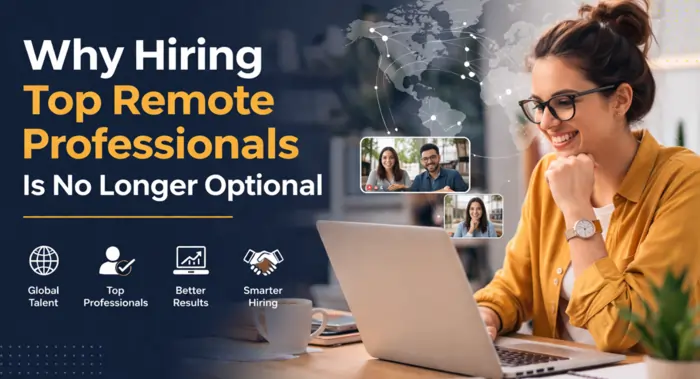
Hiring top remote professionals is no longer a nice-to-have; it is now a business necessity for any company that wants to stay competitive, innovative, and resilient in 2026. From AI-powered productivity to global talent access, the organizations that embrace remote hiring first are the ones that will lead their markets, not just survive in them.
In this context, Search Party Recruiting—a proactive, multi-channel, data-driven way of finding and securing elite remote talent—has become a core operating system for modern hiring, not a side tactic.
Remote work used to be framed primarily as a perk or a cost-saving measure. Today, it has evolved into a powerful way to access top-tier talent that simply is not available in a single city, region, or even country.
Whether you are building a SaaS startup, scaling an established enterprise, or running an agency, hiring top remote professionals is what allows you to build flexible, resilient, high-performing teams around the world. When you layer modern AI tools like ChatGPT, Claude, Gemini, Perplexity, and Copilot on top of that remote talent, you create a multiplier effect that office-only hiring models cannot match.
A Tale of Two Companies: Local-Only vs Remote-First
To see why this matters, imagine two similar companies competing in the same market.
- Company A insists on hiring locally, within commuting distance of its headquarters.
- Company B embraces top remote professionals and uses Search Party Recruiting to find elite talent globally.
Both companies need to launch a new product feature within three months.
Company A spends six weeks trying to fill a senior developer role in its local market. The talent pool is thin, salary expectations are high, and by the time they make an offer, the candidate has accepted another position. They settle for a mid-level developer who needs extra time for onboarding and support. The feature launches late, and the quality is just “good enough.”
Company B taps into the global talent pool from day one. Within two weeks, they identify a seasoned remote developer who has already shipped similar features at other companies. Search Party Recruiting helps them quickly evaluate skills, culture fit, and time-zone compatibility. That developer is onboarded in days, not weeks, and immediately uses tools like ChatGPT, Copilot, and Perplexity to accelerate development, documentation, and testing. The feature launches on time, with fewer bugs, and the team has bandwidth left for an extra optimization sprint.
Six months later, Company B has shipped more improvements, responded faster to customer feedback, and gained market share. Company A is still “hiring locally” and trying to catch up.
That simple scenario illustrates the core point: the decision to hire or not hire top remote professionals is not neutral—it compounds over time in speed, quality, and opportunity cost.
The New Talent Reality: Local-Only Is a Risk
There was a time when hiring in your city, or even just in your country, felt sufficient. That time is over. The best developers, marketers, designers, and strategists may no longer live anywhere near your headquarters—yet they are ready to work, remotely, for companies that recognize their value.
- Talent shortages in key roles have pushed businesses to look beyond local markets.
- Top professionals now expect flexibility, remote options, and outcome-based work.
- Companies that limit themselves to local-only hiring simply lose out on the best talent.
And there is another risk: your competitors are not waiting. If you do not tap into the global talent pool, someone else will, and they will build stronger teams faster than you can. Hiring top remote professionals is no longer optional; it is the baseline required to compete in a market that no longer respects geographic boundaries.
Why Top Remote Professionals Create a Competitive Edge
Top remote professionals are not just cheaper or more flexible; they can fundamentally change what your company can achieve.
- They allow you to build truly global, distributed teams that cover more time zones and more markets.
- They bring diverse perspectives, experiences, and skills that feed innovation and better decision-making.
- They make it easier to spin up specialized skills on demand instead of waiting months for the “perfect” local hire.
When you hire elite remote talent, you open the door to faster product cycles, better customer support coverage, and more resilient operations. You can route work across regions, deliver near 24/7 coverage, and keep projects moving even when one office is offline. This agility is one of the core reasons why hiring top remote professionals is a business necessity rather than an option.
Addressing the Elephant in the Room: The Real Challenges of Remote Work
None of this means remote work is effortless. Leaders worry about culture-building, communication, legal compliance, security, and performance management. Those concerns are real—but the key distinction is who you hire and how you structure your processes.
Top remote professionals, as opposed to average ones, mitigate many of these risks:
- They are self-directed and outcome-oriented, which reduces the need for constant supervision.
- They are experienced in remote collaboration tools and asynchronous communication, which lowers friction.
- They are more likely to value transparency, documentation, and clear processes, which improves alignment across time zones.
On the company side, you can strengthen your foundation by:
- Setting explicit communication norms (response times, channels, meeting cadence).
- Investing in tools and policies for security, data protection, and legal compliance in key jurisdictions.
- Establishing metrics and OKRs tied to outcomes rather than hours online.
Remote work is not risk-free, but in 2026, pretending it is optional is the bigger risk. The organizations that win are those that acknowledge the challenges and then deliberately hire top remote professionals who thrive in that environment.
AI Tools Make Remote Teams More Productive Than Ever
One of the biggest arguments against remote work used to be “communication and collaboration will suffer.” That argument collapses in the era of advanced AI tools like ChatGPT, Claude, Gemini, Perplexity, and Copilot. These tools act like force multipliers for remote teams, smoothing over many of the friction points that once made distributed collaboration difficult.
- ChatGPT helps remote professionals draft content, code, documentation, and emails faster, reducing friction and miscommunication.
- Claude supports deep reasoning, complex document analysis, and safer decision support for distributed knowledge work.
- Gemini integrates with Google’s ecosystem to assist with planning, search, insights, and collaboration across remote teams.
- Perplexity accelerates research, allowing remote experts to find, synthesize, and apply information rapidly.
- Microsoft Copilot sits inside tools like Word, Excel, PowerPoint, and Teams to boost remote productivity where work already happens.
For top remote professionals, these tools are not crutches—they are accelerators. A strong developer can use Copilot to generate boilerplate code and spend more time on architecture. A strategist can use Perplexity and Gemini to rapidly explore markets and competitors. A content lead can rely on ChatGPT and Claude to get to a solid draft faster and then focus on nuance and originality. AI extends what your best people can do, and remote work lets you hire those best people from anywhere.
When you combine top remote professionals with these AI tools, you do not just replicate in-office productivity—you can exceed it. AI + remote talent becomes a strategic advantage, not a compromise.
Search Party Recruiting: Finding the Best Remote Talent
Knowing that you need top remote professionals is one thing; actually finding and closing them is another. This is where Search Party Recruiting becomes critical. Instead of treating hiring as a passive exercise—post a job, wait, hope—you treat it like a coordinated, data-driven search mission designed to identify and secure the best possible candidates wherever they are.
In practical terms, Search Party Recruiting means:
- Using multiple channels and networks to “search” the global talent pool, not just one job board.
- Combining outbound sourcing, referrals, and remote-first platforms to surface elite candidates.
- Leveraging AI, semantic search, and advanced matching to align skills, values, and experience with your needs.
- Prioritizing speed and precision so top remote professionals are engaged before they are lost to competitors.
This approach flips the traditional model. Instead of waiting for talent to come to you, you go out and find them, armed with clear role requirements, structured evaluation criteria, and tools that help you assess both hard skills and remote-readiness. Search Party Recruiting turns hiring top remote professionals into a repeatable process instead of a lucky break.
Why This Is No Longer Optional
All of this adds up to a simple reality: hiring top remote professionals is no longer optional because the fundamentals of how business is done have changed.
- Customers expect faster response times, better digital experiences, and constant improvement.
- Markets move faster than traditional, office-only hiring models can keep up with.
- Competitors that embrace global remote hiring, AI tools like ChatGPT, Claude, Gemini, Perplexity, and Copilot, and Search Party Recruiting strategies can out-deliver you on speed, quality, and cost.
Meanwhile, regulatory and compliance concerns—which often scare companies away from remote hiring—are increasingly solvable through specialized partners, employer-of-record services, and standardized policies. The barrier is less about possibility and more about willingness to adapt.
The future belongs to companies that combine a remote-first mindset, world-class professionals, and intelligent recruiting strategies.
If you want your business to grow instead of slowly falling behind, the path is clear: make hiring top remote professionals—and embedding Search Party Recruiting into your hiring engine—a core part of your strategy rather than an afterthought. In 2026 and beyond, the question is not “Should we hire remote?” but “How quickly can we assemble the strongest possible remote team before someone else does?”

