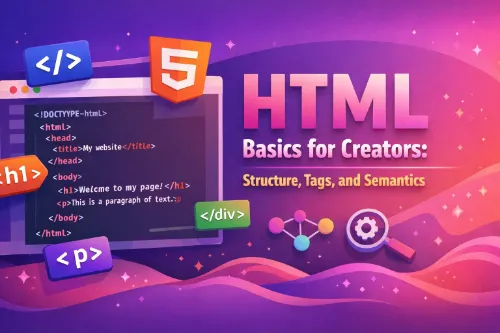
If you’re a content creator, blogger, or digital marketer—whether you’re running a niche blog or managing client sites globally—learning HTML isn’t about becoming a full‑time developer. It’s about control: control over how your pages look, how search engines read them, and how answer engines (AI search, voice assistants) decide which content to surface.
This guide walks you through HTML basics for creators so you can structure content cleanly, support SEO and AEO, and keep your brand experience consistent.
Why creators should care about HTML
What is HTML, in creator terms?
HTML (HyperText Markup Language) is the language that defines the structure of a web page: what’s a heading, what’s a paragraph, what’s navigation, and what’s the main content. Your browser reads HTML first, then layers on CSS (for styling) and JavaScript (for interactivity). If you want a deeper primer, you can skim this beginner‑friendly HTML tutorial before you dive back into your own content.
If you publish content online, you are already working with HTML—even if it’s through WordPress blocks, page builders, or templates. Knowing the basics lets you understand what’s happening behind the scenes instead of guessing.
What problems does HTML actually solve for you?
With HTML fundamentals, you can:
- Fix layout and formatting issues without waiting for a developer.
- Audit heading structure to make sure each page has one clear topic and logical subtopics.
- Understand why a post might struggle to rank because of messy markup.
- Communicate clearly with designers and devs when you need changes.
Think of HTML as the skeleton of your content. If the skeleton is misaligned, no design tweak will fully save the experience.
HTML basics for beginners (creator‑friendly)
Tags, attributes, and elements
HTML works through tags that “mark up” your content. A tag tells the browser what type of content it is (heading, paragraph, image, etc.). If you ever get stuck on what a tag does, the MDN HTML reference is a reliable place to check elements and attributes.
Example:
xml<p>This is a paragraph of text.</p>
<p> is the opening tag.</p> is the closing tag.
Together with the text inside, they form a paragraph element.
Attributes give extra information to a tag:
xml<a href="https://socialbaddie.com">Visit Social Baddie</a>
<a> is an anchor tag (a link).
Once you understand tags and attributes, you can read and lightly edit most HTML your CMS generates. For a more complete list of what’s possible, you can browse the HTML elements reference as a “dictionary” when needed.
The basic document structure
A minimal HTML5 page looks like this:
xml<!DOCTYPE html>
<html lang="en">
  <head>
    <meta charset="UTF-8">
    <title>HTML Basics for Creators</title>
    <meta name="description" content="Learn HTML basics for creators: structure, tags, and semantics so your content is clear, SEO-friendly, and answer-engine-ready.">
  </head>
  <body>
    <h1>HTML Basics for Creators</h1>
    <p>Welcome to your first HTML page.</p>
  </body>
</html>
Key pieces:
<!DOCTYPE html>declares HTML5.<html>wraps the whole page.<head>contains meta information, the title, description, and other SEO/AEO signals.<body>contains everything users actually see in the browser.
As a creator, you mostly live in the body, but the head is where your title tag, meta description, and structured data live—critical for search and answer engines.
The structure of a web page
Macro layout: header, navigation, main, footer
Modern HTML encourages semantic elements—tags that describe the role of each section instead of generic containers. This makes your page more readable, accessible, and search‑friendly.
Typical layout for a content‑driven site:
xml<body>
  <header>
    <nav>
      <!-- main navigation -->
    </nav>
  </header>

  <main>
    <article>
      <!-- blog post or main content -->
    </article>

    <aside>
      <!-- newsletter opt-in, related posts, promos -->
    </aside>
  </main>

  <footer>
    <!-- footer links, legal, socials -->
  </footer>
</body>
These tags—<header>, <nav>, <main>, <article>, <aside>, <footer>—give meaning to each region instead of leaving everything as anonymous <div>s. If you want a quick table of common semantic tags and their roles, check this semantic elements overview.
Why semantic structure matters
Semantic structure helps:
- Users: Screen readers and assistive tech can jump between navigation, main content, and footer more easily.
- Search engines: Crawlers can distinguish your main article from sidebars and boilerplate.
- Answer engines: AI systems can more easily find the core content, headings, and supporting sections to quote in answers.
When you check your theme or template, seeing proper semantic tags is a good sign that the foundation is modern.
The essential HTML tags for creators
Headings: H1, H2, H3 and content hierarchy
Headings are your outline in code. They tell both humans and machines how your ideas are organized.
Example of a healthy heading structure:
xml<h1>HTML Basics for Creators</h1>

<h2>Why Creators Should Care About HTML</h2>
<p>...</p>

<h2>HTML Structure of a Web Page</h2>

  <h3>Basic HTML Page Layout</h3>
  <p>...</p>

  <h3>Semantic HTML5 Elements</h3>
  <p>...</p>
Guidelines:
- Use one
<h1>per page to represent the main topic. - Use
<h2>for major sections. - Use
<h3>for subsections under an H2. - If you like answer‑engine traffic, turn some H2s into explicit questions, like “What is semantic HTML?” and follow them with clear, concise answers.
Paragraphs and lists
Paragraphs and lists make your content readable and scannable.
Paragraphs:
xml<p>This paragraph introduces the concept.</p>
Lists:
xml<ul>
  <li>First key takeaway</li>
  <li>Second key takeaway</li>
  <li>Third key takeaway</li>
</ul>
Use:
<p>for normal text blocks.<ul>with<li>for unordered (bulleted) lists.<ol>with<li>for ordered (numbered) lists.
Lists are useful for both users and answer engines, especially for steps, checklists, and feature breakdowns. Online tutorials like the HTML lists section show many examples if you want to practice formatting your own outlines.
Links and images
Links connect your content and guide users (and crawlers) through your site.
xml<a href="https://socialbaddie.com/web-dev/">Explore more web dev notes</a>
Best practices:
- Use descriptive anchor text that reflects where the link goes.
- Avoid vague anchors like “click here.”
Images add visual context and can support SEO when used correctly:
xml<img src="creator-setup-davao.jpg" alt="Content creator in Davao learning HTML basics on a laptop">
Tips:
- Use
alttext to briefly describe the image and its context. - Include place context (e.g., Davao, Philippines) if relevant to the story or audience.
- Don’t stuff keywords into alt text just for rankings.
If you want to see more examples of accessible image markup, MDN’s element docs are worth bookmarking.
Semantic HTML: structure with meaning
What is semantic HTML?
Semantic HTML is about using tags that describe the purpose of your content instead of using anonymous containers for everything.
Compare this old approach:
xml<div id="header">...</div>
<div id="content">...</div>
<div id="footer">...</div>
To a semantic approach:
xml<header>...</header>
<main>...</main>
<footer>...</footer>
And for blog content:
xml<article>
  <h1>HTML Basics for Creators</h1>
  <p>...</p>
</article>
Semantic HTML makes it crystal clear which parts of the page are navigation, which are main content, and which are secondary.
Key semantic tags you’ll see in themes
Here are the semantic elements that matter most for creators:
<header>– The top section of the page, often with logo and navigation.<nav>– A block of navigation links.<main>– The main content of the page (only one per page).<section>– A thematic grouping of content within a page (e.g., “Benefits,” “How it works”).<article>– Self‑contained content like a blog post, news item, or guide.<aside>– Related content that supports the main content, like sidebars or promos.<footer>– Bottom area with site‑wide info, credits, or secondary navigation.
Understanding these gives you an instant read on whether a template is structured intelligently. For a deeper walkthrough with diagrams and examples, this semantic HTML guide is excellent.
How to “write semantic markup” as a non‑dev
Even if you rarely touch raw HTML, you can:
- Pick themes and page templates that use
<main>,<article>, and logical headings. - Avoid stacking multiple hero sections that each generate an H1.
- Use sections that group related ideas and label them with appropriate headings.
When you do edit HTML directly, focus on clarity: one H1, logical H2/H3 flow, and semantic wrappers where possible.
HTML, accessibility, and UX
Accessible structure by default
Semantic HTML and a clear heading hierarchy create a more accessible experience:
- Screen readers let users jump to landmarks like navigation, main content, and footer.
- Users who rely on headings can skim the page structure quickly.
- Alt text gives context for images to users who can’t see them.
You don’t need to master every accessibility spec, but avoiding obvious problems—like using headings purely for styling or skipping alt text on meaningful images—makes a big difference. If you want to go further, MDN’s docs on HTML and accessibility are a solid next step.
Why clean code feels better
Clean, consistent HTML supports:
- Predictable behavior across devices.
- Easier debugging when a layout breaks.
- Less fragility when you change themes or revisit content months later.
Like a well‑organized Notion workspace, you don’t always see the structure at first glance, but you feel the difference in every interaction.
HTML for SEO and answer engines
Core HTML signals for SEO
From a search engine’s perspective, HTML is where your structure and signals live. Important elements include:
<title>– The page title, which often becomes the clickable headline in search results.<meta name="description">– A short summary that can appear under the title in results.<h1>– The main heading that should align with the page topic.<h2>and<h3>– Subheadings that break the topic into logical sections.<a href="...">– Internal and external links with descriptive anchor text.<img alt="...">– Alt attributes that describe images and give extra context.
If a theme outputs multiple H1s or nests headings out of order, you’ll see it instantly when you inspect the HTML or use a basic SEO audit tool.
Answer Engine Optimization (AEO) basics
Answer Engine Optimization is about shaping your content so AI search and voice assistants can easily extract useful answers. To support this, you can:
- Turn key subtopics into explicit questions in your headings, like “What is HTML?” or “How much HTML do creators need to learn?”
- Follow these headings with a direct, short answer (two to four sentences) before you add examples and side notes.
- Use bullet lists and ordered lists for steps, checklists, and definitions.
- Include an FAQ section that mirrors common real‑world questions.
Your HTML structure—headings, lists, and semantically separated sections—acts as a roadmap for any system trying to summarize or quote your content. If you want to dive deeper into AEO tactics, this AEO comprehensive guide is a strong reference.
GEO: adding location context without stuffing
If your audience is concentrated in certain regions—say, creators in the Philippines or Southeast Asia—you can add light geographic context where it’s natural. For example:
- Mention that creators in Davao or Manila often work mobile‑first, so testing responsive layouts is crucial.
- Use case studies or examples that reference local realities, like slower connections or budget hosting.
- Reference your region when it’s part of the story, not as a forced keyword.
The goal is to sound real and grounded, not like you’re trying to game location‑based results.
NLP‑friendly and human‑friendly writing
Search engines and AI tools now rely heavily on Natural Language Processing, which means they focus on meaning and relationships, not just exact keyword matches. To play well with NLP systems while staying human‑friendly:
- Write like you’re explaining concepts to a smart friend who’s new to HTML.
- Use natural phrases like “HTML basics,” “semantic HTML,” “page structure,” “headings,” and “accessibility” where they make sense.
- Keep each section focused on one main idea with a clear heading.
- Avoid robotic repetition of the focus keyword—contextual coverage matters more than exact‑match density.
This makes your content easier to read and easier for algorithms to interpret correctly.
Learn HTML step by step (without burning out)
A simple learning roadmap
You don’t need a bootcamp to get dangerous with HTML as a creator. A realistic progression might look like this:
Week 1 – Core tags and structure
- Learn
<p>,<h1>to<h3>,<ul>,<ol>,<li>,<a>,<img>. - Take a short article and rewrite it with clean headings, paragraphs, and lists.
Week 2 – Layout and semantics
- Add
<header>,<nav>,<main>,<article>,<section>,<aside>,<footer>to your toolkit. - Rebuild one of your existing blog posts in a more semantic structure.
Week 3 – SEO and AEO awareness
- Map your CMS fields (title, meta description, categories, tags) to the underlying HTML.
- Add question‑based headings and short answers to a key pillar page.
Week 4 – Clean‑up and refinement
- Audit a set of live posts for heading hierarchy, alt text, and internal links.
- Create your personal HTML checklist to run before you publish anything new.
If you want a structured practice track, the combined HTML and CSS tutorial is handy to follow in parallel while applying everything to your own site.
Practice ideas that use your real content
Instead of generic exercises, use your own site as your sandbox:
- Take a high‑traffic post and improve its headings, lists, and internal links.
- Turn a social media caption or thread into a fully structured blog article.
- Build a simple “link in bio” page using pure HTML as a mini‑project.
Set a 20‑minute timer, pick one of these tasks, and iterate. The more you do it in real contexts, the faster it sticks.
Frequently asked questions about HTML for creators
Q1. Do I need to learn HTML to be a content creator?
You don’t need to become a developer, but basic HTML skills help you fix formatting issues, improve SEO, and communicate more clearly with designers and devs. It’s a small investment with a big payoff in control and confidence.
Q2. How much HTML should bloggers and marketers learn?
If you understand headings, paragraphs, lists, links, images, and a few semantic tags like <article> and <section>, you already have enough to structure high‑quality blog posts and landing pages. Anything beyond that is bonus.
Q3. Is semantic HTML still important for SEO in 2026?
Yes. Semantic HTML helps search engines and answer engines quickly identify your main content, subtopics, and supporting sections, which improves indexing and can boost your chances of earning rich snippets and AI citations.
Q4. How does HTML help with answer engines and AI search?
Clear headings, concise definitions under each question, and well‑structured lists make it much easier for AI search and voice assistants to extract accurate answers and attribute them back to your page.
Q5. I use WordPress or a page builder—do I still need HTML?
Visual builders are helpful, but they sometimes generate messy markup and confusing heading structures. Basic HTML knowledge lets you spot issues like multiple H1s, missing alt text, or broken lists and fix them quickly instead of feeling stuck.
Q6. Is HTML different if I’m a creator in the Philippines or Southeast Asia?
The language itself is the same worldwide. What changes is context: your hosting choices, typical connection speeds, and the devices your audience uses. Understanding HTML helps you design and test with those realities in mind.
A creator‑focused HTML checklist
Before you publish your next article or landing page, run through this quick checklist:
Structure
- One clear H1 that matches the main topic.
- Logical H2/H3 hierarchy with no random jumps in levels.
- Semantic wrappers (
<main>,<article>,<section>) where your theme or builder allows it.
Content blocks
- Short paragraphs instead of walls of text.
- Lists where steps, tips, or features need to be scannable.
- No unnecessary
<br>tags used for spacing.
Links and images
- Internal links with descriptive anchor text pointing to relevant pillars or supporting posts.
- Alt text for meaningful images that fits the context and, when relevant, gently reflects location or topic.
SEO and AEO
- Title and meta description are written for humans but structured enough to work as SERP snippets.
- Key sections use question‑style headings with direct answers underneath.
- Optional FAQ at the bottom to capture extra queries.
Cleanliness
- No duplicate H1s or empty sections.
- Layout tested on mobile and desktop for readability.
Run this checklist a few times and it will quickly become second nature. HTML stops feeling like “code” and starts feeling like what it truly is for you: the backbone of your content strategy.

