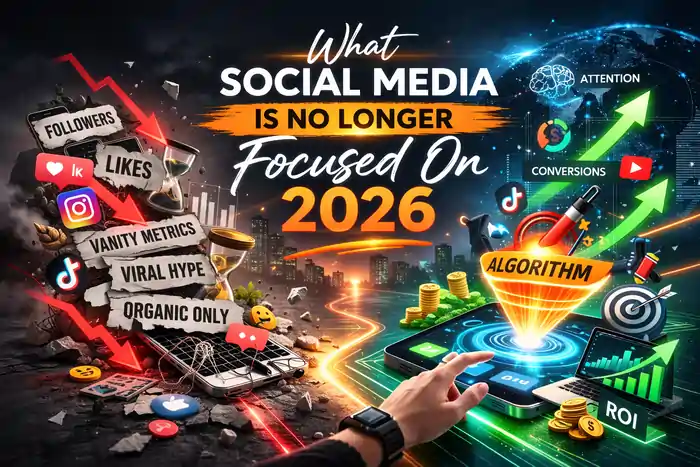
Most people are still playing a 2016 game on a 2026 field. They’re chasing followers. They’re celebrating likes. They’re obsessing over going viral. They’re posting “consistently” without a distribution plan.
But social media in 2026 is not built for that anymore. It is no longer a follower-first environment. It is no longer chronological. It is no longer “free exposure.” And it is definitely no longer just about engagement.
Social media is now an algorithm-driven distribution system inside the global attention economy — powered by AI feed ranking, behavioral data, and monetization layers. The idea of platforms functioning as marketplaces for user focus mirrors how the attention economy is framed in modern economic and media analysis.
If you misunderstand that shift, you’ll chase vanity metrics. If you understand it, you’ll build leverage by designing around ranking systems and owned demand — exactly what your Social Media Foundations pillar emphasizes: structure before scale.
Because before growth, you need structure.
Before visibility, you need infrastructure.
1️⃣ It’s No Longer About Followers
There was a time when follower count equaled reach. That time is gone.
Modern platforms prioritize:
- Watch time
- Completion rate
- Engagement signals
- Behavioral similarity clusters
- Predicted relevance
Meta explains in its documentation on how ranking works in Feed that content visibility is determined by predictive models estimating how likely a user is to interact — not simply by follower relationships. Similarly, TikTok outlines in its “How TikTok recommends videos #ForYou” guide that watch time and completion rate heavily influence distribution.
You can have:
5,000 followers
500,000 followers
5 million followers
And still get suppressed reach if retention drops. Follower count is a vanity metric. Distribution is an algorithmic outcome.
2️⃣ It’s No Longer About Going Viral
“Go viral” is still the most dangerous beginner goal. Short-form video dominance has created the illusion that reach equals growth, but virality without funnel structure equals attention without monetization.
Recent breakdowns of the creator economy — including analyses of income polarization such as the CreatorIQ data summarized in this creator volatility discussion — show how inconsistent revenue can be when growth depends solely on platform reach.
Virality is distribution. Distribution without capture is noise.
If your content goes viral but you don’t capture:
- Emails
- Community
- Product trials
- Website traffic
You’ve rented attention without building equity. Owned > borrowed.
3️⃣ It’s No Longer Chronological
Early feeds were time-based. Now they are predictive.
Meta’s Feed ranking system uses machine-learning models to evaluate signals like interaction history and predicted engagement, as detailed in its News Feed ranking and Feed ranking explainers. TikTok confirms in its recommendation documentation that behavior — watch time, replays, and interactions — not chronology, drives what appears next.
You are not posting to followers. You are publishing into a ranking engine. That shift changes everything.
4️⃣ It’s No Longer “Free Marketing”
Organic reach decline is structural. Platforms are ad-funded businesses; in an attention-economy context, attention is monetized through advertising inventory, not goodwill.
Organic reach is:
Proof of resonance.
Not guaranteed distribution.
Meta’s ad objective framework — summarized clearly in guides like this Meta Ad objectives breakdown and specialist explainers on Meta ad objectives and usage — shows how delivery is optimized based on campaign goal: awareness, engagement, leads, or sales.
Social is now hybrid:
Organic = signal testing
Paid = amplification
No paid layer? Limited scale.
5️⃣ It’s No Longer About Engagement Alone
Engagement is a signal — not a business model. Likes do not equal revenue.
Performance marketing frameworks emphasize metrics like:
- CAC
- LTV
- Conversion rate
- Payback period
Shopify and DTC-focused performance content, such as this practical ROAS guide for Shopify stores, makes it clear: revenue screenshots are meaningless without margin, LTV, and acquisition cost context.
Engagement without downstream economics is a dopamine loop.
6️⃣ It’s No Longer Just “Social”
Social media in 2026 is:
- Performance marketing
- Creator monetization
- Affiliate distribution
- Live commerce
- Subscription ecosystems
The evolution of creator monetization into multi-stream income (brand deals, platform payouts, products, memberships) is a recurring theme in creator economy breakdowns.
It is no longer networking. It is structured monetization.
7️⃣ It’s No Longer Safe to Be Platform-Dependent
Platform dependency risk includes:
- Algorithm changes
- Monetization shifts
- Account bans
- Policy changes
Owned vs paid vs earned media frameworks — often referenced in strategy literature like HubSpot’s overview of owned, earned, and paid media — reinforce that owned assets (email, website, community) are the durable core.
Followers are not assets. Emails are. Social is rented land.
8️⃣ It’s No Longer Just Content — It’s Signal Engineering
Short-form dominance is about maximizing:
- Watch time
- Retention
- Session length
TikTok explicitly highlights completion rate as a distribution driver in its recommendation system documentation.
If retention drops, reach drops.
Micro-content strategy now requires:
- Hook strength
- Narrative pacing
- Pattern interrupts
- Clear payoff
You’re engineering attention, not posting casually.
9️⃣ It’s No Longer Isolated From AI
AI now powers:
- Feed ranking
- Creative testing
- Predictive targeting
- Bid optimization
Google’s automation stack is a prime example: overviews of Smart Bidding in Google Ads show how machine learning optimizes delivery based on predicted conversion probability at each auction.
Automation amplifies structure. Weak structure = scaled weakness.
🔟 It’s No Longer Optional to Think Full-Funnel
Modern social must connect to:
- SEO (organic search capture)
- PPC (high-intent acquisition)
- Email (retention)
Google’s explanations of how search works show how organic authority compounds over time through crawling, indexing, and ranking — something social alone cannot replicate.
Integrated systems win. Isolated channels burn out.
The 2026 Social Media Reality
Social media is now:
- An AI-driven ranking engine
- A monetized attention marketplace
- A performance channel
- A distribution amplifier
- A demand generator
It is not:
- A guaranteed visibility tool
- A follower lottery
- A free growth hack
If you still treat it like 2016, you will build fragile growth. If you treat it like structured distribution feeding owned infrastructure, you build leverage.
Final Perspective | What Social Media Is No Longer
What social media is no longer focused on:
- Follower count
- Chronological posting
- Organic reach guarantees
- Vanity engagement
What it rewards instead:
- Retention
- Relevance
- Conversion
- Signal strength
- Owned audience building
If you want sustainable growth, read: Social Media Foundations.
Because before attention, you need assets.
Before visibility, you need infrastructure.
Before scale, you need control.
That’s SocialBaddie strategy 💻✨

