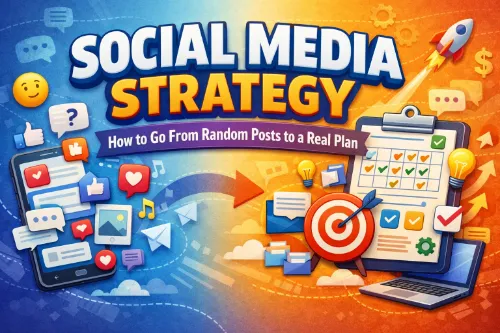
If your current “social media strategy” is posting whatever you feel like whenever you remember, this is for you. It’s time to go from random posts to a real plan that actually grows your brand instead of just filling your feed.
In this guide, we’ll walk through a simple, no-fluff social media strategy that turns chaotic posting into a clear, repeatable system. You’ll learn how to define your goals, create a social media content plan, and build a posting schedule you can actually stick to—without burning out or spending all day online.
What Is a Social Media Strategy (And Why It Matters)?
A social media strategy is your game plan for what you post, why you post it, and how it supports your business goals. It’s the difference between hoping your posts work and knowing what you’re doing with every piece of content.
When you’re stuck in random social media posts mode, everything feels disconnected. One day you’re sharing memes, the next day a product shot, then a motivational quote you found on Instagram. There’s no real social media posting strategy—just vibes. That might get you a few likes, but it won’t build a consistent social media presence or move the needle on sales, leads, or brand awareness.
If you want a deeper dive into the basics, you can also skim this detailed social media strategy guide from Hootsuite.
A real social media strategy gives you:
- A clear brand message instead of mixed signals
- A consistent social media presence instead of posting whenever you remember
- Goal-driven social media posts that support your business, not just your ego
Think of it as going from “post and pray” to a structured social media workflow that you can track, measure, and improve over time.
Signs You’re Stuck in “Random Posting” Mode
If you’re not sure whether you have a social media strategy or just a social media habit, here’s a quick self-audit.
You’re in random posting territory if:
- You post sporadically with no content plan or calendar
- You choose topics based on whatever you saw last on your feed
- You copy trends without knowing how they help your goals
- You don’t track results beyond “this got more likes than that”
- You feel pressure to “be everywhere” but don’t know why
In other words, you’re posting on social media without a plan.
And here’s the thing: the algorithm can feel brutal, but a lot of creators and business owners are not dealing with an algorithm problem—they’re dealing with a strategy problem. Once you turn random posts into a social media plan, your content stops feeling like noise and starts feeling intentional.
Step 1 – Clarify Your Goals and Success Metrics
Before you talk about content pillars, platforms, or aesthetics, you need one thing: clear goals.
Ask yourself: what do I actually want from my social media strategy?
Some common goals:
- Brand awareness (more people knowing you exist)
- Community and engagement (comments, DMs, saves, shares)
- Website traffic (clicks to your blog, offers, or shop)
- Leads and sales (booked calls, signups, purchases)
Your social media marketing strategy should be built around those goals, not around trends or what other people are doing. That’s the foundation of a goal-driven social media plan.
Once you choose your goals, pick a few success metrics (KPIs):
- Reach and impressions for awareness
- Engagement rate for community building
- Link clicks for traffic
- Conversions (signups, sales, inquiries) for revenue
If you want a more formal breakdown of these steps, the American Marketing Association has a strong piece on how to build a winning social media strategy in 8 steps.
This is how you move into data-driven social media strategy territory. You’re not just posting “because you should”—you’re posting with specific outcomes in mind.
Step 2 – Define Your Audience and Platforms
You can’t build a social media posting strategy if you don’t know who you’re talking to.
Get specific about your target audience:
- Who are they? (demographics and psychographics)
- What do they care about? (goals, desires, pain points)
- Where do they hang out online? (Instagram, TikTok, LinkedIn, Facebook, X, YouTube)
Instead of trying to be on every single platform, build your social media content plan around where your audience actually spends time and where you can show up consistently.
For example:
- A local service-based business might prioritize Facebook and Instagram.
- A B2B consultant might focus on LinkedIn and a bit of YouTube.
- A creator brand might lean into TikTok and Instagram Reels.
For a structured walk-through of choosing platforms and researching your audience, you can check out this 10-step social media marketing strategy guide from Squarespace.
Choosing platforms with intention is the first step in turning random posts into a strategy for success.
Step 3 – Craft Your Brand Message and Content Pillars
Now let’s make sure your content actually says something.
Your brand message needs to be clear: who you are, what you do, who you help, and why it matters. From that, you develop content pillars—recurring themes that keep your social media content plan organized and aligned with your goals.
Some simple content pillars you can use:
- Educational: tips, “how to” content, breakdowns
- Authority: case studies, client results, behind the scenes of your process
- Relatable / Personality: your story, opinions, beliefs, brand personality
- Social Proof: testimonials, before/afters, screenshots of wins
- Promotional: offers, launches, products, services
If you want another angle on content themes and pillars, Adobe’s 2025 guide to social media marketing strategies is a solid reference.
With strong content pillars, you stop guessing what to post. Your social media strategy framework becomes: choose a pillar, create a post that supports your goal, and plug it into your calendar.
This is the backbone of a structured social media workflow and makes it way easier to maintain a consistent social media presence without burning out.
Step 4 – Turn Ideas Into a Content Plan
Ideas without structure keep you stuck in “I should post more” mode.
To go from random social media posts to a real plan, you need to map those ideas into a social media content calendar. This is where your social media posting strategy becomes real.
Here’s a simple approach:
- Start with your goals for the month (e.g., promote a new offer, grow email list, drive website traffic).
- Choose content pillars that support those goals.
- Brainstorm topic ideas under each pillar.
- Assign each idea to a specific day on your content calendar.
Your social media content plan doesn’t have to be complicated. It can be as simple as a Google Sheet, Notion board, or even a notes app list. What matters is that you go from “I’ll post when I think of something” to “I already know what I’m posting next week.”
If you want templates instead of starting from scratch, try:
- Buffer’s collection of free social media calendar templates.
- HubSpot’s downloadable social media content calendar.
- Asana’s social media calendar template if you’re already using project management tools.
This is how you align your posts with business goals instead of letting your feed be controlled by random inspiration.
Step 5 – Create a Posting Schedule You Can Stick To
Let’s talk about consistency without toxicity.
A lot of people burn out because they hear advice like “post 3–5 times a day on every platform” and try to keep up. That’s not a sustainable social media posting strategy for most solo creators or small teams.
Instead, build a realistic schedule:
- Choose your main platforms (1–3 to start).
- Decide your minimum frequency per platform (for example, 3 posts per week on Instagram, 2 on LinkedIn, 2–3 TikToks or Reels).
- Batch-create content once or twice a week so you’re not starting from scratch every day.
This gives you planned social media content instead of panic-posting. Over time, you can adjust your posting frequency based on your data and capacity.
Remember: a simple, repeatable schedule you follow is more powerful than an “ideal” schedule you can’t maintain.
Step 6 – Optimize Posts for Engagement and Discoverability
Once you’ve got a plan, it’s time to sharpen how you show up.
An effective social media strategy isn’t just about what you post, but how you package it.
For each post, think about:
- Hook: The first line or three seconds—does it make people stop scrolling?
- Value: Are you educating, entertaining, inspiring, or provoking thought?
- Call to action: Are you telling people what to do next (like, comment, save, share, click, DM)?
- Visuals: Are your graphics or videos aligned with your brand and platform best practices?
- Searchability: Are you using relevant keywords and phrases in your captions and text overlays?
If you want structured training on this, HubSpot’s free Social Media Marketing certification course is worth bookmarking.
Even on social, basic keyword strategy matters. Use simple, natural language that mirrors how your audience talks. That’s where NLP-friendly phrasing and AEO (answer engine optimization) come in: answer questions clearly, use conversational headings, and write like you’re talking to one person, not an empty room.
You’re basically building a results-focused social media plan that makes your content easier to find, easier to understand, and easier to act on.
Step 7 – Track, Analyze, and Improve Your Strategy
Here’s where you fully step into that data-driven social media strategy.
Don’t just post and move on. Review your analytics weekly and monthly:
Weekly:
- Which posts got the highest engagement?
- Which topics or content pillars performed best?
- What formats worked (Reels, carousels, static images, text posts)?
Monthly:
- How did your reach, engagement, and clicks trend over the month?
- Did social media contribute to leads, inquiries, or sales?
- Which platforms are worth more of your energy?
Use this data to refine your social media strategy framework:
- Do more of what works
- Cut or rework what doesn’t
- Run small experiments (different hooks, posting times, formats)
Guides like the BDC social media marketing plan checklist can help you sanity-check that you’re covering all the basics as you optimize.
This move—from guessing to measuring—is what separates random posts from a real, optimized social media marketing strategy.
From Random Posts to Real Plan: Your 30-Day Blueprint
If you want a simple roadmap to get unstuck, use this 30-day action plan.
Week 1: Foundations
- Define your goals and success metrics.
- Clarify your target audience and choose 1–3 priority platforms.
- Tighten your brand message in one clear statement.
Week 2: Strategy
- Choose 3–5 content pillars that support your goals.
- Brainstorm 20–30 content ideas based on real questions, objections, and desires your audience has.
- Decide your posting frequency for each platform.
For inspiration, you can cross-check with this 8-step social media strategy breakdown from Indeed.
Week 3: Planning and Creation
- Build a basic social media content calendar for the next 30 days.
- Batch-create content (copy, visuals, short-form video) for at least 1–2 weeks at a time.
- Set up a simple structured social media workflow: ideation → creation → scheduling → posting → analyzing.
Week 4: Execution and Optimization
- Post consistently according to your social media posting strategy.
- Track performance weekly based on your chosen KPIs.
- Adjust next month’s social media content plan based on what actually worked.
By the end of these 30 days, you’re not “winging it” anymore. You’ve turned random social media posts into a strategy for success that you can grow, adapt, and scale.
Common Mistakes to Avoid
On your way from random posts to a real social media strategy, watch out for these traps:
- Chasing every trend without aligning it to your goals
- Creating content only for vanity metrics and ignoring conversion
- Trying to be on every platform instead of owning a few
- Overcomplicating your system so much that you stop posting
- Ignoring your analytics and relying only on intuition
For another perspective on common pitfalls and best practices, this 6-step guide to a winning social media strategy breaks down how to align campaigns, data, and goals.
A strong social media strategy is simple, intentional, and sustainable. If your system feels too heavy, streamline it until it’s something you can actually live with week after week.
Final Thoughts: Start Small, But Start Strategic
You don’t need a fancy agency-level social media marketing strategy to see results. You just need:
- Clear goals
- A simple social media content plan
- A realistic posting schedule
- A habit of checking your data and adjusting
That’s how you go from random posts to a real plan that supports your brand, your business, and the lifestyle you’re building.
Frequently Asked Questions
1. How often should I update my social media strategy?
You should review your social media strategy at least every quarter, but do a light check-in monthly. Adjust your goals, content pillars, or posting schedule based on what’s working, what’s not, and any shifts in your audience or offers.
2. How long does it take to see results from a social media strategy?
It usually takes 60–90 days of consistent posting and optimization to see clear patterns in reach, engagement, and traffic. Sales and leads may take longer, depending on your offer, pricing, and how warm your audience is.
3. Do I need to be on every social media platform?
No, and trying to be everywhere usually dilutes your impact. Start with one to three platforms where your ideal audience is already active and where you can show up consistently with quality content.
4. What’s the difference between a social media strategy and a content calendar?
Your social media strategy is the big-picture plan: goals, audience, platforms, positioning, and content pillars. Your content calendar is the tactical execution: what you’re posting, where, and when.
5. How do I choose the right social media KPIs for my brand?
Start from your main goals. If it’s awareness, focus on reach and impressions. If it’s community, track engagement rate. If it’s traffic and sales, prioritize clicks, signups, and conversions over likes.
6. Is it okay to reuse or repurpose my social media content?
Yes—repurposing is smart, not lazy. You can turn one core idea into multiple formats (Reels, carousels, tweets, LinkedIn posts, stories) and repost high-performing content after a few weeks or months with a new angle or hook.
7. How do I know who my target audience is on social media?
Combine what you know from your current clients/customers with platform insights. Look at who engages with your content, what they ask in DMs or comments, and which topics they respond to most. Use that data to refine your audience profile.
8. Do I need professional design skills to have a strong social media presence?
Professional design helps, but it’s not required. Clean layouts, readable text, consistent colors, and clear messaging beat busy, overdesigned graphics. Templates and simple brand guidelines go a long way.
9. What should I post if I don’t have many client results yet?
Focus on educational content, your process, your story, and your perspective. Show how you think, how you work, and how you would solve your audience’s problems even if you don’t have tons of testimonials yet.
10. How do I handle negative comments on my social media posts?
Stay calm and professional. If it’s constructive criticism, acknowledge it and respond helpfully. If it’s trolling or abuse, don’t argue—block, delete, or restrict as needed to protect your community and energy.
11. Should I prioritize reach or engagement?
Neither matters in isolation. In the early stages, reach helps you get discovered, but engagement shows that your content is resonating. Aim for a healthy balance and always tie both back to your real goals (traffic, leads, sales, etc.).
12. How important are hashtags in a social media strategy today?
Hashtags still help on some platforms, but they’re not magic. Use a small set of relevant, specific hashtags rather than long, random lists. Your hook, content quality, and watch time or saves usually matter more than hashtags alone.
13. Can I manage my social media strategy on my own, or do I need a team?
You can absolutely manage it solo if you keep the strategy simple and realistic. As you grow, you may bring in help for design, editing, or scheduling—but the core strategy can start with just you and a clear plan.
14. How do I know if my content is “on-brand”?
Ask three questions: Does this sound like me? Does it speak to my ideal audience? Does it support my core message or goals? If the answer is yes, it’s likely on-brand—even if the format or trend is new.
15. What should I do if my social media strategy stops working?
Treat it like a test, not a failure. Review your analytics, identify what changed (platform updates, audience behavior, your content), and run small experiments with new hooks, formats, and topics. Keep the parts that still work and rebuild the rest.

