
In 2026, most digital platforms—including Google, Meta, TikTok, and YouTube—use AI-driven feeds to determine what users see. These systems analyze behavior, engagement signals, content relevance, and predicted user interest in real time. Instead of displaying content chronologically, platforms prioritize what they believe each user is most likely to engage with. This means visibility is no longer based on timing or budget alone, but on performance, relevance, and user experience signals. For advertisers and creators, success depends on aligning content with how these systems evaluate value.
Introduction: The Feed Is No Longer Neutral
There was a time when digital feeds were simple and predictable. You followed accounts, and you saw their posts in chronological order. Content distribution felt direct and transparent.
That model no longer exists.
In 2026, feeds are algorithmically curated environments powered by artificial intelligence. Every piece of content you see has been filtered, ranked, and selected based on predicted behavior. What appears on your screen is not random—it is the result of continuous evaluation and optimization.
Each scroll, pause, click, and interaction contributes to a system that learns what you are likely to engage with next. This transformation has fundamentally changed how content spreads, how advertising works, and how brands grow.
Understanding this shift is no longer optional. It is foundational.
What Is an AI-Driven Feed?
An AI-driven feed is a personalized ranking system that determines what content appears in front of each user. Instead of organizing content by time, it organizes content by predicted relevance and engagement potential.
This means the platform is constantly asking a single question:
What is this user most likely to engage with right now?
Meta describes its ranking systems as relying on signals like engagement, relationships, and relevance in its explanation of how Facebook Feed ranking works.
Similarly, Google explains that its systems prioritize relevance, quality, and usability when ranking results in its public guide on how Search works.
The key idea is simple but powerful. These feeds are not static lists. They are prediction systems designed to maximize engagement.
The Core Goal of AI Feeds
All major platforms operate with a shared objective: maximize user attention.
The longer users stay on a platform, the more opportunities exist for advertising, data collection, and behavioral modeling. AI-driven feeds are designed to support this goal by continuously improving what users see.
This creates a compounding system. Better predictions lead to higher engagement. Higher engagement produces more data. More data improves future predictions.
The result is a feedback loop where the system becomes increasingly accurate over time.
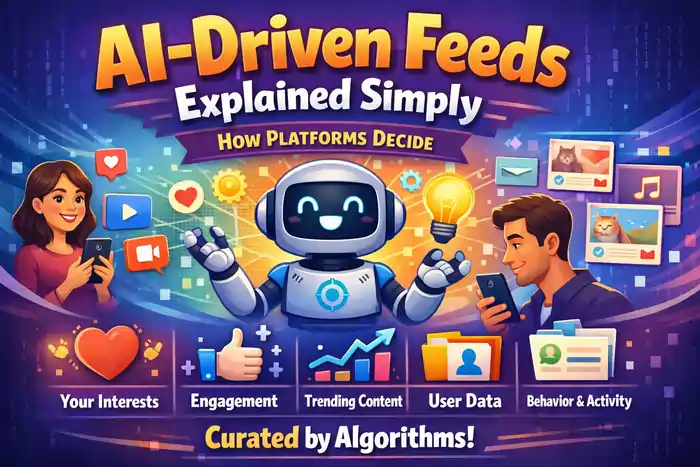
The Five Core Signals That Drive AI Feeds
AI-driven feeds rely on multiple signals to determine what content appears. These signals work together to create a personalized experience.
1. User Behavior
User behavior is the strongest signal. Platforms track actions such as clicks, watch time, scroll patterns, and interaction frequency. These behaviors reveal what users actually do, which is more reliable than what they say they prefer.
If a user consistently engages with a certain type of content, the system adapts. Over time, the feed becomes increasingly tailored to those patterns.
2. Engagement Signals
Engagement indicates value. When users like, comment, share, or save content, the platform interprets that as a sign of relevance.
Meta confirms that engagement signals play a central role in feed ranking decisions in its transparency resources on explaining ranking. Not all engagement is equal—shares and saves often carry more weight than likes because they indicate stronger intent.
3. Content Relevance
AI systems analyze the content itself: keywords, topics, visuals, and semantic relationships. Platforms attempt to understand what the content is about and how it connects to user interests.
This aligns with how Google evaluates content relevance and intent in search, as outlined in its explanation of ranking systems and signals. Relevance is no longer about exact keyword matching. It is about meaning, context, and intent.
4. Relationship Signals
On platforms like Facebook and Instagram, relationship signals influence visibility. Content from accounts that users interact with frequently is more likely to appear.
These signals include direct interactions, messaging behavior, and engagement frequency, which Meta details in its description of Facebook Feed personalization.
5. Recency
While recency still matters, it is no longer the dominant factor. AI-driven feeds prioritize relevance and engagement over timing.
A highly relevant post can outperform a newer but less engaging one.
How AI Feeds Work Step by Step
AI-driven feeds follow a structured process to determine what content appears:
- Gathering Candidates – The platform collects all potential content, including new posts, ads, and recommended material.
- Filtering – It removes low-quality, spam, or policy-violating content.
- Scoring and Ranking – Models assign scores based on predicted engagement, relevance, and user behavior.
- Personalization – Each user receives a unique feed tailored to their historical patterns and preferences.
- Continuous Learning – Every interaction feeds back into the model, refining future predictions.
This pipeline mirrors how Google describes its automated ranking systems that analyze many factors and signals.
AI Feeds Across Major Platforms
Different platforms apply similar principles with slight variations.
- Google uses ranking systems focused on relevance, quality, and usability, as detailed in its Search ranking systems guide.
- Meta emphasizes engagement, relationships, and content type in its Feed ranking explanations.
- TikTok prioritizes watch time, completion rate, and repeat engagement (as described in public creator education and analyses).
- YouTube focuses heavily on session duration, click-through rate, and overall watch time, according to YouTube’s own creator resources.
Despite these differences, the underlying principle remains consistent: performance determines visibility.
Why AI Feeds Changed Marketing
Before AI-driven feeds, content distribution was relatively predictable. If you had followers, you could reach them consistently.
Now, distribution is conditional.
Content must earn visibility through performance. If it resonates with users, it spreads. If it does not, it disappears.
This shift has changed how marketers approach content and advertising. It is no longer enough to publish consistently. Content must align with user intent and generate engagement to be pushed by the feed.
Ads Inside AI-Driven Feeds
Advertisements are now integrated directly into these systems and compete with organic content for attention.
This means ads must meet the same standards as content. They need to be relevant, engaging, and aligned with user expectations.
Google explains in its guide on how the Google Ads auction works that ad visibility depends on a combination of bid, ad quality, and the expected impact of assets—not just budget. This reinforces a key idea: ads are not separate from the system; they are evaluated within it.
AI Feeds and User Intent
One of the most important developments is the ability of platforms to infer intent.
- Search engines capture explicit intent: users type what they want.
- Feeds capture implicit intent: they predict what users might want based on behavior.
This allows platforms to surface content—and ads—before users actively search for them, based on patterns reflected in past engagement.
The Role of Machine Learning
Machine learning enables these systems to function at scale.
It identifies patterns, predicts outcomes, and continuously optimizes performance. As more data is collected, predictions become more accurate.
Google highlights how AI enhances content evaluation and ranking in its post about Search’s guidance on AI-generated content, emphasizing that helpful, people-first content is still the core standard.
Machine learning does not replace strategy. It amplifies it.
Why Some Content Performs Better
Content that performs well typically shares common characteristics:
- It captures attention quickly.
- It maintains engagement (watch time, scroll depth, reading time).
- It delivers clear value and aligns with user expectations.
Content that fails often lacks relevance, clarity, or alignment with user intent. The difference is not random—it is driven by measurable signals like engagement, retention, and negative feedback.
The Feedback Loop
AI-driven feeds operate through feedback loops.
- Content that performs well receives more visibility → gets more engagement → gains even more reach.
- Content that performs poorly is shown less often, limiting its ability to recover.
This creates a system where performance compounds over time—for better or worse.
How to Succeed in AI-Driven Feeds
Success requires alignment with how the system evaluates value.
- Focus on retention by creating content that holds attention, not just generates clicks.
- Match intent by addressing specific problems, needs, or interests.
- Encourage engagement through clear value, strong hooks, and calls to interact (likes, saves, shares, comments).
- Be consistent so the system has enough data to understand your content and your audience.
- Use data to refine your approach—analyze what works, what doesn’t, and adjust accordingly.
The Bigger Insight
AI-driven feeds are not just content distribution tools—they are decision-making systems.
They evaluate, predict, and optimize continuously. Visibility is not given—it is earned through performance.
Frequently Asked Questions
1. Are AI-driven feeds the same as “the algorithm”?
Yes. When people talk about “the algorithm,” they’re usually referring to the AI-driven ranking systems that decide what content appears in feeds and search results.
2. Do hashtags still matter in AI-driven feeds?
They matter less as a primary driver and more as context. AI relies more on behavior, relevance, and engagement than on hashtags alone.
3. Why do I see posts from accounts I don’t follow?
Platforms surface “recommended” or “suggested” content when they believe it matches your interests based on your past behavior, even if you don’t follow the creator.
4. Can posting more often increase my reach?
Posting more gives the system more data, but it doesn’t guarantee reach. Quality, relevance, and engagement signals still determine whether each piece of content is pushed.
5. Why do some of my posts go viral while others flop?
Small differences in hook, topic, timing, or audience fit can lead to big changes in early engagement, which then affects how far the feed pushes each post.
6. Do external shares (e.g., from messaging apps) affect performance?
Yes, when shared links bring users back to the platform and generate engagement, those signals can reinforce that a piece of content is valuable.
7. Are comments more important than likes?
Generally, deeper interactions like comments, shares, and saves are weighed more heavily than simple likes, because they indicate stronger interest.
8. Does deleting underperforming posts help my account?
Not usually. The system cares more about how current and future content performs. Deleting posts doesn’t reset your history or “clean” your account.
9. Can AI-driven feeds penalize clickbait?
Yes. If users click but quickly bounce, hide, or report content, those negative signals can reduce future reach, even if the initial click-through rate is high.
10. How long does it take for a post to “settle” in the feed?
Many posts get most of their reach within the first 24–72 hours, but platforms may continue to resurface content if engagement remains strong or becomes relevant again.
11. Do edits to a post affect its performance?
Minor edits usually don’t reset performance, but major changes to content or metadata after publishing can sometimes disrupt how the system evaluates it.
12. Does engagement from bots or fake accounts help?
No. Low-quality, non-human engagement can harm your overall signals and may trigger spam or integrity systems, reducing trust in your content.
13. Are AI-driven feeds biased toward big accounts?
Larger accounts have more data and often more engagement, but strong content from smaller accounts can still break through when performance signals are high.
14. How important is watch time for short-form video feeds?
Extremely important. On platforms like TikTok and Reels, completion rate and watch time are among the strongest predictors of whether a video will be shown more widely.
15. What’s the single best way to improve performance in AI-driven feeds?
Start by improving the first 3–5 seconds or first screen: a clear hook, relevant topic, and fast delivery dramatically increase the chance that users will stay, engage, and send the right signals back to the system.
Final Perspective | AI-Driven Feeds Explained
In 2026, platforms do not simply display content. They decide what is worth showing.
They filter based on relevance. They rank based on engagement. They personalize based on behavior.
This makes the system more competitive, but also more predictable for those who understand it.
Bottom Line
AI-driven feeds determine visibility based on behavior, engagement, relevance, and user experience.
To succeed, content must align with these factors.
Final Insight
The creators and advertisers who grow in 2026 are not the ones who post the most or spend the most. They are the ones who understand how platforms make decisions—and design their content accordingly. Visibility is no longer controlled by timing or budget alone. It is controlled by performance. And performance is driven by alignment with the system.

