In 2008, the safe advice was simple:
Go to college.
Get a degree.
Apply for jobs.
In 2026, that formula is no longer guaranteed.
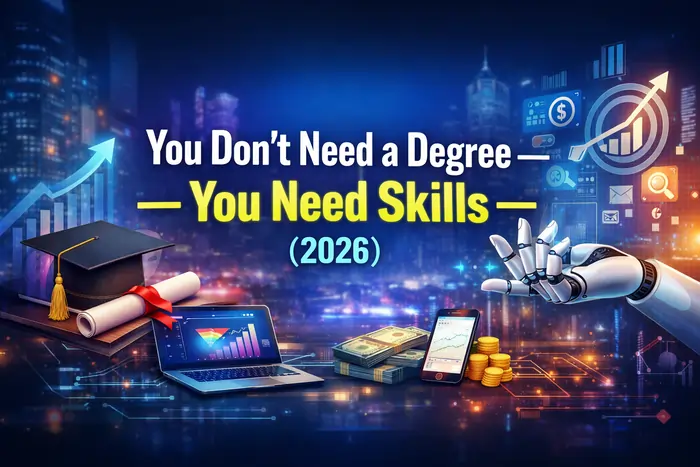
You don’t need a degree.
But you absolutely need skills.
Not random skills.
Not vague “soft skills.”
Not motivational quotes.
You need market‑ready, monetizable, future‑proof skills that create leverage inside the digital economy.
Because we are no longer operating in a credential‑first world.
We are operating in a proof‑of‑work economy.
And in that economy:
Skills compound.
Credentials expire.
The Degree vs Skills Debate (2026 Reality)
The degree vs skills debate is no longer philosophical — it’s structural.
Companies are shifting toward:
- Skills‑based hiring
- Portfolio‑based hiring
- Competency‑based hiring
- Experience over education
LinkedIn’s own Skills‑Based Hiring Insights show a steady rise in job posts that don’t require degrees and a strong consensus among recruiters that accurately assessing skills is critical to quality of hire. At the same time, the World Economic Forum’s Future of Jobs Report 2025 highlights that nearly 40% of core skills are expected to change within just a few years, reinforcing the urgency of reskilling and upskilling.
Credential inflation has made degrees common but not differentiating. A diploma no longer guarantees competency. Meanwhile, businesses need people who can execute immediately.
That’s why you see increasing searches for:
- Do you need a college degree in 2026?
- Is college still worth it?
- Can I get a job without a degree?
- Highest‑paying jobs without college?
The answer is layered.
A degree can help.
But skills create mobility.
The Job Market in 2026: What Actually Matters
The job market trends in 2026 show a clear pattern:
- Automation is replacing repetitive work.
- AI is accelerating knowledge tasks.
- Digital transformation jobs are expanding.
- Workforce transformation is skill‑driven.
McKinsey’s research on digital and workforce transformation, such as its insights on reskilling and remote work, shows that organizations investing in digital capabilities and talent upskilling outperform peers in productivity and profitability. That demand translates directly into digital skills for 2026.
This creates a widening skills gap.
Employers don’t struggle to find degrees.
They struggle to find applied capability.
That’s why:
- Tech jobs without a degree are growing.
- Remote jobs with no degree required are increasing.
- Digital careers without college are expanding.
- Self‑taught career paths are becoming normalized.
The U.S. BLS overview of computer and IT occupations projects these roles to grow much faster than average from 2024 to 2034, with about 317,700 openings per year — many of which emphasize practical competency over traditional academic paths.
We are moving toward a competency‑based hiring economy.
And that changes everything.
Skills Over Credentials: Why the Shift Happened
Degrees signal education.
Skills signal execution.
In a digital economy powered by an AI‑driven workforce, what matters is:
- Can you generate revenue?
- Can you improve performance?
- Can you reduce costs?
- Can you build systems?
This is where the idea of career capital becomes powerful.
Career capital is built through:
- Skill acquisition
- Project‑based learning
- Real‑world experimentation
- Building digital assets
- Creating proof of work
HubSpot’s inbound and content marketing research shows that companies using structured content ecosystems consistently generate more leads and revenue than those without a sustained system — a clear example of specific skills (content strategy, SEO, funnel design) producing measurable value.6minded+1
In 2026, execution > theory.
High‑Income Skills 2026: What Actually Pays
If you want a career without a degree, focus on high‑income skills that:
- Solve expensive problems
- Operate inside digital infrastructure
- Scale with automation
- Are AI‑resistant but AI‑amplified
Here are monetizable digital skills that matter.
1. Search Engine Optimization (SEO)
SEO is a skills‑based career with long‑term leverage.
It blends:
- Technical SEO
- Semantic search
- Structured data
- AI search optimization
- Core Web Vitals
- Website architecture
Google’s “How Search Works” documentation explains that ranking depends on relevance, quality, and usability, supported by clean technical structure — not just keywords stuffed into pages. Its Core Web Vitals guidance further ties loading, interactivity, and visual stability metrics to search performance.developers.
If you want a full roadmap, read (“SEO Careers: Skills & Growth Paths”) and treat it as a skills blueprint instead of a job description list.
SEO is proof that you can build a digital career without college — if you understand infrastructure.
2. Performance Marketing Skills
Paid media skills are directly tied to revenue.
You must understand:
- CPC, CPM, and CTR
- CAC calculation
- ROAS interpretation
- LTV modeling
Google’s Ads auction overview explains how ad visibility is determined by bid, ad quality, and expected impact — not just budget size — making strategic skill more important than raw spend.
If you can manage a budget profitably, your earning ceiling increases.
This is why performance marketing is one of the highest‑paying skills without a degree.
3. Data Analytics & Attribution
Modern marketing is data‑first.
You need:
- Attribution models
- Multi‑touch analysis
- Funnel reporting
- Conversion path mapping
- Analytics dashboards
Google’s documentation for GA4 and data‑driven attribution shows how machine learning assigns credit across touchpoints, making data literacy essential for understanding what actually drives revenue.
Without analytics understanding, you cannot scale anything.
4. Web Development Skills
You don’t need a computer science degree to become a developer.
But you do need:
- HTML, CSS, JavaScript
- Backend fundamentals
- API logic
- Database structure
GitHub’s Octoverse reports consistently show JavaScript and Python among the most used languages globally, confirming sustained demand for coding skills across products, tools, and internal systems. The BLS data for software and IT roles points to strong wage and job growth for developer‑adjacent careers, reinforcing that portfolios and Git repos often matter more than transcripts.
Bootcamp vs. college is now a real conversation because portfolio‑based hiring often outweighs grade sheets.
5. Social Media Marketing Skills
Social media is no longer creative‑only.
It requires:
- Platform literacy
- Funnel thinking
- Paid media management
- Audience targeting
- AI content tools
- Automation workflows
Meta’s public explanations of feed and ranking systems describe how engagement signals and predicted relevance drive distribution, meaning operators who understand distribution mechanics outperform content‑only creators.
If you understand how platforms rank and route attention, you become more valuable than someone who only posts.
Skill Stacking Strategy: The Real Advantage
One skill is good.
Skill stacking is leverage.
Examples:
- SEO + copywriting
- Paid media + funnel strategy
- Analytics + CRO
- Web development + technical SEO
The World Economic Forum’s skills outlook emphasizes continuous reskilling and cross‑functional capabilities (analytical thinking, resilience, tech literacy) as core survival strategies in an automation‑driven economy.digital-skills-jobs.
Skill stacking increases:
- Freelance income potential
- Consulting value
- Career resilience
In a lifelong learning economy, stacking skills creates optionality.
Alternatives to College Degree (That Actually Work)
Viable paths include:
- Online learning platforms
- Micro‑credentials
- Digital certifications vs. degrees
- Project‑based learning
- Apprenticeships
But remember:
Certification ≠ competency.
The key is proof of work.
Build:
- Case studies
- Personal projects
- Websites and apps
- Paid ad campaigns
- SEO experiments
Proof > transcript.
Future‑Proof Skills in the AI Economy
AI is not eliminating careers.
It is reshaping them.
To future‑proof yourself, focus on:
- AI‑assisted development
- Prompt literacy
- Automation strategy
- Systems thinking
- Technical fundamentals
WEF’s Future of Jobs analysis notes that AI and big data, networks and cybersecurity, and tech literacy sit at the top of the fastest‑growing skill clusters, alongside resilience, flexibility, and lifelong learning.reports.
Google’s Smart Bidding and automated bidding systems are a live example of machine learning handling repetitive optimization while still requiring humans who understand strategy, constraints, and interpretation.
AI amplifies skilled operators.
AI replaces unskilled repetition.
If you cannot debug or architect systems, AI cannot save you.
Build Assets, Not Just Resumes
Instead of asking:
“How do I get hired?”
Ask:
“What digital asset can I build?”
Assets include:
- Websites
- Email lists
- SEO content hubs
- Affiliate marketing systems
- Subscription communities
Platforms fluctuate.
Owned infrastructure compounds.
Final Insight | You Don’t Need a Degree
You don’t need a degree.
But you need:
- In‑demand skills 2026
- Future‑proof skills
- Monetizable digital skills
- Analytical thinking
- Execution discipline
- Skill stacking strategy
- Proof of work
The future belongs to:
- Builders
- Operators
- Analysts
- Strategists
Not passive credential collectors.
In the AI‑driven workforce:
- Skill > Credential
- Execution > Theory
- Infrastructure > Resume
- Understanding > Automation
And skills compound faster than degrees ever will.

