
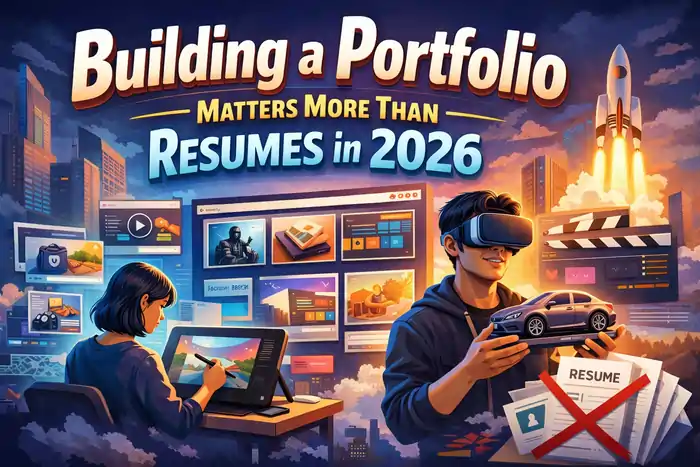
In 2015, hiring decisions often began with one document: the résumé. Employers scanned education history, job titles, and years of experience before deciding whether a candidate deserved an interview. In 2026, the process looks different.
Hiring managers increasingly ask a different question: “Can this person actually do the work?” That shift has made one thing clear across digital industries: your portfolio now matters more than your résumé. A résumé tells a story about your career. A portfolio proves what you can do. And in a world driven by digital work, analytics, and real-time performance data, proof of execution has become the new professional currency.
The Changing Nature of Hiring
The rise of portfolios reflects broader changes in the labor market. Companies are moving away from traditional hiring filters like degrees or rigid credential requirements and toward skills-based hiring models. LinkedIn’s workforce research notes that many organizations are prioritizing demonstrated skills and real work examples over formal qualifications—especially in technology and digital roles—as outlined in its skills-based hiring insights at LinkedIn Skills-Based Hiring.
Instead of asking where you studied, employers increasingly ask: What projects have you worked on? What results have you delivered? What problems have you solved? A résumé alone rarely answers those questions. A portfolio does.
Why Portfolios Matter More in Digital Careers
Digital industries operate differently from many traditional professions. Results are measurable. In fields such as SEO, digital marketing, UX design, software development, content strategy, and data analytics, work outcomes can often be tracked through metrics like traffic growth, engagement, conversions, or performance improvements.
Because of this, hiring managers want to see evidence of execution. For example, a résumé might say: “Managed SEO campaigns.” A portfolio can show keyword ranking improvements, organic traffic growth, technical SEO audit examples, and content optimization strategies. Those real examples make a candidate far more credible.
The Rise of the Proof-of-Work Economy
Many experts describe today’s digital labor market as a proof-of-work economy. Instead of relying solely on credentials, employers want demonstrable capability. This concept aligns with broader economic trends.
Research from the World Economic Forum’s Future of Jobs Report 2025 indicates that nearly 40% of core job skills are expected to change by 2030 due to technological transformation, with growing emphasis on analytical thinking, technological literacy, resilience, and creative problem solving at WEF Future of Jobs 2025. These are skills that are best demonstrated through real projects, not just listed on a résumé.
Why Résumés Alone Are Losing Power
Résumés still matter—but they have limitations. A résumé typically summarizes job titles, company names, responsibilities, and education. However, it rarely shows how well someone performed their work.
Two candidates may have identical job titles but very different skill levels. Without evidence of outcomes, hiring managers must rely on assumptions. Portfolios remove that uncertainty. They provide visibility into process, thinking, execution, and results. This transparency helps employers make better hiring decisions.
Portfolios Show How You Think
A strong portfolio does more than display finished projects. It explains how you approached the work.
For example, a digital marketing portfolio might include:
- the problem a business faced
- the strategy developed
- the implementation process
- the measurable results
This structure demonstrates strategic thinking and analytical reasoning, not just output. Employers want to understand how you solve problems, because that ability predicts future performance.
The Portfolio Advantage in SEO Careers
Search engine optimization is a perfect example of why portfolios matter. SEO performance can be measured through organic traffic growth, ranking improvements, click-through rate increases, technical SEO fixes, and content visibility.
Because these results are data-driven, professionals can showcase their impact clearly. For instance, an SEO portfolio might include screenshots of Google Search Console data, keyword ranking case studies, technical audit summaries, and before-and-after performance comparisons. These examples provide direct evidence of capability. In contrast, a résumé might only say: “Responsible for SEO optimization.” The difference is significant.
Data-Driven Work Is Replacing Title-Based Authority
Another reason portfolios matter more is that authority is shifting away from job titles and toward demonstrable skill. Historically, working at a well-known company signaled competence. But today, independent professionals often produce work that rivals or exceeds corporate teams.
Platforms like GitHub, Behance, personal websites, and content portfolios allow professionals to showcase their work publicly. Hiring managers increasingly look for GitHub repositories or live demos as part of technical screening, a pattern reflected in industry guidance on using project portfolios to stand out with employers at GitHub Portfolio Strategy. As a result, individual output has become more visible than institutional affiliation. This democratizes opportunity: a freelancer with strong work samples can compete with candidates from large organizations.
The Economics of Skill Demonstration
Economic research also supports the importance of demonstrable skills. The U.S. Bureau of Labor Statistics reports that computer and information technology occupations are projected to grow much faster than average from 2024 to 2034, with hundreds of thousands of openings annually, as detailed in its outlook for tech roles at BLS Computer and IT Occupations.
These fields reward individuals who combine technical expertise, analytical ability, and continuous learning. Portfolios provide the clearest way to display those competencies.
What a Strong Portfolio Looks Like
A strong portfolio typically includes several components:
- Real projects – Examples of work completed for clients, employers, or personal projects.
- Context and explanation – Background on the problem being solved.
- Strategy and process – How the solution was developed.
- Results – Evidence of impact, such as performance improvements or measurable outcomes.
- Reflection – Insights about what worked, what didn’t, and what was learned.
This structure shows both competence and self-awareness.
Personal Projects Can Become Portfolio Assets
Many professionals worry that they cannot build a portfolio without paid work. In reality, personal projects can be just as valuable.
Examples include:
- building a niche website
- launching a content blog
- optimizing a personal project for SEO
- analyzing public datasets
- redesigning an existing website as a UX exercise
These projects demonstrate initiative. They also show employers that the candidate actively develops their skills outside formal employment—an approach that mirrors the “skills signals” LinkedIn’s Economic Graph finds effective in expanding opportunities for candidates who showcase abilities directly at LinkedIn Skills Signal Research.
The Portfolio Builds Career Confidence
Creating a portfolio has psychological benefits as well. When professionals document their work, they develop a clearer understanding of their strengths and progress.
Instead of feeling uncertain about their skills, they can point to concrete examples of their capabilities. This confidence improves performance in interviews and negotiations.
The Portfolio Creates Career Optionality
A strong portfolio also increases career flexibility. Professionals with documented work can pursue multiple opportunities, including:
- freelance consulting
- full-time employment
- entrepreneurship
- remote work opportunities
Because their skills are visible, they are less dependent on traditional hiring pipelines and degree screens—consistent with skills-based hiring trends LinkedIn reports, where focusing on demonstrated skills can expand talent pools dramatically at LinkedIn Skills-Based Hiring.
The Internet Makes Portfolios Easy to Share
Another reason portfolios have become more important is technological accessibility. Professionals can now showcase their work through personal websites, LinkedIn portfolios, online case studies, and digital repositories.
This accessibility increases transparency in the hiring process. Employers can evaluate work directly rather than relying solely on résumé claims.
Employers Value Evidence Over Claims
From an employer’s perspective, portfolios reduce hiring risk. Hiring mistakes can be expensive. Reviewing real work helps companies assess whether candidates can:
- solve complex problems
- communicate effectively
- execute strategies
- adapt to challenges
These capabilities are difficult to infer from a résumé alone, but they become clearer when reviewing actual projects, case studies, or code.
The Future of Hiring Is Demonstration
As artificial intelligence automates routine tasks, human value increasingly lies in problem solving, creativity, and strategic thinking. These qualities are best demonstrated through work.
Organizations such as the OECD emphasize the importance of lifelong learning and skill development in adapting to evolving labor markets; the OECD Employment Outlook 2025 stresses continuous upskilling and adult learning as key to “staying in the game” in a changing labor market at OECD Employment Outlook. Portfolios support this ongoing skill development. They encourage professionals to continually build and showcase their expertise.
Portfolio Thinking Encourages Learning
Another advantage of portfolio-driven careers is that they encourage continuous improvement. Professionals begin to think in terms of experiments, projects, and results.
Instead of focusing solely on job titles, they focus on building a body of work. This mindset accelerates learning and aligns with the skills-first, lifelong-learning approach many workforce reports now recommend.
How to Start Building a Portfolio
Creating a portfolio does not require years of experience. It begins with documenting your work.
Start by collecting:
- project summaries
- performance data
- screenshots of improvements
- written case studies
Even small improvements can demonstrate valuable skills. Over time, these examples accumulate into a powerful professional asset.
The Long-Term Career Advantage
When professionals invest in building a portfolio early in their careers, they gain a long-term advantage. Their work becomes discoverable.
Opportunities emerge organically through networking, referrals, and online visibility. Instead of constantly applying for jobs, their portfolio can attract opportunities—especially in fields where employers increasingly search by skills and project evidence rather than pedigree.economicgraph.
For more insights, read: SEO Careers: Skills and Growth Paths (2026)
Final Perspective: Portfolio Matters More Than Resumes
The modern workforce values evidence of capability. Résumés still play a role in summarizing experience. But portfolios provide something more powerful: proof.
They show what you can build, improve, and achieve. In the digital economy, where results can be measured and shared instantly, your body of work becomes your professional identity. That identity travels with you across companies, industries, and opportunities.
In 2026 and beyond, the professionals who succeed will not simply list their skills. They will demonstrate them. And the most effective way to do that is by building a portfolio that tells the story of what they can actually do.

