
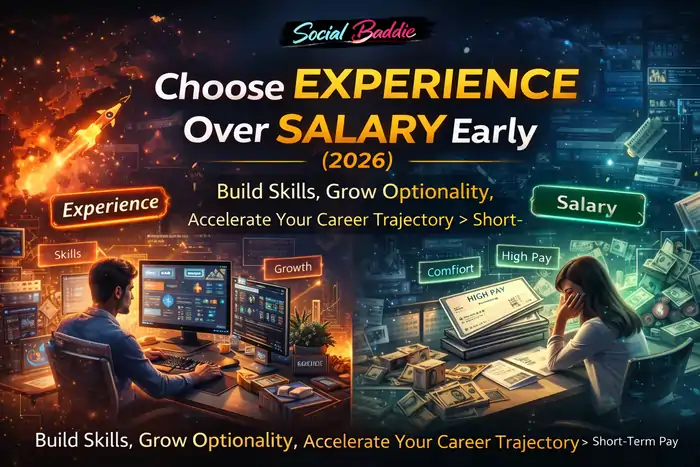
In 2026, choosing experience over maximum starting salary is not a romantic idea.
It’s a leverage decision.
The 2026 Workforce Reality
The World Economic Forum’s Future of Jobs Report 2025 estimates that employers expect about 39–40% of core skills required on the job to change by 2030 as AI, automation, and digital transformation reshape roles, with 63% of companies citing the skills gap as their biggest barrier to transformation. The same report highlights rising demand for both technology skills (AI, big data, cybersecurity) and human skills (creative thinking, resilience, flexibility).
That reinforces a critical point:
Your early career advantage is not salary.
It is adaptability.
If your role accelerates skill development, you future‑proof yourself against labor market volatility.
The Early Career Dilemma: Experience vs Salary
Every early‑career professional eventually faces the same choice:
Offer A:
- Higher salary
- Clear title
- Limited responsibility
- Slower learning curve
Offer B:
- Lower salary
- Broader responsibility
- Steeper learning curve
- Faster exposure
The instinct is predictable:
Take the money.
But money earned early without skill growth creates a ceiling.
Experience earned early creates a runway.
Salary is a short‑term reward.
Experience is a long‑term asset.
And assets compound.
What Is Career Capital?
Career capital is the collection of:
- Skills
- Capabilities
- Proof of work
- Network access
- Execution maturity
- Domain understanding
It determines:
- Your negotiating power
- Your mobility
- Your earning ceiling
- Your optionality
Salary is compensation for your current value.
Career capital determines your future value.
Early in your career, you don’t need maximized compensation.
You need accelerated capability.
The Salary Trap in Your 20s
There’s a subtle trap in prioritizing salary too early:
It creates comfort before competence.
You may earn:
- A stable income
- A respectable title
- Predictable tasks
But if your learning curve flattens, your growth stalls.
High early salary with low exposure often leads to:
- Narrow specialization
- Limited problem‑solving range
- Slower adaptability
- Reduced long‑term leverage
In a world shaped by AI disruption and workforce transformation, that’s risky. The WEF report notes that over half of workers will need reskilling or upskilling by 2030, with millions at medium‑term risk if they don’t adapt.weforum+1
A comfortable early role can quietly reduce adaptability.
The 2026 Workforce Context (Why This Matters Now)
Global labor data backs this reality.
The U.S. Bureau of Labor Statistics overview of computer and IT occupations projects these roles to grow “much faster than average” from 2024 to 2034, with around 317,700 openings per year driven by both new demand and replacement needs. Specific roles like computer and information systems managers are projected to grow about 15% over the decade, far above the overall job market.
These paths reward:
- High skill density
- Technical and analytical depth
- Continuous learning
Not just time in seat.
Your long‑term career resilience depends on skill acquisition rate — not just tenure and not just compensation.
If your role teaches you:
- Systems thinking
- Analytical depth
- Communication under pressure
- Technical fundamentals
- Execution discipline
You are building durable capital.
If your role teaches you only process repetition, you are building fragility.
Skill Compounding: The Real Wealth Engine
Salary grows linearly.
Skills grow exponentially.
When you develop one skill deeply, it creates leverage for others.
Example:
- You learn technical execution.
- That improves problem‑solving.
- That increases confidence.
- That increases responsibility.
- That increases visibility.
- That increases opportunity.
- That increases earning power.
This is compounding.
Early‑career experience accelerates compounding.
Early‑career salary rarely does.
Experience Builds Optionality
Optionality means you can:
- Pivot industries
- Freelance
- Consult
- Negotiate better roles
- Build something of your own
Optionality reduces fear.
Less fear increases risk tolerance.
Risk tolerance, applied intelligently, increases opportunity.
Experience builds optionality because it expands your capability set.
Salary does not automatically expand optionality.
The Mentorship Multiplier
One of the most undervalued aspects of early‑career decisions is mentorship.
A lower‑paying role inside a high‑growth team with strong mentorship can:
- Compress years of learning into months
- Accelerate maturity
- Expose blind spots
- Build standards of excellence
Mentorship compounds your growth rate.
High salary without mentorship often slows it.
Ask yourself:
- Will this environment stretch me?
- Or simply compensate me?
Exposure > Comfort
Exposure matters more than comfort early on.
Exposure to:
- Strategy meetings
- Client interactions
- Cross‑functional work
- Performance analysis
- Risk decisions
- Failure recovery
These experiences create pattern recognition.
Pattern recognition is what separates operators from observers — and operators earn more over time.
The Opportunity Cost of Early Salary
Every decision carries opportunity cost.
If you choose the higher‑paying but slower‑growth role, you may lose:
- Skill acceleration
- Network expansion
- Leadership exposure
- Technical depth
- Cross‑functional awareness
That lost momentum compounds.
Five years later, the person who chose growth may surpass you in both skill and income.
Short‑term income can quietly delay long‑term expansion.
When Salary Should Come First
This isn’t about glorifying struggle.
There are situations where salary must come first:
- Financial hardship
- Family obligations
- Debt pressure
- Geographic constraints
If financial stability is fragile, security is strategic.
But once survival is covered, optimization should begin.
After stability, growth should dominate your decision‑making.
Startup vs Corporate Early Career
This decision often reflects the experience vs salary trade‑off.
Corporate roles may offer:
- Higher starting salary
- Defined structure
- Clear boundaries
- Narrow scope
Startups may offer:
- Lower salary
- Broader responsibility
- Faster exposure
- Skill acceleration
Neither is universally “better.”
But if your goal is capability density early in your career, exposure‑rich environments often deliver more growth per year worked.
Responsibility Density Matters
A useful metric for evaluating early roles:
Responsibility density.
Ask:
- How many different types of decisions will I make?
- How many skills will I develop?
- How much ownership will I carry?
Higher responsibility density usually means faster growth.
Faster growth is leverage.
The Long‑Term Income Curve
Early salary feels important because it’s visible.
But long‑term earning potential depends on:
- Skill depth
- Reputation
- Problem‑solving range
- Execution history
- Strategic thinking
If your experience compounds for 5–7 years, your income curve can steepen dramatically. The person who optimized for salary early may plateau sooner.
Income ceilings are determined by capability ceilings.
Economic research aggregated in tools like the Federal Reserve’s FRED database supports this: lifetime earnings growth tracks with human capital accumulation — education, training, and experience that enhance productivity.
Career ROI: Think in 5‑Year Windows
Instead of asking:
“How much does this job pay?”
Ask:
“What will this role make me capable of in 5 years?”
Project forward.
If this role builds:
- Strategic awareness
- Technical proficiency
- Communication strength
- Leadership exposure
It may multiply your value far beyond the initial salary gap.
Think in career ROI, not monthly income.
Ego vs Leverage
Early career salary can feed ego.
It looks good on social media.
It sounds impressive in conversations.
But ego is not leverage.
Leverage is capability.
If a lower‑paying role builds more leverage, it may be the smarter move.
The goal is not to impress peers.
The goal is to expand power.
AI and the Experience Premium
As AI tools automate repetitive tasks, the value of:
- Strategic thinking
- Systems integration
- Context interpretation
- Human judgment
- Complex coordination
increases.
Future‑of‑work analyses from organizations like the WEF and OECD stress that lifelong learning, re‑skilling, and skills‑based hiring will be central to keeping workers employable as technology reshapes roles.oecd+2
Experience builds these traits.
Salary does not.
Choosing experience early is a hedge against being automated later.
The Proof‑of‑Work Economy
We now operate in a proof‑of‑work economy.
Employers increasingly value:
- Demonstrable execution
- Portfolio evidence
- Problem‑solving clarity
- Real results
Skills‑based hiring research from LinkedIn shows more companies dropping rigid degree requirements in favor of verified skills and practical output.
If you are building real experience, you are building proof.
If you are simply collecting paychecks without growth, you are building dependency.
Dependency reduces negotiating power.
Experience increases it.
Skill Stacking Early
Early years are ideal for stacking skills.
Examples:
- Technical skill + communication
- Analytical skill + creativity
- Strategy + execution
- Marketing + operations
- Data + storytelling
Stacked skills increase:
- Income potential
- Career mobility
- Entrepreneurial opportunity
- Consulting leverage
Salary does not stack.
Skill does.
Burnout Risk and Balance
Choosing experience does not mean choosing exploitation.
You must evaluate:
- Growth vs chaos
- Stretch vs burnout
- Mentorship vs neglect
- Opportunity vs instability
Growth environments should stretch you, not break you.
Experience without support can turn into exhaustion.
Choose environments that challenge you intelligently.
A Career Decision Framework
When evaluating early career roles, ask:
- What skills will I build?
- Who will I learn from?
- What exposure will I gain?
- How much ownership will I have?
- How fast will my responsibility grow?
- What will I be capable of in 5 years?
Salary should be part of the equation.
But not the dominant variable.
Long‑Term Strategy Over Short‑Term Comfort
The first 5–7 years of your career shape the next 30.
If you invest them in:
- Deep learning
- Strategic exposure
- Technical mastery
- Execution experience
- Relationship building
Your future self benefits disproportionately.
If you invest them in:
- Comfort
- Status
- Early consumption
- Minimal stretch
Your ceiling lowers quietly.
One Strategic Reminder (Digital Careers)
If you are building in digital fields, skills compound especially fast.
In search, growth, and digital infrastructure roles, execution capability expands income potential dramatically over time. Structured skill progression and proof of work matter far more than starting salary — which is why a clear skills roadmap for areas like SEO or analytics can be more valuable than chasing the highest first offer.
The principle applies across modern digital careers:
Capability precedes leverage.
Optimize for Trajectory | Experience Over Salary
In 2026, careers are no longer linear ladders.
They are dynamic trajectories.
Optimize for:
- Skill acceleration
- Exposure density
- Responsibility growth
- Mentorship access
- Optionality creation
Early salary is visible.
Experience is invisible.
But invisible investments compound.
Ten years from now, the people who chose:
- Growth over comfort
- Learning over ego
- Exposure over stability
- Skill over validation
Will have both:
- Deep experience
- And high income.
Because in the long run, experience builds income.
Salary does not build experience.
Choose accordingly.
For more insights, read: SEO Careers: Skills and Growth Paths (2026)

