Most beginners hear “PPC” and think:
Run ads → Get clicks → Make money.
That’s not how pay‑per‑click advertising works.
PPC is not instant profit. It’s controlled customer acquisition through an auction‑based system where you pay for attention — and your structure decides whether that attention becomes revenue.
If you don’t understand the mechanics, you waste ad spend. If you understand the system, you control performance.
Even Google’s own Google Ads auction explainer spells out that advertisers enter a real‑time auction where bid, relevance, and expected performance determine if you show at all and where you appear.
Let’s break this down simply.
What Is Pay‑Per‑Click (PPC)?
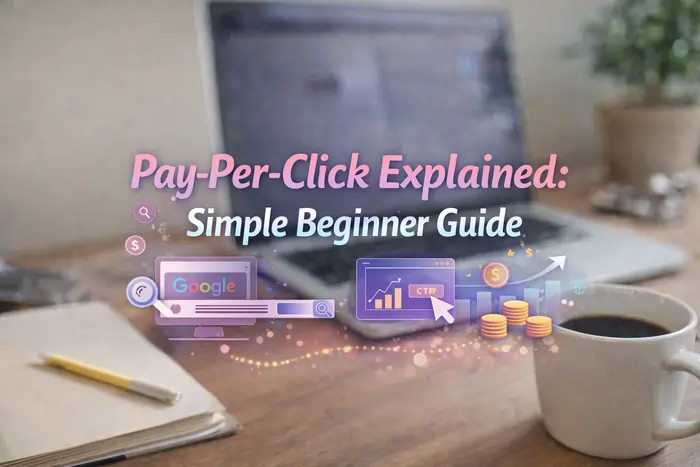
Pay‑per‑click (PPC) is a digital advertising model where you pay a fee each time someone clicks your ad — the classic PPC definition describes it as buying visits instead of waiting for organic ranking.
You’re buying traffic instead of earning it organically.
If you look at finance‑driven explainers like Corporate Finance Institute’s PPC overview, PPC sits under performance marketing because you only pay when a measurable action (the click) happens.
PPC typically falls under:
- Paid search marketing
- Search engine marketing (SEM)
- Performance marketing
- Media buying
And the usual platforms include:
- Google Ads
- Microsoft Ads
- Meta Ads
- TikTok Ads
- YouTube Ads
- Display Network
- Shopping Ads
“Boosting posts” is just the shallow end; in a full PPC setup you’re working with intent, auctions, and structured campaigns, not just hitting a blue “boost” button and hoping.
How PPC Actually Works (The Ad Auction)
Every time someone searches on Google, an ad auction happens in milliseconds.
In Google’s How the Google Ads auction works, they show how eligible ads are pulled into the auction and ranked using Ad Rank rather than pure bid.
Your position is determined by:
- Maximum CPC bid
- Quality components (historical performance, expected CTR)
- Ad relevance to the query
- Landing page experience
- The expected impact of formats and extensions
A simple mental model that matches Google’s docs:
Ad Rank ≈ Bid × Quality factors.
You don’t simply “pay more to win.” If your Quality Score is low, your CPC climbs, your CPA creeps up, and your ROAS gets squeezed — not because the platform “hates you,” but because the auction is rewarding better relevance and user experience.
Structure beats brute‑force budget.
Understanding Cost Per Click (CPC)
Cost per click (CPC) is the actual price you pay when someone clicks your ad.
That CPC moves based on competition, industry, keyword match type, audience targeting, geography, and device. Highly competitive verticals like legal or insurance routinely show CPCs above $50, while niche or long‑tail markets can sit comfortably under $2.
This is why ROAS‑focused content, like Shopify’s how to increase ROAS, keeps repeating the same idea: what matters isn’t just CPC, it’s what happens after the click — margins, conversion rate, and lifetime value.
Clicks without conversion are just a very expensive traffic hobby.
The Metrics That Actually Matter
If you’re running PPC campaigns, your “vitals panel” is:
- CTR (click‑through rate)
- Conversion rate
- CPA (cost per acquisition)
- ROAS (return on ad spend)
- LTV (lifetime value)
- CAC (customer acquisition cost)
Revenue screenshots lie if you don’t know your break‑even ROAS. ROAS explainers aimed at ecommerce operators show, again and again, that a “2x ROAS” can be a win or a loss depending on your margin stack and retention.
If your product sells for 100, your gross margin is 40%, and your all‑in overhead eats another 20%, you can’t live at 2x ROAS forever — the math just doesn’t clear.
Google’s conversion tracking guides are blunt: until you define what a “conversion” is and track it correctly, the system will optimize for cheap clicks instead of valuable customers.
No conversion tracking means no intelligent automation.
PPC Campaign Structure Explained Simply
Inside Google Ads, structure looks like:
Account
→ Campaign
→ Ad Groups
→ Keywords
→ Ads
Guides on Google Ads account structure all push the same principle: clean hierarchy gives you control.
If your account structure is messy — broad match everywhere, zero negative keywords, no segmentation by intent or funnel stage — you’re giving the algorithm a fuzzy brief and a wide open wallet.
Google’s own keyword match‑type documentation, plus match‑type explainers like Semrush’s keyword match guide, show how broad, phrase, and exact match trade reach for precision. Broad match without negatives turns into “pay for everything”; exact match with smart negatives turns into “pay for what you actually want.”
Structure is how you tell the platform: “These are the searches I am willing to pay for — and these are the ones I absolutely won’t.”
PPC vs SEO (Why They’re Not Competitors)
PPC gives you:
- Immediate traffic once campaigns are live
- Fast signal on what people actually click and buy
- Rapid testing loops for offers, angles, and landing pages
SEO gives you:
- Compounding organic traffic over time
- Topical authority and brand search
- Durable search equity that doesn’t disappear when you cut ad spend
Google’s How Search Works makes it clear that organic ranking relies on crawling, indexing, and hundreds of signals — a completely different engine from the paid auction that Google Ads runs.
Think of it this way:
- PPC is acceleration — you buy speed and data.
- SEO is infrastructure — you build the highway that traffic runs on.
Your strongest play is using PPC to discover winning keywords, angles, and pages, then hard‑baking those insights into content and SEO.
AI & Automation in PPC (2026 Reality)
Automation in PPC is no longer optional “pro mode”; it’s the default:
- Smart Bidding strategies like Target CPA and Target ROAS
- Performance Max campaigns
- Contextual, per‑auction bid adjustments
- AI‑assisted creative suggestion and testing
In Google’s Smart Bidding documentation and API introductions, they show how the system adjusts bids for each auction based on device, location, query context, audience signals, and predicted conversion probability.
But every serious automation guide has a hidden disclaimer: this only works with clean, consistent conversion data.
Small or chaotic accounts — low volume, unstable tracking, constantly changing goals — don’t give the algorithm enough signal density to learn. Automation then magnifies the chaos instead of the performance.
Automation is an amplifier. It multiplies whatever structure you feed it.
Privacy & First‑Party Data
As third‑party cookies fade and browsers tighten tracking, PPC is shifting into a first‑party‑data‑first world.
That means your stack has to include:
- Real first‑party data collection (emails, logins, consent‑based events)
- Clear consent and preference management
- Clean pixel/tag setups and, where possible, server‑side events
- Attribution that respects both privacy and performance decisions
Privacy research like PwC’s consumer trust studies all converge on one theme: people will share data when they understand what they get in return and when they feel in control.
In PPC terms, that means:
- Consent banners that are honest and not dark‑pattern‑heavy
- Clear explanations of how you use data to improve experience
- A tracking setup that actually works when cookies are limited
Privacy‑first isn’t a “legal checkbox”; it’s a performance moat. Trusted brands convert better and retain better.
Why Beginners Lose Money on PPC
Most beginner PPC losses are boringly predictable:
- Landing pages that are slow, generic, or confusing
- No funnel structure (all campaigns aim for “cold audience → buy now”)
- No negative keywords and sloppy match types
- Zero audience segmentation or remarketing
- No creative testing cadence
- Scaling budgets before unit economics are stable
If you look at operator‑focused PPC playbooks (HubSpot‑style, agency blogs, etc.), they hammer the same fundamentals: tracking, testing, and tight feedback loops, not heroic “one magic campaign.”
PPC is a math and iteration game, not a vibes game.
What PPC Really Means in 2026 | Pay-Per-Click Explained
In 2026, PPC means:
- You’re buying intent, not guaranteed revenue.
- You’re entering a live auction every time a user searches.
- You’re managing acquisition risk with your bids, budgets, and funnel.
- You’re scaling based on data, not dashboard dopamine.
PPC is not fast money. It’s fast feedback.
Used alone, it can turn into an expensive ad dependency. Paired with strong SEO infrastructure, email and retention, and a real offer that converts, it becomes leverage — a way to pour paid traffic into what already works instead of trying to buy your way out of a weak offer.
If you’re serious about learning correctly, connect this with:
👉 PPC Basics: Beginner Guide to Pay‑Per‑Click (2026)
Clarity first.
Structure second.
Profitability third.
That’s the SocialBaddie way 💻✨

