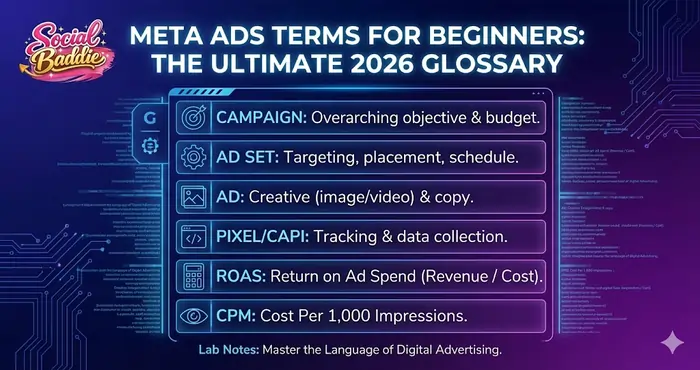
Understanding Meta Ads terms for beginners is the first bridge you must cross if you intend to turn social media scrolls into scalable profit. In the high-velocity landscape of 2026, where artificial intelligence drives nearly every impression, simply knowing the acronyms isn’t enough. You need to understand how these metrics interact with Meta’s modern neural networks, specifically the Andromeda retrieval engine and the GEM (Generative Evaluation Model).
This guide is designed as a deep-dive “Lab Note” for the Social Baddie tribe. We’ve moved beyond the basic definitions of 2020. This is a technical, tactical, and humanized roadmap to the language of Meta advertising today. Whether you are building an e-commerce empire or scaling a service-based agency, these terms are the vital signs of your business.
The 2026 Context: Why Meta Ads Terms Matter More Than Ever
Before we define the metrics, we must address the “Brain” of the operation. In 2026, Meta Ads terms for beginners have evolved because the platform has moved away from manual “button-pushing” toward Predictive Modeling.
For years, advertisers acted like surgeons, manually selecting interests and behaviors. Today, Meta acts like a pilot on autopilot. Your job is no longer to steer the plane; it is to read the dashboard and ensure the engine has enough fuel (data) and the right direction (creative).
The “Andromeda” Shift
In 2026, Meta’s Andromeda system handles ad delivery. It doesn’t just look for “people who like coffee”; it analyzes your video pixels and caption text in real-time to predict intent. Because the AI is so fast, the traditional metrics like CPC and CTR now represent “Signal Quality” rather than just “Ad Performance”.
The “GEM” Era
The Generative Evaluation Model (GEM) is the evaluator. It looks at your ROAS and determines if your campaign is healthy enough to receive more “Traffic.” If you don’t understand these terms, you cannot communicate with the AI.
The Big Four: Foundational Meta Ads Metrics
If you open Meta Ads Manager today, you will see a wall of data. Ignore the noise. For 90% of beginners, the “Big Four” metrics below tell the entire story of your success or failure.
2.1 CPM: Cost Per Mille (Cost per 1,000 Impressions)
What it is: CPM is the “Entry Fee” to the auction. It is the cost to show your ad 1,000 times. In Latin, Mille means thousand.
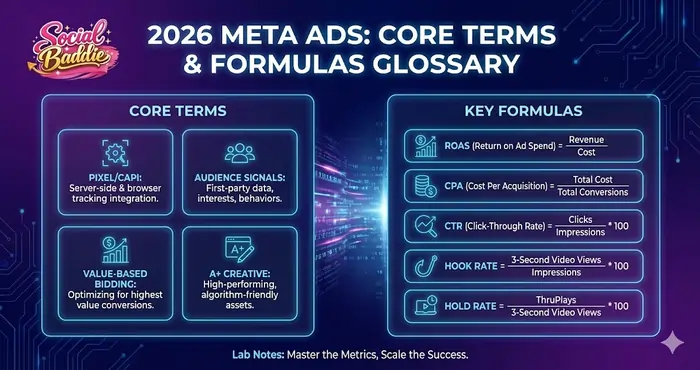
CPM=(Total ImpressionsTotal Spend)×1,000
The 2026 Perspective: In 2026, CPMs are highly volatile. They are no longer just a reflection of competition; they are a reflection of your Ad Quality Score. If your ad is annoying or click-baity, Meta will “tax” you with a higher CPM. If your ad is helpful and keeps people on the platform, Meta rewards you with a lower CPM.
- High CPM: You are likely in a high-competition niche (like Healthcare or Insurance) or your creative is fatiguing.
- Low CPM: You have high-quality, broad-appeal creative.
2.2 CTR: Click-Through Rate
What it is: The percentage of people who saw your ad and actually clicked on it. This is the ultimate “Resonance Metric.”
CTR=(ImpressionsClicks)×100
The 2026 Perspective: We now differentiate between CTR (All) and CTR (Link Click).
- CTR (All): Includes likes, comments, and “See More” clicks. It measures general curiosity.
- CTR (Link Click): Measures the intent to leave the platform and visit your site. This is the “Baddie” metric. If this is below 1%, your “Hook” (the first 3 seconds of your video) is failing.
2.3 CPC: Cost Per Click
What it is: The average price you pay for a single visitor to your destination.
CPC=Total Link ClicksTotal Spend
The 2026 Perspective: A low CPC is not always a win. In the era of Andromeda, the algorithm can easily find “cheap” clicks from people who habitually click ads but never buy. We call these “trash clicks.” Always look at your CPC in relation to your Conversion Rate.
2.4 ROAS: Return On Ad Spend
What it is: The North Star of e-commerce. It tells you how many dollars you get back for every dollar you spend.
ROAS=Total Ad SpendTotal Revenue
The 2026 Perspective: In the PPC Lab, we look at nROAS (New Customer ROAS). Because Meta’s AI is now so good at finding your existing customers, a high overall ROAS can be a trap. You want to ensure you are acquiring new blood, not just paying Meta to show ads to people who were going to buy anyway.
The Knowledge Graph: Meta Ads Benchmarks 2026
To understand Meta Ads terms for beginners, you need a frame of reference. Below are the 2026 industry benchmarks based on recent Meta AI performance data.
| Industry | Avg. CPM | Avg. CTR (Link) | Avg. CPC | Target ROAS |
|---|---|---|---|---|
| E-commerce | $12.50 | 1.8% | $0.65 | 3.5x |
| SaaS / Tech | $35.00 | 0.9% | $3.40 | 2.5x |
| Healthcare | $28.00 | 1.2% | $1.90 | 4.0x |
| Home Services | $22.00 | 1.5% | $1.50 | 5.0x |
| Education | $18.00 | 1.1% | $1.30 | 3.0x |
Lab Note: If your metrics are significantly worse than these benchmarks, do not blame the targeting. In 2026, Creative is the Targeting. Your visuals are the reason your CPM is high or your CTR is low.
Advanced Supporting Terms: The “Signal” Vocabulary
Once you’ve mastered the Big Four, you need to understand the technical “Signals” that allow the Meta AI to function. These Meta Ads terms for beginners bridge the gap between “marketing” and “data science”.
4.1 CAPI: Conversions API
The Conversions API is the 2026 successor to the simple “Pixel.” Because of increased privacy laws and browser blockers, the Pixel often misses 30-40% of sales. CAPI creates a direct server-to-server connection. If your CAPI isn’t set up, the Meta AI is flying blind.
4.2 CPA: Cost Per Action (or Acquisition)
This is the total cost to get one person to take your desired action (e.g., a purchase or a lead).
CPA=Total ConversionsTotal Spend
In 2026, we focus on CPA vs. LTV (Lifetime Value). If it costs you $50 to acquire a customer who spends $200 over a year, your business is healthy, even if your initial ROAS looks low.
4.3 Conversion Rate (CVR)
The percentage of people who clicked your ad and then completed the purchase on your site.
CVR=(Link ClicksConversions)×100
If your CTR is high but your CVR is low, your Landing Page is the problem, not your ads.
4.4 Frequency
The average number of times a single person has seen your ad.
- 1.0 – 2.0: Fresh audience.
- 3.0 – 5.0: Danger zone. Creative fatigue is setting in.
- 6.0+: You are annoying your audience. It’s time for new creative.
The Advantage+ Revolution: Automation Terms
In 2026, Meta has consolidated most manual features into the Advantage+ suite. These are the most critical “Modern” Meta Ads terms for beginners.
5.1 ASC: Advantage+ Shopping Campaigns
ASC is Meta’s “All-in-One” solution for e-commerce. You don’t pick audiences; you simply give the AI your budget and your creatives. The system handles the rest. In the PPC Lab, we’ve found that ASC often delivers a 15-20% higher ROAS than manual campaigns because it has access to the full Andromeda dataset.
5.2 Advantage+ Audience
This replaces the old “Detailed Targeting.” Instead of forcing Meta to only show ads to “Golfers,” you give it a “Suggestion.” The AI starts with golfers but then expands to anyone it predicts will buy based on their behavior.
5.3 Advantage+ Creative
Meta will automatically brighten your photos, add music to your videos, or even swap your headlines to see which combination works best. While this sounds like magic, be careful—it can sometimes make your brand look “AI-generated” and cheap.
Practical Application: A Day in the PPC Lab
Let’s look at how a “Social Baddie” strategist uses these Meta Ads terms for beginners to troubleshoot a failing campaign.
The Scenario: You are running an ad for a $100 luxury candle. After 3 days, your stats look like this:
- Spend: $300
- CPM: $40 (High)
- CTR: 0.5% (Low)
- CPC: $8.00 (Very High)
- Sales: 0
The Analysis:
- High CPM ($40): Meta thinks your ad is low quality or highly irrelevant.
- Low CTR (0.5%): Your “Hook” is boring. People are scrolling right past it.
- High CPC ($8.00): Because people aren’t clicking, Meta has to charge you a fortune for the few clicks you do get.
The Fix: Instead of changing your audience, you change your Creative. You swap the boring “Product on a Table” photo for a “UGC (User-Generated Content)” video of someone smelling the candle and reacting emotionally.
New CPM: $15
New CTR: 2.5%
New CPC: $0.60
Result: Sales start flowing.
The Learning Phase: The Patience Metric
One of the most vital Meta Ads terms for beginners is the Learning Phase. This is the period where Meta’s algorithm is gathering data.
The Rule of 50: An ad set generally needs 50 conversion events per week to “exit” the learning phase and stabilize.
The Fatal Mistake: Most beginners make “Significant Edits” (changing the budget or the image) every day. Every time you do this, you reset the learning phase. You are essentially giving the AI a lobotomy right as it starts to get smart.
Pro-Tip: If you see “Learning Limited” in your dashboard, it means you aren’t spending enough to get 50 conversions. Either increase the budget or move your “Optimization Event” higher up the funnel (e.g., optimize for “Add to Cart” instead of “Purchase”).
Creative Strategy Vocabulary
Since Creative is the Targeting in 2026, you need to speak the language of ad design.
- The Hook: The first 1-3 seconds of a video designed to stop the thumb from scrolling.
- The Body: The middle section that explains the “Transformation” (how the product helps the user).
- The CTA (Call to Action): The final instruction (“Shop Now,” “Download Guide”).
- UGC (User-Generated Content): Ads that look like real social posts from customers. These consistently have the highest CTR in 2026.
- Dynamic Creative: A feature where you upload multiple assets and Meta’s GEM model assembles the best version for each user.
Budgeting and Bidding Terms
How you pay for your ads is just as important as what the ads look like.
9.1 CBO vs. ABO
- CBO (Campaign Budget Optimization): Now called Advantage Campaign Budget. You set a budget at the top level, and Meta distributes it to the best-performing ad sets.
- ABO (Ad Set Budget Optimization): You manually tell Meta exactly how much to spend on each audience. Use this only for testing new “Angles”.
9.2 Cost Caps and Bid Caps
In 2026, many “Baddies” use Cost Caps. You tell Meta: “Do not spend my money unless you can get me a sale for under $30.”
Pros: Protects your profit margins.
Cons: If your creative is bad, Meta simply won’t spend your budget at all. It is the ultimate “Truth Serum” for your marketing.
Conclusion: From Beginner to Performance Engineer
Mastering Meta Ads terms for beginners is about more than memorizing a glossary; it’s about understanding the relationship between human psychology and machine learning.
In 2026, the successful advertiser is the one who:
- Reads CPM to judge ad quality.
- Reads CTR to judge creative resonance.
- Reads ROAS to judge business viability.
- Trusts the AI (Andromeda and GEM) to handle the delivery while they focus on the storytelling.
Stop treating Meta Ads like a “set it and forget it” tool. Treat it like a high-performance engine. Keep your signals clean with CAPI, your creative fresh to avoid Fatigue, and your focus on the metrics that actually deposit money into your bank account.
Stay curious, stay data-driven, and keep scaling. For more “Lab Notes” and deep-dives into the 2026 PPC landscape, follow Jem’s latest insights.

