

If your campaigns are not converting, it is rarely just your creative. It is your targeting. Understanding Meta Ads Targeting Basics is the foundation of profitable Facebook and Instagram advertising. Without mastering the fundamental mechanics of how Meta identifies and segments users, no amount of budget or scaling tactics will produce stable results. Many advertisers jump into Ads Manager, select a few interests, launch ads, and hope the algorithm figures everything out. That is not a strategy; that is guessing.
This guide will break down Meta Ads Targeting Basics in a structured, data-driven way so you can build predictable campaigns that scale. You will learn how the system has evolved in 2026, where AI-driven signals now outweigh manual interest stacking. By mastering these Meta Ads Targeting Basics, you ensure your marketing budget is spent on high-intent users most likely to generate a return on investment.
Overview: What Is Audience Targeting in Meta Ads?
Before diving deeper into Meta Ads Targeting Basics, we must answer a simple question: What is audience targeting in Meta Ads? Audience targeting is the process of defining who sees your ads across the Meta ecosystem, including Facebook, Instagram, Messenger, and the Audience Network.
It allows advertisers to segment users based on:
- Demographics: Age, gender, and education levels as tracked by Pew Research Center studies.
- Location: Precise GEO targeting by city, region, or zip code.
- Interests: Pages followed, topics engaged with, and consumer habits.
- Behaviors: Device usage, travel patterns, and purchasing history.
- Owned Data: Website visitors, email lists, and app engagement.
In 2026, the core of Meta Ads Targeting Basics has shifted. Targeting now acts as a “signal” rather than a set of hard rules. You are telling Meta’s AI who your ideal customer is, and the system uses that signal to predict which users are most likely to complete your chosen objective.
Why Meta Ads Targeting Basics Matter More Than Creative
Creative attracts attention, but targeting determines who sees it. If you show a world-class offer to the wrong audience, performance will drop. Understanding Meta Ads Targeting Basics improves conversion rates, stabilizes the learning phase, and ensures scaling efficiency. When targeting is structured correctly, your campaigns become predictable assets rather than unpredictable expenses.
The Three Core Audience Types in Meta Ads
Every campaign built on Meta Ads Targeting Basics relies on three primary audience categories. Each category serves a specific purpose in your marketing funnel.
Knowledge Graph: Core Audience Types
| Audience Type | Data Source | Funnel Stage |
| Core Audience | Meta Native Data | Cold Prospecting |
| Custom Audience | Owned Tracking Data | Warm Retargeting |
| Lookalike Audience | Seed Data Expansion | Scaling & Growth |
Interest Targeting Explained (With Examples)
Interest targeting falls under the “Core Audience” umbrella. This is usually where beginners start their journey with Meta Ads Targeting Basics. This method allows you to select people based on the pages they follow, the topics they engage with, and their general shopping behavior.
Examples of Interest Targeting Application:
- Example 1 (Fitness): If you sell home workout programs, you might target “Home workout,” “Gym membership,” and “Personal trainers”.
- Example 2 (B2B): If you sell e-commerce tools, you might target “Shopify,” “Digital marketing,” and “Small business owners”.
A critical rule in Meta Ads Targeting Basics is to avoid “stacking” too many unrelated interests in one ad set. Stacking dilutes the signal and makes it impossible to identify which specific interest is driving performance. Instead, test segments individually to build a clear profile of your winning audience.
GEO Targeting Strategy and Regional Optimization
Location impacts both the cost of your ads (CPM) and the behavior of your buyers. Advanced Meta Ads Targeting Basics requires a sophisticated GEO strategy to avoid wasting budget in low-performing regions.
Strategic Location Frameworks:
- Local Services: Use precise radius targeting around your storefront or service area.
- National Brands: Segment campaigns by region or state to monitor how conversion costs fluctuate across different economies.
- International Scaling: Segment by country to adapt messaging culturally and account for global market trends.
In the Philippines, for example, advertisers often segment by Metro Manila versus provincial regions to account for differences in logistics and delivery infrastructure. This level of detail is essential for mastering Meta Ads Targeting Basics in local markets.
Custom Audiences vs Lookalike Audiences
Understanding the difference between Custom Audiences vs Lookalike Audiences is a major part of Meta Ads Targeting Basics. Custom audiences are built from your “warm” data—people who already know your brand.
Custom Audience Sources:
- Website visitors (via Meta Pixel).
- Email lists (CRM uploads).
- Instagram/Facebook engagement.
- Video viewers.
Lookalike Audiences (LALs) take that warm data and expand it. Meta analyzes your “seed” audience and finds millions of other people who share similar behaviors. In 2026, the quality of your seed data determines the success of your LAL. If your seed audience is low-quality, your lookalike will be ineffective.
Knowledge Graph: Custom vs Lookalike Differences
| Feature | Custom Audience | Lookalike Audience |
| Data Source | Your Private Data | Meta’s AI Expansion |
| Temperature | Warm / Hot | Cold / Prospecting |
| Primary Use | Retention/Retargeting | Massive Scaling |
How Broad Targeting Works in 2026
Targeting has evolved from manual selection to AI-led optimization. Understanding How Broad Targeting Works in 2026 is now a requirement for advanced media buyers. Broad targeting involves removing almost all interest and behavior restrictions, allowing Meta’s Advantage+ algorithm to optimize entirely based on conversion data.
Broad targeting works best when:
- Your tracking (Pixel + CAPI) is 100% accurate.
- You have sufficient conversion volume (50+ events per week).
- Your creative is designed to speak to a specific sub-segment.
If you lack historical data, jumping straight into broad targeting can be risky. Modern Meta Ads Targeting Basics suggests starting with structured interest testing and gradually moving to broad targeting as your account data increases.
Audience Size Framework and Budget Alignment
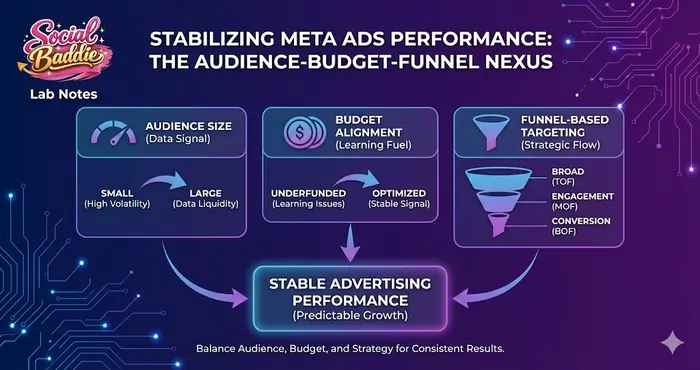
Audience size directly impacts the stability of your ads. If an audience is too small, you will face high frequency and “creative fatigue”. If it is too large without enough budget, the AI will never gather enough data to optimize.
Knowledge Graph: Audience Size Optimization
| Audience Size | Budget Fit | Risk Level |
| Small (<500k) | Low Budget | High Fatigue Risk |
| Medium (1M – 5M) | Moderate Budget | Highly Stable |
| Large (5M+) | High Budget | Requires Strong Data |
Funnel-Based Targeting Strategy
Meta Ads Targeting Basics is incomplete without proper funnel alignment. You must categorize your audiences based on their relationship with your brand to drive success in The Growth Lab.
1. Top of Funnel (TOF) – Cold
Focus on broad targeting, lookalikes, and wide interest segments. The objective is awareness and finding new potential customers.
2. Middle of Funnel (MOF) – Warm
Focus on website visitors and social media engagers. The goal is to nurture interest and move them toward a consideration event.
3. Bottom of Funnel (BOF) – Hot
Focus on high-intent actions like “Add to Cart” or “Initiate Checkout”. This is where you use dynamic remarketing to close the sale.
Knowledge Graph: Funnel Targeting Map
| Funnel Stage | Audience Type | Primary Objective |
| Top (TOF) | Broad / Lookalike | Prospecting / Sales |
| Mid (MOF) | Engagement / Viewers | Consideration / Leads |
| Bottom (BOF) | Website High-Intent | Conversion / Revenue |
Beginner Audience Mistakes That Waste Money
Even experienced advertisers can fail if they ignore the core Meta Ads Targeting Basics. Understanding these common errors helps protect your marketing budget.
- Targeting Too Narrow: Restricting the audience so much that the AI cannot find enough converters to optimize.
- Stacking Unrelated Interests: Combining “Luxury Cars” with “Dog Food,” making it impossible to know who is actually buying.
- Ignoring Exclusions: Failing to exclude past purchasers from your “Cold” campaigns, leading to wasted impressions.
- No Retargeting Layers: Neglecting the people who have already interacted with your brand.
- Manual Over-Editing: Changing targeting during the Learning Phase, which resets the AI’s progress.
Ecommerce and Lead Generation Targeting Structures
Mastering Meta Ads Targeting Basics requires adapting your structure to your specific business model within Social Baddie.
For Ecommerce:
Focus on layered retargeting. Use dynamic product ads to show users exactly what they left in their cart. Ensure your catalog is connected to your Business Manager for automated relevance.
For Lead Generation:
Focus on industry categories and job titles. Build lookalikes based on your “Lead” conversion event. In B2B, segmenting by LinkedIn-style job seniority can drastically improve lead quality.
AI Optimization and Advantage+ Targeting
Meta is now an AI-driven platform. Advantage+ Audience settings allow Meta to expand beyond your manual interest selections if the system finds a better opportunity elsewhere. While this automation is powerful, it does not replace the need for Meta Ads Targeting Basics. AI works best when it is given a strong “seed” or “suggestion” to start from. As an advertiser, your job is to provide that initial structure and then allow the AI to scale based on performance data.
Strategic Implementation Checklist
To ensure you are following the best practices for Meta Ads Targeting Basics, use this final checklist:
- [ ] Is my Pixel and CAPI data accurate?
- [ ] Have I segmented my funnel into TOF, MOF, and BOF?
- [ ] Are my audiences large enough for my daily budget?
- [ ] Have I excluded past purchasers from my prospecting campaigns?
- [ ] Am I using a mix of interest, custom, and lookalike audiences?
Final Strategic Summary
Meta Ads Targeting Basics is not about adding more layers of complexity; it is about providing the AI with high-quality signals. By defining who your customer is, where they are in their buying journey, and what data you have to support them, you create a system for predictable growth. Strong targeting leads to lower costs, higher conversion rates, and the ability to scale your business with confidence. Focus on building a solid foundation first, and then allow Meta’s AI to amplify your results.

