
Meta Ads Foundations are one of the most powerful and flexible digital advertising toolkits available today. When used correctly, they help businesses and creators reach the right audience, generate high-quality leads, and drive consistent sales across Facebook, Instagram, Messenger, and the Audience Network.
This guide is built for complete beginners. You don’t need advanced technical skills or a massive budget—just a clear understanding of how Meta Ads work, how to set them up without overwhelm, and how to avoid the common budget-burning mistakes that stop most people before they see results.
Meta Ads Foundations: Quick Start Summary
If you’re short on time, here’s the essential cheat sheet for understanding Meta Ads. Facebook and Instagram ads are managed from one unified platform, and every ad follows the same structure: Campaign → Ad Set → Ad. For beginners, the key is choosing one clear objective at a time instead of trying to accomplish everything in a single campaign.
Equally important is getting the technical foundation right. Proper Pixel or CAPI setup and accurate tracking matter far more than hacks or complex bidding tactics. As Meta’s AI receives clean data, it learns who your ideal customer is and steadily improves performance—putting you ahead of most advertisers who simply boost posts and hope for results.
I. What Are Meta Ads? (The 2026 Landscape)
Meta Ads are paid promotions run through Meta Ads Manager, the central platform for advertising across Facebook and Instagram. Today, success with Meta Ads is less about manual adjustments and more about working in partnership with Meta’s AI, which uses data to make smarter delivery decisions.
Meta Ads let you reach new audiences, re-engage people who’ve already interacted with your brand, and optimize specifically for actions like purchases, sign-ups, or clicks. Powered by billions of data points and machine learning, the system predicts who should see your ad and when—turning Meta Ads from a simple expense into a scalable investment.
II. Why Meta Ads Are Ideal for Beginners
For many, Meta is the first paid platform they master. This is because the Meta Ads Foundations are designed to scale with you—from a $5/day local operation to a global enterprise.
1. Low Barrier to Entry
You don’t need a massive agency to start. You can launch your first campaign with the price of a cup of coffee per day. This “pay-as-you-go” model allows for rapid testing without financial ruin.
2. The Power of Intent vs. Interest
While Google Ads focus on “Search Intent” (what people are looking for), Meta focuses on “Interest and Behavior.” You can put your product in front of someone before they even know they need it.
3. Built-In Optimization
Meta’s algorithm is its greatest asset. Once you provide the creative and the objective, the system does the heavy lifting of finding the right person. This reduces the manual workload for beginners significantly.
III. Understanding the Meta Ads Ecosystem
Before you start clicking buttons, you must understand where the various tools live. This is a vital part of the Meta Ads Foundations ecosystem.
Meta Business Manager
Think of this as your “Office.” It is the umbrella that holds your Ad Accounts, Facebook Pages, Instagram Profiles, and your Pixels. It allows you to manage permissions for employees or agencies without sharing your personal Facebook login.
Meta Ads Manager
This is your “Workshop.” This is the specific tool where you build campaigns, set budgets, and analyze the data. Every successful advertiser spends the majority of their time here.
Meta Business Suite
This is the “Front Desk.” It is a simplified interface primarily used for scheduling organic posts and responding to messages. While it has basic advertising features, true professionals always graduate to Ads Manager for the full suite of controls.
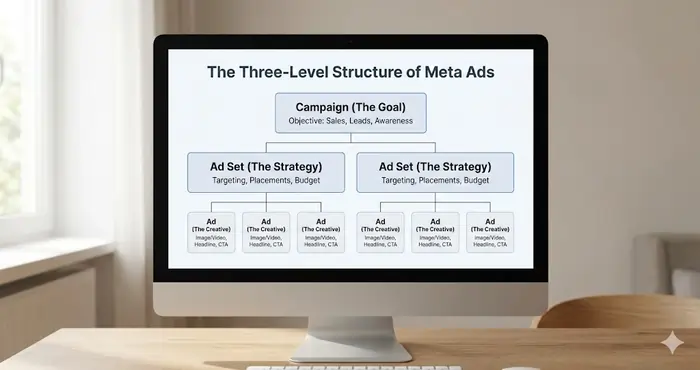
IV. How Meta Ads Work: The Three-Level Structure
A core tenet of Meta Ads Foundations is the hierarchy of a campaign. If you understand this, you understand the platform’s logic.
Level 1: The Campaign (The Goal)
This is where you choose your Objective. Are you looking for brand awareness, website traffic, or hard sales? You can only choose one primary goal per campaign. This tells Meta’s AI what “success” looks like.
Level 2: The Ad Set (The Strategy)
The Ad Set is where the technical decisions live. Here, you define:
- Targeting: Who should see this? (Age, gender, interests, location).
- Placements: Where should it show? (Stories, Reels, Feed).
- Budget: How much are you willing to spend per day?
Level 3: The Ad (The Creative)
This is the “Face” of your business. It is what the user sees while scrolling. It consists of the image/video, the headline, the body text, and the Call-To-Action (CTA) button like “Learn More” or “Shop Now.”
V. Meta Ads Foundations: The Learning Phase Explained
When you launch a new ad, it doesn’t perform perfectly on second one. It enters the Learning Phase. This is a period where Meta’s algorithm explores different “pockets” of your audience to see who responds best.
What beginners must know about the Learning Phase:
- Consistency is Key: It usually takes about 50 “optimization events” (like 50 sales or 50 leads) for the algorithm to stabilize.
- Don’t Touch!: Every time you make a “significant edit” (like changing the budget or the image), the learning phase resets.
- Volatility: Expect your costs to be high and inconsistent in the first few days. This is normal.
VI. Setting Up Meta Ads Step by Step
To build your Meta Ads Foundations correctly, follow this sequence:
Step 1: Create a Meta Business Account
Go to business.facebook.com/overview. Do not use your personal account for business ads. Using a Business Manager allows for better security and access to advanced features like Custom Audiences.
Step 2: Configure the Ad Account
Ensure your currency and time zone are correct. Warning: You cannot change these once the account is created, and it will affect your reporting and billing forever.
Step 3: Connect Your Assets
Link your Facebook Page and Instagram Account. If you don’t have an Instagram account, Meta can still run ads on Instagram using your Facebook Page’s name, but it is less effective for building a brand.
Step 4: The Meta Pixel & CAPI
This is the most critical technical step in the Meta Ads Foundations checklist. The Pixel is a piece of code on your website that reports back to Meta when someone buys something. In 2026, you should also set up the Conversions API (CAPI) to ensure data privacy compliance and better tracking accuracy.
VII. Meta Ads Beginner Setup Checklist
Before you toggle that campaign to “On,” verify this list:
- ✅ Business Manager is verified and secured with 2FA.
- ✅ Ad Account has a valid payment method (Credit Card or PayPal).
- ✅ Meta Pixel is active and firing on all website pages.
- ✅ Campaign Objective matches the actual business goal.
- ✅ Creative is formatted correctly for both Feed (1:1) and Stories (9:16).
- ✅ Landing Page loads in under 3 seconds.
VIII. Deep Dive: Objectives & Targeting
In the world of Meta Ads Foundations, your choice of objective acts as a filter for the billions of users on the platform.
Choosing the Right Objective
- Awareness: Good for big brands with huge budgets who just want to be “seen.”
- Traffic: Great for bloggers who want readers, but generally bad for e-commerce.
- Engagement: Use this to get likes and comments to build “Social Proof.”
- Leads: Best for service businesses (Realtors, Coaches, Gyms).
- Sales: The gold standard for e-commerce stores.
The Evolution of Targeting
In the past, we used “Laser Targeting” (e.g., People who like Starbucks AND are aged 24). In 2026, Meta Ads Foundations have moved toward Broad Targeting. By giving the algorithm more freedom, you allow the AI to find customers you might have never thought of.
Geo-Targeting remains essential. Whether you are targeting a 5-mile radius around a local bakery or an entire continent for a digital software product, Meta’s GPS and IP-based tracking are incredibly accurate.
IX. Ad Formats and Creative Strategy
Your “Creative” (the ad itself) is now your most important targeting tool. The words you use and the images you show act as a signal to Meta. This is a core part of modern Meta Ads Foundations.
The “Big Three” Formats:
- The Static Image: Simple, clean, and great for clear offers.
- The Video (Reels/TikTok style): High engagement. In 2026, vertical video dominates. User-generated content (UGC) usually outperforms high-production commercials.
- The Carousel: Excellent for showcasing a collection of products or telling a step-by-step story.
Ad Copywriting Principles
Within the Meta Ads Foundations framework, copy should follow the AIDA model:
- Attention: A “scroll-stopping” first line.
- Interest: A relatable problem or an exciting benefit.
- Desire: Social proof (reviews) or a “limited time” offer.
- Action: A very clear instruction (e.g., “Click the link below to claim your 20% discount”).

X. Budgeting, Bidding, and Metrics
How do you know if your Meta Ads Foundations are yielding a profit? You must understand the math of the auction.
Daily vs. Lifetime Budgets
- Daily: Better for evergreen campaigns that run indefinitely. It allows for easier scaling (increasing the budget by 10-20% every few days).
- Lifetime: Better for promotions with a hard start and end date (like a Black Friday sale).
The Metrics That Matter
Don’t get distracted by “Vanity Metrics” like Likes or Shares. Focus on:
- CPM (Cost per 1,000 Impressions): How expensive is the audience you are targeting?
- CTR (Click-Through Rate): Is your ad interesting enough to click? (Aim for >1%).
- CPA (Cost Per Action): How much does it cost to get one lead or one sale?
- ROAS (Return on Ad Spend): If you spend $1, do you get $3 back?
$$ROAS = \frac{\text{Total Revenue from Ads}}{\text{Total Ad Spend}}$$
Using LaTeX for the formula:
$$\text{ROAS} = \frac{\text{Revenue}}{\text{Cost}}$$
XI. Placements: Where the Magic Happens
Meta allows your ads to appear in over 20 locations. As part of your Meta Ads Foundations strategy, you should generally start with Advantage+ Placements (formerly Automatic Placements).
This allows Meta to bid in the “cheapest” locations first. For example, if a user is cheaper to reach on an Instagram Story than on the Facebook Feed at 10:00 PM, Meta will shift your budget there automatically.
XII. Tracking Performance: The Pixel & Beyond
Without tracking, you are just gambling. The Meta Ads Foundations technical stack relies heavily on the Meta Pixel.
Why the Pixel is Non-Negotiable:
- Retargeting: It allows you to show an ad to someone who put an item in their cart but didn’t check out.
- Conversion Tracking: It tells you exactly which ad resulted in money in your bank account.
- Optimization: It teaches Meta what your “buyer” looks like, so it can find more people just like them.
XIII. Optimizing Your Campaigns
Once your ads are running, the real work begins. Meta Ads Foundations optimization is about “trimming the fat.”
- The 3-Day Rule: Never judge an ad’s performance based on the first 24 hours. Wait at least 72 hours for the data to settle.
- A/B Testing: Test two different headlines against each other. Only change one thing at a time so you know what caused the change in performance.
- Scaling: When an ad is winning, don’t double the budget overnight. This can shock the algorithm. Increase it by 20% every 48-72 hours.
XIV. Real-World Meta Ads Foundations in Practice
Let’s look at how two different businesses apply these Meta Ads Foundations.
Scenario A: The Local Dentist
- Goal: Leads (Apppointments).
- Targeting: 10-mile radius around the clinic, ages 25-60.
- Creative: A video walk-through of the office and a “New Patient Special” offer.
- Result: High local intent, steady stream of bookings.
Scenario B: The E-commerce Apparel Brand
- Goal: Sales.
- Targeting: Broad (United States), Interests: “Sustainable Fashion.”
- Creative: A carousel showing 5 different best-selling t-shirts.
- Result: High volume of transactions, optimized by the Pixel for maximum ROAS.
XV. Common Mistakes in Meta Ads Foundations
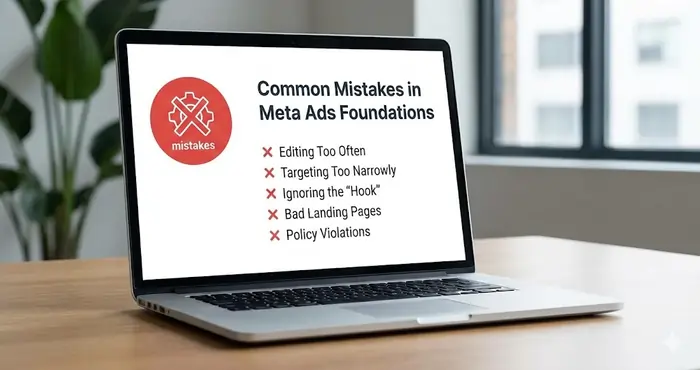
Even the best marketers stumble. Avoid these common errors in your Meta Ads Foundations:
- Editing Too Often: Patience is a virtue in advertising. Let the AI work.
- Targeting Too Narrowly: If your audience is under 50,000 people, your costs will skyrocket.
- Ignoring the “Hook”: If the first 3 seconds of your video are boring, nobody will see the rest.
- Bad Landing Pages: If your ad is great but your website is confusing, you will lose the sale.
- Policy Violations: Meta is strict about health claims, financial promises, and sensitive imagery. Always read the Advertising Policies first.
XVI. What Beginners Should Avoid First
As you master Meta Ads Foundations, stay away from “shiny objects”:
- Avoid manual bidding until you have spent at least $10,000.
- Avoid complex multi-step funnels until you can make a simple “Ad to Page” campaign work.
- Avoid buying “likes” or engagement from bots; it ruins your Pixel data.
Master Meta Ads Foundations first. Everything else is just a distraction until you have a profitable baseline.
XVII. Frequently Asked Questions (FAQ)
Is Meta Ads still relevant in 2026?
Absolutely. While new platforms emerge, Meta’s data advantage and the sheer volume of users on Instagram and Facebook make it the most reliable “bottom-line” driver for businesses.
How much budget do I really need?
While you can start with $5, a daily budget of $20 per day is recommended to give the algorithm enough data to exit the learning phase in a reasonable timeframe.
Can I run ads without a website?
Yes, using “Lead Forms” within Meta. However, having a website allows you to use the Pixel, which is a core part of long-term Meta Ads Foundations.
Final Thoughts: Your Path Forward
Learning Meta Ads Foundations isn’t about secret hacks—it’s about understanding human psychology, feeding the algorithm clean data, and testing with discipline. While the platform and interface will evolve, the core principles—campaign structure, strong creative, and reliable tracking—remain constant.
Start simple, test with intention, and improve gradually. Meta Ads reward patience, clarity, and consistency, and when you build on these foundations, you create a marketing engine that can perform for years.