
Introduction: The “Expert Economy” and the End of Referral Reliance
In the digital landscape of 2026, Meta Ads for Coaches and Freelancers have evolved from a luxury into a foundational necessity for service-based businesses. While many consultants, mentors, and creative professionals still struggle with the “feast or famine” cycle of referral-only business, those utilizing the Meta Platforms advertising ecosystem are building predictable, scalable lead generation machines.
The unpredictable nature of organic reach on social media means that relying on the “algorithm gods” for visibility is no longer a viable business strategy. This guide, a primary resource within our PPC Lab Notes, is designed to bridge the gap between complex technical media buying and the unique needs of the “expert economy.” Whether you are a business coach in Davao or a freelance developer in London, these frameworks from The Growth Lab will transform how you acquire high-ticket clients.
Part 1: Defining Meta Ads for Coaches and Freelancers in 2026
The Strategic Definition
Meta Ads for Coaches and Freelancers are paid promotional campaigns deployed across Facebook, Instagram, Messenger, and the Meta Audience Network to attract high-intent leads. Unlike generic e-commerce ads that focus on impulse low-ticket product sales, ads for service providers are built on Trust, Authority, and Transformation.
Managed through the Meta Ads Manager, these campaigns allow you to stop “shouting into the void” and start placing your specific solution in front of the exact person experiencing the problem you solve.
Why the 2026 Landscape is Different
With the rise of Generative AI in advertising, Meta’s targeting has undergone a paradigm shift. In previous years, advertisers relied on granular “interest buckets.” In 2026, we provide Signals. Meta’s AI now scans your ad copy, transcribes your video hooks, and analyzes your landing page to determine who your audience is. For the modern freelancer, this means your Creative is your Targeting.
Part 2: Why Meta Ads Outperform Organic Strategy
Service-based professionals often hesitate to pay for traffic, but the math of 2026 tells a different story.
1. Speed to Market
Organic growth is a marathon; Meta Ads are a sprint. While an SEO strategy on Social Baddie is vital for long-term authority, Meta Ads allow you to validate a new coaching offer or freelance service in 48 hours.
2. Precise Audience Segmentation
Meta’s Ad Targeting capabilities are unmatched for B2B and high-ticket B2C niches. You can target based on:
- Job Titles: Reaching “Founders,” “CEOs,” or “VPs of Engineering.”
- Economic Signals: Targeting “Top 5% Household Income” (US only) or “Frequent International Travelers.”
- Business Maturity: Reaching “Facebook Page Admins” who have held that role for over 2 years.
3. Lowering the “Trust Barrier”
The “Social Proof” loop on Meta is powerful. When a prospect sees your ad, they also see the likes, comments, and shares from your existing community. This “passive trust” is essential for high-ticket coaching where the investment risk is perceived as high.
Part 3: The Social Baddie “Expert Funnel” Architecture
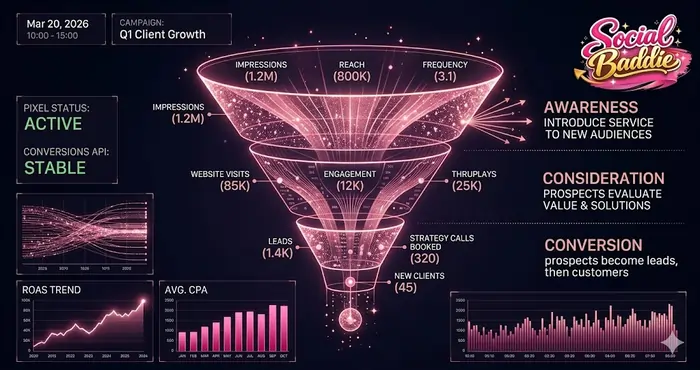
To succeed with Meta Ads for Coaches and Freelancers, you cannot simply ask for a $5,000 sale on the first click. You must build a funnel that mirrors the Customer Journey.
Phase 1: The “Authority” Layer (Awareness)
- The Hook: Stop the scroll by addressing a specific pain point (e.g., “Why your freelance business isn’t scaling past $5k/month”).
- Content Type: Short-form vertical video (Reels) or long-form “Standardized Authority” posts.
- The Goal: Build a “warm” audience of people who have watched at least 50% of your video.
Phase 2: The “Solution” Layer (Consideration)
- The Lead Magnet: Exchange a high-value resource for an email address or phone number.
- Format: Facebook Lead Ads. In 2026, the “Instant Form” is often superior to external landing pages because it reduces friction.
- The Offer: “The Freelancer’s 2026 Tax Guide” or “The 10-Minute Coaching Discovery Audit.”
Phase 3: The “Closing” Layer (Conversion)
- The Call to Action (CTA): Invite the lead to a “Strategy Call” or “Clarity Session.”
- The Retargeting Factor: Use dynamic ads to show testimonials to anyone who opened your lead form but didn’t submit it. This “nudge” is where most of the ROI is found.
Part 4: Technical Mechanics – The Meta Auction
Understanding the “Auction” is vital. Meta doesn’t just show ads to the highest bidder; it shows ads that provide the most Total Value.
$$Total Value = (Advertiser Bid \times Estimated Action Rate) + User Value$$
For coaches, User Value is determined by engagement. If people hide your ad or report it as “irrelevant,” your costs will skyrocket. According to WordStream’s benchmark data, the average CTR for professional services is roughly 1.04%. If you are consistently below 0.8%, your message isn’t resonating with your chosen audience.
The “Learning Phase” Protocol
Every ad set begins in the Learning Phase. Meta needs roughly 50 conversion events per week to stabilize. If you are a freelancer with a small budget, you should optimize for a “top-of-funnel” event (like a Lead Form) rather than a “bottom-of-funnel” event (like a booked $2,000 package) to ensure the algorithm gets enough data to learn.
Part 5: Deep Dive – Targeting Strategies for 2026
When running campaigns at The Growth Lab, we utilize three distinct audience “buckets”:
1. Broad Targeting (The AI-Led Path)
In 2026, “Broad” (targeting only age, gender, and location) often outperforms specific interests. Why? Because it gives Meta’s AI the maximum “breathing room” to find users who engage with your content.
2. Custom Audiences (The Retargeting Goldmine)
This is where you build depth. We create audiences based on:
- Website Visitors: People who have spent more than 60 seconds on the Social Baddie home page.
- Video Viewers: Anyone who watched 15 seconds of your “How to Scale” video.
- Engagers: Anyone who messaged your Instagram profile in the last 90 days.
3. Lookalike Audiences (The Expansion Vector)
Meta takes your “best” leads and finds 1-5 million people who “look” like them. For coaches, creating a 1% Lookalike of Booked Consultations is the single fastest way to scale a high-ticket program.
Part 6: Budgeting, Bidding, and the “Scale or Fail” Rule
Budget management is where most freelancers lose money.
The Testing Budget
Start with $10 – $20 per day per ad set. Run this for at least 72 hours without touching it. This is your “Market Research” phase. You aren’t buying leads yet; you are buying data.
Vertical Scaling (The 20% Rule)
Once you find a “Winning” ad set (where the CPA is below your target), increase the budget. But never increase it by more than 20% every 48 hours. Doubling your budget overnight is the fastest way to break the algorithm and send your campaign back into the Learning Phase.
CBO vs. ABO: When to Use What?
- ABO (Ad Set Budget Optimization): Use this for Testing. You control exactly how much goes to each audience.
- CBO (Campaign Budget Optimization): Use this for Scaling. Let Meta decide which audience gets the most money based on real-time performance.
Part 7: Creative Strategy – The 2026 “Social Baddie” Blueprint
Creative is no longer about “looking pretty.” It’s about Psychological Resonance.
The 3-Part Ad Structure
- The Hook (0-3 seconds): A bold statement or a visual pattern-interrupt. (e.g., “Stop sending cold emails. It’s 2026.”)
- The Body (The Authority): Briefly explain your unique mechanism. What do you do differently than every other coach?
- The Call to Action (The Direct Instruction): Tell them exactly what to do next. “Tap the button below to download the framework.”
User-Generated Content (UGC) vs. High Production
For freelancers, UGC (recorded on a phone in natural light) typically has a 20-30% lower CPA than studio-shot ads. People buy from people, and lo-fi content feels like a native post from a friend, not an intrusion from a brand.
Part 8: Landing Pages and Lead Forms – Friction vs. Intent
Where do you send the traffic?
The Case for Facebook Lead Forms
For most coaches, Meta Lead Forms are the winner. They pre-fill the user’s data (name/email), leading to a much higher conversion rate.
- High Intent Option: Always add a “Custom Question” (e.g., “What is your current monthly revenue?”) to filter out low-quality “tire kickers.”
The Case for External Landing Pages
If you are an established coach with a high-ticket program ($10k+), you need the extra space of a landing page to build the case. Ensure your site, like Social Baddie, is optimized for mobile speed.
Part 9: Advanced Optimization – Beyond the Click
Once the ad is running, the work begins.
1. Analyzing the “Hook Rate”
If your 3-second view rate is below 25%, your hook is failing. Change the first 3 seconds of the video, not the whole ad.
2. Monitoring Frequency
In small niche audiences (like “Tagum City Small Businesses”), your frequency will rise quickly. If your frequency hits 3.0 or higher in a 7-day period, it’s time to refresh your creative to avoid “Ad Fatigue.”
3. The CRM Integration
Use a tool like Zapier to connect your Meta Leads to your CRM (like HubSpot or GoHighLevel) immediately. According to Harvard Business Review, if you don’t contact a lead within the first 5 minutes, your chances of closing them drop by 400%.
Part 10: Common Mistakes Coaches and Freelancers Make
1. The “Too Professional” Trap
Using stock photos or overly corporate language. In the expert economy, your “Unfiltered” self is your competitive advantage.
2. Targeting Too Narrowly
Don’t layer 10 different interests. If your audience size is under 100,000, Meta’s AI won’t have enough data to optimize. Keep it broad and let your Ad Copy filter the people.
3. No Retargeting
90% of your clients won’t book on the first click. If you aren’t running a small “Retargeting” ad set for people who visited your site, you are leaving 50% of your revenue on the table.
Conclusion: Turning Ad Spend into a Scalable Empire
Meta Ads for Coaches and Freelancers are the ultimate lever for business growth. By moving from “hope-based marketing” to “data-driven systems,” you gain the freedom to focus on what you do best: serving your clients and delivering results.
Success in 2026 requires a hybrid approach. Use Social Baddie for your Search Engine Optimization and organic authority, but use Meta Ads for the raw power of client acquisition.
If you’re ready to build your predictable lead machine, explore the deeper technical frameworks in our PPC Lab Notes or join the elite circle in The Growth Lab. The expert economy is waiting—it’s time to scale.

