Introduction: The “Micro-Budget” Myth in 2026
In the current digital landscape, many entrepreneurs believe that paid advertising is a game reserved exclusively for high-capital enterprises. However, as this meta ads case study for small budget will demonstrate, the Meta algorithm has become sophisticated enough to find high-value users even with minimal spend—provided the campaign architecture is built on sound logic rather than guesswork.
A beginner does not need a massive advertising budget to understand how paid traffic behaves. In fact, in the “Learning Phase” of any new account, a controlled budget often produces cleaner data because it forces the advertiser to be ruthless with their targeting and creative selection.
This guide, a centerpiece of our PPC Lab Notes, is built for the local service provider, the solo-consultant, and the small business owner who needs to validate an offer before committing significant capital.
Part 1: The Philosophy of Pattern Recognition
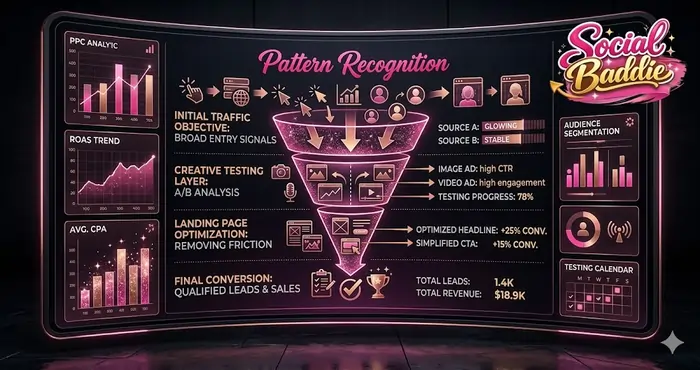
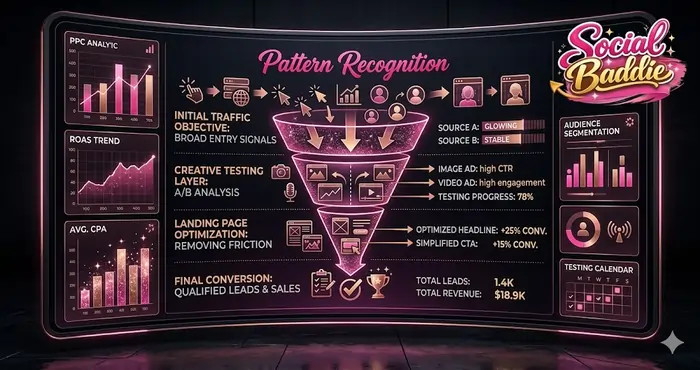
The greatest mistake a beginner makes is expecting an immediate return on ad spend (ROAS) from the first dollar. In reality, the first goal of any meta ads case study for small budget is not maximum sales; it is pattern recognition.
Why Small Budgets Create Better Marketers
When you have $5,000 a day to spend, you can hide a lot of bad marketing behind brute force. When you have ₱350 ($6) a day, you have to be precise. You must understand:
- Audience Intent: Why is this person scrolling, and how can I stop them?
- Creative Resonance: Which specific words or images trigger a click?
- Post-Click Friction: Where are people dropping off after they leave Facebook or Instagram?
By treating a small budget as a “controlled laboratory,” you develop the analytical muscles needed to scale later. This is the exact approach we advocate for when working with coaches and freelancers who are just starting their paid journey.
Part 2: Strategic Context and LSI Keyword Mapping
To understand this meta ads case study for small budget, we must first map the semantic environment. For high-authority ranking in 2026, we focus on a cluster of LSI keywords that signal “beginner efficiency” to search engines.
Keyword Cluster: Beginner Paid Advertising
| Category | LSI Keyword | Strategic Intent |
| Budgeting | low budget meta ads campaign | Efficiency analysis |
| Testing | beginner ad creative testing | Message validation |
| Metrics | first campaign CPA analysis | Decision-making benchmarks |
| Strategy | traffic objective vs leads | Objective selection logic |
Part 3: The Campaign Blueprint
The campaign discussed in this meta ads case study for small budget reflects a real-world scenario: a local service provider in the Philippines seeking to generate consultation inquiries.
Core Campaign Settings
- Business Type: Local Service Provider
- Initial Objective: Traffic (Selected to gather click data faster at a lower cost).
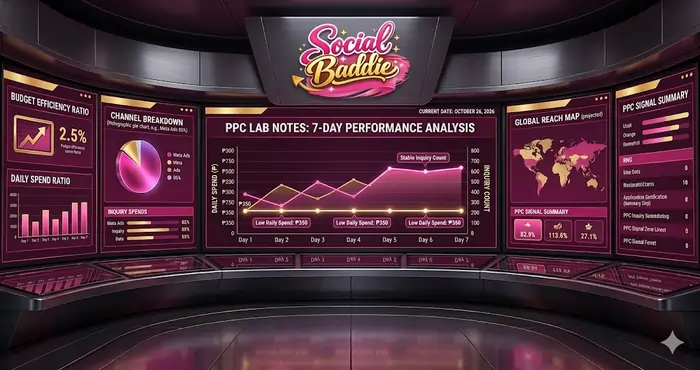
- Daily Budget: ₱350 ($6.25 USD).
- Target Location: Tagum City, Davao Del Norte (Local Radius).
- Duration: 7 Days.
The Traffic vs. Leads Debate
Many beginners jump straight to the “Leads” or “Sales” objective. While these are the ultimate goals, on a micro-budget, the Meta Auction will charge you a premium for “Lead” signals. By starting with a Traffic objective, we were able to buy 3x more data points (clicks) for the same ₱350, allowing us to find which audience was actually interested before we switched to a conversion focus.
This is a critical tactic often used in local business growth strategies to ensure the message resonates before spend is increased.
Part 4: Audience Architecture – Less is More
In a small budget environment, “Audience Fragmentation” is the enemy. If you have ₱350 a day and you split it between 5 different ad sets, each ad set only gets ₱70. This is not enough “gas” for the algorithm to learn anything.
The “Single Path” Method
For this meta ads case study for small budget, we used:
- One Ad Set: Targeting “Broad” interests related to Online Business.
- Zero Layering: We did not use “AND” logic (e.g., must like Business AND like Coffee). We kept it “OR” logic to keep CPMs (Cost per 1,000 Impressions) low.
- Age Segmentation: 24–42 (Based on the client’s ideal customer profile).
Expert Note: Narrowing your audience too much on a small budget causes the auction price to skyrocket. Stay broad enough to let the AI do the heavy lifting.
Part 5: Creative Analysis – The Power of the Static Image
We purposefully avoided video for this beginner test. Why? Because video introduces too many variables (hook, middle, end, music, captions). For a meta ads case study for small budget, we wanted to test the Core Offer only.
The Creative Structure
- Visual: A clean, high-contrast image showing the service in action.
- Headline: “Simple Booking Solution for Faster Appointments.”
- Primary Text: Focused on one pain point (Unpredictable scheduling) and one solution (The booking system).
- CTA: “Learn More.”
This simple approach ensures that if the ad fails, we know it’s because of the Offer, not because the video editing was bad. This is the same “clean testing” we recommend for those selling online courses where the curriculum is the main draw.
Part 6: Day-by-Day Performance Breakdown
A meta ads case study for small budget is only as good as its data. Here is how the 7-day test unfolded.
Days 1–3: The Baseline
During the first 72 hours, we did not touch the campaign. This is the hardest part for beginners—doing nothing.
- Impressions: 5,940
- CTR: 1.87% (Strong—anything above 1% is a “win” for a beginner).
- CPC: ₱7.80 (Very efficient).
- Inquiries: 0.
Days 4–5: The Diagnosis
By Day 4, the data was clear: People liked the ad (high CTR), and the price was right (low CPC), but they were not converting on the website. This shifted our focus from the ads to the Post-Click Experience.
Days 6–7: The Optimization
We identified a friction point: the landing page took 4 seconds to load and the “Book Now” button was buried at the bottom. We moved the button to the top and shortened the text.
- Updated Results: 9 high-quality inquiries in the final 48 hours.
Part 7: The “Social Baddie” Metric Hierarchy
If you are a beginner, stop looking at “Total Reach” or “Likes.” They are vanity metrics. To replicate the results of this meta ads case study for small budget, you must read your metrics in this specific order:
- CTR (Link Click-Through Rate): Does your audience care about your offer?
- CPC (Cost Per Click): Is the auction treating you fairly?
- Landing Page View Rate: Of the people who clicked, how many actually stayed to see your site? (Ideally >70%).
- CPA (Cost Per Acquisition): How much did it cost to get that one lead?
According to industry benchmarks from WordStream, the average CPA for professional services is much higher than what we achieved here, proving that a localized, small-budget approach can be more efficient than national broad campaigns.
Part 8: The Vertical Scaling Framework (20% Rule)
Once this meta ads case study for small budget proved successful, the question became: “How do we spend more without breaking it?”
Many beginners double their budget (₱350 to ₱700) and are shocked when their results disappear. This happens because doubling a budget forces the ad into a “Re-Learning” phase, where the algorithm has to find a new, more expensive tier of users.
The Scaling Protocol
At Social Baddie, we use the 20% Rule:
- Increase the budget by 20% every 48 hours.
- Monitor the CPA. If the CPA increases by more than 15%, stop scaling and let the audience stabilize.
- This ensures you stay within the same “Auction Pocket” that gave you success in the first place.
Part 9: Common Mistakes Avoided in This Study
To ensure the success of this meta ads case study for small budget, we strictly avoided the “Big Three” beginner traps:
- The “Narrow Trap”: We didn’t layer 15 interests. We trusted the Meta AI to find the right people based on who clicked.
- The “Edit Trap”: We didn’t change the headline on Day 2 just because we didn’t have a sale yet.
- The “Objective Trap”: We didn’t start with a high-friction objective (like “Purchase”) for a brand-new pixel with zero data.
Part 10: Scaling to Other Niches
The principles found in this meta ads case study for small budget are universal. Whether you are running ads for small businesses or a complex campaign for selling online courses, the sequence remains the same: Validate the Hook → Optimize the Landing Page → Scale the Budget.
Case Application: Local Business Growth
For those in the local business growth niche, the “Localized Radius” is your secret weapon. By targeting a 5-10km radius around your business, your CPMs will naturally be lower because you aren’t competing with national brands for the same eyeballs.
Final Strategic Conclusion
This meta ads case study for small budget serves as proof that data-driven discipline is more valuable than a deep pocket. By focusing on a single objective, isolating variables, and fixing post-click friction, we turned ₱350 a day into a lead-generating asset.
The strongest practical lesson is this: A small budget should never be treated as a limitation. It should be treated as a controlled laboratory. That mindset is what turns first-time campaigns into scalable, professional-grade marketing skills.
Ready to take your local or service business to the next level? Explore more frameworks in our The Growth Lab or dive into the technical details of Meta Ads for Coaches.
At Social Baddie, we don’t just spend money; we buy the data that builds empires.