
Executive Summary: The Evolution of Precision
Interest targeting in Meta Ads is no longer just a beginner tool. In 2026, it functions as a strategic audience validation system inside the advertising ecosystem of Meta Platforms. While the industry narrative has shifted heavily toward “Broad Targeting” and Advantage+ Shopping Campaigns, real-world data across e-commerce, B2B lead generation, and local service accounts shows a more nuanced reality.
Interest targeting in Meta Ads works best as a structured testing framework—not necessarily as a permanent scaling strategy. This guide, part of our comprehensive PPC Lab Notes, provides the roadmap for navigating the Meta auction in an era of signal loss and AI-driven delivery.
What Is Interest Targeting in Meta Ads?
The Technical Definition
Interest targeting in Meta Ads is a methodology within Meta Ads Manager that allows advertisers to display creative assets to users based on their specific hobbies, brand affinities, behavioral patterns, and digital activity signals harvested across Facebook, Instagram, and the Meta Audience Network.
In the current 2026 landscape, this targeting lives under the Audience → Detailed Targeting section. Unlike “Broad” targeting, which relies entirely on the pixel and creative to find an audience, interest targeting provides the algorithm with a “seed” or a boundary.
The 2026 Paradigm Shift
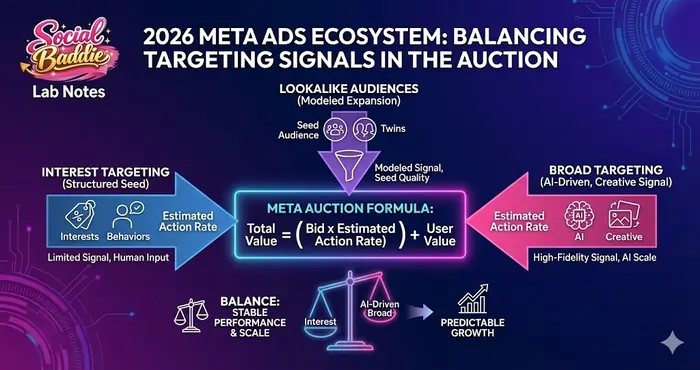
Years ago, interests were “hard” buckets. If you targeted “Coffee,” your ad went to coffee lovers. Today, interest targeting is a probabilistic signal. According to recent digital advertising trends, Meta’s machine learning uses your selected interests as a starting point, but the “Estimated Action Rate” remains the ultimate gatekeeper for ad delivery.
How the Meta Algorithm Processes Interests
To master interest targeting in Meta Ads, one must understand the “Auction Dynamics.” Meta does not simply show ads to everyone in your chosen interest group. Instead, it runs a real-time auction every time a user opens an app.
The Winning Formula
The formula for winning the auction is:
$$Total Value = (Advertiser Bid \times Estimated Action Rate) + User Value$$
- Advertiser Bid: How much you are willing to pay.
- Estimated Action Rate: How likely the user is to take your desired action (Purchase, Lead, Click).
- User Value: The relevance and quality of your ad.
Core Algorithm Factors for Interest Groups
| Factor | Role | Performance Impact |
| Semantic Mapping | Linking user behavior to interests | Defines initial reach |
| Ad Quality | Historical engagement data | Dictates CPM (Cost Per 1000 Impressions) |
| Signal Density | Amount of data points per user | Increases targeting accuracy |
| Conversion History | Pixel data health | Essential for The Growth Lab scaling |
Strategic Frameworks for Interest Grouping
When building campaigns on Social Baddie, we categorize interest targeting into four specific structures:
1. The Interest Stack (The “OR” Logic)
This is the most common method. You group 5-10 related interests into a single ad set.
- Example: “Yoga” OR “Lululemon” OR “Mindfulness” OR “Meditation.”
- Strategic Purpose: This creates a large enough “Learning Pool” for the algorithm. In 2026, we recommend an audience size of 500,000 to 5,000,000 for national campaigns.
2. The Layered Audience (The “AND” Logic)
Layering is used to define “High-Intent” segments.
- Example: (Interest: “Real Estate Investing”) AND (Behavior: “Engaged Shoppers”) AND (Demographic: “Top 5% Household Income”).
- Strategic Purpose: This ensures that the person is not just interested in the topic, but also has the financial behavior to convert.
3. The Competitor Conquest
While Meta has removed some specific competitor interests over the years, “indirect competitor targeting” remains viable. By targeting publications, public figures, or software tools your competitors’ customers use, you can build a highly relevant cold audience.
4. Behavior-Based Targeting
Unlike interests (which are based on what people “like”), behaviors are based on what people “do.” This includes:
- International Travelers (sourced from location signals).
- Mobile Device Users (e.g., iPhone 15 Pro Max users).
- Facebook Page Admins (essential for B2B).
Broad Targeting vs. Interest Targeting vs. Lookalikes
A common question in our Growth Lab is: “When do I stop using interests?”
The Comparison Matrix
- Interest Targeting: Best for new accounts, niche products, and validation. It provides “guardrails” when the Meta Pixel has zero data.
- Lookalike Audiences (LAL): Once you have 500+ conversions, LALs allow you to find people similar to your customers. However, since Apple’s iOS 14.5+ updates, LAL precision has decreased compared to previous years.
- Broad Targeting: This is the “Holy Grail.” You provide only Age, Gender, and Location. You let the Creative do the targeting. This requires high spend and a mature pixel.
The “Social Baddie” Testing Protocol
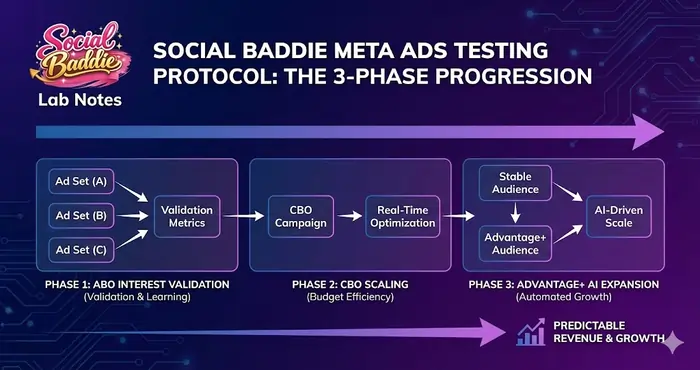
We recommend a 3-Phase approach to testing interest targeting in Meta Ads.
Phase 1: The Validation Phase (ABO)
Use Ad Set Budget Optimization (ABO) to give each interest stack a fair shake.
- Test A: Broad (Control)
- Test B: Interest Stack 1 (Direct Interests)
- Test C: Interest Stack 2 (Indirect/Lifestyle Interests)
Phase 2: The Scaling Phase (CBO)
Take the winning ad sets from Phase 1 and move them into a Campaign Budget Optimization (CBO) structure. Here, Meta’s AI will automatically shift budget to the best-performing audience in real-time.
Phase 3: The Advantage+ Expansion
Once an interest stack is stable, toggle on Advantage Detailed Targeting. This allows Meta to go outside your selected interests if it finds a cheaper conversion.
Why Creative is the New “Targeting”
In 2026, the words on your image and the first three seconds of your video are more important than the “interest” you select. Meta’s Artificial Intelligence scans your creative, transcribes your audio, and reads your “hooks” to determine who should see the ad.
If you target “Golf” but your video shows people “Tennis,” the algorithm will eventually stop showing the ad to golfers because the User Value signal is low.
Creative Strategy Tips:
- Call out the audience in the headline: “Attention Davao Entrepreneurs…”
- Use Visual Cues: Show the product in a context that matches the interest.
- A/B Test Hooks: Test one video with an “educational” hook and one with an “emotional” hook against the same interest stack.
Common Mistakes and How to Avoid Them
1. Audience Overlap
If you have two ad sets targeting similar interests (e.g., “Fitness” in one and “Gym” in another), you may end up bidding against yourself in the auction. Use the Audience Overlap Tool in Meta Business Suite to check for this.
2. The “Narrow” Trap
Avoid making your audiences too small. If your audience is under 100,000, your CPMs will skyrocket because the algorithm has no “room to breathe.” Meta needs volume to find the users most likely to convert.
3. Neglecting Exclusions
To maintain high ROAS, you must exclude your existing customers and recent website visitors from your cold interest campaigns. This ensures your budget is spent on New Customer Acquisition.
GEO, AEO, and SEO – The Search-Social Synergy
Modern interest targeting in Meta Ads doesn’t exist in a vacuum. It is part of a larger search ecosystem.
- Search Engine Optimization (SEO): The interests you target should mirror the high-intent keywords you rank for on the Social Baddie blog.
- Answer Engine Optimization (AEO): As people use AI tools like Perplexity or Gemini to ask “What is the best skincare for 30-year-olds?”, Meta’s interests allow you to put your brand in front of those same segments on social media.
- Generative Engine Optimization (GEO): Structuring your ad copy with NLP-friendly terms helps Meta’s AI categorize your ads more accurately.
Real-World Case Studies
Case Study A: E-commerce (Skincare)
- Problem: High CPA on Broad targeting for a new brand.
- Solution: Implemented Layered Interest Targeting (Interests: Organic Beauty + Behavior: Engaged Shoppers).
- Result: 42% decrease in CPA and a 2.5x increase in ROAS within 14 days.
Case Study B: Local Service (Davao, Philippines)
- Problem: Ads reaching people outside the service area.
- Solution: Combined Radius Targeting with Life Event Targeting (“Recently Moved”).
- Result: 60% higher lead quality for a local furniture rental business.
Final Strategic Conclusion
Mastering interest targeting in Meta Ads is about finding the balance between human intuition and machine learning. By using interests as a validation framework, you provide the Meta algorithm with the necessary data to eventually transition into high-scale broad targeting.
For those looking to dive deeper into performance marketing, explore our other PPC Lab Notes or join the discussion at The Growth Lab.
At Social Baddie, we believe that data-driven testing is the only way to win in the ever-changing landscape of digital advertising. Start small, test rigorously, and scale what works.

