
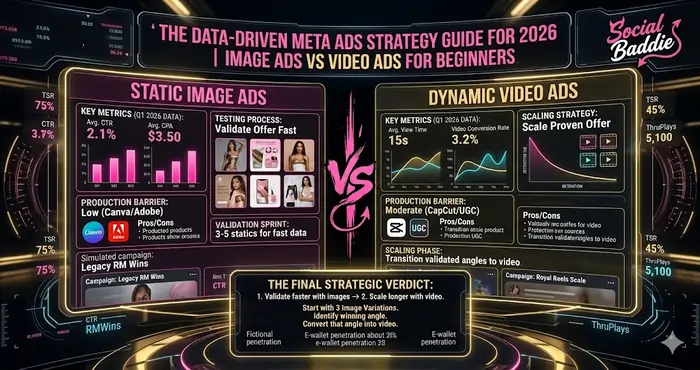
If you are a media buyer deciding between Image Ads vs Video Ads for Beginners, here is the strategic truth that most gurus won’t tell you: Image ads validate your message; video ads scale your reach. In the 2026 Meta ecosystem, the algorithm has shifted almost entirely to a “creative-led” targeting model. This means your creative assets are no longer just “the ad”—they are the primary data signal that tells Meta who your customer is.+1
For beginners, choosing the wrong format isn’t just an aesthetic mistake; it’s a structural failure that can lead to high CPAs and rapid budget depletion. This guide serves as your performance marketing blueprint to navigating this choice at https://socialbaddie.com/.
Why “Image Ads vs Video Ads for Beginners” is the Wrong Question
Most newcomers ask which format converts better. As a digital marketing specialist focused on PPC, I argue that the better question is: Which format provides the fastest speed of learning?
In The Growth Lab, we’ve observed that format is a secondary variable. Success in 2026 is driven by creative strategy, audience intent, and offer clarity. However, the debate persists because the format directly influences your key performance indicators (KPIs). When you choose a format, you are choosing how you want to pay for attention.
- CPM (Cost per 1,000 Impressions): Meta often discounts CPMs for video because it keeps users on the platform longer.
- Thumb-Stop Rate: This is the percentage of people who stop scrolling when they see your ad.
- Creative Fatigue: This is the point where your audience stops responding to your ad because they’ve seen it too many times.
The Power of Static: Why Beginners Should Start with Image Ads
Image ads are static, but in the world of high-performance media buying, simplicity is a massive competitive advantage. They rely on visual hierarchy and cognitive speed. The human brain processes images significantly faster than video sequences, making them the ultimate tool for direct response marketing.
1. Speed of Validation
If you have a $20/day budget, you cannot afford to wait 7 days for a video ad to accumulate enough data to tell you if your hook is working. With image ads, you can test 5 different headlines and 5 different visuals in 48 hours. This rapid iteration is the heartbeat of a successful PPC campaign.
2. Cognitive Ease
An image ad forces you to be clear. You don’t have 15 seconds to explain a product; you have 1 second. This constraint forces beginners to master Headline Writing and Offer Framing, which are the fundamental building blocks of all successful advertising. You can quickly design these using tools like Canva or Adobe Express.
3. Lower Production Risk
A bad video ad—with poor lighting, shaky audio, or a weak hook—will kill a campaign instantly. A simple image ad with a bold promise is much harder to “get wrong.” For a beginner, reducing the number of variables that can fail is the smartest path to the first conversion.
The Scale of Motion: When to Graduate to Video Ads
Video ads introduce the dimension of time. This allows the Meta algorithm to collect much deeper data points than a simple click. Meta tracks 3-second views, ThruPlays, and retention percentages at 25%, 50%, and 75%.
1. The Engagement Pool Advantage
When you run a video ad, you are building an “Engagement Audience.” You can later retarget people who watched 50% of your video. This is a much “warmer” audience than someone who just scrolled past an image. This is a core strategy we refine within The Growth Lab.
2. Storytelling and Education
If your product is complex—like a SaaS platform, a coaching service, or a high-ticket e-commerce item—an image might not be enough. Video allows you to:
- Agitate the Problem: Show the pain point the user is feeling.
- Demonstrate the Solution: Show the product in action.
- Build Authority: Let the user see and hear a human being, which builds instant trust.
3. Scaling Stability
Once you find a winning message via image testing, moving it into a video format often “unlocks” scale. Video ads generally have a higher “saturation point,” meaning you can spend more money on them before the performance starts to degrade. Professionals use tools like CapCut or InVideo to maintain high-tempo video production.
Funnel Stage Analysis: The 2026 Strategic Blueprint
A balanced Meta Ads account doesn’t choose one format; it uses both strategically across the customer journey.
Top of Funnel (Cold Audience – TOF)
- Format: Video (UGC or Explainer).
- Goal: Awareness and Education.
- Why: You need to “stop the scroll” and explain why they should care. User-Generated Content (UGC) is currently the highest-performing format for cold traffic.
Middle of Funnel (Warm Audience – MOF)
- Format: Hybrid (Video Testimonials + Image Comparisons).
- Goal: Objection Handling and Trust.
- Why: They know who you are, but they aren’t sure if the product works for them. Show them proof.
Bottom of Funnel (Hot Retargeting – BOF)
- Format: Image (Dynamic Product Ads or “Last Chance” statics).
- Goal: Conversion.
- Why: Don’t distract them with a 60-second video when they are ready to buy. Show them the product, the price, and the ROAS-driven CTA.
Creative Fatigue: The Silent Budget Killer
One of the biggest differences between Image Ads vs Video Ads for Beginners is how they handle fatigue.
- Image Fatigue: Occurs quickly. Once a user has seen a static image 3 times, the “novelty” wears off. To sustain image ads, you must swap backgrounds, fonts, or colors every 7–14 days.
- Video Fatigue: Occurs slowly. Because a video has more “depth,” a user can see it multiple times and focus on different parts of the message. This makes video the superior choice for high-spend campaigns ($100+/day).
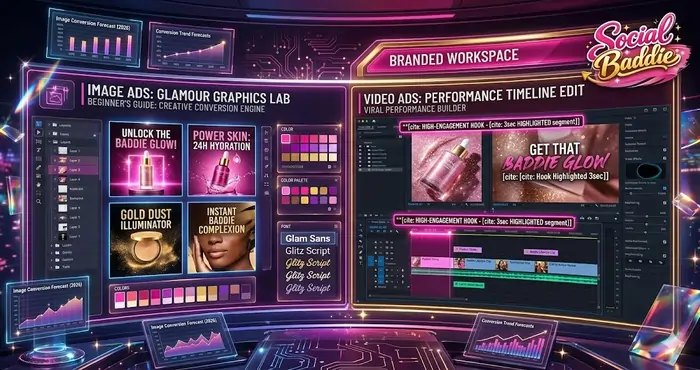
Decision Framework: Image Ads vs Video Ads for Beginners
If you are stuck, use this checklist to decide your starting point:
- Is your budget under $30/day? Start with Image Ads.
- Is your product easily understood in 1 second? Start with Image Ads.
- Is your product a “Service” or “Solution” to a complex problem? Start with Video Ads.
- Do you have high-quality testimonials? Use Video Ads in the retargeting phase.
- Are you a solo-preneur with limited time? Start with Image Ads and automate the testing in The Growth Lab.
Common Beginner Pitfalls in 2026
As a performance marketer, I see the same mistakes repeatedly:
- Over-Producing Video: Beginners spend $2,000 on a cinematic video that has no “Hook.” In 2026, a raw iPhone video often outperforms a professional camera crew.
- Weak Headlines on Images: An image ad is only as good as its text. If your headline doesn’t call out the specific problem, the image is just “digital noise.”
- Ignoring the First 3 Seconds: In video, if you don’t have a “pattern interrupt” immediately, your drop-off rate will be 90%+. Refer to Meta’s Creative Center for the latest successful hooks.
Final Strategic Conclusion
The true resolution to the Image Ads vs Video Ads for Beginners debate is structured progression. Beginners should optimize for Speed of Learning. Start with 3–5 static image variations to find your “winning angle.” Once you have a headline and a visual that consistently gets clicks, use that exact messaging to script your first video ad. This “Hybrid Validation” method ensures you aren’t guessing with your video production—you are building on a foundation of proven data.
In Meta advertising, format is the vehicle, but strategy is the engine. Master your offer, understand your data, and use both images and videos as tools to scale your profitable growth at https://socialbaddie.com/.
Knowledge Graph: Creative Performance Matrix
| Metric | Image Ads | Video Ads |
| Initial Setup Cost | Very Low | Moderate to High |
| Ideal for Testing Hooks | Winner | Secondary |
| Ideal for Retargeting | Secondary | Winner |
| Longevity (Fatigue) | Low | High |
| Algorithm Data Signals | Clicks/Conversions | Watch Time/Retention/Clicks |

