
Overview
If you are learning how to write Meta ad copy for beginners, you are probably facing one frustrating problem: your ads are running, but they are not converting. Most beginners think ad performance depends only on targeting or budget. However, at Social Baddie, our nine years of experience has proven that copy is one of the strongest performance drivers in any campaign.
Even with correct targeting, weak copy leads to low CTR, high CPC, an unstable learning phase, and rising CPA. This guide will show you exactly how to write Meta ad copy for beginners using a simple five-step structure that aligns with performance metrics like CTR, CPA, and ROAS. This framework is built on real performance campaign structures used in The Growth Lab for scaling both eCommerce and service-based brands.
In the 2026 advertising landscape, copy is no longer just “text on a screen.” It is a data signal. It is the primary way you communicate with the Meta Lattice AI to tell it who your ideal customer is. If your copy is vague, your data is vague. If your data is vague, your scaling is impossible.
The Psychology of the Click: Why Structure Trumps Creativity
When most people think about how to write Meta ad copy for beginners, they envision a creative writer in a dark room waiting for “inspiration.” In performance marketing, we don’t wait for inspiration; we follow architecture.
The average Meta user scrolls through roughly 300 feet of content every day. Your ad is an uninvited guest in their social feed. To succeed, your copy must perform three psychological tasks in under 1.5 seconds:
- Stop the lizard brain (The Hook).
- Validate the struggle (The Problem).
- Offer a bridge to a better reality (The Solution).
The “Creative as Targeting” Shift
In 2026, the industry has shifted. Because we often use broad targeting to allow the algorithm to breathe, your copy is actually your primary targeting tool. If you write about “Back Pain,” the AI scans the text and starts showing the ad to people whose behavior suggests they have back pain. Therefore, learning how to write Meta ad copy for beginners is actually a technical skill in audience segmenting.
What Is Meta Ad Copy and Why It Matters
Meta ad copy refers to the written content inside your Meta Ads campaign. It is the verbal component of your creative asset. It includes:
- Primary Text: The main body of the ad that appears above the image or video on mobile.
- Headline: The bold text next to the CTA button.
- Description: The smaller text below the headline (often only visible on Desktop).
- Call-to-Action (CTA): The button that dictates the final step.
When learning how to write Meta ad copy for beginners, understand this clearly: copy is the “salesperson” of your ad. It influences everything from your Click-through rate (CTR) to your ultimate Return on ad spend (ROAS). Strong copy improves signal quality, which directly assists in Meta algorithm optimization by signaling the algorithm on who to prioritize based on user engagement.
Why Most Beginners Fail at Writing Meta Ad Copy
Before mastering the formula, you must identify common failure points.
The “Me-Centered” Trap
Beginners often write about themselves: “We are a 10-year-old family business.” The customer doesn’t care. The customer cares about their own problem.
The Feature-Focus Error
Beginners list features: “Our software has 20 different dashboard views.” Performance writers list outcomes: “Get the clarity you need to scale without checking 20 different spreadsheets.”
The Lack of White Space
On mobile devices, a wall of text is an immediate “skip.” If you don’t use line breaks, your message is lost. This is a core pillar of our PPC lab notes. According to industry standards on Direct Response Copywriting, the goal of your ad is to provoke an immediate reaction, which is only possible when the text is readable.
How to Write Meta Ad Copy for Beginners Using the 5-Step Formula
Step 1: Start With a Pattern-Interrupt Hook
The first line determines performance. If it does not stop the scroll, the rest does not matter. This is often referred to as Visual and Textual Salience, where your copy must stand out against a sea of organic content.
The “Baddie” Insight: If your hook is boring, your ROAS will be non-existent. You have three lines of text before Meta hides the rest under a “See More” button. Use them wisely.
Proven Hook Formats:
- The Negative Callout: “Stop wasting money on agencies that don’t care about your ROI.”
- The “If/Then” Hook: “If you’re spending $50/day on ads and getting zero sales, read this.”
- The Statistical Shocker: “87% of eCommerce brands fail in the first year because of this one mistake.”
Step 2: Identify the Specific Problem (The Agitation)
Your audience must feel understood. You are essentially holding up a mirror to their current frustration. Clarity builds immediate trust and leverages the Problem-Agitation-Solution (PAS) framework to agitate the user’s specific pain point.
Don’t just say “Business is hard.” Say, “You’re tired of waking up at 2 AM to check your Ads Manager, only to see your CPA has doubled again.”
Step 3: Present the Solution Clearly (The Bridge)
Introduce your offer simply. This aligns with the Jobs to be Done (JTBD) theory, focusing on the “job” the user is hiring your product to do.
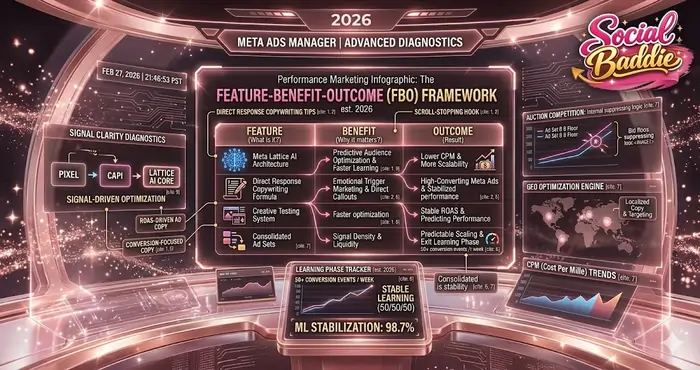
The Feature → Benefit → Outcome framework:
| Feature | Benefit | Outcome |
| :— | :— | :— |
| Full-funnel strategy | Better audience alignment | Lower CPA |
| Creative testing system | Faster optimization | Stable ROAS |
| Conversion tracking | Accurate data | Smarter scaling |
| Broad Targeting Setup | Lower CPMs | Infinite Scalability |
Step 4: Add Proof or Credibility
Proof reduces the friction of the “click.” Users are skeptical of ads. Use Social Proof to bridge the trust gap.
- “Join 5,000+ marketers using this blueprint.”
- “The exact strategy we used to scale Adscrew PH to a 5x ROAS.”
- “Featured in [Authority Publication].”
Step 5: End With a Clear Call-to-Action (CTA)
Do not assume people know what to do. Use direct commands aligned with Meta’s CTA standards.
- Low Friction: “Learn More,” “Watch Video.”
- High Intent: “Shop Now,” “Book Appointment,” “Get Quote.”
The Architecture of High-Converting Headlines
The headline is the second most important piece of copy after the first line of the primary text. In the mobile feed, the headline sits right next to the CTA button.
Headline Strategies for Beginners:
- The Result Headline: “Scale to $10k/Month Today”
- The Scarcity Headline: “Only 5 Strategy Spots Left for February”
- The Benefit-Driven Headline: “Lower Your CPA by 30% Without Increasing Budget”
How to Optimize Meta Ad Copy After Launch: The Data Feedback Loop
Writing copy is only step one. Optimization improves profitability. You cannot judge copy based on “how it looks.” You must judge it based on the Ads Manager metrics.
Key Metrics to Watch:
- Hook Rate (3-Second View / Impression): Tells you if your first line (and visual) is working.
- CTR (Link Click-Through Rate): Tells you if your “Solution” and “Offer” are compelling enough to leave the platform.
- CPC (Cost Per Click): Higher CTR usually leads to lower CPC.
- Conversion Rate: If CTR is high but conversion is low, your copy might be “over-promising” and causing a mismatch on the landing page.
At The Growth Lab, we recommend testing one variable at a time—usually the hook variation first—to improve signal clarity without resetting the learning phase.
Meta Ad Copy Structure Knowledge Graph
| Section | Purpose | Example | Performance Metric Impact |
| Hook | Stop the scroll | “Tired of rising Meta costs?” | High Hook Rate / Lower CPM |
| Problem | Build resonance | “Most brands can’t scale past $1k/day.” | Higher Engagement / Lower CPC |
| Solution | Show the path | “Our 3-step scaling blueprint fixes that.” | Higher CTR |
| Proof | Reduce friction | “Tested on $1M+ in ad spend.” | Higher Conversion Rate |
| CTA | Direct the action | “Download the Blueprint Now” | Lower CPA |
Creative and Copy Synergy: The 2026 Power Couple
You cannot learn how to write Meta ad copy for beginners in a vacuum. The copy must work with the image or video.
- The Harmony Rule: If your image shows a happy woman using a skincare product, your copy should talk about the feeling of confidence, not the chemical composition of the cream.
- The Conflict Rule (Pattern Interrupt): Sometimes, using copy that “disagrees” with the image can stop the scroll. (e.g., An image of a broken car with the hook: “This is the best thing that ever happened to my wallet.”)
GEO Optimization Strategy for Meta Ad Copy
When scaling globally, messaging must adapt to cultural and economic realities.
| Region Type | Messaging Focus | Tone Requirement |
| Tier 1 (US/UK/AU) | Efficiency, Time-Saving, Status | Highly professional / Direct |
| Emerging Markets | Affordability, Opportunity, Practicality | Warm / Community-focused |
| Local Campaigns | Proximity, Trust, Community | Hyper-local / Conversational |
Geo-aware messaging increases resonance and CTR. If you are targeting the Philippines, using local context or Taglish in your Social Baddie style can drastically improve engagement compared to a generic “Global” ad.
Using AI to Write Meta Ad Copy (Without Sounding Like a Bot)
In 2026, AI is everywhere. However, most beginners make the mistake of letting the AI do the thinking.
The Correct Way to Use AI:
- Feed the Formula: Don’t ask it to “Write a Facebook ad.” Ask it to “Write a Meta ad using the PAS framework with a pattern-interrupt hook.”
- Inject the Baddie Voice: Add your unique personality. AI is great at structure but terrible at “wit.”
- Fact-Check the Hook: AI often writes generic hooks like “Unlock your potential.” Manually replace these with the high-impact hooks we discussed in Step 1.
Final Checklist Before Publishing Your Meta Ad
Before you hit “Publish” on your next Adscrew PH campaign, run through this checklist:
- [ ] Does the first line stop the scroll?
- [ ] Is there a clear problem identified in the first 3 lines?
- [ ] Is the solution simple to understand?
- [ ] Is there at least one piece of social proof?
- [ ] Is the CTA a direct command?
- [ ] Did you use enough line breaks for mobile readability?
- [ ] Does the headline complement the primary text?
Final Takeaway
Learning how to write Meta ad copy for beginners is not about being creative; it is about being clear. Structure beats cleverness every single time. When your copy aligns with your targeting and account architecture, scaling becomes a predictable science rather than a gamble.
Master these fundamentals in our latest PPC research and start turning your ad spend into measurable growth. Remember: Meta is a machine. Feed it clean data, clear copy, and consistent structure.
Would you like me to help you draft three different “Pattern-Interrupt Hooks” for your next campaign, or shall we look at a futuristic dashboard showing how these copy changes impact your CTR?

