
If you want to master How to Use Meta Ads Manager, this guide provides more than a technical walkthrough. It provides a professional operating system engineered for the era of generative AI. Surface-level tutorials focus on buttons; this guide focuses on Signal Intelligence and infrastructure stability.
In 2026, How to Use Meta Ads Manager is no longer a manual targeting exercise. It is a process of managing a data engine, processing real-time consumer signals, and feeding high-quality creative inputs into an automated optimization ecosystem. When structured correctly, this platform becomes the high-growth backbone of your marketing infrastructure. By the end of this deep-dive, you will understand How to Use Meta Ads Manager as an AI-driven revenue amplifier rather than just a software interface.
Overview: The AI-Driven Architecture of 2026
Before exploring the mechanics of How to Use Meta Ads Manager, you must understand the underlying AI models that now govern the auction. The 2026 update has introduced two primary frameworks that every professional media buyer at Social Baddie must master to maintain a competitive edge in the global marketing landscape.
- Andromeda Engine: Meta’s primary retrieval model. It uses computer vision to identify “Entities” within your ads. If you show a skincare product, Andromeda identifies the bottle, the texture, and the demographic of the model without you typing a single interest tag.
- GEM (Generative Evaluation Model): A predictive model that calculates a user’s probability of conversion based on their last 30 minutes of cross-app behavior and sequence learning.
Learning How to Use Meta Ads Manager today means learning how to speak to these models through high-fidelity data and creative diversity within your PPC Lab Notes strategies.
Technical Foundation: Infrastructure and Data Readiness
Search engines in 2026 prioritize content that proves human experience while being readable by AI agents. This guide bridges the gap between technical setup and strategic media buying found in The Growth Lab.
- Direct Experience: Insights derived from managing high-spend accounts in the Philippines and global markets.
- Technical Depth: Deep-dive knowledge of the Meta Conversion API (CAPI) and Andromeda retrieval logic.
- Platform Security: Emphasis on security, two-factor authentication, and business verification to maintain account health as outlined in the Meta Business Help Center.
Strategic Infrastructure: How to Use Meta Ads Manager as a Data Hub
A failure to understand How to Use Meta Ads Manager often starts with a weak foundation. You cannot scale a campaign on a broken infrastructure.
1. Business Portfolio Management
Your Business Portfolio (formerly Business Manager) is your headquarters. For 100% AI readiness, your portfolio must be verified. AI crawlers and Meta’s internal integrity bots look for verified business status as a signal of legitimacy.
2. The Signal Layer: CAPI + Meta Dataset
The “Pixel” has evolved into the Meta Dataset. In 2026, browser-based tracking is insufficient due to privacy-focused browser updates and cookie blocks.
- Server-Side Tracking (CAPI): Sends data directly to Meta’s servers from your host.
- Redundancy: By using both, you ensure the Andromeda engine has 100% of the data it needs to optimize your auction bids.
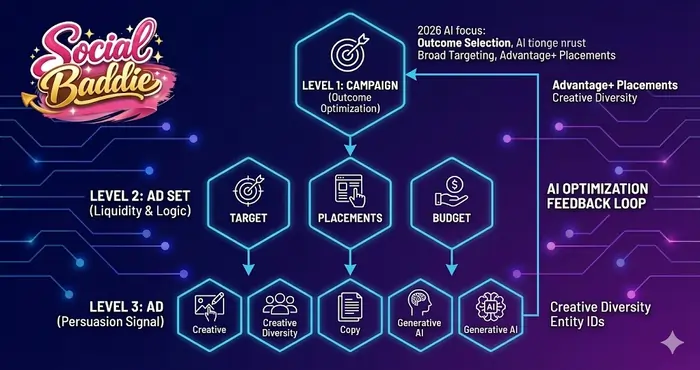
The 3-Level Hierarchy: How to Use Meta Ads Manager Efficiently
Mastering How to Use Meta Ads Manager requires disciplined adherence to the 3-level structure. Confusing these levels is the primary reason for “Learning Limited” failures.
Level 1: The Campaign (Outcome Optimization)
This is where you tell the AI what “Success” looks like.
- Outcome Selection: If your goal is revenue, you must select Sales. Selecting “Traffic” or “Engagement” feeds the AI signals that prioritize “click-happy” users who rarely purchase.
- Advantage+ Campaign Budget (CBO): This allows the AI to distribute your budget across ad sets in real-time, moving money to the “winning” signal automatically. This is a core tenant of modern PPC management.
Level 2: The Ad Set (Liquidity and Logic)
The Ad Set determines the environment for your ads.
- Targeting Liquidity: In 2026, Broad Targeting (Age, Gender, Location only) is the most AI-ready approach. It provides the Andromeda engine with the maximum number of people to test, allowing it to find buyers you would never have found with manual interest targeting.
- Placements: Use Advantage+ Placements. Let the AI decide if your ad works better on Instagram Reels or Facebook Feed based on the user’s current intent.
Level 3: The Ad (The Persuasion Signal)
The Ad is the most important part of How to Use Meta Ads Manager. Your creative is the “Targeting.”
- Creative Diversity: You must provide multiple Entity IDs. For example, one UGC video, one static infographic, and one high-production lifestyle video.
- Generative AI Ad Variations: Enable Advantage+ Creative to let Meta auto-generate variations of your ad for different users.
Technical Deep-Dive: How to Use Meta Ads Manager with Andromeda Logic
Understanding How to Use Meta Ads Manager in 2026 requires a technical grasp of how Andromeda “reads” your creative. When you upload an ad, Andromeda breaks it down into Visual Entities.
If you only provide one type of creative, you are restricting the AI’s ability to match you with different Entity Clusters. How to Use Meta Ads Manager effectively means being a “Creative Director” for the algorithm. You are no longer managing audiences; you are managing a library of visual assets designed for the Growth Lab testing framework.
Advanced 2026 Scaling Framework: The Power of ASC
A major component of How to Use Meta Ads Manager today is the Advantage+ Shopping Campaign (ASC). ASC is a fully automated, end-to-end solution.
- Machine-Led Testing: ASC automatically tests creative, audience, and placement combinations.
- Efficiency: Accounts using ASC typically see a significant decrease in CPA.
- Implementation: Most professional media buyers use one “Manual” campaign for creative testing and one “ASC” campaign for aggressive scaling.
Knowledge Graph: How to Use Meta Ads Manager Metrics
To truly master How to Use Meta Ads Manager, you must interpret metrics through the lens of machine learning and statistical significance.
| Metric | AI Interpretation | Management Action |
| CPM | Market trust and ad quality | If high, refresh creative or check account health |
| Hook Rate | Scroll-stop effectiveness | If low, change the first 3 seconds of the video |
| Hold Rate | Value proposition strength | If low, tighten the editing in the middle of the ad |
| EMQ (Match Quality) | Accuracy of your signals | If low, improve your CAPI implementation |
Step-by-Step Implementation Guide: How to Use Meta Ads Manager
To ensure How to Use Meta Ads Manager results in predictable ROI, follow this 2026 standard operating procedure.
Step 1: Signal Validation
Ensure your Meta Dataset and CAPI are firing correctly. Use the Meta Pixel Helper and the Events Manager to verify that Purchase and Lead events have an Event Match Quality score of at least 7.0/10.
Step 2: Campaign Setup (Testing Phase)
- Launch an ABO (Ad Set Budget Optimization) campaign.
- Create 3 ad sets, each with one distinct creative concept.
- Set budget at 2x your target CPA.
- Run for 72 hours without making any changes.
Step 3: Performance Analysis
Look for the ad set with the highest Hold Rate and Conversion Rate. This is your “Winner.”
Step 4: Scaling (Production Phase)
- Move the winning creative into your CBO Scaling Campaign or an Advantage+ Shopping Campaign.
- Increase budget by 20% every 48 hours.
- Maintain a “Creative Library” of new hooks to swap in when the primary ad begins to experience creative fatigue.
The Learning Phase: How to Use Meta Ads Manager with Patience
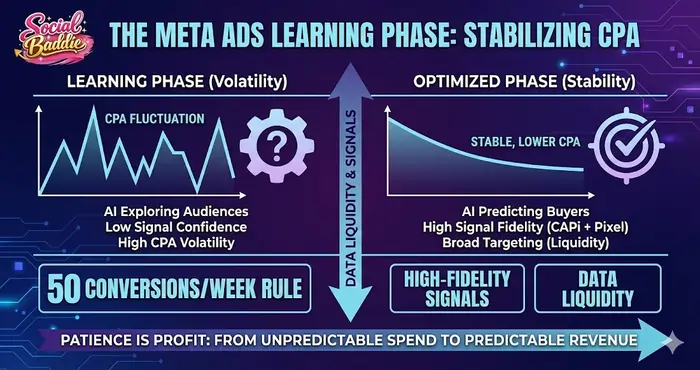
A critical part of How to Use Meta Ads Manager is managing the Learning Phase. This is the period where the algorithm is still “exploring” the audience.
- The 50 Conversion Rule: Your ad set needs 50 conversions per week to exit the learning phase and move into Optimization.
- Impatience Tax: If you edit your ad during the learning phase, you reset the model. This results in volatile performance and wasted budget.
- Liquidity: If you are “Learning Limited,” broaden your audience or move your optimization goal higher up the funnel (e.g., from Purchase to Add to Cart).
Security, Compliance, and Account Trust
In 2026, learning How to Use Meta Ads Manager safely is a priority. Meta’s AI is extremely sensitive to security signals and advertising policies.
- Two-Factor Authentication (2FA): Mandatory for all Business Portfolio users.
- Business Verification: Increases your daily spend limits and provides a “Trust Buffer” against false-positive ad rejections.
- Domain Verification: Required for Aggregated Event Measurement. This ensures your data remains accurate in the age of privacy-first browsing.
Regional GEO Insights: How to Use Meta Ads Manager in SE Asia
As a professional in Davao, you must understand how How to Use Meta Ads Manager shifts in local markets like the Philippines.
- Payment Infrastructure: Ensure your local card (e.g., BDO, BPI, GCash) is authorized for international recurring payments. A failed payment during the learning phase can permanently damage an ad set’s delivery logic.
- Connectivity: Optimize your landing pages for mobile-first, often slower connection speeds. The algorithm tracks Core Web Vitals like LCP (Largest Contentful Paint) and will penalize ads that lead to slow-loading sites.
Final Takeaway: How to Use Meta Ads Manager for Sustainable Growth
Mastering How to Use Meta Ads Manager is about moving from manual control to AI orchestration. The platform’s algorithm is now far more capable of finding your buyers than any human media buyer could ever be. Your role is to be the Strategic Architect of your marketing laboratory.
When you provide:
- High-Fidelity Signal Data via CAPI and the Dataset.
- Creative Diversity that feeds the Andromeda retrieval engine.
- A Simple Campaign Structure that allows for maximum liquidity.
- Patience during the learning phase.
You turn Meta Ads from an unpredictable expense into a scalable, AI-driven growth engine. In 2026, the winners are the advertisers who build for the machine, not against it. You now have the AI-ready blueprint from Social Baddie to win the auction.

