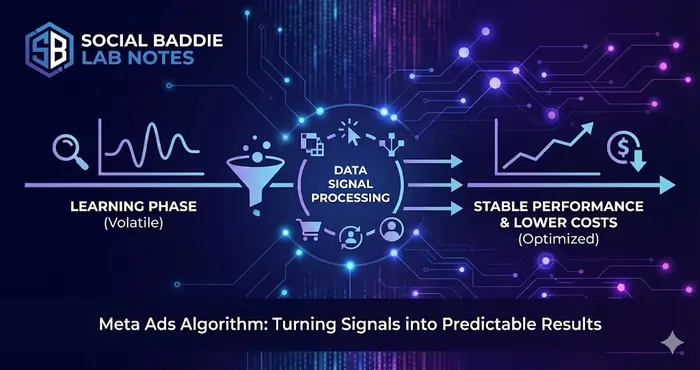
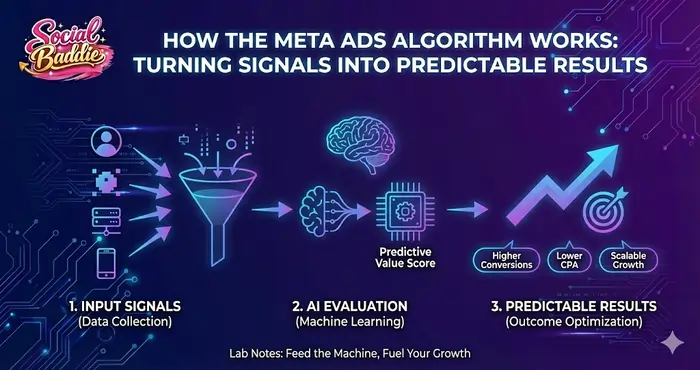
If you truly want stable and scalable performance from Facebook and Instagram advertising, you must understand How the Meta Ads algorithm works. Most advertisers focus on hacks, secret targeting tricks, or short-term tactics. But the truth is simpler and more strategic: when you align your campaigns with how the system thinks, performance becomes predictable.
This guide explains How the Meta Ads algorithm works in clear, simple English. It is structured for beginners, business owners, and serious media buyers who want long-term results instead of temporary wins. You will learn the auction logic, learning phase behavior, data signals, scaling mechanics, creative influence, and advanced optimization strategy using the latest 2026 machine learning frameworks.
This is not theory. This is how the system actually behaves.
What Is the Meta Ads Algorithm?
Before going deeper into How the Meta Ads algorithm works, we must define it properly.
The Meta Ads algorithm is a massive, multi-layered machine learning ecosystem that decides which content gets shown to which user in real-time. In 2026, this system is largely powered by a new architecture known as Andromeda. This deep-learning retrieval and ranking system is capable of processing millions of real-time intent signals per second—everything from how long a user pauses on a specific video frame to the sentiment of their comments.
The algorithm does not “guess.” It predicts probability. Its core mission is to balance two competing interests:
- Value for Advertisers: Helping businesses reach people who will likely perform a specific action, such as buying a product or submitting a lead form.
- Value for Users: Ensuring the ads shown are relevant, interesting, and not disruptive to the user experience.
If Meta showed irrelevant ads, users would leave the platform. If Meta showed ads that did not convert, advertisers would stop spending. How the Meta Ads algorithm works is by finding the perfect “sweet spot” where both parties win.
How the Meta Ads Algorithm Works: Step-by-Step Deep Breakdown
To fully understand How the Meta Ads algorithm works, we must break it into four core systems: the Auction System, Data Signal Processing, Learning Phase Modeling, and Optimization and Scaling.
1. The Auction System: Where Every Impression Is Decided
Every time a user opens Facebook, Instagram, or Reels, an instant auction happens in the background. This happens in milliseconds. Unlike a traditional auction where the highest bidder always wins, Meta uses a sophisticated formula called Total Value.
The Total Value Formula:
TotalValue=Bid+EstimatedActionRate+AdQuality
Let us break this down into its constituent parts:
- The Bid: This is what you are willing to pay to achieve your desired outcome. While a higher bid helps, it is only one-third of the equation.
- Estimated Action Rate (EAR): This is the algorithm’s prediction of how likely a person is to take the action you want. This is arguably the most powerful lever in the entire formula.
- Ad Quality: This is a measure of the quality of your ad based on feedback from people viewing or hiding the ad, and assessments of low-quality attributes like clickbait, engagement bait, or poor landing page experiences.
The winner is the ad with the highest Total Value. This explains why a small business with a modest budget can sometimes “outbid” a global corporation. If the small business has a highly relevant ad with a high Estimated Action Rate, their Total Value might be higher than a giant brand with a boring, irrelevant ad and a massive bid.
2. Estimated Action Rate: The Core of How the Meta Ads Algorithm Works
Estimated Action Rate (EAR) is the heart of How the Meta Ads algorithm works. It represents the machine’s “confidence” in your ad’s ability to convert a specific user.
Meta calculates EAR by analyzing:
- Historical Performance: How has this ad performed in the last few hours or days?
- User History: Does this specific user have a history of clicking on “Fitness” ads? Do they usually buy things on Tuesdays?
- Similar User Patterns: Have people with similar interests and behaviors converted on this ad recently?
- Landing Page Experience: Does the website load fast? Is the content relevant to the ad?
If the algorithm predicts that User A has a 10% chance of buying and User B has a 1% chance, it will prioritize showing your ad to User A. If your ad is so effective that it maintains a high EAR across a broad audience, your costs (CPM) will drop because Meta wants to reward content that provides value to its users.
3. Data Signals: What Feeds the Algorithm
Data is the fuel for machine learning. Without signals, the algorithm is “blind.” Understanding the hierarchy of these signals is vital to mastering How the Meta Ads algorithm works.
The algorithm ingests signals from several sources:
- On-Platform Signals: Likes, shares, comments, video view percentage, and time spent hovering over an image.
- Off-Platform Signals: This is where the Meta Pixel and Conversion API (CAPI) come in. When a user visits your site, adds to cart, or purchases, that signal is sent back to Meta.
- Deterministic vs. Probabilistic Data: Meta uses known data (User X logged in on phone and desktop) and “modeled” data to fill in gaps left by privacy updates.
To make the algorithm work for you, you must provide it with clean, high-volume data. If your tracking setup is incomplete, the algorithm cannot learn who your buyers are, and your performance will eventually stall.
4. The Learning Phase: Training the Machine
The “Learning Phase” is the period during which the algorithm is still gathering enough data to determine the best people to show your ads to. Many advertisers panic during this phase because results can be volatile.
How the Meta Ads algorithm works during this phase involves high-velocity testing. The system shows your ads to different “clusters” of people within your targeting parameters to see who responds best.
- The 50-Event Rule: Generally, an ad set needs about 50 optimization events (e.g., 50 purchases) within a 7-day window to exit the learning phase.
- Stability is Key: Every time you make a “significant edit,” you reset the learning phase. Significant edits include changing the budget by more than 20%, changing the creative, or changing the targeting.
When an ad set is in “Learning Limited,” it does not mean it will stop spending. It simply means the algorithm hasn’t found enough data to optimize effectively. You should either increase your budget, broaden your audience, or move your optimization event higher up the funnel (e.g., from Purchase to Add to Cart).
The Role of Creative in How the Meta Ads Algorithm Works
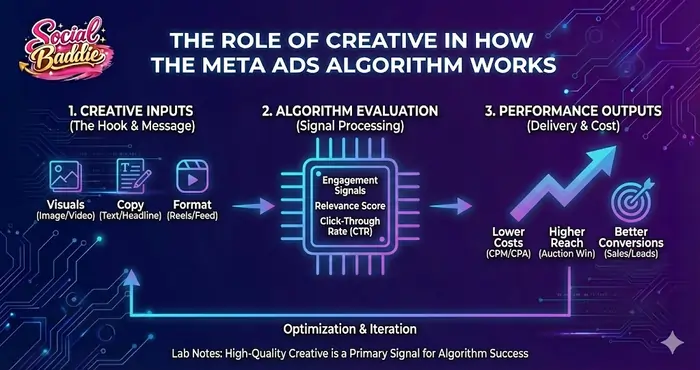
In the current era of advertising, Creative is the Targeting. Because the algorithm has become so smart at reading images and video scripts using advanced Computer Vision, it knows exactly what your ad is about before you even spend a dollar.
How the Meta Ads algorithm works regarding creative involves three main processes:
- Content Scanning: Meta’s AI “looks” at your video frames and “listens” to the audio. If you have a dog in the video and mention “pet food,” it knows to test your ad against pet owners.
- Engagement Feedback: If people “Stop the Scroll” (high Hook Rate), the algorithm rewards you. If people click “See More” on the text, that is a positive signal.
- The Aesthetic Signal: High-quality, native-feeling content (like User Generated Content or UGC) often gets a higher Ad Quality score because it doesn’t look like a disruptive advertisement.
If your creative is poor, no amount of “secret targeting” or high bidding will save your campaign. The algorithm will simply see that no one is engaging, lower your Estimated Action Rate, and your costs will skyrocket.
Why Ads Suddenly Stop Performing: Performance Decay Explained
It is a common frustration: a campaign works perfectly for two weeks and then suddenly dies. This is not a glitch; it is a direct result of How the Meta Ads algorithm works in response to market signals.
- Creative Fatigue: This happens when your target audience has seen your ad too many times. Your Click-Through Rate (CTR) drops, which causes the Estimated Action Rate to drop, which lowers your Total Value in the auction.
- Audience Saturation: If you are targeting a small, niche audience, you eventually run out of “High Intent” people. The algorithm has to move to “Lower Intent” people within that same group, raising your CPA.
- Auction Overlap: If you have multiple ad sets targeting the same people with the same ads, you are essentially competing against yourself. Meta will “deprioritize” one of the ad sets to prevent the user from being annoyed.
- External Competition: During holidays or major events (like Black Friday), the “Bid” component of the auction formula increases across the board. If your “Ad Quality” and “EAR” don’t increase to match, you will lose auctions.
To fix performance decay, you must introduce “New Signals.” This usually means launching a new creative or testing a new “Hook” to re-engage the audience.
Advanced Strategy: Scaling Without Breaking the System
Scaling is the process of increasing your budget to get more results. However, because of How the Meta Ads algorithm works, you cannot simply 10x your budget overnight.
Vertical Scaling (Increasing Budget)
If you increase a budget from $100 to $1,000 in one click, the algorithm sees a massive influx of cash and tries to spend it as fast as possible. This often leads to the system bidding on “low-quality” impressions just to fulfill the budget requirement, which destroys your ROI.
- The 20% Rule: Increase your budget by 20% every 48–72 hours. This allows the algorithm to slowly expand its search for buyers without losing its “anchor” of high-probability users.
Horizontal Scaling (Expanding Reach)
This involves taking a winning ad and moving it into new environments.
- Lookalike Audiences: Creating a 1% Lookalike of your buyers gives the algorithm a fresh pool of people who “look” like your previous successes.
- Broad Targeting: Removing all interests and only using age, gender, and location. This gives the algorithm maximum “Liquidity”—the freedom to find anyone on the platform who might buy.
CBO vs. ABO: Who Makes the Decision?
- Campaign Budget Optimization (CBO): You give the money to the Campaign, and the algorithm decides which Ad Set gets the cash. This is the “hands-off” approach that works best for accounts with lots of data.
- Ad Set Budget Optimization (ABO): You dictate exactly how much each Ad Set spends. This is better for testing new audiences where you want to ensure the algorithm doesn’t “pick a favorite” too early.
Technical Appendix: Deep Machine Learning Concepts
To truly master How the Meta Ads algorithm works, we should touch on the technical logic used by Meta’s engineering teams in 2026.
Bayesian Inference
The algorithm uses a form of statistical “guessing” called Bayesian Inference. It starts with a “prior” belief (e.g., “I think people who like Yoga buy this mat”). As it gets data (e.g., “Actually, people who like Pilates are buying more”), it updates its “posterior” belief. The more data it gets, the less it relies on its initial guess and the more it relies on hard evidence.
Reinforcement Learning
Meta uses a reward-based system. When the algorithm shows an ad and gets a “Purchase,” it gets a “Reward.” It then analyzes all the characteristics of that purchase and tries to repeat the action to get more rewards. If it shows an ad and gets “Hidden” or “Reported,” it receives a penalty and will stop showing that ad to similar people.
Feature Engineering
The algorithm breaks your ad and your audience into “features.”
- User Features: Device, OS, internet speed, time of day, historical CTR.
- Ad Features: Color palette, video length, keywords in the headline, landing page load speed.
- Context Features: Is the user on a bus (mobile data) or at home (Wi-Fi)? Are they on the “Explore” page or their “Feed”?
Common Myths That Damage Performance
There is a lot of misinformation regarding How the Meta Ads algorithm works. Let’s debunk the most dangerous ones:
- The Algorithm is trying to steal my money: Actually, the algorithm wants you to succeed. If you make money, you spend more money. The system is designed to find you the cheapest results possible within your constraints.
- I need to change my ads every day to keep the algorithm fresh: Incorrect. Constant changes prevent the algorithm from ever exiting the Learning Phase. Stability is the friend of machine learning.
- Narrow targeting is better because it’s more precise: In the past, yes. Today, narrow targeting often “chokes” the algorithm. By giving it a tiny audience, you prevent it from using its massive processing power to find buyers you might have never thought of.
- The Boost Post button is the same as the Ads Manager: No. Boosting a post uses a simplified version of the algorithm optimized for “Engagement” (likes), not “Conversions” (sales). If you want predictable ROI, always use the Ads Manager.
Complete System Overview: The Algorithm Lifecycle
Practical Case Scenario: Putting It All Together
The Setup:
A boutique skincare brand launches a new moisturizer. They set up a campaign with a “Broad” audience (Ages 25–55, Women, USA). They use a video showing the product texture.
Week 1 (The Learning Phase):
The first three days are rocky. The CPA (Cost Per Acquisition) is $45, while the goal is $30. The advertiser resists the urge to turn it off. By day seven, the Pixel has recorded 52 purchases. The algorithm now “knows” that women who follow “Clean Beauty” blogs and use iPhones are the primary buyers.
Week 2 (The Optimization Phase):
The algorithm stops showing the ad to people who have never bought skincare online. The CPA drops to $28. The delivery becomes stable. The “Estimated Action Rate” is now very high because the ad has a proven track record.
Week 3 (The Scaling Phase):
The advertiser increases the budget from $100/day to $120/day. Because the increase is small, the algorithm stays in “Optimization” mode. Performance remains steady.
Week 4 (The Fatigue Phase):
The frequency hits 4.0. The CTR starts to dip. The advertiser notices this and launches a “New Creative” to the same audience. The algorithm treats this as a fresh signal, and the cycle begins again at a higher level of efficiency.
Final Takeaway: Stop Fighting the Machine
Understanding How the Meta Ads algorithm works changes your entire advertising mindset. It transforms you from a “hacker” looking for a shortcut into a “partner” working with one of the most powerful AI systems on the planet.
Success on Meta is not about controlling every setting. It is about:
- Providing Clean Data: Ensuring your Pixel and CAPI are sending accurate signals.
- Maintaining Structural Simplicity: Giving the algorithm the “Liquidity” it needs to work.
- Allowing the Learning Phase to Complete: Having the patience to let the machine find your buyers.
- Scaling Responsibly: Not “shocking” the system with sudden changes.
- Improving Creative Quality: Giving the algorithm high-quality fuel to win more auctions.
The Meta Ads system is a prediction engine. If you guide it properly, it rewards stability, data consistency, and high-quality content. Mastering How the Meta Ads algorithm works is about respecting machine learning behavior, understanding auction dynamics, and building campaigns designed for long-term optimization. For more strategies, check Jem’s insights.
When you align with the algorithm instead of fighting it, advertising becomes strategic, not stressful. Predictable, not random. Scalable, not temporary.
That is the real advantage in today’s digital landscape