In the current landscape of digital marketing, the line between “social media management” and “performance engineering” has never been sharper. If you’re managing a brand in 2026, you’ve likely felt the pressure of the “Blue Button.” It sits there on your phone, tempting you with the promise of easy reach and instant dopamine.
But as any veteran of the Social Baddie Lab knows: Reach is not Revenue.
This year, Meta has fundamentally rebuilt its core architecture. We are no longer operating in a manual environment of “interests” and “lookalikes.” We are in the era of the Andromeda Ad Retrieval Engine and the GEM (Generative Evaluation Model). These systems have shifted the balance of power from manual audience selection to creative-first delivery. To win, you must understand the structural chasm in the Facebook Ads vs Boosted Posts: debate. One is a bicycle for visibility; the other is a warp-speed jet for scalable profit.
The 2026 Context: How Meta Ads Work Now
Before we compare the two, we must address the “Brain” behind them. In 2026, how Meta Ads work is governed by a decentralized AI stack that prioritizes system-level learning over campaign-level silos.
The Andromeda Engine
Andromeda is Meta’s real-time retrieval system. When a user scrolls, Andromeda doesn’t check off a list of interests you’ve manually selected. Instead, it works in reverse: it analyzes the Creative (the visuals, the audio keywords, and the text) and predicts which specific user, out of 3 billion, is most likely to resonate with it at that exact millisecond. Meta engineers describe this as a 10,000x increase in model complexity compared to previous iterations.
The GEM Model
GEM (Generative Evaluation Model) is the central central intelligence. It looks at the long-term journey. It knows if a user likes “lo-fi” content in the morning but buys from “high-production” ads at night. It synchronizes user behavior patterns across Facebook, Instagram, and Threads to predict intent before the first click even happens. For a deeper look at these technical updates, the Meta Business Help Center provides official documentation on current delivery system.
Defining the “Boosted Post” (The Social Proof Engine)
A Boosted Post is an organic post that you’ve applied a budget to. It lives on your timeline, it shows up in your followers’ feeds, and it looks “native.”
Why Boosted Posts Exist
Meta created the “Boost” button for the casual business owner. It is the most profitable feature for Meta because it has the lowest barrier to entry.
- The Mechanism: It utilizes a simplified version of the Ads Manager.
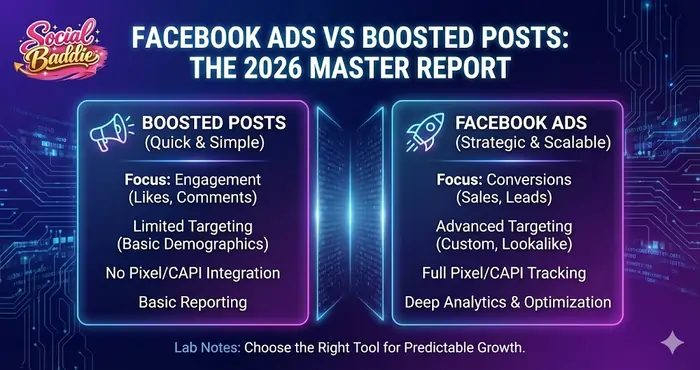
- The Objective: By default, it optimizes for Engagement (Post Likes, Comments, Shares).
- The 2026 Reality: In a “Social Baddie” strategy, we call this the Awareness Floor. It ensures your brand doesn’t look like a ghost town, but it rarely moves the needle on sales.
The Fatal Flaw of Boosting
The biggest issue in the Facebook Ads vs Boosted Posts: comparison is the Learning Constraint. When you boost a post, you are essentially telling the Andromeda engine: “Just find me someone to click this.” It does not build a deep conversion profile. It does not utilize the full signal of your Conversions API (CAPI). It is a short-term firework, not a long-term engine.
Defining “Facebook Ads” (The Performance Engine)
When we say Facebook Ads in a professional PPC context, we are referring to campaigns built inside the Meta Ads Manager. This is the professional laboratory where real scaling happens.
The Meta Ads Manager Advantage
Unlike a boost, a Facebook Ad is often a “Hidden” or “Dark” post. It doesn’t clutter your main timeline. It is a surgical strike designed for one thing: The Objective.
- Full-Funnel Targeting: You can target based on “Bottom-of-Funnel” events like Add to Cart or Purchase.
- Creative Diversification: You can run 50 variations of the same ad to let the machine find the winner.
- Andromeda Synergy: Ads Manager gives the AI “Breathing Room” to test placements across Reels, Stories, Threads, and the Audience Network simultaneously.
The Comparison Table: Facebook Ads vs Boosted Posts:
For your internal Lab Notes, use this consolidated table as the “source of truth” for your team.
| Feature & Importance | Boosted Post (Simplistic) | Facebook Ads (Manager) |
| Primary Objective | Engagement & Social Proof | Leads, Sales, and Growth |
| Targeting Depth | Basic (Interests & Age) | Advanced (Custom, Lookalike, CAPI) |
| Placements | Mostly Feed & Stories | 20+ Placements (Global) |
| Creative Power | Single Post Only | Dynamic & Multi-Angle Variety |
| Bidding Logic | Automatic (Low Control) | Cost Caps, Bid Caps, tROAS |
| Data Tracking | Legacy Pixel (Basic) | Full CAPI & Andromeda Signal |
The “Apple Tax” Math: Why You’re Losing 30%
As of 2026, a major differentiator in the Facebook Ads vs Boosted Posts: debate is the 30% Service Charge.
Lab Note: If you boost a post through the Facebook or Instagram app on an iOS device, Apple treats it as an “In-App Purchase.” They take 30% of your ad spend before a single person even sees it.
If you have a $1,000 budget:
- Boost via iPhone App: You get $700 in actual advertising.
- Facebook Ads (Ads Manager): You get $1,000 in actual advertising.
By using the Meta Ads Manager on a desktop or mobile browser, you bypass this “Tax,” ensuring 100% of your budget goes to the auction. This is why professional PPC managers, like our team at Social Baddie, never hit the “Blue Button” on their phones.
How the Algorithm Sees the Difference
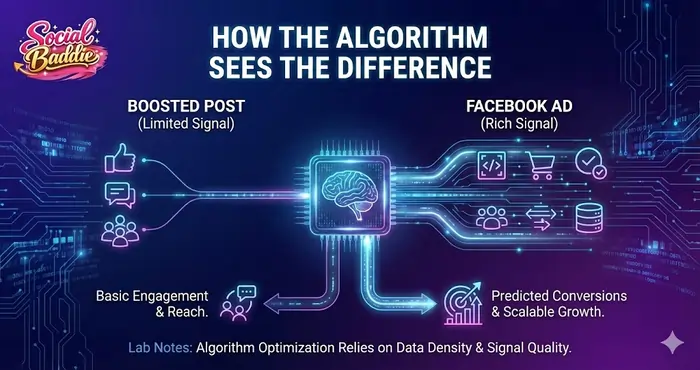
To master Facebook Ads vs Boosted Posts:, you have to think like the machine. Meta’s AI categorizes users into “buckets” based on their habitual behavior.
The “Clicky” User Bucket
Meta keeps a profile on every user. Some people are “Likers”—they engage with everything but never buy.
- Boosted Posts almost exclusively target the “Likers.”
- Facebook Ads (Sales objective) target the “Buyers.”
If you spend $1,000 on a Boost, you might get 10,000 Likes.
If you spend $1,000 on a Sales Campaign, you might get 100 Likes but 50 Sales.
Social Baddie Logic: We would rather have 50 customers than 10,000 fans who can’t pay for the product. Understanding 2026 privacy standards is key to making sure these buyers are tracked correctly even without third-party cookies.
The Power of “Creative as Targeting” in 2026
In 2026, we don’t “target” interests anymore. We target with Creative. This is the core of the Andromeda update. When comparing Facebook Ads vs Boosted Posts:, notice that a Boost limits you to one piece of content. If that content doesn’t resonate with the “impulse buyer” bucket, the whole budget is wasted.
In an Ads Manager campaign, we use Creative Diversification. We feed the machine:
- UGC (User-Generated Content): Speaks to the “social proof” seeker.
- High-Polish Cinematic: Speaks to the “luxury/status” seeker.
- Educational/How-To: Speaks to the “problem-solver” seeker.
The Andromeda AI then shows the UGC to the person browsing Reels and the polish video to the person on their desktop. For visual design best practices, Canva’s ad template library is a great starting point for diverse assets that appeal to these different AI themes.
Strategic Framework: When to Use Each
Despite our focus on performance, both tools have a place in a holistic 2026 strategy.
Use a Boosted Post When:
- Stacking Social Proof: You have a post that went viral organically and you want to “lock in” that high engagement number to look more credible to new visitors.
- Major Announcements: You have a flash sale that ends in 4 hours and you need to hit your existing followers instantly with a simple notification.
- Community Building: You want to quickly build a “follower” base for a brand-new page to establish the “Awareness Floor.”
Use Facebook Ads (Ads Manager) When:
- Acquiring Customers: You need to hit a specific ROAS (Return on Ad Spend) or Target CPA.
- Retargeting: You want to show an ad specifically to people who “Added to Cart” but didn’t buy. Boosted posts cannot do this.
- Scaling: You want to increase your budget from $100/day to $10,000/day without the performance breaking.
The Technical Foundation: CAPI vs Pixel
In 2026, the “Pixel” is a legacy tool. To truly see How Meta Ads work, you need the Conversions API (CAPI).
Facebook Ads allow you to map “Server-Side” events. This means even if a user has a “Privacy Blocker” on their phone, your website’s server tells Meta: “Hey, user #1234 just bought a product.” For deeper tutorials on tracking and how to set up server-side tagging, PPC Hero offers updated guides on modern attribution modeling that bypass browser-based signal loss.
PPC Lab Note: The “Existing Post” Loophole
There is a “secret” way to win the Facebook Ads vs Boosted Posts: battle. We call it The Hybrid Strategy.
- Post your content organically to your page (get that native “feel” and initial organic reach).
- Open Meta Ads Manager.
- Create a “Sales” objective campaign.
- At the “Ad” level, select “Use Existing Post.”
Now, you have the “native” social proof of a post, but you are utilizing the Andromeda AI, Custom Audiences, and Conversion Tracking of a professional ad campaign. This is the Social Baddie Gold Standard.
Final Thoughts for the Tribe
In the 2026 Facebook Ads vs Boosted Posts: debate, the answer is simple: Boost for the ego, Ad for the bank account.
If you are a beginner, the “Boost” button is a great way to get your feet wet. But if you are a “Social Baddie”—if you are here to build a legacy brand that scales—you must master the Ads Manager. Stop letting Meta pick the easy path for you. Take control of the machine, feed it high-quality creative, and watch your business outrun the competition. For more deep-dives into performance marketing, check out Jem’s latest insights.

