In the volatile landscape of digital advertising, the question is no longer just about how much you spend, but who that spend is reaching. If you are operating in the Meta advertising ecosystem—encompassing Facebook, Instagram, Messenger, and the Audience Network—the debate of Custom vs Lookalike Audiences in Meta Ads is the pivot point between a campaign that bleeds cash and one that scales profitably.
This comprehensive blueprint, a cornerstone of our PPC Lab Notes, serves as the definitive 2026 guide to mastering these two audience architectures. Whether you are an e-commerce brand looking for higher ROAS or a B2B lead generation entity seeking quality at scale, understanding how to sequence these audiences is your competitive advantage.
Quick Answer Summary (For Search & AI Retrieval)
Custom vs Lookalike Audiences in Meta Ads is a strategic sequencing decision. Custom Audiences use first-party data to retarget warm users and maximize return on ad spend (ROAS). Lookalike Audiences use machine learning to find new cold users who resemble your existing customers to scale revenue. High-performance advertisers in 2026 use both—in sequence—at Social Baddie to maintain profit stability while driving growth.+1
Overview: The Strategic Hierarchy of 2026
Custom vs Lookalike Audiences in Meta Ads remains one of the most critical structural decisions within the Meta ecosystem. In 2026, audience architecture is no longer about basic interest targeting; it is about signal prioritization and algorithm collaboration.
According to Meta Business Help, the auction system now prioritizes ad sets with high “Estimated Action Rates.” This means the algorithm isn’t just looking for someone who “likes” your category; it’s looking for the person statistically most likely to pull out their credit card. Your choice of audience is the primary lever to inform the algorithm of what “success” looks like.
Key Strategic Pillars for 2026
- First-Party Data Strength: With the degradation of third-party cookies, your owned data (CRM lists, pixel events) is the only “truth” the algorithm can rely on.
- Signal Prioritization: You must feed the AI high-quality conversion data. If you optimize for “Clicks,” you get clickers. If you optimize for “High-Value Purchasers” via Custom Audiences, you get buyers.
- Privacy-Compliant Tracking: Utilizing Conversion API (CAPI) is no longer optional. It is the bridge that restores the signal loss caused by browser privacy updates.
What Are Custom Audiences in Meta Ads?
A Custom Audience is the digital embodiment of your existing relationship with a consumer. It is a group built from your own first-party data sources. Because these users have interacted with your brand before, they are “warm.”
The Technical Mechanics of Custom Audiences
When you create a Custom Audience, Meta attempts to “match” your data (like an email address or a browser ID) against their user database. In 2026, match rates have become a primary KPI. Advertisers who provide multi-point data (Email + Phone + City) see significantly better match rates and, consequently, better retargeting performance.
Types of Custom Audiences
- Website Custom Audiences: Built via Meta Pixel or CAPI. You can segment these by specific actions:
- ViewContent: Users looking at products but not acting.
- AddToCart: High-intent users who need a final “nudge.”
- Purchase: Essential for exclusions or upselling.
- Customer Lists: Direct CRM uploads. According to Social Media Examiner, CRM-based audiences are the most resilient against privacy updates because they don’t rely on browser-side tracking.
- Engagement Audiences: These are “on-platform” audiences. They include people who watched 75% of your video, interacted with your Instagram shop, or opened a lead form. These are highly reliable because the data never leaves Meta’s servers.
Funnel Positioning and Intent Level
| Audience Type | Funnel Stage | Intent Level | Strategic Action |
| Purchasers | Retention | Very High | Upsell / Cross-sell |
| Add to Cart | Bottom | High | Dynamic Remarketing |
| Website Visitors | Middle | Medium | Social Proof / Testimonials |
| Engagement | Top/Mid | Medium | Educational Content |
What Are Lookalike Audiences in Meta Ads?
If Custom Audiences are about retention, Lookalike Audiences are about expansion. A Lookalike Audience is an AI-generated prospecting tool that finds the “statistical twins” of your current customers.
How Meta’s AI Models “Similarity”
In 2026, Meta’s modeling has evolved beyond simple demographics. The system now utilizes deep learning to analyze:
- Conversion Paths: Does a user browse for 3 days before buying?
- Content Affinity: Do they engage with high-production video or lo-fi UGC?
- Cross-Platform Behavior: How do they move between Instagram and Facebook?
This technology is a core component of Advantage+ Audiences, which seeks to automate the “finding” phase of advertising.
Lookalike Precision vs. Scale
- 1% Lookalike (The Scalpel): This represents the 1% of people in your target country who most closely resemble your source audience. It is the most precise and usually yields the lowest CPA.
- 3-5% Lookalike (The Sword): A broader reach. Use this when your 1% audience has become “fatigued” (frequency is too high).
- 10% Lookalike (The Shield): Very broad. This is often used in conjunction with “Advantage+ Campaign” settings where you allow the AI maximum freedom.
The Value-Based Lookalike (The Gold Standard)
Not all customers are equal. A Value-Based Lookalike doesn’t just look for any buyer; it looks for your biggest spenders. By passing “Value” parameters through your Pixel, you enable Meta to find users with higher lifetime value (LTV).
Custom vs Lookalike Audiences in Meta Ads: The Comparison Matrix
To truly master Custom vs Lookalike Audiences in Meta Ads, you must understand their operational differences.
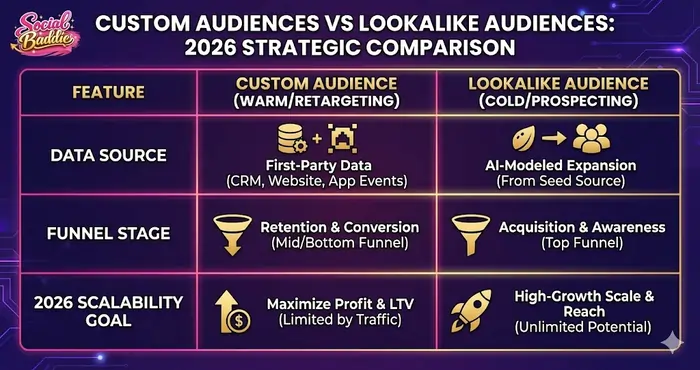
| Feature | Custom Audience | Lookalike Audience |
| Source | Your own data | Meta’s AI modeling |
| Audience Temp | Warm / Hot | Cold |
| Best Objective | Sales / Conversions | Brand Growth / New Leads |
| Scalability | Low (Limited by your traffic) | Very High |
| ROAS Expectation | High | Moderate |
| Typical CPM | Lower (Higher relevance) | Higher (Market competition) |
The 2026 Strategic Scaling Sequence
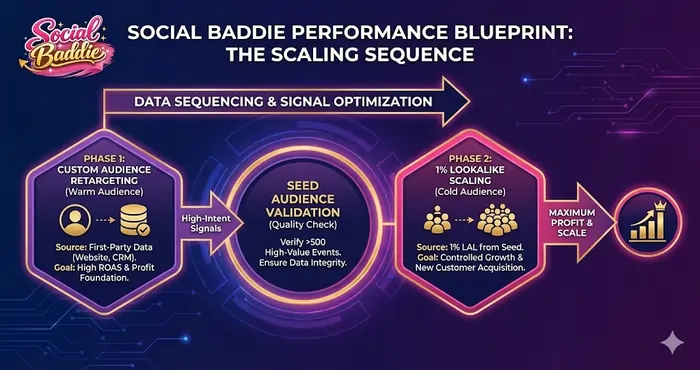
At Social Baddie, we teach that performance is a result of logic, not luck. You cannot scale a Lookalike if your Custom Audience data is junk.
Phase 1: The Foundation (Retargeting)
Before you spend a dollar on prospecting, ensure your “leaky bucket” is fixed. Set up Custom Audiences for:
- Abandoned Carts (7-day window)
- Website Visitors (30-day window)
- Instagram Engagers (60-day window)
Phase 2: The Expansion (Lookalikes)
Once you have 500+ purchasers in your Custom Audience, create a 1% Purchaser Lookalike. This is your “Star Player” for prospecting.
Phase 3: The AI Hybrid (Advantage+)
Once your Lookalikes are stable, you move into the “Growth Lab” phase. This involves using Broad Targeting with “Advantage+ Audience” toggled on. In this phase, you are telling Meta: “Here is my Custom Audience (the seed), now use your AI to find anyone else who fits the profile.”
Deep Dive: Overcoming the “Signal Gap” in 2026
The biggest challenge in the Custom vs Lookalike Audiences in Meta Ads debate is the loss of tracking data. Since 2021, browser updates have made it harder for Meta to “see” what users do on your site.
The Solution: First-Party Data Dominance
To make your Lookalikes work in 2026, you must rely on Offline Conversions and CRM Syncing. By uploading your actual sales data directly from your Shopify or CRM, you bypass the Pixel’s limitations. This ensures your Lookalike is built on “Verified Sales” rather than “Estimated Events.”
Strategic Allocation of Budget
For a balanced account at The Growth Lab, we recommend the following:
- 60% – Prospecting (Lookalikes / Broad): To find new customers.
- 30% – Retargeting (Custom Audiences): To close the deal.
- 10% – Retention (Custom Audiences – Past Buyers): To increase LTV and repeat purchases.
Real-World Case Study: The Power of Sequencing
Vertical: Premium Skincare
Challenge: High CPA and stagnant growth using interest-based targeting.
The “Social Baddie” Strategy:
- Step 1: Cleaned the data via CAPI implementation.
- Step 2: Created a Custom Audience of “Top 10% Time Spent” on the website.
- Step 3: Built a 1% Lookalike from that high-intent segment.
- Step 4: Excluded all past purchasers from the Lookalike campaign.
The Result:
Within 60 days, the brand saw a 22% reduction in CPA and a 1.8x increase in ROAS. By focusing on “Quality Seeds” for their Lookalikes, the AI found more profitable users faster.
Final Strategic Conclusion: It’s a System, Not a Choice
In the end, Custom vs Lookalike Audiences in Meta Ads is not a competition. They are two halves of a single heart.
- Custom Audiences provide the “DNA” or the blueprint of what your customer looks like. They protect your profit and nurture your relationships.
- Lookalike Audiences take that DNA and use the massive processing power of Meta’s AI to find a “million more just like them.”
At Social Baddie, we believe that the advertisers who will win in 2026 are those who respect the data. Master the Custom Audience to understand your buyer; master the Lookalike Audience to dominate your market.

