Overview
Broad Targeting in Meta Ads 2026 has transitioned from an experimental tactic into the mandatory foundation for scaling paid advertising profitably. In an era defined by signal loss and the rise of machine learning, the Social Baddie methodology emphasizes a “machine-first” approach. This blueprint explores the deep mechanics of how broad targeting works to turn creative signals and first-party data into a sustainable scaling engine.
By moving away from restrictive manual filters and toward open-ended discovery, advertisers can unlock efficiencies that were previously hidden behind manual assumptions. This guide provides a deep-dive into the technical and strategic layers of the Meta advertising ecosystem, ensuring your campaigns are optimized for both human resonance and algorithmic precision. To stay competitive, brands must understand that the algorithm is no longer just a tool; it is a collaborator in the search for high-value customers.
What is Broad Targeting in Meta Ads 2026?
At its core, Broad Targeting in Meta Ads 2026 refers to a campaign architecture where the advertiser removes interest, behavioral, and granular demographic constraints. Instead of telling Meta who to find, you provide the system with high-quality signals and allow its predictive modeling to identify the highest-value users.
Understanding how broad targeting works is essential for any modern media buyer. It is an invitation for Meta’s AI to conduct real-time market research on your behalf. It uses Large Language Models and computer vision to analyze your ads and match them with users whose current behavior suggests an imminent conversion. This shift is a central theme in our PPC lab notes, where we have observed that unrestricted audiences consistently achieve lower CPMs and more stable long-term performance than traditional interest stacking.
The primary goal here is to remove the friction of manual selection. When you define an audience too narrowly, you increase your costs by bidding in a crowded, small pool. Broad targeting allows you to bid in the “general population” auction, where the AI can find your customers in unexpected places—like a fitness enthusiast who also happens to be a high-net-worth real estate investor.
The Machine Learning Architecture: How Broad Targeting Works Under the Hood
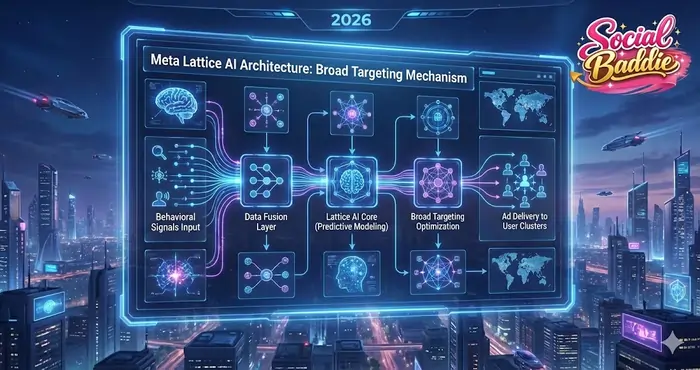
To master modern advertising, one must understand the machine learning architecture behind the platform. Specifically, how broad targeting works is rooted in two primary AI systems: Lattice and Andromeda.
1. The Lattice Model
Meta’s Lattice architecture is a unified multi-modal system that predicts outcomes across all surfaces—Reels, Feed, and Stories—simultaneously. Unlike older models that required separate data sets for each placement, Lattice understands that a user’s interaction with a Reel is a signal for what they might buy on their Feed. This cross-surface intelligence is the backbone of how broad targeting works efficiently. Lattice allows Meta to process 10,000 times more data points than previous models, making it the most sophisticated consumer prediction engine in existence.
2. The Andromeda Retrieval Engine
Andromeda is the engine that matches your ad to the user. It processes trillions of signals per second to determine the estimated action rate. When you implement this strategy, you give Andromeda the freedom to scan the entire global auction to find pockets of users who are undervalued by other advertisers but highly relevant to your offer. This retrieval process is a fundamental part of how broad targeting works to lower your cost per acquisition. Andromeda doesn’t just look for “buyers”; it looks for “buyers at this exact moment.”
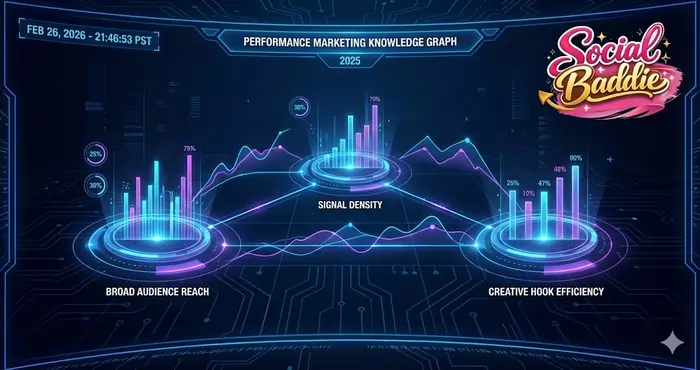
Knowledge Graph: The 3-Column Performance Blueprint
| Strategy Pillar | Technical Mechanism | Growth Outcome |
| Open Audience | Removes bid friction | Lower CPMs and wider reach |
| Signal Density | CAPI & Server-side data | Faster algorithm stabilization |
| Creative Hooks | Behavioral filtering | High-intent traffic acquisition |
The Evolution of Scaling: The History of How Broad Targeting Works
The shift toward broad strategies was accelerated by the industry-wide move toward privacy. With the deprecation of third-party cookies and the rise of Apple’s App Tracking Transparency (ATT), the interests we used to rely on became stale and inaccurate.
According to the IAB State of Data Report, first-party data has become the primary driver of performance. In our research at The Growth Lab, we have documented that Meta’s AI now compensates for signal loss by using conversion modeling. This means the system can predict a purchase even when the direct path is obscured. However, this modeling requires high volumes of data. Understanding how broad targeting works in this context means realizing that the algorithm needs “liquidity”—a large pool of potential users—to find enough patterns to be successful.
Before 2021, media buyers were surgeons. In 2026, they are data architects. The “manual era” was about exclusion; the “AI era” is about inclusion and signal quality.
Why Creative is the New Targeting
In a world governed by AI, your creative asset is your primary targeting filter. Because you are not selecting an audience in the ad set, your ad must do the talking to the algorithm. This is a critical realization in understanding how broad targeting works today.
The Mechanism of Creative Filtering
- The Hook: Calls out the specific persona (e.g., “Attention SEO Specialists”). This is the verbal filter that tells the AI who to look for.
- The Context: Meta’s AI reads the objects and text in your video to determine the niche using computer vision. This is the visual filter.
- The Engagement: The AI observes who stops scrolling. If only marketers stop to watch your ad, the AI will naturally seek out more marketers. This is the behavioral filter.
This behavioral feedback loop is exactly how broad targeting works to replace manual interest selection. By changing only the first three seconds of an ad, you can effectively target entirely different psychological segments within a broad audience. Creative testing is no longer just about finding a “winner”; it’s about defining your audience through content.
Implementation: The Step-by-Step SOP on How Broad Targeting Works
To correctly set up your campaigns, you must follow a technical protocol that aligns with the machine. Here is the operational breakdown of how broad targeting works in practice:
1. Objective Selection
Always select “Sales” or “Leads” to ensure the AI optimizes for bottom-funnel actions. If you select “Traffic,” the algorithm will find people who click but never buy, which breaks the logic of how broad targeting works for ROI. The AI is a literalist; it will give you exactly what you ask for.
2. Budgeting Framework
Use Advantage Campaign Budget (CBO) to let the AI move money to the winning ads dynamically. This allows the system to shift resources to whichever creative is currently identifying the best audience cluster. CBO acts as the financial engine that fuels the broad strategy’s exploration.
3. Audience Configuration
- Location: Country-wide (or your entire service area).
- Age/Gender: Open (unless legally restricted).
- Interests: Completely empty. Do not “stack” or “layer.” Any restriction here is a signal to the AI to stop searching elsewhere.
4. Technical Tracking
Ensure the Meta Conversions API (CAPI) is sending server-side events to maximize signal match quality. This is the “fuel” for the engine. Without high-quality data, the mechanism of how broad targeting works becomes significantly less efficient. CAPI is the bridge that keeps your performance stable even in the face of browser-based privacy updates.
The Role of Signal Stability
You cannot run broad campaigns successfully on a blind account. The algorithm needs to know what success looks like. A major part of how broad targeting works effectively is the “Signal Loop.”
By uploading hashed customer lists and ensuring high-quality CAPI signals, you provide the AI with a map of your ideal buyer. Even without manual targeting, the AI uses these samples to look for lookalike behaviors across its billions of users. At Social Baddie, we recommend a “Data First, Target Second” approach. The more data you feed the system, the better how broad targeting works to find your next customer. Data density is the only true competitive advantage in 2026.
Knowledge Graph: Decision Framework for Broad Scaling
| Volume Metric | Recommended Strategy | Risk Level |
| <20 Sales/Week | Interest “Seed” targeting | Moderate |
| 20-50 Sales/Week | Test Broad in a separate CBO | Low |
| >50 Sales/Week | 100% Broad Targeting | Minimal |
Deep-Dive: The Learning Phase and How Broad Targeting Works
The “Learning Phase” is the period when Meta’s system is still exploring the best way to deliver your ad set. In a broad setup, this phase is more active because the system has more directions to explore.
Understanding how broad targeting works during this phase requires patience. You must achieve approximately 50 conversion events within a seven-day window to exit this phase. If you interfere too early—by changing the budget or creative—you reset the machine’s memory and break the efficiency of the broad strategy. Many advertisers fail because they can’t handle the “volatility” of the first 48 hours. In 2026, the learning phase is where the profit is built.
Common Pitfalls: When You Don’t Understand How Broad Targeting Works
While powerful, this is not a “set and forget” solution. It fails when the advertiser provides poor instructions to the machine.
- Premature Interference: Making changes during the initial 72 hours resets the algorithm’s progress.
- Weak Messaging: If your ad is too generic, the AI won’t know who to show it to, leading to high bounce rates and low quality scores.
- Insufficient Budget: A broad ad set needs enough budget to get at least 50 conversions per week. If you under-fund the campaign, you break the mechanism of how broad targeting works and stay in “Learning Limited” indefinitely.
- Over-Segmentation: Splitting broad audiences into too many ad sets dilutes the signal. Consolidation is the key to scaling.
Avoiding these mistakes is critical for maintaining the performance-first standard we uphold at Social Baddie.
Advanced Scaling: The 70/20/10 Model
Once you have stabilized your Broad Targeting in Meta Ads 2026 campaigns, use this allocation model for scaling:
- 70% Broad (Prospecting): To find new customers and lower CPMs.
- 20% Advantage+ Shopping (ASC): For automated catalog-based scaling.
- 10% High-Intent Retargeting: For closing the loop on website visitors.
This structure, often taught at The Growth Lab, ensures that your account remains liquid and resistant to audience saturation. It maximizes the efficiency of how broad targeting works across the entire funnel. Scaling broad isn’t just about spending more; it’s about maintaining a healthy mix of exploration and exploitation.
Privacy and Signal Stability
Success in the current landscape depends on the quality of your data infrastructure. The Meta Conversions API (CAPI) is now a mandatory requirement. Without it, the algorithm is essentially operating with “half a brain.”
When you provide server-side signals, you are reinforcing the feedback loop that governs how broad targeting works. This signal restoration allows the AI to see past the limitations of browser-based tracking, ensuring that every purchase is attributed and used to further optimize your targeting clusters. This is especially important for long-term sustainability in the PPC space. In 2026, the brands that win are those that own their data.
The Strategic Importance of Post-Click Experience
While we focus on how broad targeting works within the Meta ecosystem, the post-click experience is equally vital. The algorithm observes “Post-Click Behavior.” If users click your broad ad but immediately bounce from your landing page, Meta will assume the ad is a “mismatch” and stop delivering it.
To make how broad targeting works for your bottom line, ensure your landing page copy mirrors your ad copy exactly. This continuity signals to the AI that it has found the right audience, reinforcing the positive feedback loop. Your landing page is essentially an extension of your targeting.
Creative Refresh Cycles: Keeping Broad Audiences Fresh
Because broad audiences are so large (often in the millions), they are resistant to “Audience Fatigue” but susceptible to “Creative Fatigue.”
To maintain the efficiency of how broad targeting works, we implement a weekly testing cadence:
- Test 3-5 New Concepts: Run these in a separate ad set with a “Broad” audience to find the next winner.
- Move Winners to Scaling: Once a creative proves its ROAS, move it into your main scaling CBO.
- Retire Losers: Do not keep underperforming ads running, as they steal budget from the winning assets and degrade the signal quality.
- Iterate on Success: Take the elements of your winning hooks and try to beat them with variations.
Final Strategic Conclusion
The era of manual audience “hacking” has ended. Success with Broad Targeting in Meta Ads 2026 requires a partnership with the algorithm. By providing high-quality signals and magnetic creative, you allow Meta to do what it does best: find your customers at the lowest possible cost.
As we continue to evolve these strategies at Social Baddie, our focus remains on the synergy between data and desire. Trust the machine, monitor the signals, and focus on your message. That is the blueprint for growth. Understanding how broad targeting works is not just about turning off filters; it is about building a system that allows the most powerful advertising AI in the world to work for you.
Feed the algorithm clean data. Test methodically. Scale what the system proves. That is the blueprint for sustainable Meta performance.

