
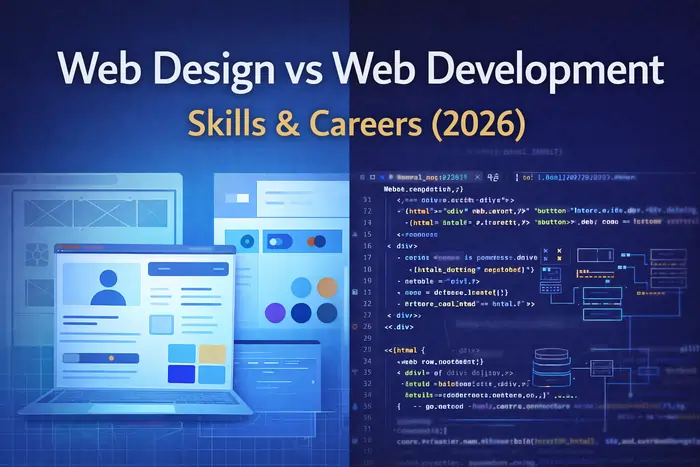
In 2026, the question is no longer:
“Should I work in tech?”
It’s:
Should I choose web design or web development?
Both careers sit at the center of digital infrastructure. Both shape how websites function. Both are high‑demand tech career paths. But they are not the same.
Understanding the difference between web design and web development is foundational if you’re:
- Exploring a web development career roadmap
- Considering a UI/UX course
- Looking at a web development bootcamp
- Debating coding vs design career paths
- Building a portfolio for web designer or web developer roles
And if you’ve already read Web Foundations Explained: Design & Dev Basics (2026), you know that websites are infrastructure — not just pages. Now let’s break down who builds what.
What Is Web Design?
Web design focuses on visual structure and user experience.
A web designer works on:
- User interface design (UI design)
- User experience design (UX design)
- Responsive design
- Web layout design
- Visual design principles
- Typography in web design
- Color theory in web design
- Interaction design
Designers build:
- Wireframes
- Prototypes
- Design systems
- User flows
They typically use tools like:
- Figma
- Adobe XD
- Webflow
Figma’s own documentation and community kits, such as its design system documentation resources, emphasize reusable components, design tokens, and consistent documentation as core to modern UI workflows. This is exactly how serious web designers think in 2026 — in systems, not single screens.
Accessibility in Web Design
Modern web designers must understand accessibility design.
The W3C Web Content Accessibility Guidelines (WCAG) define how to make web content perceivable, operable, understandable, and robust for people with disabilities, which now ties directly into user experience, legal compliance, and overall product quality. Accessibility is no longer optional design polish — it is part of baseline professionalism.
Google’s guidance on building helpful, people‑first content in Search Central’s “Creating helpful, reliable content” documentation also makes it clear that usability and accessibility influence how content is evaluated for search visibility. Accessible, user‑friendly design is good UX and good SEO.
What Is Web Development?
Web development focuses on technical implementation and system architecture.
Developers work on:
- Front‑end development
- Back‑end development
- Full‑stack systems
- APIs
- Database management
- Version control (Git)
- Web security basics
Front‑End Development
Front‑end developers use:
- HTML
- CSS
- JavaScript
- React
- Vue
- Angular
- Bootstrap
- Tailwind CSS
They convert visual design into functional code and handle layout, client‑side logic, and browser behavior.
According to the Stack Overflow Developer Survey, JavaScript continues to rank among the most widely used and loved technologies, reinforcing how central front‑end skills are in the global developer ecosystem. Front‑end work is where design intent meets technical execution.
Back‑End Development
Back‑end developers work with:
- Node.js
- PHP
- Python for web
- MySQL
- MongoDB
- REST APIs
- CMS development
- WordPress development
They build:
- Server‑side logic
- Authentication systems
- Data handling
- Application infrastructure
The GitHub Octoverse reports routinely show backend and full‑stack ecosystems (like JavaScript, TypeScript, and Python) among the most actively developed languages and frameworks in public and private repositories, highlighting sustained demand for server‑side and infrastructure skills. This is client‑side vs server‑side architecture in action.
Web Designer vs Web Developer: Career Outlook (2026)
Career data supports both paths.
According to the U.S. Bureau of Labor Statistics profile for Web Developers and Digital Designers, employment in these roles is projected to grow faster than the average for all occupations over the coming decade, driven largely by ecommerce expansion and mobile usage. That demand underpins:
- Entry‑level web developer roles
- Junior web designer roles
- Remote web developer jobs
- Remote web design jobs
Web and digital roles sit inside the broader “computer and information technology” category, which BLS expects to keep expanding as more services move online.
Which Pays More: Web Design or Web Development?
Salary varies by location, industry, and stack — but patterns are clear.
BLS and industry compensation guides consistently show that median pay for web developers tends to be higher than for general graphic designers, because of the technical specialization and the impact on revenue‑critical systems. Full‑stack developer roles typically command higher salaries than narrow front‑end positions, while senior UX and product designers at tech companies can match or exceed many engineering salaries when they own high‑stakes product flows.
The difference usually comes down to:
- Skill stack depth
- Specialization
- Years of experience
- Portfolio quality and outcomes
SEO & Performance: Where Design and Development Overlap
Web design affects user experience.
Web development affects technical SEO.
Google’s guidance on performance metrics in its Core Web Vitals documentation explains how Largest Contentful Paint (LCP), Interaction to Next Paint (INP), and Cumulative Layout Shift (CLS) measure real‑world user experience for loading, responsiveness, and visual stability. Web.dev’s article on Web Vitals reinforces that Core Web Vitals apply to all pages and should be monitored by all site owners.developers.
Core Web Vitals directly tie into:
- Website performance
- UX and SEO
- Conversion rates
Developers influence:
- Page speed and asset loading
- Server performance and caching
- CDN integration and bundling strategies
Designers influence:
- Layout stability (fewer layout shifts)
- Visual hierarchy and CTA clarity
- Accessibility and interaction patterns
This is why understanding website foundations matters.
If you haven’t yet: Web Foundations Explained: Design & Dev Basics (2026).
Because infrastructure impacts scalability.
AI in Web Design & Development (2026)
Generative AI coding tools are accelerating workflows.
GitHub Copilot assists developers with autocompleting, refactoring, and debugging code, effectively acting as a pair programmer for routine tasks. On the design side, AI‑powered tools connected to Figma and other platforms help with:
- Wireframe generation
- Layout automation
- Design‑to‑code exploration
However, AI amplifies skill — it does not replace system understanding.
You still need:
- Programming logic
- Problem‑solving skills
- Visual hierarchy knowledge
- System architecture awareness
AI speeds up implementation, but it cannot define product strategy, user flows, or information architecture for you.
No‑Code vs Traditional Development
Platforms like:
- Webflow
- Shopify
- WordPress
allow low‑code and no‑code site creation.
But even no‑code platforms require understanding:
- CMS structures vs fully custom development
- Website optimization fundamentals
- SEO‑friendly design and semantics
- Conversion‑optimized page structure
HubSpot’s inbound marketing statistics, including their long‑running inbound and content marketing reports, repeatedly show that websites with structured content hubs and blog ecosystems generate more leads than isolated landing pages. Infrastructure matters even when you’re “no‑code.
How to Choose Between Web Design and Web Development
Choose web design if you enjoy:
- Visual storytelling
- UX psychology
- Typography and color systems
- Interaction and motion design
Choose web development if you enjoy:
- Logical systems and debugging
- APIs and data flows
- Databases and server logic
- Backend architecture challenges
Both paths require:
- Continuous learning
- Portfolio building
- Real‑world projects and iteration
The Bigger Picture: Digital Infrastructure
McKinsey Digital’s research on enterprise performance, highlighted in its digital and technology insights, shows that organizations investing in robust digital infrastructure significantly outperform peers on growth and efficiency. The same principle applies individually.
Whether you pursue:
- UI/UX designer salary growth
- Full‑stack developer compensation
- Freelance web designer income
- Remote web developer roles
Your advantage increases when you understand:
- Digital infrastructure
- Website foundations
- SEO fundamentals
- Core Web Vitals
- Technical SEO
- Site architecture
Because in 2026, careers are not just about job titles.
They’re about systems thinking.
Final Insight | Web Design vs Web Development
Web design vs web development is not a competition.
It’s collaboration.
Design shapes experience.
Development builds functionality.
Both power digital ecosystems.

