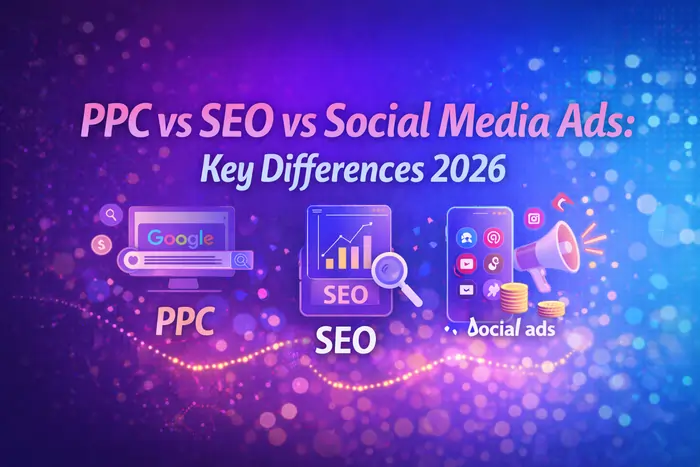
Every beginner eventually asks:
- Should I focus on SEO?
- Should I run Google Ads?
- Or should I just use social media ads?
The question is almost never “Which is better?” in a vacuum.
The real question is: what stage is your business in, and what are you optimizing for — speed, sustainability, or scale?
Understanding PPC vs SEO vs social ads means understanding:
- Speed vs sustainability
- Paid traffic vs organic traffic
- Demand capture vs demand generation
- Short‑term vs long‑term growth
- Acquisition cost vs compounding growth
Let’s break it down clearly.
First: What Each Channel Actually Is
SEO (Search Engine Optimization)
SEO is organic marketing.
You publish optimized content, then Google crawls, indexes, and ranks it — exactly how they outline the process in How Search Works.
Over time, you’re building:
- Organic rankings
- Search visibility
- Topical authority
- Backlink profile strength
- Internal linking structure
- Search equity
SEO traffic is:
- Intent‑driven (people are actively searching)
- Compounding (wins stack)
- Sustainable (no budget switch to flip off)
- Cost‑efficient long term
But SEO takes time. In Ahrefs’ “How Long Does It Take to Rank in Google?”, most top‑ranking pages are months or years old, not brand‑new posts.
SEO is infrastructure.
PPC (Pay‑Per‑Click)
PPC is paid search marketing — usually grouped under SEM (search engine marketing).
You enter an auction, set bids, pay per click (CPC), and compete on:
- Bid
- Ad quality / Quality Score
- Ad relevance to the query
- Landing page experience
In Google’s “How the Google Ads auction works”, Ad Rank — a mix of your bid and quality factors — is what actually determines if your ad appears and in what position.
Platforms most people mean when they say “PPC” include:
- Google Ads
- Microsoft Ads
- YouTube Ads
- Shopping Ads
- Display Network
PPC gives you:
- Immediate traffic
- Keyword‑level targeting precision
- High‑intent search capture
- Scalable testing loops
But it also introduces:
- Cost per acquisition (CPA) pressure
- Customer acquisition cost (CAC) math
- Break‑even ROAS constraints
Operator‑focused guides like Shopify’s ROAS playbook keep repeating the same thing: a 3x ROAS is meaningless without margin context.
If you’re serious about learning PPC structure correctly, this sits on top of your pillar: PPC Basics: Beginner Guide to Pay‑Per‑Click (2026) — otherwise PPC becomes expensive guessing.
Social Media Ads
Social ads live inside:
- Meta Ads (Facebook + Instagram)
- TikTok Ads
- YouTube Ads
- Other paid social platforms
This is paid social — not search.
Instead of responding to a query, you’re interrupting the scroll. In Meta’s ad objectives guide, campaigns are built around goals like awareness, consideration, or conversions, not keywords.
You rely on:
- Audience and interest targeting
- Behavioral and lookalike audiences
- Creative testing (hooks, visuals, angles)
- Engagement signals (views, watch time, comments, shares)
You’re generating demand more than you’re capturing it.
Social ads are:
- Attention‑based
- Creative‑dependent
- Algorithm‑driven
The Core Differences
1️⃣ Speed vs Compounding
PPC
When you launch a well‑structured Google Ads campaign, traffic can start within minutes — this “instant visibility” is exactly what Google pitches on its Google Ads product page.
Social Ads
When your Meta or TikTok campaigns go live, you also get immediate reach, but performance leans heavily on creative quality and targeting.
SEO
When you follow Google’s own SEO Starter Guide principles, you’re playing a slower game: improve structure and content now, harvest rankings and organic clicks over months.
If you need fast signal and testing: PPC wins.
If you want compound growth: SEO wins.
If you want scalable awareness and storytelling: social ads win.
2️⃣ Intent Level
Search ads capture explicit intent.
When someone types “buy running shoes size 9,” both PPC and SEO can meet them at that exact moment of purchase intent. That’s what makes search “bottom‑of‑funnel” in most funnel breakdowns.
SEO captures that organically; PPC captures it by paying the auction.
Social ads, by contrast, hit people mid‑scroll. They’re not actively asking for you; you’re inserting a solution into their feed. That’s why Meta’s campaign objectives framework leans so heavily on awareness and consideration for many accounts.
Search = solution‑aware user.
Social = discovery‑stage user.
Different psychology, different conversion rates, different expectations.
3️⃣ Cost Structure
PPC Cost Model
You live in metrics like:
- CPC (cost per click)
- CPA (cost per acquisition)
- ROAS (return on ad spend)
- CAC (customer acquisition cost)
- LTV (lifetime value)
Performance content like Shopify’s ROAS breakdown and Cometly’s ROAS guides all say the same thing: revenue screenshots lie if you don’t know your margins and LTV.
Clicks without conversion are just an expensive traffic hobby.
SEO Cost Model
With SEO, your cost profile is front‑loaded:
- Content strategy and production
- Technical fixes and site performance
- Link acquisition and digital PR
But as long‑term ranking studies show, once you’re ranking, your marginal cost per extra organic visitor trends toward near‑zero. The compounding effect is the asset.
Social Ads Cost Model
With social ads, creative fatigue is part of the game. Meta’s own ad relevance diagnostics documentation shows how weak engagement increases costs and reduces delivery.
If creative fails, CPA spikes quickly. You pay both for impressions and for the opportunity cost of weak attention.
PPC vs SEO Pros and Cons
| Factor | PPC (Search Ads) | SEO (Organic Search) |
|---|---|---|
| Speed | Instant traffic when live | Slow build; months for meaningful rankings |
| Control | Direct control via bids, keywords, audiences | Indirect control via content, links, and site structure |
| Duration | Stops when budget stops | Keeps earning as long as you maintain relevance |
| Cost predictability | Highly trackable CPC/CPA/ROAS | Upfront investment; lower marginal cost over time |
| Risk | High if unit economics unknown | High if you expect “fast SEO wins” |
PPC is acceleration.
SEO is infrastructure.
AI & 2026 Automation Reality
AI now drives:
- Smart Bidding strategies (Target CPA, Target ROAS, Maximize Conversions)
- Performance Max campaigns
- Predictive targeting and audiences
- Automated creative suggestions
In Google’s own Smart Bidding and Google Ads API introduction, they describe how bids are adjusted in every auction using signals like device, location, query context, and audience data.
But every serious Smart Bidding guide has a hidden warning: without clean conversion tracking, Smart Bidding is just “smart guessing.” Google’s conversion tracking help articles make it very clear the system can only optimize around the events you feed it.
No conversion data, no intelligent automation.
Automation amplifies your structure. It does not replace it.
Privacy & First‑Party Data
As third‑party cookies fade and browser protections tighten, platforms are pushing brands toward first‑party data.
That means:
- Explicit consent and preference management
- Clean tagging and, where possible, server‑side tracking
- Clear, user‑friendly explanations of data use
PwC’s Consumer Intelligence Series on digital trust keeps finding the same pattern: users reward brands that handle data transparently and respectfully, and punish those that don’t.
In practical terms:
- PPC needs reliable first‑party conversion signals to bid well.
- SEO benefits when users trust your brand and stay engaged.
- Social ads perform better when you can feed in high‑quality first‑party audiences and custom lists.
Privacy isn’t just a legal checkbox — it’s a performance lever.
Attribution Reality
Multi‑channel attribution is messy, which is why Google Analytics’ About Attribution and other model explainers exist in the first place.
A realistic journey can look like:
- Someone sees your TikTok ad (social).
- They Google your brand (SEO and PPC).
- They click a branded search ad.
- They come back direct and finally convert.
If you only trust last‑click and “turn off whatever doesn’t get the final click,” you often cut off the awareness and mid‑funnel support that made the sale possible.
You don’t just lose performance.
You quietly collapse your own funnel.
When to Use PPC vs SEO vs Social
Use PPC when:
- You need immediate data and traffic
- You have clear buyer‑intent keywords
- You know your break‑even ROAS and CAC
Use SEO when:
- You want sustainable, compounding growth
- You can commit at least 6–12 months
- You’re serious about building authority and brand
Use social ads when:
- You have strong creative and story angles
- You’re building awareness or demand
- Your product/category is visually or emotionally driven
The Real Answer: It’s Not Either/Or
The strongest 2026 acquisition systems stack channels:
- SEO = foundation (infrastructure, authority, organic demand)
- PPC = accelerator (fast testing, precise intent capture)
- Social ads = amplifier (attention, demand generation, creative storytelling)
Think in terms of:
- Owned media (SEO, email, your site)
- Paid media (PPC + social)
- Earned media (backlinks, PR, mentions)
Algorithms change. Auctions get more expensive. CPMs rise.
Infrastructure — your content, authority, and owned audience — is what survives.
Final Thoughts | PPC vs SEO vs Social Media Ads
“PPC vs SEO vs social media ads” is not a “which is best?” argument.
It’s a:
- Timeline decision
- Budget decision
- Risk decision
- Infrastructure decision
Build authority.
Buy precision.
Generate attention.
And if you’re serious about mastering paid traffic properly:
👉 PPC Basics: Beginner Guide to Pay‑Per‑Click (2026)
Clarity first.
Structure second.
Scale third.
That’s SocialBaddie execution 💻✨

