

If you’re stepping into the world of digital marketing, you’ve likely heard a hundred different theories on the “algorithm.” Some treat it like a slot machine; others treat it like a math equation. The truth is somewhere in the middle.
To run a profitable brand today, you don’t just need to know how to click buttons in the Ads Manager. You need to understand the underlying logic. This guide is a deep-dive exploration of How Meta Ads work, designed to give you the “unfair advantage” in a world of automated bidding.
The 2026 Paradigm Shift: From Targeting to Predictive Modeling
For a decade, digital advertising was about “finding the person.” You would layer interests: “Show my ad to people who like luxury watches, live in Silang, and follow Rolex.”
In 2026, that version of advertising is dead. How Meta Ads work today is based on Predictive Modeling.
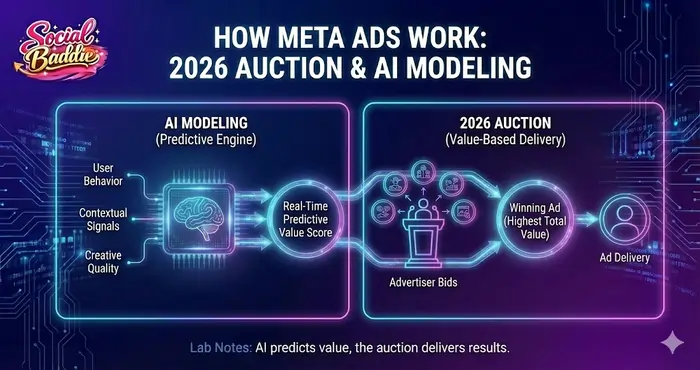
Meta no longer waits for you to tell it who your customer is. Instead, it uses a massive neural network to analyze every pixel of your creative, every word in your copy, and every millisecond of user behavior to predict who will buy before they even know they want to. This is the core of the “Andromeda” engine: a system that prioritizes intent signals over static demographic data.
The Engine Under the Hood: The Three Pillars of Delivery
To understand How Meta Ads work, you must understand that every time a user opens Instagram or Facebook, a billion-dollar auction happens in the background within 100 milliseconds.
Meta doesn’t just pick the person with the most money. If they did, the platform would be flooded with boring, high-budget ads, and users would leave. To balance profit and user experience, Meta uses a specific “Total Value” formula.
The Total Value Formula
Winning an ad placement is a math problem:
Total Value=(Advertiser Bid×Estimated Action Rate)+User Value
Pillar A: The Advertiser Bid
This is the amount you are willing to pay for a specific result (a click, a lead, or a sale). However, in 2026, most advertisers use Automated Bidding. This means you aren’t setting a manual dollar amount; you’re telling Meta, “Here is my budget—find me the most results possible.”
Pillar B: Estimated Action Rate (EAR)
This is the “Brain” of the operation. Before showing your ad, Meta asks: “What is the statistical probability that THIS specific user will take the action the advertiser wants?” * If you’re optimizing for Sales, and Meta knows a user just browsed three competitor websites, your EAR for that user skyrockets.
How Meta Ads work effectively is by matching high-intent users with high-quality offers.
Pillar C: User Value (The Ad Quality Score)
Meta protects the “Scroll.” If your ad is annoying, click-baity, or leads to a slow-loading website, your User Value score drops. A low User Value acts like a “tax”—it makes your ads more expensive because Meta has to “compensate” for the fact that you’re potentially annoying their users.
Creative is the New Targeting
In the “PPC Lab,” we often say: The Creative is the targeting. When you upload a video or an image, Meta’s AI “scans” the content. It recognizes objects, identifies the sentiment of the faces, and parses the text on the screen. It then uses this data to decide which “bucket” of people to show the ad to.
How Meta Ads Work with Visual Intelligence:
- Optical Character Recognition (OCR): The system reads the text on your video overlays. If your video says “PPC Strategies,” it immediately looks for users who engage with marketing content.
- Scene Recognition: If your image features a tropical beach, Meta targets people currently searching for vacations.
The Feedback Loop: If the first 100 people who see your ad are “Digital Nomads” and they all scroll past, Meta shifts the targeting. It learns in real-time.
Lab Note: This is why you should avoid “vague” creatives. If your ad is too artistic and doesn’t clearly show what you’re selling, the algorithm will struggle to categorize you, leading to wasted spend. Check our creative optimization tips.
The Signal Revolution: CAPI and First-Party Data
You cannot talk about How Meta Ads work without mentioning the “Signal.” Since the privacy updates of 2021 (iOS 14) and the sunsetting of cookies in 2025, Meta can no longer rely solely on the “Pixel.”
Today, the system relies on the Conversions API (CAPI).
CAPI creates a “server-to-server” connection. Instead of the browser telling Meta, “Someone bought a shirt,” your website’s server tells Meta directly.
Why Signal Strength Matters
If Meta only sees 60% of your sales because of tracking issues, the algorithm thinks your ad is failing. It will stop showing the ad to people like your customers.
When you improve your Signal Match Quality, you are essentially “feeding the beast” better data, which allows the machine to optimize with 10/10 accuracy.
Understanding the “Learning Phase”
Every new campaign starts in the Learning Phase. This is the most misunderstood part of How Meta Ads work.
During this phase, Meta is “testing the waters.” It might show your ad to 500 people in the morning and 500 different people in the evening to see which group reacts better.
The 50-Event Rule: Generally, an ad set needs 50 optimization events (e.g., 50 sales) within a 7-day window to “exit” the learning phase.
The Danger Zone: Many beginners see high costs on Day 1 and turn the ad off. This is a mistake. On Day 1, the algorithm is intentionally “spending to learn.” Turning it off is like quitting a marathon at the first mile.
Advantage+ and the Era of Automation
As we move through 2026, Meta is pushing everyone toward Advantage+ Campaigns. This is the ultimate expression of How Meta Ads work in the modern age.
Advantage+ Shopping (ASC): You don’t pick audiences. You don’t pick placements. You simply give Meta 20-30 creatives and a budget. The machine handles the rest.
Advantage+ Creative: Meta will automatically brighten your photos, add music to your videos, or swap your headline and body text to see which combination performs best for each individual user.
For a “Social Baddie” strategist, the job has shifted. You are no longer a “Media Buyer” (someone who manages the machine); you are a Creative Strategist (someone who gives the machine high-quality fuel).
Troubleshooting: Why Ads Stop Working
Even when you understand How Meta Ads work, performance can dip. In our “Lab Notes,” we categorize these into three main buckets:
A. Creative Fatigue
If you’ve been running the same ad for 3 weeks, your “Frequency” (the number of times one person sees the ad) goes up. When people see the same ad 4-5 times, they start to ignore it. Meta sees this drop in engagement and raises your costs.
B. Auction Competition
Sometimes, costs go up because a big brand (like Nike or Coca-Cola) has just entered the auction with a $10M budget for a holiday sale. They “bid up” the floor of the auction, making it more expensive for everyone else.
C. Landing Page Friction
If your ad has a 5% Click-Through Rate (amazing!) but zero sales, the problem isn’t the ad. The problem is what happens after the click. If your website is slow or the “Buy Now” button is hard to find, Meta’s algorithm will eventually penalize you because the User Value is low. Test with tools like Google PageSpeed Insights.
Final Thoughts for the Social Baddie Tribe
Understanding How Meta Ads work is a journey, not a destination. The system is a living, breathing AI that changes every day. Your goal as a marketer in 2026 isn’t to “beat” the algorithm; it’s to partner with it.
Provide the machine with:
- High-Resolution Creative that speaks to a specific pain point.
- Clean Data Signals via CAPI.
- Patience to let the learning phase complete.
Do those three things, and you’ll find that the “black box” of Meta advertising becomes your most predictable growth engine.

