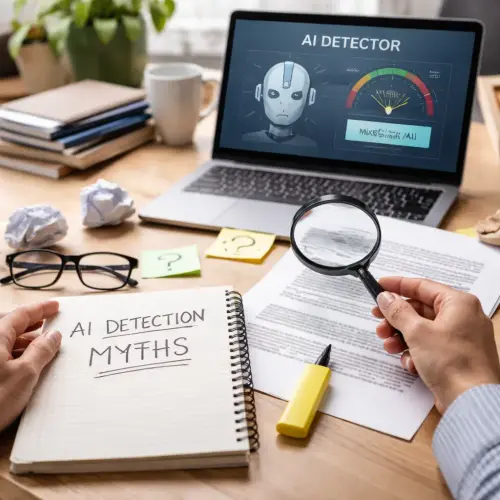
AI content detection myths Key Takeaways
This article clears up ten persistent myths so you can evaluate content detectors with a clear, skeptical eye—and keep your focus on writing that serves your audience, not a scoring algorithm.
- AI content detection myths often overstate a detector’s reliability; most tools have high false-positive rates, especially on non-native or technical writing.
- No detector can definitively prove a text was written by a human or AI; they only assign probability scores based on training data and analysis.
- Understanding the limitations of these tools helps you create content that is both human-first and resilient to unreliable scoring.
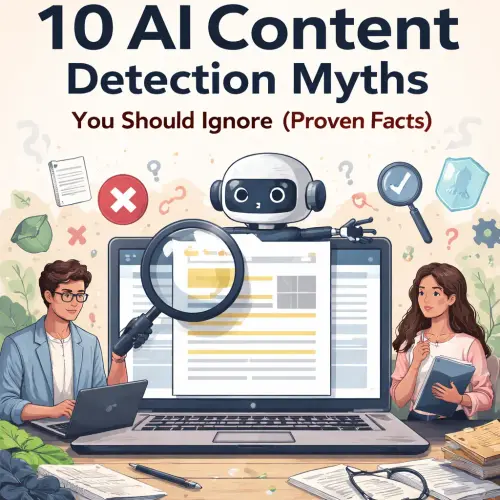
What You Need to Know About Current AI Content Detection Myths
With the rise of generative AI, a cottage industry of detection tools has emerged. Unfortunately, so have a lot of myths about AI detection that cause unnecessary anxiety for writers, marketers, and editors. Many believe these tools are infallible or that they can “think” like a teacher grading an essay. In reality, most detectors are pattern-matching algorithms trained on specific datasets, and they make mistakes all the time.
This article clears up ten persistent myths so you can evaluate content detectors with a clear, skeptical eye—and keep your focus on writing that serves your audience, not a scoring algorithm.
Myth 1: AI Detectors Can Prove Content Was Written by AI
This is arguably the biggest of the common AI content detection myths to ignore. No detector can definitively prove authorship. Tools like GPTZero, Originality.ai, and Turnitin generate a probability score—typically a percentage—that a text is AI-generated. But that number is a statistical estimate, not a verdict.
False positives are rampant. A study by Stanford researchers found that AI detectors frequently misclassify non-native English writing as AI-generated. Human editors remain the only reliable judge of whether content was likely produced by a machine or a person.
Myth 2: Detectors “Think” Like a Human Reviewer
People imagine detectors scanning for nuance, creativity, or original insight. They don’t. Most detectors analyze statistical properties such as perplexity (how predictable the text is) and burstiness (variation in sentence length and structure). AI-generated text often has lower perplexity and more uniform sentence length, but many human writers also produce predictable, even prose—especially in technical or instructional contexts.
The tool does not “read” your work. It runs mathematical formulas against a large language model’s output patterns and flags texts that resemble those patterns.
Myth 3: All AI Detectors Are Equally Accurate
Accuracy varies wildly across tools. Some are trained on older GPT-2 or GPT-3 data and fail when tested against GPT-4 or GPT-4o. Others sacrifice precision for recall, meaning they catch more AI content but also flag more human writing as AI.
A 2024 evaluation by the University of Maryland showed that the best detectors still misclassify between 10% and 30% of human-written content. Relying solely on any single tool is a recipe for false accusations.
Myth 4: If You Wrote It Yourself, the Detector Will Always Say “Human”
Many writers experience a jarring moment: they submit their own original work to a detector and receive a score suggesting it was AI-generated. This happens because of false positives, especially if the writing is clear, concise, or follows a predictable structure. Even the US Constitution has been flagged as AI-generated by some tools.
Writing style alone is not proof of origin. Your natural voice can overlap with the statistical patterns that detectors associate with AI.
Myth 5: Detectors Can Spot Any AI-Generated Text, No Matter the Model
Detectors are usually trained on specific AI models. A tool fine-tuned on GPT-3.5 output may not recognize text from Claude, Gemini, or even GPT-4. As new models appear with different statistical profiles, detection becomes a never-ending cat-and-mouse game.
This is why tools constantly update their algorithms—and why they often lag behind the newest generation of AI writing.
Myth 6: Using Synonyms or Rewriting Sentences Will Fool Every Detector
While surface-level rewrites can sometimes lower a detection score, they are not a guaranteed bypass. More sophisticated detectors look at deeper structural patterns, such as paragraph progression, topic transitions, and lexical diversity. A quick synonym swap often leaves underlying statistical fingerprints intact.
That said, thoughtful rewriting combined with your own ideas, examples, and structure usually results in content that detectors score as human—because it is genuinely human-like.
Myth 7: Low Detection Scores Always Mean the Content Is Safe from Penalties
Search engines like Google have stated that they do not use AI detection scores as a ranking factor. They care about helpfulness, reliability, and expertise—not whether a sentence was composed by a human or an AI. A low detection score does not guarantee high rankings. Similarly, a high detection score does not automatically harm your site if the content is valuable and original. For a related guide, see How Google Responds to AI-Generated Content in 2026.
The best strategy is to create content that satisfies user intent, regardless of who or what wrote the first draft.
Myth 8: AI Detectors Are Biased Only Against AI-Generated Text
In reality, detectors show measurable biases. They frequently penalize writing from people whose first language is not English, as well as neurodivergent writers whose natural style may differ from typical human patterns. This creates an equity problem: tools that claim to preserve authenticity can inadvertently discriminate against legitimate human expression.
Ethicists and researchers have called for more transparent reporting of false-positive rates by demographic group, but few vendors comply.
Myth 9: You Should Always Run Your Content Through an AI Detector Before Publishing
Running every piece through a detector is not a best practice. It can create unnecessary doubt, encourage micromanagement of prose, and lead to the reduction of your own voice as you try to satisfy a flawed algorithm. Instead, invest your energy in fact-checking, clarity, and ensuring your content meets audience needs.
If you are concerned about internal policies at school or work, check specific guidelines rather than relying on a detection tool as a universal arbiter.
Myth 10: AI Detectors Will Eventually Become Perfectly Accurate
This is perhaps the most dangerous myth. As AI language models evolve, they generate text that is increasingly indistinguishable from human writing. It is theoretically impossible for a detector to ever achieve 100% accuracy without false positives—because the statistical distributions of human and AI text will always overlap. The more humans mimic AI patterns (in an attempt to pass detection) and the more AI models mimic human variation, the blurrier the line becomes.
A future of perfect detection is a fantasy. Better policy, disclosure, and ethical use of AI are more realistic goals.
Key Takeaways on AI Content Detection Myths
AI content detection myths persist because the technology sounds more impressive than it really is. Detectors are useful as one signal among many, but they are not truth machines. Keep these facts in mind:
- No detector can prove any text was written by AI or a human.
- False positives affect a wide range of human writers, especially non-native speakers and clear writers.
- Search engines prioritize value and relevance, not detection scores.
- The most reliable quality assurance is still an informed human review.
Useful Resources
For a deeper look at how detectors work and their limitations, consult these resources:
- Stanford HAI: AI Detectors Biased Against Non-Native English Writers – A comprehensive study on false-positive rates and bias.
- Originality.ai – One of the more widely used detectors, with transparent reporting on accuracy and ongoing research.
Frequently Asked Questions About AI content detection myths
Can AI content detectors be 100% accurate?
No. No detector can achieve perfect accuracy because the statistical distributions of human and AI text overlap. False positives and false negatives are inherent to the technology.
Do search engines penalize content flagged as AI-written?
Google and other major search engines have stated they do not use AI detection scores as ranking factors. They focus on content quality, originality, and helpfulness. For a related guide, see How AI SEO Audits Identify Ranking Issues Faster.
What is a false positive in AI detection?
A false positive is when a detector classifies human-written text as AI-generated. This happens often with clear, predictable, or technical writing.
Are some AI detectors better than others?
Yes. Accuracy varies by tool, training data, and the AI model being tested. No detector outperforms all others across every scenario.
Can rewriting AI text help it pass detection?
Surface-level rewriting sometimes lowers detection scores, but deeper structural patterns may remain. Adding original insight and examples works better than synonym swapping.
Why did my personal writing get flagged as AI?
Your writing may match statistical patterns the detector associates with AI, such as uniform sentence lengths or low lexical diversity. This does not mean your writing is robotic—only that the tool’s model is imperfect.
Is it safe to use AI assistance for writing?
Yes, as long as you review, edit, and fact-check the output. Responsible AI use involves human oversight and accountability for the final content.
Do universities accept detection scores as evidence of cheating?
Many universities advise against using detection scores as sole evidence. Institutional policies vary, and false positives can lead to unfair accusations.
Can AI detectors tell which model wrote the text?
Some advanced tools attempt to identify the AI model, but accuracy is low, especially with newer or less common models.
What is perplexity in AI detection?
Perplexity measures how predictable a text is. AI-generated text often has lower perplexity because language models choose highly probable words.
What is burstiness in AI detection?
Burstiness measures variation in sentence length and structure. Many AI systems produce more uniform sentences than humans, but not always.
Are AI detectors biased?
Yes. Studies show detectors are more likely to flag non-native English writing and neurodivergent writing as AI-generated.
Should I stop using AI detection tools entirely?
Not necessarily—they can be useful as a rough indicator. Just don’t treat them as definitive or use them to replace human judgment.
Can I avoid false positives in AI detection?
You can reduce the chance of false positives by adding your own examples, opinions, and varied sentence structures. There is no guaranteed method, however.
Do detectors work on non-English text?
Some detectors support multiple languages, but accuracy is generally lower than for English, and training data is often limited.
How do I know if an AI detection result is reliable?
Cross-check with multiple tools and consider the context. If a detector flags a known fact-based or highly technical piece, be skeptical.
Can ChatGPT detect AI-written text?
No. ChatGPT is a language model, not a detection tool. It has no reliable ability to determine whether text was written by AI or a human.
Will AI detectors improve over time?
They will improve, but fundamental limits—due to overlapping distributions with human writing—mean 100% accuracy is unattainable.
Is it ethical to use AI writing tools?
Yes, when used transparently and with human oversight. The ethical issue is deception, not the tool itself.
What should I do if my content is falsely accused of being AI?
Be prepared to show your writing process, notes, or drafts. Many platforms and institutions have appeal processes for false accusations.