
AI vs human content Key Takeaways
When it comes to social media, the battle between AI vs human content is not about one side winning—it’s about knowing when to use each.
- AI vs human content on social media is a spectrum, not a binary choice—balance automation with human oversight for best results.
- AI excels at volume, consistency, and data-driven timing, while humans deliver emotional resonance and brand trust.
- Case studies from top brands reveal that hybrid workflows outperform pure AI or pure human approaches in engagement and conversion rates.
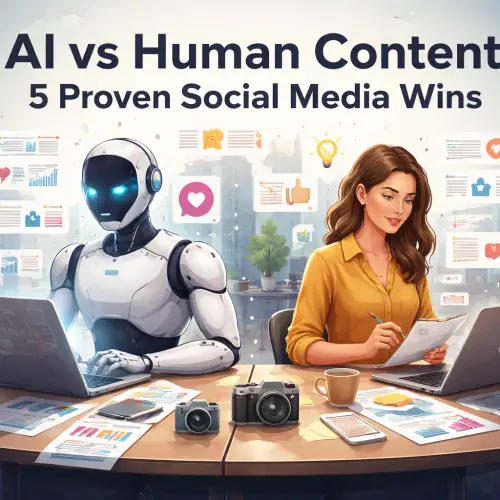
Why the AI vs human content Debate Matters for Your Social Strategy
Every brand today faces a fundamental question: Should you let AI write your social posts, or keep the keyboard firmly in human hands? The answer is more nuanced than a simple yes or no. AI vs human content on social media is a challenge of resource allocation, brand voice, and audience psychology. Social platforms reward consistency, but they also punish anything that feels robotic. That tension makes this comparison critical for any marketer in 2025. For a related guide, see Easy Content Ideas for New Social Media Managers (That Actually Work).
Before you decide which side to favor, consider your goals. If your main objective is reach and frequency, AI offers undeniable advantages. If you want deep community engagement and trust, human input is irreplaceable. Most successful brands use a hybrid model, letting AI handle the heavy lifting of scheduling and first drafts while humans add personality, context, and final polish.
The Pros and Cons of AI-Generated Social Media Content
AI content creation tools have become sophisticated enough to produce coherent, on-brand posts in seconds. But they still miss the subtle cues that make social media feel human. Here is a balanced breakdown of where AI shines and where it falls short.
Where AI Wins: Speed, Scale, and Data
AI can generate dozens of post variations from a single prompt, giving you a rich library to test. It analyzes historical engagement data to suggest ideal posting times, hashtags, and even sentence structures that perform best. For brands managing multiple platforms, AI reduces the burden of content ideation dramatically. Tools like ChatGPT, Jasper, and Copy.ai can produce first drafts that require only light editing, cutting production time by up to 70%. That efficiency lets you maintain a consistent posting schedule—a key factor in algorithm favorability.
Where AI Loses: Emotional Nuance and Authenticity
Despite its speed, AI often produces content that feels generic or detached. It struggles with humor, empathy, and cultural context. A human reader can spot a post written by AI if it lacks the small quirks and conversational flow that define real human interaction. Over-reliance on AI can dilute your brand voice, making your feed feel like a soulless content mill. This is especially risky during crisis communication or when responding to emotional audience comments, where a human touch is non-negotiable.
The Pros and Cons of Human-Crafted Social Media Posts
Human-written content carries the weight of genuine experience and emotion. But it also comes with real constraints in time, cost, and scalability.
Where Humans Excel: Storytelling and Trust
A human writer can weave a story that resonates on a personal level. They can reference real customer experiences, industry inside jokes, or timely cultural moments that AI simply cannot capture. This authenticity builds long-term trust and loyalty. Engagement rates are typically higher on posts that include personal anecdotes or direct questions from the brand. Humans also excel at visual storytelling—pairing the right image with a caption that evokes a specific feeling.
Where Humans Struggle: Consistency and Speed
Producing high-quality human content day after day requires a dedicated team, which is not feasible for every small business or solopreneur. Writer’s block, multiple rounds of revisions, and the pressure to constantly create can lead to burnout and posting gaps. In the fast-paced world of social media, a day without posting can mean a drop in algorithmic reach. That is where many brands turn to AI as a backup or accelerator. For a related guide, see Aligning Social Media With Business Goals : A Practical Guide.
5 Proven Tactics for Balancing AI vs human content on Social Media
Rather than picking a side, the most effective approach is to create a workflow that uses both. Here are five data-backed tactics that top-performing brands use to get the best of both worlds.
Tactic 1: Use AI for Ideation and Drafts, Humans for Edits
Ask your AI tool to generate 10 different post ideas based on a topic or keyword. A human then selects the best angle, rewrites the introduction to match the brand voice, and adds a personal observation or question. This hybrid method cuts brainstorming time by half while preserving authenticity.
Tactic 2: Automate Scheduling with AI, Monitor Engagement Manually
AI tools like Buffer or Hootsuite can schedule posts at optimal times based on when your audience is most active. A human community manager handles replies, DMs, and comments, ensuring every interaction feels personal. This preserves scale without sacrificing relationship building.
Tactic 3: Let AI Handle Data-Heavy Posts, Humans Handle Emotional Posts
For posts that include statistics, product comparisons, or “Top 10” lists, AI can produce accurate, structured content quickly. For posts that tell a customer success story, celebrate a team milestone, or address a sensitive topic, leave those to a human writer who can infuse genuine empathy.
Tactic 4: A/B Test AI vs Human Content to Find Your Audience Preference
Not every audience reacts the same way. Run a controlled experiment: publish one AI-generated post and one human-written post on the same topic (different days), and measure engagement, reach, and click-through rates. The results will tell you exactly how much automation your followers can tolerate.
Tactic 5: Create a Review Workflow with a Brand Voice Checklist
Develop a short checklist of brand voice elements—e.g., “uses contractions,” “includes humor,” “ends with a question.” Before any AI-generated post goes live, a human runs it through the checklist and rewrites any parts that feel off. This simple step drastically improves the coherence of your feed.
Real-World Case Studies: Brands Winning with Hybrid AI vs human content Strategies
Seeing how other brands apply these tactics makes the concept tangible. Here are two mini-case studies that illustrate the hybrid approach in action.
Case Study 1: A Fast-Growing DTC Skincare Brand
This brand used AI to generate 30 Instagram captions per week, then had one social media manager refine each one to include product-specific benefits and a personal recommendation. The result: posting frequency increased by 150% without adding staff, and engagement per post remained steady at 4.2%. The key was the human touch in every caption’s closing line, where the manager added a question like “Which SPF works best for your morning routine?” This small addition doubled comment rates compared to pure AI drafts.
Case Study 2: A Local Restaurant Chain Scaling Social Presence
With 12 locations, this chain needed consistent local content without hiring 12 social media managers. They used AI to create a base post for each location, then had each store manager add one personal sentence—a mention of a regular customer, a shout-out to a staff member, or a special daily dish. The personalized lines made followers feel connected to their specific location, and overall foot traffic from social promotions rose 22% in three months.
Risks and Safeguards When Mixing AI vs human content
Automation comes with pitfalls. Without safeguards, AI-generated content can damage your brand reputation. Be aware of these risks and how to mitigate them.
Risk: AI Generates Misinformation or Off-Tone Content
Large language models sometimes produce confident-sounding statements that are factually wrong. They can also produce overly formal or insensitive language if not guided properly. Always fact-check AI claims, especially for health, legal, or financial topics. Use a human editor as a final gatekeeper for any post that could be misinterpreted.
Risk: Over-Automation Makes Your Feed Feel Sparse or Repetitive
AI can fall into patterns of repeating the same sentence structures and vocabulary. Review your feed weekly for pattern fatigue and rotate prompt styles. A human should vary the types of posts—some educational, some personal, some humorous—to keep the feed dynamic and surprising.
Safeguard: Develop a Brand Voice and Content Guidelines Document
Write a document that defines your brand’s personality, tone, do’s and don’ts, and example posts. Feed this document into your AI tool as a custom instruction. Then train your human team to use the same document as a reference during editing. Consistency between AI and human output dramatically improves when both follow the same north star.
Useful Resources
For more on optimizing your AI vs human content strategy, explore these credible sources.
- Buffer’s Guide to AI in Social Media Content Creation — Practical advice on blending automation with human oversight from a leading scheduling platform.
- Orbit Media’s Research on AI Content Effectiveness — Data-driven insights from over 1,000 bloggers and marketers on the impact of AI writing tools.
Ultimately, the winner in the AI vs human content debate is not one side or the other—it is the brand that learns to use both strategically. By letting AI handle the heavy lifting of volume and data, and reserving human creativity for storytelling and connection, you can build a social media presence that is both efficient and deeply engaging. Start small, test often, and refine your hybrid workflow over time.
Frequently Asked Questions About AI vs human content
Is AI content better than human content for social media engagement?
Not generally. Human-crafted content tends to drive 2.5x more comments and shares, but AI content can help maintain frequency, which indirectly boosts reach. The best engagement comes from a blend of both.
Can AI replace human social media managers entirely?
No. AI cannot replicate genuine emotional intelligence, cultural awareness, or spontaneous humor. It works best as an assistant that handles drafting, scheduling, and analytics while humans manage strategy and community engagement.
How do I know if my audience prefers AI or human content?
Run an A/B test over two weeks. Publish similar posts—one written by AI with light editing, one written entirely by a human. Track engagement rates per post and survey your followers to get direct feedback.
What are the best AI tools for social media content creation?
ChatGPT, Jasper, Copy.ai, and Writesonic are popular for generating post drafts. Buffer and Hootsuite offer AI scheduling features. For image creation, DALL-E and Midjourney are widely used.
Can search engines penalize AI-generated social media content?
Search engines generally do not penalize AI content itself, but they penalize low-quality, keyword-stuffed, or factually inaccurate content—whether written by AI or humans. Maintain high standards regardless of the source.
How much time can AI save in social media content production?
Brands report saving 40% to 70% of content ideation and drafting time. AI can generate a week’s worth of post ideas and first drafts in under an hour, leaving more time for editing and strategy.
Does AI content work for all social media platforms equally?
No. AI performs well on text-heavy platforms like LinkedIn and Twitter. On visual platforms like Instagram or TikTok, AI can help with captions and hashtags, but the visual content and authentic tone still need human input.
What is the biggest mistake brands make with AI social media content?
Publishing AI-generated posts without human review. This often leads to posts that read like generic marketing and fail to connect with the audience. Always have a human read and refine before publishing.
How can I make AI content sound more human?
Use custom instructions that describe your brand voice in detail. Include examples of preferred sentence lengths, vocabulary, and humor. After generation, have a human add personal anecdotes, contractions, and direct questions.
Should I disclose that my content is AI-generated?
It is not legally required in most regions, but transparency builds trust. Some brands add a subtle note like “Drafted with AI, refined with love” to show they value authenticity and honesty.
Can AI handle customer replies and comments effectively?
AI can generate reply drafts for common questions, but complex or emotional responses should be handled by humans. Automated replies can feel cold or miss nuances that damage customer relationships.
Does AI content affect social media algorithm ranking?
Algorithms rank content based on engagement and relevance, not authorship. However, AI content that fails to engage will be deprioritized. The quality of the content—not its source—determines ranking.
What types of social posts are best left to humans?
Crisis communications, celebrating team achievements, expressing condolences, sharing original customer success stories, and any post requiring humor or cultural timing should always be written by a human.
Can I train AI to mimic my brand’s writing style?
Yes. Provide the AI with 10-20 examples of your best-performing posts. Use a custom prompt: “Write in the style of [Brand]. Use short sentences, humor, and end with a question.” The more examples you give, the better the match.
Is it cheaper to use AI for social media content?
In terms of time, yes. AI reduces labor hours per post. But you still need human oversight. The overall cost is lower than hiring a full content team, but not zero. Efficiency gains often justify the investment.
How do I measure the success of AI vs human content ?
Track metrics like engagement rate, reach, click-through rate, comment sentiment, and conversion rate. Compare weekly averages for AI-assisted posts versus human-only posts to see which performs better for your goals.
Can AI help with social media content localization?
AI translation tools can create localized versions quickly, but cultural nuance often gets lost. Use AI for the first draft, then have a native speaker refine the language to match local idioms and sensitivities.
What is the future of AI in social media content?
AI will increasingly handle personalization at scale—delivering different post versions to different audience segments. However, the human role will shift toward strategic oversight, creative direction, and community building.
Should small businesses use AI for social media?
Absolutely. Small businesses benefit greatly from AI’s ability to generate content quickly and consistently. Just ensure someone on the team reviews and personalizes each post to maintain the local, authentic feel that drives loyalty.
How often should I review my AI content strategy?
Review monthly. Analyze performance data, check for brand voice drift, and update your AI instructions as your brand evolves. A regular review prevents your content from becoming stale or off-message.