keyword intent strategies Key Takeaways
Understanding keyword intent strategies is the difference between burning through your PPC budget and generating a strong return.
- Keyword intent strategies help you categorise search queries by what a user actually wants, so you serve the right ad at the right time.
- Mapping intent to ad groups and landing pages improves Quality Score, lowers cost-per-click, and increases conversion rates.
- The 9 strategies outlined here cover everything from intent classification to negative keyword pruning, giving you a complete PPC optimisation framework.
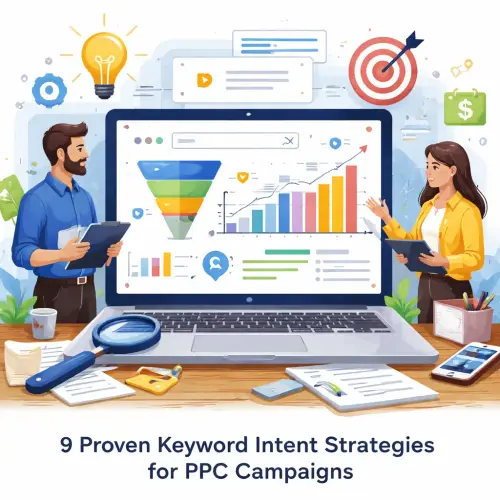
Why Keyword Intent Strategies Matter for Modern PPC
PPC advertising has evolved far beyond simple broad-match keyword lists. Today’s auction algorithms reward relevance — and relevance starts with intent. When you align your ads with the user’s underlying goal, you improve your Quality Score, lower your cost-per-click, and dramatically increase conversion rates. Without a solid intent framework, even the best bid strategy will underperform.
Think about the difference between someone searching “coffee machine cleaning tips” and “buy espresso machine online.” The first user wants information; the second wants a checkout. If you target both with the same ad group, you waste budget on clicks that rarely convert. PPC campaigns keyword targeting must account for these nuances to be truly effective. For a related guide, see 8 Audience-First PPC Strategies That Convert Better.
What You Need Before Implementing Keyword Intent Strategies
Before diving into the 9 strategies, make sure you have a solid foundation in place. Effective PPC campaigns keyword targeting requires clean account structure, accurate conversion tracking, and a willingness to test.
Prerequisites for Successful Intent-Based PPC
- Clean account structure — separate campaigns for branded, non-branded, and competitor terms.
- Conversion tracking — not just clicks, but value-based actions like purchases, sign-ups, or lead form submissions.
- Sufficient data — at least 30 days of search query reports to identify intent patterns.
- Landing page flexibility — ability to create or customise pages for different intent groups.
9 Keyword Intent Strategies to Optimise Your PPC Campaigns
1. Classify Every Keyword by Intent Category
Start by sorting your keyword list into four buckets: informational (user wants to learn), navigational (user wants a specific site), commercial (user is comparing options), and transactional (user is ready to buy). This is the foundational step of all keyword intent strategies. Use a spreadsheet or PPC management tool to tag each keyword. For example, “how to clean a car engine” is informational; “buy car engine degreaser online” is transactional.
Best practice: Create separate ad groups for commercial and transactional terms. Informational terms can feed a remarketing list.
2. Build Separate Campaigns for Each Intent Type
Once classified, move high-intent transactional keywords into a dedicated “Purchase” campaign with aggressive bid strategies. Commercial terms can go into a “Comparison” campaign with lower bids. This structural separation is central to PPC campaigns keyword targeting because it lets you control budgets, bidding, and ad copy at the intent level.
Example: A SaaS company might have a “Free Trial” campaign for commercial intent and a “Pricing” campaign for transactional intent.
3. Match Ad Copy to Search Intent
Your ad copy should mirror the language and emotional state of the searcher. For informational queries, use headlines like “5 Ways to Fix a Leaky Faucet.” For transactional queries, go with “Order a Professional Faucet Repair Kit Today.” This copy-intent alignment is one of the most impactful keyword intent strategies because it increases click-through rates and Quality Score simultaneously.
Best practice: Use dynamic keyword insertion for commercial terms but disable it for informational terms to avoid irrelevant headlines.
4. Align Landing Pages with Intent
A user searching “best running shoes for flat feet” needs a comparison page, not a product page for a single shoe. Intent-driven landing pages are essential for 9 keyword intent strategies for PPC. Informational intent → blog post or guide. Commercial intent → category page or comparison table. Transactional intent → product page with strong CTA.
Example: If you sell CRM software, send “HubSpot alternatives” commercial queries to a comparison landing page, and “buy CRM software” transactional queries to a pricing + checkout page.
5. Use Negative Keywords by Intent
Exclude terms that signal the wrong intent for your campaign. For example, if you sell premium accounting software, add “free,” “download,” and “open source” as negative keywords at the campaign level. This refines your PPC campaigns keyword targeting and prevents wasteful spending on non-purchasing intent.
Best practice: Review your search query report weekly and add irrelevant intent terms to your negative list.
6. Layer Audience Signals on Intent Bidding
Combine keyword intent with audience data. For instance, a transactional keyword like “buy office chairs” gets a bid boost when the searcher is in a “recent visitors” audience list. This layered approach is a cornerstone of advanced keyword intent strategies because it surfaces high-value users even if their search terms seem low intent. For a related guide, see 7 Proven First-Party Data Strategies for PPC Success.
Example: An e-commerce site saw a 22% increase in ROAS when they combined “informational + in-market audience” ad groups with remarketing lists.
7. Segment Campaigns by Purchase Funnel Stage
Create campaigns that mirror the classic AIDA funnel (Awareness, Interest, Decision, Action). Each stage gets its own ad copy, landing page type, and bid modifier. This is a practical implementation of 9 keyword intent strategies for PPC that scales well for larger accounts.
- Awareness (top of funnel): informational keywords, lower bids, awareness content.
- Interest (middle of funnel): commercial keywords, moderate bids, comparison content.
- Decision/Action (bottom of funnel): transactional keywords, higher bids, product pages.
8. Leverage Responsive Search Ads Based on Intent
Responsive Search Ads (RSAs) let you test multiple headlines and descriptions. Feed RSA assets specifically written for each intent bucket. For commercial terms, pin comparison-oriented headlines. For transactional terms, pin urgency-driven headlines like “Limited Stock.” This is a tactical keyword intent strategy that automates testing while keeping relevance high.
Best practice: Create at least three RSA per ad group, each focused on a different intent angle (feature, price, social proof).
9. Use Intent Data to Bid Modifiers
Analyse historical conversion data by intent category. If “commercial comparison” keywords convert at 5% while “informational blog” keywords convert at 0.5%, adjust your bid modifiers accordingly. This data-driven approach to PPC campaigns keyword targeting ensures you invest more where intent is strongest.
Example: Bump bids by 30% for all “transactional” keywords in your account after a 60-day analysis shows they drive 3x more revenue per click.
Common Mistakes When Applying Keyword Intent Strategies
Even with the best framework, it’s easy to slip into old habits. Here are the most frequent pitfalls:
- Over-segmenting too early: Don’t create 50 tiny ad groups before you have data. Start with 4–5 intent-based groups.
- Ignoring negative intent: Failing to exclude “free” or “job” terms can drain your budget.
- Using the same landing page for all intents: A blog post may not convert a transactional searcher, and a checkout page won’t satisfy an informational query.
Optimisation Tips for PPC Campaigns Keyword Targeting
Once you have your intent-based structure live, optimisation is key:
- Review search query reports every 7 days to catch new intent patterns.
- Update negative keyword lists at least monthly.
- Test landing page variations for each intent bucket quarterly.
- Use A/B testing on ad copy for commercial vs. transactional keywords.
Remember, 9 keyword intent strategies for PPC are not a set-and-forget project. As user behaviour shifts, your intent classification should evolve too.
Useful Resources
For a deeper dive into intent classification, read the comprehensive guide on WordStream: Search Intent Guide for PPC. It covers how to match keywords to funnel stages with real examples.
If you want to see how Quality Score interacts with intent, check Google Ads Help: About Quality Score. This official resource explains the formula behind ad rank and how relevance — driven by intent — directly impacts your costs.
Frequently Asked Questions About Keyword Intent Strategies
Mastering keyword intent strategies is not a one-time setup — it’s an ongoing discipline. Start by classifying your top 100 keywords, build separate ad groups for each intent, and let the data guide your next move. Your PPC campaigns will thank you with higher ROAS and lower wasted spend.
Frequently Asked Questions About keyword intent strategies
What are keyword intent strategies in PPC?
Keyword intent strategies are methods used to categorise search queries by the user’s goal — informational, navigational, commercial, or transactional — and then structure your PPC campaigns (ad groups, ad copy, landing pages, bids) accordingly to improve relevance and ROI. For a related guide, see Local Keyword Research Using AI Tools.
Why is search intent important for PPC?
Search intent determines whether a click converts. If you serve a transactional ad to an informational searcher, you waste budget. Intent-based targeting improves Quality Score, lowers CPA, and increases conversion rates.
How do I classify keyword intent?
Look at the words used: “how to,” “guide,” “tips” → informational; “vs,” “best,” “compare” → commercial; “buy,” “price,” “order” → transactional. Also check your search query report for actual user behaviour.
Can one keyword have multiple intents?
Yes, some keywords are ambiguous — for example “iPhone 15” could be informational (reviews) or transactional (buy). In that case, use separate ad groups and let ad copy signal the intent, then analyse performance to decide.
What is the difference between commercial and transactional intent?
Commercial intent means the user is researching options (e.g., “best CRM for small business”). Transactional intent means they’re ready to purchase (e.g., “buy Salesforce subscription”). Commercial leads often need comparison content before buying.
How do I match ad copy to intent?
Use the user’s language. For informational queries, start with a benefit-driven headline. For transactional queries, include urgency or a clear CTA like “Shop Now” or “Get 20% Off.” Test multiple RSA variations per intent bucket.
Should I have separate campaigns for each intent?
Yes, if your budget allows. Separate campaigns let you set different bid strategies, budgets, and tracking templates per intent. Smaller accounts can group intent at the ad group level instead.
What landing page should I use for informational keywords?
Use a blog post, guide, or video page that educates the user. Avoid pushing a product page unless the informational query is directly related to a specific SKU (e.g., “how to install Model 3000”).
What landing page should I use for transactional keywords?
Use a product page, pricing page, or checkout-optimised page with a clear CTA. Remove distractions like navigation that might lead users away from conversion.
How do negative keywords relate to intent?
Negative keywords help you exclude terms that don’t match your target intent. For example, if you sell paid software, adding “free” as a negative keyword prevents your ads from showing to informational searchers who won’t convert.
How often should I review my keyword intent categories?
Review every 30–60 days. Search behaviour changes, and new queries emerge. Use your search query report to spot new intent patterns and adjust categories accordingly.
Can I automate keyword intent classification?
Yes, tools like Optmyzr and Adalysis offer automated keyword grouping by intent. However, manual review is still recommended, especially for ambiguous terms unique to your industry.
What’s the difference between keyword intent and keyword match type?
Match type (broad, phrase, exact) controls how closely a user’s query must match your keyword. Intent is about the user’s goal. Both are important — you can target exact match transactional keywords or phrase match commercial keywords, for example.
Does intent affect Quality Score?
Indirectly, yes. Quality Score depends on click-through rate, ad relevance, and landing page experience. Intent-based ad copy and landing pages improve all three, leading to a higher Quality Score and lower CPC.
What is the best way to test intent-based ad copy?
Use Responsive Search Ads with at least 3 headlines and 2 descriptions per intent bucket. Run for 30 days, then pause low-performing combinations. Repeat monthly to keep copy fresh.
Can I use intent strategies for YouTube or Display campaigns?
Yes. For YouTube, align your video content with intent — short how-to ads for informational, demo videos for commercial, and promo videos for transactional. For Display, use custom audiences based on intent behaviours.
How do I handle intent for branded keywords?
Branded keywords are typically navigational or transactional. Create a separate campaign for branded terms. Use ad copy that reinforces brand trust, and send traffic to a high-converting landing page.
What if my budget is too small for multiple intent campaigns?
Focus on the highest-intent keywords first — transactional and commercial. Use a single campaign with separate ad groups for each intent. Scale up as data proves what works.
Do all the 9 keyword intent strategies work for B2B PPC?
Yes, but the intent cycle is often longer. B2B buyers spend more time in the commercial research phase. Adjust your landing pages to offer whitepapers, case studies, and ROI calculators for commercial intent.
How do I measure if my keyword intent strategies are working?
Track conversion rate, cost per conversion, and Quality Score by intent category. If transactional ad groups show a higher conversion rate but lower Quality Score, refine your ad copy and landing page relevance.