
Smart Bidding vs Manual PPC Key Takeaways
Choosing between automated and hands-on bidding is one of the most consequential decisions in paid search.
- Smart Bidding vs Manual PPC differences center on control, data requirements, and the speed of optimization.
- Automated bidding excels when you have sufficient conversion history, while manual bidding gives you full control over individual keyword bids.
- Understanding each fact helps you avoid costly mistakes like using Smart Bidding with too little data or over-managing a campaign that would benefit from automation.
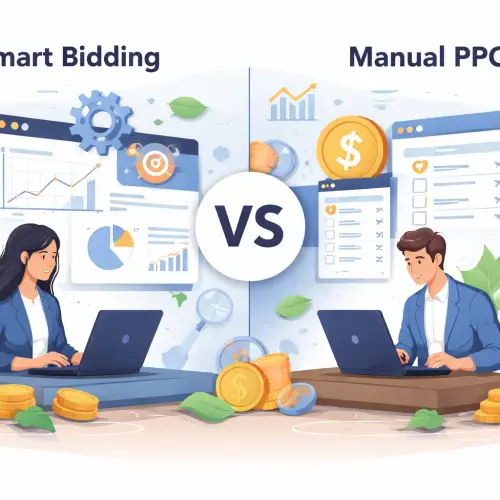
Why the Smart Bidding vs Manual PPC Decision Matters
Paid search is more competitive than ever. Whether you manage a small local account or a high-volume ecommerce portfolio, your bidding strategy determines how efficiently your budget converts into clicks and sales. Smart Bidding vs Manual PPC represents a fundamental fork in the road: one path uses machine learning to adjust bids in real time; the other relies on human judgment and historical data. For a related guide, see Meta Ads Case Study for Small Budget: Beginner Campaign That Generated Real Results.
The right choice depends on factors like conversion volume, campaign objectives, and your tolerance for hands-on management. The following eight facts give you a clear, fact-based framework for making that choice.
Fact 1: Data Requirements — The Critical Threshold
Smart Bidding needs a minimum of 30 conversions in the past 30 days to work reliably. Below that threshold, the algorithm lacks enough signal to make meaningful bid adjustments. Manual PPC has no such requirement; you can start bidding the moment you launch a campaign.
What This Means for Your Campaign
If you are launching a new product line or a seasonal campaign, manual bidding is safer. Once you accumulate enough conversion data, you can switch to automated bidding. Many advertisers make the mistake of flipping the switch too early, resulting in wasted spend. A good rule of thumb is to wait until you have at least 50 conversions per month for each campaign you want to automate.
Fact 2: Control Levels — Hands-On vs Hands-Off
Manual PPC gives you granular control at the keyword, device, and location level. You can raise bids for top-performing keywords and lower them for underperformers. Smart Bidding hands that control to Google’s algorithm, which optimizes for your chosen goal (conversions, target CPA, target ROAS) in real time.
When Control Matters Most
If you have strict margin requirements or need to respond quickly to market changes — like a competitor launch — manual control can be invaluable. Conversely, if your campaign spans hundreds of keywords and multiple devices, manual adjustments become impractical. In those cases, letting the machine take over can improve efficiency.
Fact 3: PPC Bidding Strategies Compared on Speed of Optimization
Smart Bidding adjusts bids for every auction — up to billions of times per day — based on user signals like device, location, time of day, and remarketing lists. Manual PPC adjusts bids only when you make changes, which may be once a day or even once a week.
The Practical Impact
For a campaign targeting a broad audience with a high volume of searches, Smart Bidding can capture opportunities you would never see with manual adjustments. But for a niche campaign with a small number of searches, real-time optimization offers limited benefit. In that case, a manually set bid at the right level will perform just as well.
Fact 4: Budget Efficiency — The Hidden Costs of Each Approach
Smart Bidding vs Manual PPC has a direct effect on how your budget is spent. Smart Bidding often reduces wasted spend by automatically lowering bids for unlikely converters. Manual PPC can result in overspend on underperforming keywords if you are not constantly monitoring performance.
Budget Efficiency in Practice
In a study by Google, advertisers using Target CPA Smart Bidding saw an average of 20% more conversions at the same cost compared to manual bidding. However, those results require sufficient data. Manual PPC can be just as efficient for small accounts where you can personally review search query reports and adjust bids weekly.
Fact 5: Learning Phase — The Hidden Cost of Automation
When you switch to Smart Bidding, the algorithm enters a learning phase that typically lasts 1–2 weeks. During this time, performance can dip as the system tests bid levels. Manual PPC has no learning phase; performance is stable from day one.
How to Manage the Learning Phase
If your campaign has tight performance targets, avoid making changes during the learning phase unless absolutely necessary. Each time you change a bid strategy setting or make a significant budget adjustment, the learning phase restarts. Patience is key. For time-sensitive campaigns like holiday sales, manual bidding may be the safer choice because you cannot afford a performance dip.
Fact 6: 8 Facts about Smart Bidding — The Role of Conversion Tracking
Smart Bidding is entirely dependent on accurate conversion tracking. If your conversion tracking is broken, the algorithm will optimize for the wrong actions — or no actions at all. Manual PPC can function without conversion tracking, relying on click performance as a proxy for success. For a related guide, see 7 Smart Ways Generative AI Is Changing PPC Ads (Proven).
Check Your Tracking Before You Switch
Before enabling Smart Bidding, audit your conversion tracking. Ensure that all meaningful actions — purchases, sign-ups, leads — are tracked correctly and that there are no duplicate conversions or missing tags. Many advertisers skip this step and then wonder why Smart Bidding underperforms. Manual PPC, while less dependent on tracking, still benefits from clean data for informed bid decisions.
Fact 7: Audience Signals — Where Automation Shines
Smart Bidding leverages audience signals that manual bidding cannot easily replicate. It can adjust bids for users in specific remarketing lists, demographic segments, or in-market audiences — all in real time. Manual PPC allows you to set bid adjustments for these segments, but the adjustments are static and must be manually updated.
When to Use Audience-Based Bidding
If your campaigns target a well-defined audience — for example, returning visitors or users who viewed a specific product — Smart Bidding can automatically prioritize those users. Manual PPC works best when you want to apply a consistent bid regardless of user behavior, such as in a brand campaign where you want to appear for every search. For a related guide, see 9 Smart ChatGPT Tips for PPC Campaigns.
Fact 8: Long-Term Performance — Which Strategy Adapts Best
Over time, Smart Bidding adapts to changes in user behavior, seasonality, and competitive dynamics without manual intervention. Manual PPC requires you to constantly monitor and adjust bids to maintain performance. In a stable, low-competition market, manual bidding can match automated performance. In a dynamic market, Smart Bidding tends to outperform.
The Long-Term View
A 12-month study of ecommerce accounts showed that Smart Bidding campaigns maintained consistent ROAS even as competitors increased spend, while manual campaigns required weekly bid adjustments to avoid losses. For most growing businesses, a hybrid approach works best: use Smart Bidding for your main campaigns and manual bidding for experiments or niche products.
Comparing PPC Bidding Strategies Compared: A Quick Reference Table
| Factor | Smart Bidding | Manual PPC |
|---|---|---|
| Data requirement | 30+ conversions in 30 days | None |
| Control level | Low (set goals only) | High (keyword-level) |
| Speed of adjustment | Real-time per auction | When you make changes |
| Learning phase | Yes (1–2 weeks) | No |
| Dependence on tracking | Critical | Low to moderate |
| Best for dynamic markets | Yes | No |
| Best for small accounts | No | Yes |
| Audience adaptation | Excellent | Limited |
When to Use Each Approach
Choosing the right strategy is not about picking a winner — it is about matching the tool to the job. Use Smart Bidding when you have at least 30 conversions per month, reliable conversion tracking, and a campaign that spans many keywords or devices. Use Manual PPC when you are starting a new campaign, working with a limited budget, managing a niche account, or when you need full control over keyword-level bids.
For many advertisers, the best approach is a hybrid strategy. Run your core, high-volume campaigns with Smart Bidding while maintaining manual control over experiments, brand campaigns, or seasonal promotions. This gives you the benefits of automation where it works best without losing the flexibility that only human judgment can provide.
Useful Resources
For a deeper dive into how Smart Bidding works under the hood, read the official Google Ads documentation on Smart Bidding. To understand the manual bidding mechanics in detail, check out the WordStream guide to manual CPC bidding.
Frequently Asked Questions About Smart Bidding vs Manual PPC
What is the main difference between Smart Bidding and Manual PPC?
Smart Bidding uses Google’s machine learning to automatically adjust bids in real time based on conversion signals, while Manual PPC lets you set and adjust bids yourself at the keyword or ad group level.
Does Smart Bidding outperform Manual PPC?
Not always. Smart Bidding outperforms manual when you have sufficient conversion data and accurate tracking. For small accounts or new campaigns, manual bidding often delivers better results.
How many conversions are needed for Smart Bidding?
Google recommends at least 30 conversions in the past 30 days. For best results, aim for 50 or more to give the algorithm a reliable signal.
Can I switch from Manual PPC to Smart Bidding?
Yes. Most advertisers start with manual bidding and switch to Smart Bidding once they have enough conversion history. Expect a 1–2 week learning phase after switching.
Is Smart Bidding more expensive than Manual PPC?
Smart Bidding can increase or decrease cost depending on your goals. Target CPA and Target ROAS strategies aim to maximize conversions within a set cost, often resulting in lower cost per conversion than manual.
Does Manual PPC work for ecommerce?
Yes, especially for small ecommerce stores with a limited number of products. As the account grows, manual management becomes difficult, and Smart Bidding offers better efficiency.
What happens if conversion tracking breaks with Smart Bidding?
Smart Bidding will optimize for whatever signal it receives. If tracking breaks, it may stop delivering conversions or optimize for the wrong actions. Regular tracking audits are essential.
Can I use Smart Bidding without conversion tracking?
Technically, you can use Enhanced CPC, but full Smart Bidding strategies like Target CPA or Target ROAS require conversion tracking to function.
How long does the Smart Bidding learning phase last?
The learning phase typically lasts 1–2 weeks. Performance may fluctuate during this period. Avoid making major changes until the learning phase ends.
Does Smart Bidding work for local businesses?
Yes, as long as you have enough conversion data. Local businesses with low search volume may struggle to hit the 30-conversion threshold and should stick with manual bidding.
Which bidding strategy is better for brand campaigns?
Manual PPC is often better for brand campaigns because you want to control exact match bids and ensure your ad shows for every brand search without paying more than needed.
Can Smart Bidding adjust bids for different devices?
Yes. Smart Bidding automatically adjusts bids for device type, location, time of day, and hundreds of other signals without manual device bid adjustments.
What are the risks of using Smart Bidding?
The main risks are using it with insufficient data, poor conversion tracking, or making constant changes that restart the learning phase. These can lead to wasted spend.
Is Manual PPC better for low-budget campaigns?
Yes. With limited budget, you want full control over where every dollar goes. Manual bidding lets you pause underperformers and allocate spend to proven keywords.
Does Smart Bidding work with all match types?
Yes. Smart Bidding works with broad, phrase, and exact match keywords. For best results, use a mix of match types and let the algorithm prioritize the best-converting queries.
How often should I check my manual bids?
At least once a week for stable campaigns, and daily for competitive or seasonal campaigns. Regular checks help avoid overspending on low-performing keywords.
Can I combine Smart Bidding with manual bid adjustments?
Yes, you can set bid adjustments for location, device, or audience segments. Smart Bidding will use those adjustments as starting points and optimize from there.
What is the best bidding strategy for lead generation?
Target CPA with Smart Bidding is often best for lead generation because it focuses on getting the most conversions at your target cost. Manual PPC works if you have a small number of high-value leads.
Does Smart Bidding work for mobile-only campaigns?
Yes. Smart Bidding automatically adjusts for mobile, tablet, and desktop. It often delivers a higher share of clicks on mobile when those users are more likely to convert.
How do I know if my campaign has enough data for Smart Bidding?
Check your conversions in the last 30 days. If you have fewer than 30, stick with manual bidding. Also check that your conversion rate is stable — high volatility can confuse the algorithm.