
Topical authority in SEO is the process of building deep, interconnected content around a specific subject to signal expertise, trust, and relevance to search engines. By creating high-quality content clusters, using strategic internal linking, and aligning with search intent, websites can achieve sustainable rankings, improved organic traffic, and long-term visibility in search results.
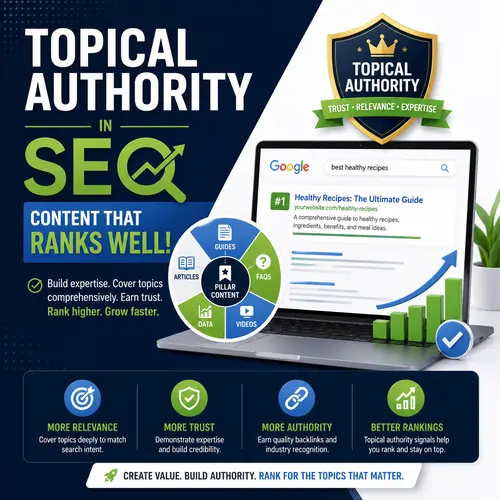
Building topical authority in SEO is no longer optional—it’s the foundation of modern search visibility. Search engines have shifted toward understanding topics, entities, and relationships, rather than just matching keywords.
According to Google’s Search Quality Evaluator Guidelines, content that demonstrates expertise, experience, and trustworthiness is more likely to rank consistently. This means websites must go beyond surface-level articles and focus on deep, structured, and interconnected content ecosystems.
In today’s landscape, combining SEO, GEO (Generative Engine Optimization), and AEO (Answer Engine Optimization) is what separates short-term rankings from long-term authority.
The Evolution of SEO: From Keywords to Topics
Traditional SEO focused heavily on exact-match keywords, but modern algorithms rely on semantic search and Natural Language Processing (NLP).
Google’s guide on How Search Works explains that search engines now interpret:
- Context
- Intent
- Relationships between topics
- User behavior signals
This evolution means that building topical authority is essentially about becoming the most reliable and comprehensive source for a subject.
How Topical Authority Impacts Rankings
Strong topical authority influences multiple ranking factors simultaneously:
- Improves crawl efficiency
- Enhances indexation depth
- Strengthens internal link equity
- Increases user engagement metrics
Industry research from Ahrefs and SEMrush consistently shows that websites covering topics comprehensively tend to dominate SERPs.
Advanced Content Cluster Strategy
A content cluster strategy is not just about grouping articles—it’s about building a logical content architecture.
Pillar Page Characteristics:
- Broad topic coverage
- High search volume keyword targeting
- Acts as central authority hub
Cluster Content Characteristics:
- Long-tail keyword focus
- Deep subtopic coverage
- Linked back to pillar page
Framework inspired by HubSpot’s Topic Cluster Model.
Semantic SEO and Entity Optimization
Semantic SEO focuses on meaning rather than exact keywords. This includes:
- Using entity-based keywords
- Covering related concepts
- Structuring content logically
Search engines rely on entity recognition, which is reinforced by:
- Internal linking
- Contextual keyword usage
- Content depth
This aligns with modern NLP algorithms.
Content Depth vs Content Volume
Publishing more content doesn’t automatically build authority. What matters is:
- Coverage completeness
- Topical relevance
- Content quality
A well-structured 20-article cluster can outperform 100 random blog posts.
Content Refresh Strategy for Authority Growth
Topical authority is not static—it requires continuous updates.
Best Practices:
- Update statistics and data
- Add new sections
- Improve internal links
- Expand thin content
Google’s Helpful Content System favors fresh, people-first content.
External Authority and Trust Signals
Building topical authority is strengthened by referencing credible sources:
These references reinforce E-E-A-T signals and improve credibility.
Internal Linking Strategy (Advanced)
According to Google Search Central, internal links help search engines understand content relationships.
Advanced Tips:
- Use contextual anchors
- Avoid orphan pages
- Link high-authority pages to new content
GEO + AEO Optimization Layer
GEO (Generative Engine Optimization)
Content must be:
- Structured clearly
- Answer-focused
- Context-rich
AEO (Answer Engine Optimization)
- Use direct answers
- Add FAQ sections
- Optimize for voice queries
Research from Backlinko supports this shift.
Measuring Topical Authority Performance
Use:
Track:
- Topic-level rankings
- Internal page growth
- Keyword clustering performance
Expanded Conclusion
Building topical authority in SEO is a long-term investment that compounds over time. Instead of chasing individual rankings, you create a network of relevance that search engines trust.
With the integration of semantic SEO, content clusters, and AI-aligned optimization (GEO + AEO), your content becomes future-proof. The goal is not just ranking—it’s becoming the definitive source for your niche.
Frequently Asked Questions
1. What is topical authority in SEO?
Topical authority in SEO refers to how well a website covers a subject comprehensively. It is built through interconnected, high-quality content. Search engines reward sites that demonstrate consistent expertise.
2. How do content clusters improve SEO?
Content clusters organize related topics into a structured system. This improves internal linking and contextual relevance. It also helps search engines understand your content hierarchy.
3. How long does it take to build authority?
It usually takes several months to a year depending on competition. Consistency in publishing is key. Results compound over time.
4. What is a pillar page?
A pillar page is a comprehensive guide covering a broad topic. It acts as the main hub for related content. Cluster pages link back to it.
5. What are LSI keywords?
LSI keywords are related terms connected to your main keyword. They help improve contextual understanding. Using them enhances NLP optimization.
6. What is semantic SEO?
Semantic SEO focuses on meaning instead of exact keywords. It uses related terms and entities. This aligns with modern search algorithms.
7. Why is internal linking important?
Internal linking connects related pages within your site. It improves crawlability and user navigation. It also distributes authority across pages.
8. What is E-E-A-T?
E-E-A-T stands for Experience, Expertise, Authoritativeness, and Trustworthiness. It is a key ranking factor. High E-E-A-T improves credibility.
9. What is AEO?
Answer Engine Optimization focuses on providing direct answers. It helps content appear in featured snippets. It improves visibility in voice search.
10. What is GEO in SEO?
Generative Engine Optimization prepares content for AI-driven search engines. It emphasizes structured and clear information. This improves AI extraction.
11. Can AI content rank?
Yes, if it is high-quality and human-edited. It must provide real value. Quality matters more than origin.
12. How often should content be updated?
Content should be reviewed regularly. Updates improve accuracy and rankings. Fresh content performs better.
13. Does keyword density matter?
Keyword density is less important today. Natural usage is preferred. Overuse can harm rankings.
14. What tools help build authority?
Tools like Ahrefs and SEMrush are useful. They provide keyword and performance insights. Data helps refine strategies.
15. Is topical authority better than backlinks?
Both are important for SEO success. Authority builds relevance while backlinks build trust. Combining both is ideal.
16. What is search intent?
Search intent reflects what users want to find. Aligning with it improves rankings. It ensures content meets expectations.
17. How does NLP affect SEO?
NLP helps search engines understand context. It improves interpretation of content. Writing naturally supports this.
18. What is the biggest SEO mistake?
Creating thin or low-quality content is the biggest mistake. It fails to provide value. Depth and relevance are essential.
19. Can small sites build authority?
Yes, especially in niche topics. Focused content helps build relevance faster. Consistency is key.
20. What is the future of SEO?
SEO is moving toward AI and semantic understanding. Content must be structured and helpful. Authority will become even more important.
Disclaimer
This article is for educational and informational purposes only. SEO strategies, ranking factors, and search engine algorithms evolve frequently due to ongoing updates from platforms like Google and other search engines. While the techniques and insights shared here are based on current best practices and industry research, results may vary depending on your niche, competition, and implementation.
Always test your strategies, validate outcomes using reliable data sources, and continuously adapt your approach based on real performance metrics, user behavior, and the latest algorithm changes. It is also recommended to cross-reference multiple authoritative sources and stay updated with official search engine guidelines to ensure long-term success and compliance.

