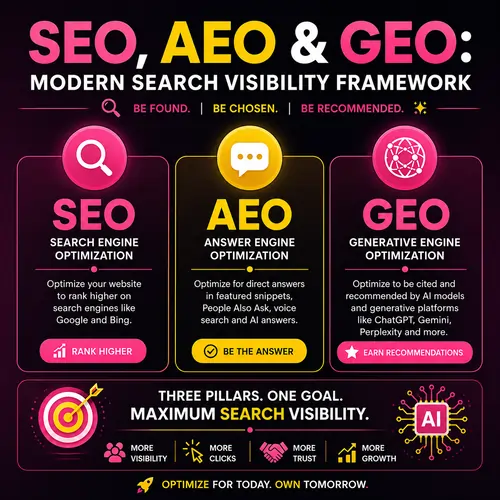
SEO AEO and GEO Strategy are three interconnected strategies that define modern search visibility. SEO (Search Engine Optimization) focuses on ranking in traditional search results, AEO (Answer Engine Optimization) targets direct answers in SERP features and voice assistants, and GEO (Generative Engine Optimization) ensures visibility in AI-generated answers. Combining all three allows brands to appear across Google search, AI platforms, and voice search ecosystems, even in zero-click search environments.
Introduction: The Evolution of Search Visibility
Search is no longer just about rankings. It’s about visibility across multiple search environments, including search engines, AI tools, and voice assistants. Traditional SEO strategies alone are no longer enough to capture the full spectrum of modern search behavior.
Today, users expect:
- Instant answers
- Conversational responses
- Context-aware results
This shift has led to the rise of:
- AEO (Answer Engine Optimization)
- GEO (Generative Engine Optimization)
Together with SEO, they form a complete search visibility framework designed to dominate both click-based and zero-click search results.
What is SEO (Search Engine Optimization)?
SEO is the foundation of digital visibility. It focuses on optimizing websites to rank in search engine results pages (SERPs).
Core Elements of SEO:
- On-page SEO optimization
- Technical SEO
- Keyword research
- Content optimization
- Backlink building
Key SEO keywords:
- organic search traffic
- search rankings
- SERP visibility
- technical SEO audit
- on-page SEO factors
SEO ensures your content is discoverable, crawlable, and indexable.
What is AEO (Answer Engine Optimization)?
AEO is about becoming the answer.
Instead of focusing on rankings, AEO focuses on:
- direct answers
- featured snippets
- voice search results
- People Also Ask (PAA)
Key AEO strategies:
- Answer questions clearly
- Use structured content
- Optimize for question-based queries
- Focus on search intent optimization
Important AEO keywords:
- featured snippets optimization
- voice search SEO
- answer box ranking
- position zero SEO
AEO helps your content appear where users don’t need to click.
What is GEO (Generative Engine Optimization)?
GEO is the newest layer of search optimization. It focuses on visibility in AI-generated content.
GEO focuses on:
- AI search engines
- chatbots
- generative AI platforms
Key GEO strategies:
- Write context-rich content
- Use semantic structure
- Provide complete answers
- Build strong topical authority
Important GEO keywords:
- AI search optimization
- generative search engines
- AI content visibility
- semantic search optimization
GEO ensures your content is selected, summarized, and cited by AI systems.
Why You Need SEO + AEO + GEO Together
Most strategies fail because they focus only on SEO.
The reality:
- SEO gets you ranked
- AEO gets you featured
- GEO gets you cited
Combining all three creates:
- Higher search visibility
- Better brand authority
- Stronger multi-platform presence
12 Key Differences Between SEO, AEO, and GEO
| # | SEO (Search Engine Optimization) | AEO (Answer Engine Optimization) | GEO (Generative Engine Optimization) |
|---|---|---|---|
| 1 | Targets rankings | Targets answers | Targets AI summaries |
| 2 | Focuses on clicks | Focuses on visibility | Focuses on inclusion |
| 3 | Uses keywords | Uses questions | Uses context |
| 4 | Optimizes pages | Optimizes answers | Optimizes meaning |
| 5 | Works on SERPs | Works in featured snippets | Works in AI tools |
| 6 | Is crawl-based | Is extraction-based | Is synthesis-based |
| 7 | Relies on backlinks | Relies on clarity | Relies on context depth |
| 8 | Prioritizes structure | Prioritizes direct answers | Prioritizes completeness |
| 9 | Measures traffic | Measures visibility | Measures AI citations |
| 10 | Targets users | Targets questions | Targets AI systems |
| 11 | Uses metadata | Uses content formatting | Uses semantic meaning |
| 12 | Is traditional SEO | Is adaptive SEO | Is future-focused SEO |
Why this table works (SEO + AEO + GEO)
- Ideal for featured snippet tables
- Easy for AI models to extract and summarize
- Improves content scannability
- Reinforces semantic relationships
LSI Keywords for Modern Search Optimization
To rank across all systems, you must use LSI keywords (Latent Semantic Indexing keywords).
Examples of LSI keywords:
- search intent optimization
- semantic SEO strategy
- AI search results
- content structure SEO
- voice search queries
- SERP features optimization
- natural language processing SEO
- entity-based SEO
Using these improves:
- content relevance
- AI understanding
- search performance
Content Strategy for SEO + AEO + GEO
Content must now serve:
- Users
- Search engines
- AI systems
Key principles:
- Clarity over complexity
- Structure over length
- Context over keywords
How to Structure Content for AI and Search
Use:
- Clear headings (H1, H2, H3)
- Bullet points
- Short paragraphs
- Direct answers
This improves:
- crawlability
- indexability
- AI extractability
The Role of NLP in Modern SEO
Natural Language Processing (NLP) is critical.
Optimize for NLP SEO:
- Use natural language
- Include synonyms
- Avoid keyword stuffing
- Focus on meaning
This improves:
- semantic relevance
- AI compatibility
Search Intent Optimization | SEO AEO and GEO Strategy
Understanding search intent is essential.
Types:
- Informational intent
- Navigational intent
- Transactional intent
Matching intent increases:
- Rankings
- Engagement
- Conversions
Building Topical Authority
To win across SEO, AEO, and GEO, you need topical authority.
Steps:
- Create content clusters
- Strengthen internal linking
- Cover topics deeply
This signals:
- Expertise
- Authority
- Trust
AI-Optimized Content Creation
Your content must be:
- Clear
- Structured
- Context-rich
Focus on:
- semantic keyword integration
- content readability
- AI extractable formatting
Voice Search and Conversational SEO
Voice search is growing rapidly.
Optimize by:
- Using conversational keywords
- Answering questions directly
- Keeping responses concise
Measuring Success in Modern Search
Traditional metrics are not enough.
Track:
- impressions
- SERP visibility
- featured snippet rankings
- AI mentions
Common Mistakes to Avoid
- Ignoring AEO and GEO
- Overusing keywords
- Poor structure
- Weak content depth
- Lack of intent alignment
Future of Search Visibility
Search is becoming:
- AI-driven
- Conversational
- Context-aware
To stay competitive:
- Adapt quickly
- Test strategies
- Focus on visibility
Frequently Asked Questions
1. What is SEO?
SEO (Search Engine Optimization) improves website visibility in search engines. It focuses on rankings, traffic, and optimization techniques. It is the foundation of digital search strategy.
2. What is AEO?
AEO (Answer Engine Optimization) focuses on providing direct answers to user queries. It helps content appear in featured snippets and voice search. It prioritizes clarity and structure.
3. What is GEO?
GEO (Generative Engine Optimization) optimizes content for AI platforms. It ensures content is included in AI-generated responses. It focuses on context and completeness.
4. Why combine SEO, AEO, and GEO?
Combining all three improves overall visibility. It allows content to rank, appear, and be cited. This creates a complete search strategy.
5. What are SERP features?
They are enhanced search results like snippets and panels. They provide quick answers. They improve user experience.
6. What is search intent?
Search intent is the purpose behind a query. It determines what users want. Matching intent improves rankings.
7. What are LSI keywords?
They are related keywords that support your topic. They improve context. They help search engines understand content.
8. What is semantic SEO?
It focuses on meaning and context. It uses related keywords and concepts. It improves relevance.
9. How does NLP impact SEO?
NLP helps search engines understand language. It focuses on context and meaning. It improves accuracy.
10. What is topical authority?
It means being an expert in a subject. It improves trust and rankings. It is built through content depth.
11. What is voice search optimization?
It focuses on spoken queries. It uses conversational language. It improves visibility in voice assistants.
12. What is AI search?
AI search uses machine learning to generate answers. It pulls information from multiple sources. It provides direct responses.
13. How do I optimize for AI?
Use structured content and clear answers. Focus on context and readability. Use semantic keywords.
14. What is content clustering?
It organizes content around topics. It improves internal linking. It builds authority.
15. What is technical SEO?
It focuses on website structure and performance. It improves crawlability. It supports rankings.
16. What is on-page SEO?
It optimizes content and HTML elements. It includes keywords and structure. It improves relevance.
17. What is off-page SEO?
It involves backlinks and external signals. It builds authority. It improves rankings.
18. What is SERP visibility?
It measures how often your content appears. It includes rankings and features. It reflects exposure.
19. How often should I update content?
Update regularly to stay relevant. Fresh content performs better. It improves rankings.
20. What is the future of SEO?
SEO is evolving with AI. Visibility matters more than clicks. Adaptation is essential.
Disclaimer
This content is for informational and educational purposes only and reflects current best practices in SEO, AEO, and GEO. Search engines and AI technologies continuously evolve, and results may vary depending on industry, competition, and implementation. Always validate strategies with real data, test consistently, and adapt based on performance insights and emerging trends.