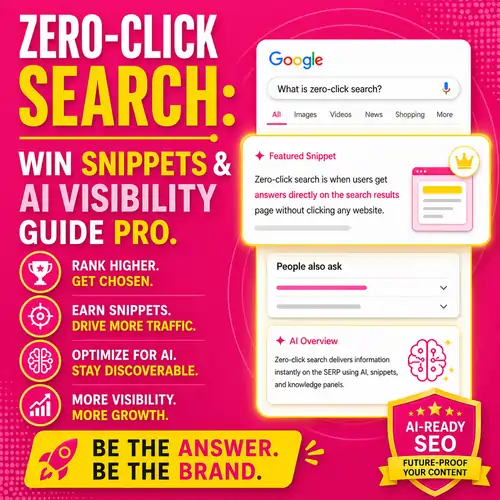
Zero-click search is when users get answers directly from the search engine results page (SERP) without clicking a website. To win in this space, brands must optimize for featured snippets, AI-generated answers, and semantic search visibility. This requires structured content, strong search intent alignment, NLP optimization, and building topical authority so search engines and AI tools can extract and display your content effectively.
Introduction: The Shift to Zero-Click Search
Search has evolved beyond clicks. Today, users expect immediate answers, and search engines are delivering exactly that through zero-click search results, AI search results, and enhanced SERP features.
This means your content must now compete not just for rankings—but for visibility inside Google itself. Whether it’s a featured snippet, People Also Ask (PAA) box, or an AI-generated answer, your goal is to be the source that search engines extract from.
Modern optimization requires a hybrid approach:
- SEO (Search Engine Optimization)
- AEO (Answer Engine Optimization)
- GEO (Generative Engine Optimization)
You can also read, “Meet Baby Ann Diaz: The AI-Driven SEO Specialist Helping Brands Win in Zero-Click Search (SEO + AEO + GEO)”, where I break down how combining these strategies creates real search visibility—not just rankings.
In this guide, we’ll go deeper into the execution—how to dominate zero-click search, increase search visibility, and position your brand as an authority—even without clicks.
What is Zero-Click Search?
Zero-click search occurs when a user finds the answer they need directly on the SERP, without visiting a website.
Common SERP features that drive zero-click behavior:
- Featured snippets
- Knowledge panels
- People Also Ask (PAA)
- AI-generated answers
- Local packs
- Voice search results
These are powered by machine learning, semantic SEO, and natural language processing (NLP), which prioritize content that is clear, structured, and contextually relevant.
Why Zero-Click Search Matters
Zero-click search doesn’t eliminate value—it shifts it.
Key advantages:
- Increased brand visibility
- Stronger authority signals
- Better user trust and recognition
- Higher influence on decision-making
Being visible in AI answers or featured snippets positions your brand as the “default answer,” which is often more powerful than a click.
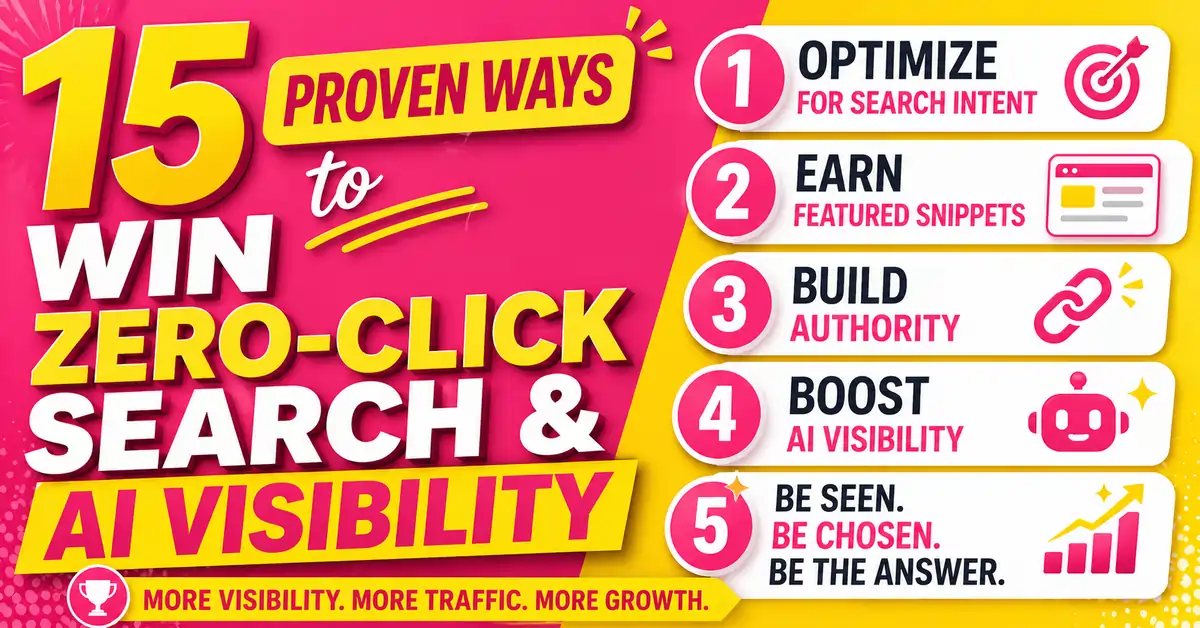
15 Proven Ways to Win Zero-Click Search & AI Visibility
If you want to dominate zero-click search, you need a system—not guesswork. Below are proven strategies to improve SERP visibility, featured snippet rankings, and AI answer inclusion.
1. Target question-based keywords
Focus on who, what, when, where, why, and how queries. These trigger featured snippets and AI-generated answers.
2. Answer questions immediately
Provide a clear answer within the first 40–60 words. This increases your chances of being selected for position zero.
3. Use structured headings
Apply proper H1, H2, H3 hierarchy. This improves crawlability and helps AI extract information.
4. Optimize for featured snippet formats
Use:
- Bullet lists
- Numbered lists
- Tables
- Short paragraphs
These formats dominate SERP features.
5. Use LSI keywords and semantic SEO
Include related terms like:
- search intent optimization
- AI search results
- voice search SEO
- content structure SEO
This strengthens topical relevance.
6. Build topical authority clusters
Create interconnected content with strong internal linking. This signals expertise to search engines.
7. Optimize for People Also Ask (PAA)
Add question-based sections to capture multiple SERP placements.
8. Write in an AI-extractable format
Use short sentences and clear formatting so content is easy for AI to parse.
9. Align with search intent
Match informational, navigational, and transactional intent to increase relevance.
10. Implement schema markup
Use FAQ schema, HowTo schema, and structured data SEO to enhance visibility.
11. Optimize for voice search
Use conversational language and direct answers for voice assistants.
12. Strengthen E-E-A-T signals
Show experience, expertise, authority, and trustworthiness to improve AI inclusion.
13. Monitor SERP feature performance
Track impressions, featured snippets, and visibility metrics.
14. Update content regularly
Fresh content improves ranking stability and AI relevance.
15. Prioritize visibility over clicks
Appearing in:
- AI-generated answers
- featured snippets
- knowledge panels
builds long-term brand authority.
How Featured Snippets Work
A featured snippet is a highlighted answer displayed at the top of Google results.
Types of featured snippets:
- Paragraph
- List
- Table
- Video
To win them:
- Answer questions directly
- Use structured formatting
- Target long-tail keywords
Optimizing for AI Visibility
To rank in AI search results, your content must be:
- Context-rich
- Clearly structured
- Easy to summarize
Key AI SEO strategies:
- Use semantic keywords
- Apply content clustering
- Provide complete answers
- Avoid ambiguity
Keyword Strategy for Zero-Click SEO
Your keyword strategy should include:
- Long-tail keywords
- question-based queries
- conversational keywords
- LSI keywords
This aligns with how users search and how AI interprets queries.
Content Structure for Snippet Optimization
Content structure directly impacts AI extraction.
Best practices:
- Use clear headings
- Keep paragraphs short
- Use lists and tables
- Highlight key answers
This improves:
- indexability
- crawl efficiency
- snippet eligibility
The Role of NLP in SEO
Natural Language Processing (NLP) allows search engines to understand meaning.
Optimize for NLP SEO by:
- Writing naturally
- Using synonyms and variations
- Avoiding keyword stuffing
- Focusing on context
Search Intent Optimization
Understanding search intent is critical for ranking.
Types:
- Informational intent
- Navigational intent
- Transactional intent
Aligning with intent improves both:
- Rankings
- Conversions
Building Topical Authority
To dominate zero-click search, you must build topical authority.
Steps:
- Create content clusters
- Strengthen internal links
- Cover topics deeply
- Maintain consistency
AEO: Answer Engine Optimization
AEO focuses on providing direct, structured answers.
Techniques:
- Use question-based headings
- Provide concise answers
- Format for extraction
GEO: Generative Engine Optimization
GEO ensures content is optimized for AI platforms.
Strategies:
- Write context-rich content
- Use structured formatting
- Provide complete answers
Voice Search Optimization
Voice queries are conversational.
Optimize by:
- Using natural phrases
- Answering questions directly
- Focusing on local SEO
Measuring Zero-Click SEO Success
Key metrics:
- Impressions
- SERP visibility
- Featured snippet rankings
- Brand mentions
Common Mistakes to Avoid
- Ignoring search intent
- Poor structure
- Overusing keywords
- Not optimizing for AI
Future of Zero-Click Search
Search is evolving toward:
- AI-driven results
- Personalized answers
- Conversational interfaces
Frequently Asked Questions
1. What is zero-click search?
Zero-click search happens when users get answers directly from the search results page without clicking any website. This typically occurs through featured snippets, knowledge panels, and AI-generated answers. It reflects how modern search engines prioritize fast, direct information delivery to improve user experience.
2. Why is zero-click search important?
It increases brand visibility even if users don’t visit your website. When your content appears in SERP features or AI answers, users still associate your brand with authority. Over time, this builds trust, recognition, and influences future clicks and conversions.
3. How do featured snippets work?
Featured snippets extract relevant content from webpages and display it at the top of search results. Google selects answers that are clear, concise, and well-structured for easy understanding. Proper formatting, such as lists and direct answers, significantly improves your chances of being featured.
4. What is AEO?
Answer Engine Optimization (AEO) focuses on optimizing content to provide direct, accurate answers to user queries. It is designed to improve visibility in voice search, AI assistants, and zero-click results. AEO prioritizes clarity, structure, and intent-based responses.
5. What is GEO?
Generative Engine Optimization (GEO) targets AI-driven platforms that generate answers from multiple sources. It ensures your content is structured, context-rich, and easy for AI to understand and summarize. GEO is essential for visibility in tools like AI chatbots and generative search engines.
6. How can I optimize for AI search?
Use structured content with clear headings and logical flow to improve AI extraction. Incorporate semantic keywords and provide complete, context-rich answers. Focus on readability and clarity so both humans and machines can easily process your content.
7. What are LSI keywords?
LSI keywords (Latent Semantic Indexing keywords) are related terms that support your main keyword. They help search engines understand the broader context of your content. Using them naturally improves relevance, ranking potential, and semantic depth.
8. What is search intent?
Search intent refers to the reason behind a user’s query. It is typically categorized into informational, navigational, or transactional intent. Aligning your content with the correct intent improves both rankings and user satisfaction.
9. How does NLP impact SEO?
Natural Language Processing (NLP) allows search engines to interpret human language more effectively. It focuses on meaning, context, and relationships between words rather than exact keyword matches. Optimizing for NLP improves content relevance and increases chances of appearing in AI-driven results.
10. What is topical authority?
Topical authority means being recognized as a trusted source within a specific subject area. You build it by creating comprehensive, interconnected content around a topic. This improves rankings, strengthens trust signals, and increases your chances of dominating SERP features.
11. How do I win featured snippets?
Answer questions clearly and directly within the first few lines of your content. Use structured formatting like bullet points, numbered lists, and tables. Target long-tail keywords and question-based queries to increase your chances of ranking in position zero.
12. What is voice search optimization?
Voice search optimization focuses on optimizing content for spoken queries used in voice assistants. These queries are usually conversational and longer than typed searches. Using natural language and direct answers improves visibility in voice search results.
13. Does zero-click reduce traffic?
Zero-click search can reduce direct clicks to your website. However, it increases overall search visibility and brand exposure. Being consistently visible in SERP features builds long-term authority and trust with users.
14. How do I measure zero-click SEO?
Track metrics such as impressions, SERP feature visibility, and featured snippet ownership. Tools like Google Search Console can help monitor performance. Focus on visibility trends rather than just clicks to evaluate success.
15. What are SERP features?
SERP features are enhanced search results that go beyond traditional blue links. Examples include featured snippets, knowledge panels, and People Also Ask boxes. They provide quick answers and improve user experience.
16. How important is structure?
Content structure is critical for both users and search engines. A clear structure improves readability, navigation, and content extraction by AI systems. Well-organized content has a higher chance of appearing in featured snippets and AI answers.
17. What is semantic SEO?
Semantic SEO focuses on optimizing content based on meaning and context rather than just keywords. It involves using related terms, entities, and concepts to improve understanding. This approach aligns with how modern search engines process information.
18. Can beginners rank in zero-click search?
Yes, beginners can rank if they focus on quality and structure. Clear, well-organized content can outperform more established sites in certain queries. Consistency and proper optimization are key to building authority over time.
19. How often should content be updated?
Content should be updated regularly to maintain relevance and accuracy. Search engines favor fresh, up-to-date information. Regular updates also improve performance and increase visibility in search results.
20. What is the future of SEO?
SEO is evolving toward AI-driven and intent-based search experiences. Visibility, authority, and content quality are becoming more important than raw traffic. Adapting to new technologies and trends is essential for long-term success.
Disclaimer
This content is for informational and educational purposes only and reflects current best practices in SEO, AEO, and GEO. Search engine algorithms, AI systems, and ranking factors are constantly evolving, so results may vary depending on industry, competition, and implementation. Always validate strategies with real data, conduct ongoing testing, and adjust your approach based on performance metrics and emerging trends.