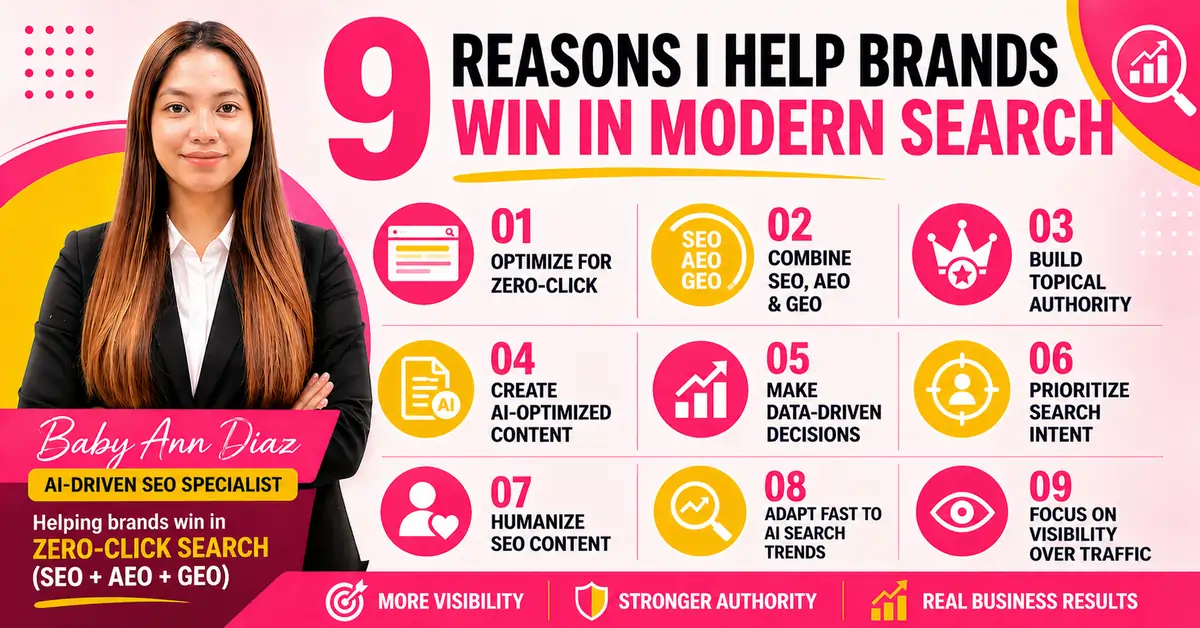
I’m Baby Ann Diaz, an AI-driven SEO specialist helping brands adapt to zero-click search by combining SEO, AEO (Answer Engine Optimization), and GEO (Generative Engine Optimization). I focus on improving not just rankings, but search visibility, topical authority, and real business results in today’s AI-powered search landscape where being seen matters more than being clicked.
The world of search engine optimization has changed more in the last two years than it did in the previous decade—and I’ve seen this shift firsthand.
Traditional SEO strategies that once focused purely on rankings and traffic are no longer enough. Today, we’re operating in a landscape dominated by AI search, zero-click results, and rapidly evolving user behavior.
That’s exactly where I position myself.
As an AI-driven SEO specialist, I help brands move beyond outdated tactics and build visibility where it actually matters today.
The Shift I’ve Seen: From Traditional SEO to AI-Driven Search
Search is no longer just about Google rankings—and if you’re still treating it that way, you’re already behind.
Users are now getting answers from:
- AI-powered search engines
- Featured snippets
- Knowledge panels
- Voice search
- Generative AI tools
This has led to the rise of zero-click search, where users get what they need without ever visiting your site.
What this means in practice:
- Less traffic doesn’t always mean less value
- Visibility matters more than clicks
- Authority is becoming the real ranking factor
My work focuses on helping brands adapt to this reality using a combined strategy of SEO, AEO, and GEO.
What Makes My Approach Different
I don’t rely on outdated SEO playbooks.
Instead, I focus on:
- AI-powered content optimization
- Deep search intent analysis
- Building real topical authority
- Structuring content for AI extraction
- Applying entity-based SEO and NLP optimization
Search engines—and AI systems—care about:
- Context
- Clarity
- Authority
- Relevance
So that’s exactly what I optimize for.
9 Reasons I Help Brands Win in Modern Search
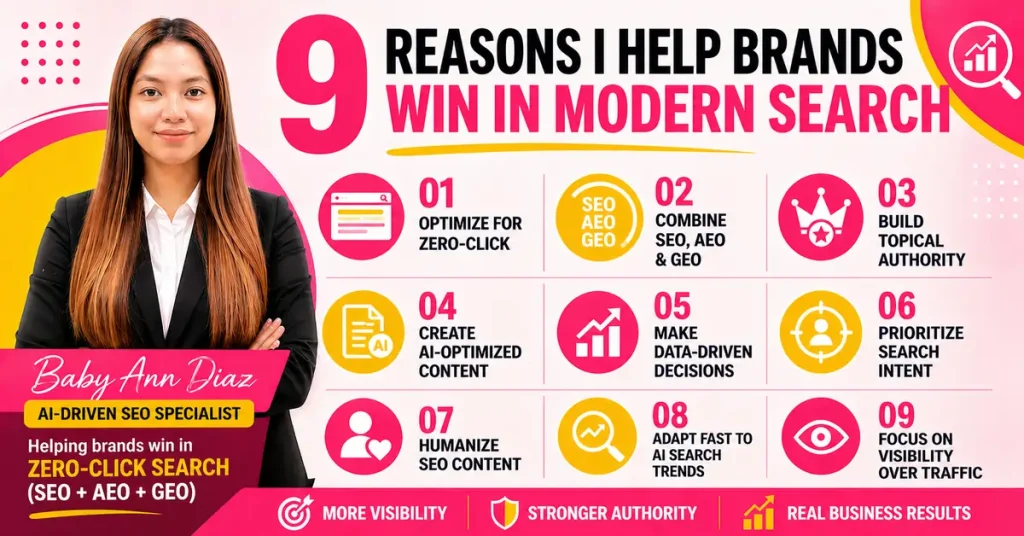
1. I Optimize for Zero-Click Search
Zero-click search isn’t a trend—it’s the default now.
I help brands:
- Show up in featured snippets
- Get included in AI-generated answers
- Improve overall SERP visibility
Because even if users don’t click, they still see your brand.
2. I Combine SEO + AEO + GEO
Most people stop at SEO.
I don’t.
I integrate:
- SEO (Search Engine Optimization)
- AEO (Answer Engine Optimization)
- GEO (Generative Engine Optimization)
This allows my clients to show up across:
- Google search
- AI tools
- Voice assistants
- Generative platforms
3. I Focus on Topical Authority (Not Just Content Volume)
Publishing random content doesn’t work anymore.
I build topical authority by:
- Creating structured content clusters
- Strengthening internal linking
- Covering topics deeply—not just broadly
This tells search engines and AI systems: “This brand knows what it’s talking about.”
4. I Build AI-Optimized Content
Content today needs to work for both humans and machines.
My approach includes:
- NLP optimization
- Clear, scannable structure
- Semantic keyword integration
So content is not just readable—it’s extractable by AI.
5. I Make Data-Driven Decisions
I don’t guess.
I rely on:
- Search data
- Behavioral insights
- Performance metrics
Every strategy I implement is backed by real data, not assumptions.
6. I Prioritize Search Intent
Understanding search intent is one of the biggest gaps I see in SEO.
I align content with:
- Informational intent
- Transactional intent
- Navigational intent
That’s how I help brands not just rank—but convert.
7. I Humanize SEO Content
There’s too much generic AI content out there.
I make sure content is:
- Clear
- Useful
- Easy to read
- Actually helpful
Because ranking is one thing—earning trust is another.
8. I Adapt Fast to AI Search Trends
Search is evolving fast—and I stay ahead of it.
I continuously:
- Test strategies
- Monitor AI search trends
- Adjust based on what’s working now
That’s how I keep brands competitive.
9. I Focus on Visibility Over Traffic
Traffic alone doesn’t define success anymore.
I help brands prioritize:
- Search visibility
- Brand presence
- Authority building
Because in modern SEO, being seen is often more valuable than being clicked.
How I Approach SEO, AEO, and GEO
What I Do with SEO (Search Engine Optimization)
With SEO, I focus on:
- Keyword and topic optimization
- Technical SEO improvements
- Content strategy
- Site performance
How I Apply AEO (Answer Engine Optimization)
With AEO, I structure content to:
- Appear in featured snippets
- Answer questions directly
- Work for voice search
The goal is simple: be the answer.
How I Use GEO (Generative Engine Optimization)
With GEO, I optimize for:
- AI-generated responses
- Chat-based search
- Generative platforms
This ensures your brand is part of the conversation—even when users don’t search traditionally.
Why AI-Driven SEO Matters Now
AI is changing how people discover information.
If your content isn’t optimized for:
- AI extraction
- Semantic understanding
- Contextual relevance
…it simply won’t show up where it matters.
That’s why AI-driven SEO isn’t optional anymore—it’s essential.
How I Help Businesses Grow
Here’s how I typically work with brands:
Content Optimization
I refine structure, clarity, and relevance so content performs better.
Technical SEO
I ensure your site is fast, crawlable, and properly optimized.
Entity-Based SEO
I connect your content to recognized topics and entities.
User Experience
I improve readability and engagement.
Continuous Optimization
I track performance and adjust strategies over time.
The Future of Search (From My Perspective)
Search is moving toward:
- AI-first experiences
- Conversational search
- Personalized answers
The brands that adapt early will dominate.
The ones that don’t will struggle to stay visible.
Conclusion
I believe SEO today is no longer just about rankings.
By combining SEO, AEO, and GEO, I help brands:
- Stay visible
- Build authority
- Compete in zero-click environments
If you’re still relying on old SEO tactics, you’re missing where search is actually going.
Frequently Asked Questions
1. What makes your SEO approach different?
I focus on SEO, AEO, and GEO together instead of relying only on traditional ranking strategies. This allows me to optimize not just for search engines, but also for AI systems and answer-based platforms. The result is a more future-proof strategy that builds long-term visibility, not just short-term traffic spikes.
2. What is zero-click search in simple terms?
Zero-click search happens when users get answers directly on the search results page without clicking any website. This includes featured snippets, AI-generated summaries, and knowledge panels. Because of this shift, visibility and brand presence matter just as much—if not more—than actual website visits.
3. Why do you prioritize AEO?
I prioritize AEO (Answer Engine Optimization) because search behavior is becoming more answer-driven. Users want quick, direct responses, and platforms are designed to provide them instantly. By optimizing for AEO, I help brands become the source of those answers, increasing exposure even when clicks don’t happen.
4. How is GEO different from SEO?
GEO (Generative Engine Optimization) focuses on optimizing content for AI-generated responses and conversational search environments. Traditional SEO focuses on ranking web pages in search engines. Both are important, but GEO ensures your content is included in AI-generated answers, which is where search is heading.
5. Can SEO still drive traffic?
Yes, SEO can still drive significant traffic, but the way it works has evolved. Not all visibility results in clicks anymore, especially with zero-click environments. That’s why I balance traffic-focused strategies with visibility and authority-building approaches.
6. What is topical authority?
Topical authority means becoming a trusted source on a specific subject by covering it comprehensively. Instead of publishing random articles, I create structured content ecosystems around key topics. This builds trust with search engines, improves rankings, and increases overall visibility.
7. How does AI impact SEO?
AI is transforming how search engines interpret and deliver results. It prioritizes context, user intent, and semantic understanding rather than just keywords. This means SEO strategies must evolve to focus on clarity, structure, and relevance.
8. Do small businesses need AI SEO?
Yes, AI-driven SEO is especially beneficial for small businesses. It allows them to compete with larger brands by focusing on smart strategies instead of just budget. With the right approach, even smaller websites can gain strong visibility in search and AI platforms.
9. Is keyword research still relevant?
Keyword research is still important, but it has evolved significantly. It now includes semantic keywords, related entities, and search intent rather than exact match phrases. I focus on context-driven keyword strategies that align with how modern search engines understand content.
10. What is NLP in SEO?
NLP (Natural Language Processing) is how search engines understand human language. It helps them interpret meaning, context, and relationships between words. By optimizing content with NLP in mind, I make it easier for search engines and AI systems to accurately understand and rank content.
11. How long does SEO take to work?
SEO is a long-term strategy that requires consistency and patience. Depending on competition and industry, results can take weeks to months to fully develop. However, the long-term benefits of strong SEO far outweigh short-term marketing tactics.
12. What tools do you use?
I use a combination of SEO tools, analytics platforms, and AI-driven systems. The specific tools depend on the project and goals of the business. However, I always prioritize strategy and data interpretation over relying solely on tools.
13. Can SEO help increase sales?
Yes, when done correctly, SEO can directly impact revenue. By attracting the right audience and aligning content with user intent, it improves conversion opportunities. It’s not just about traffic—it’s about bringing in users who are ready to take action.
14. What are content clusters?
Content clusters are groups of related content that revolve around a central topic. They are connected through internal linking and structured hierarchy. This approach strengthens topical authority and improves how search engines understand your site.
15. How important is content quality?
Content quality is one of the most critical factors in modern SEO. High-quality content builds trust, improves engagement, and increases rankings. Poor or generic content, especially AI-generated without human refinement, often fails to perform.
16. What is search intent?
Search intent is the reason behind a user’s query. It could be informational, transactional, or navigational. Understanding intent allows me to create content that truly matches what users are looking for, leading to better results.
17. Will AI replace SEO specialists?
No, AI enhances the work of SEO specialists rather than replacing them. Strategy, creativity, and critical thinking still require human expertise. AI is a tool—but execution and decision-making remain human-driven.
18. What is entity-based SEO?
Entity-based SEO focuses on connecting content to recognized topics, people, or concepts. This helps search engines understand relationships and context more effectively. It improves visibility in both traditional and AI-driven search results.
19. How often should SEO strategies change?
SEO strategies should be reviewed and updated regularly. Search algorithms, user behavior, and AI systems evolve quickly. Continuous optimization ensures that your strategy stays effective and competitive.
20. Why should businesses work with you?
Because I combine modern SEO, AEO, and GEO strategies with real-world application. My approach is practical, data-driven, and focused on results that matter today—not outdated tactics. I help businesses stay visible, competitive, and ready for the future of search.
Disclaimer
This article is intended for informational and educational purposes only and reflects current insights into SEO, AEO, and GEO strategies based on industry trends and practical experience. While the strategies and frameworks discussed aim to improve search visibility, brand authority, and online performance, results may vary depending on multiple factors such as industry competitiveness, website condition, content quality, and implementation consistency.
Search engine algorithms, AI systems, and ranking factors are constantly evolving, which means no SEO strategy can guarantee fixed or permanent results. What works today may require adjustments in the future, and ongoing optimization is essential for sustained performance. Readers and businesses are encouraged to conduct their own research, testing, and analysis before making strategic decisions based on this content.
This content does not constitute professional, legal, or financial advice. For tailored strategies, businesses should consult directly with an SEO specialist or digital marketing professional to align recommendations with their specific goals, resources, and market conditions.